
FatturaPA XML Format: Structure, File Name and Signature
FatturaPA is one XML file: a header and one or more bodies. Read from the Agency's specification 1.4 and schema 1.2.3: blocks, file name, signature, rejections.

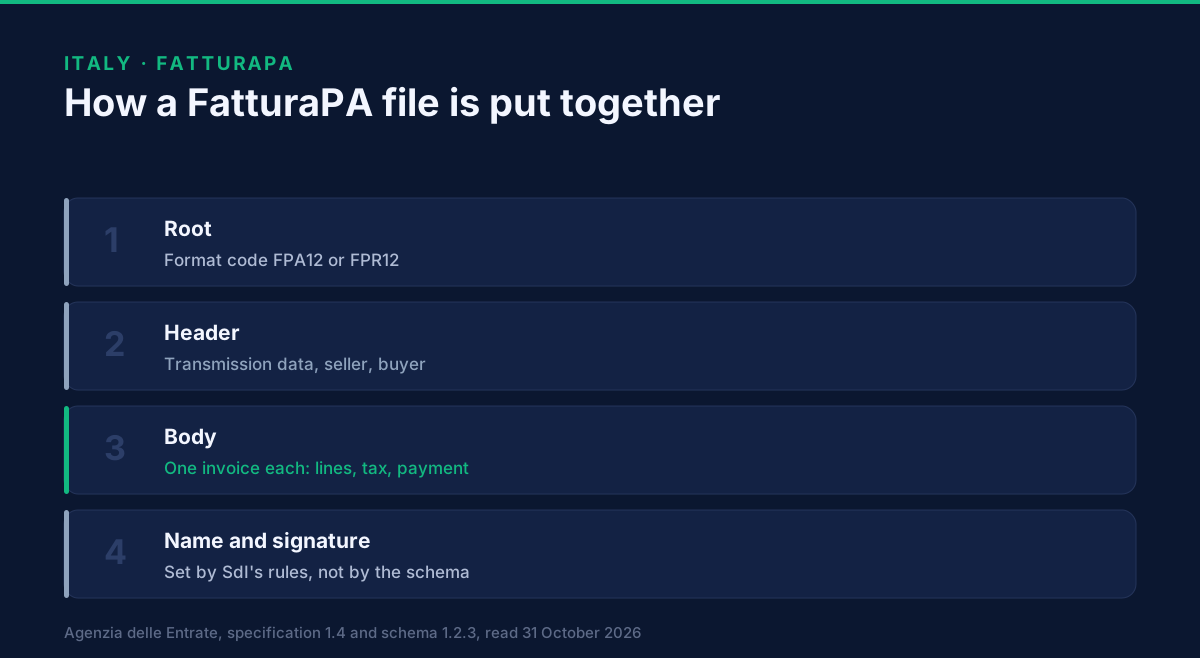
A FatturaPA invoice is one XML file with a single header and one or more bodies, written to the
Agenzia delle Entrate's schema version 1.2.3 and its technical specification version 1.4. The header
says who sells, who buys and where the file goes. Each body is one invoice: its general data, its
lines and tax summary, its payment details and any attachments. That is the structure whether the
invoice is a public-sector invoice (format code FPA12) or a private one (FPR12).
This page is for the integration lead or developer outside Italy who has to produce the file, or check one a system has produced. It reads the Agency's own documents on 31 October 2026 and sets out the blocks, the file name, the signature and the checks that reject a file. How to reach Italy's exchange system and how to archive the result are separate questions and are not covered here.
Which version is current?
Specification 1.4 and schema 1.2.3, valid from 1 April 2025. The Agency's FatturaPA documentation page lists them under "Documentazione valida dal 1 aprile 2025": the XML schema for FatturaPA version 1.2.3, the schema for the ordinary invoice, the schema for the simplified invoice version 1.0.2, style sheets for display, and Specifiche tecniche del formato della FatturaPA versione 1.4. The previous set, specification 1.3.2 with schema 1.2.2, is listed as valid until 31 March 2025.
Specification 1.4 is dated 31 January 2025. Its own revision table gives the history in four lines:
| Revision | Date | What changed |
|---|---|---|
| 1.3 | 4 May 2020 | Several new values for withholding type, document type, nature code and payment method |
| 1.3.1 | 1 October 2020 | End-of-validity dates for the generic nature codes N2, N3 and N6 |
| 1.3.2 | 1 October 2022 | New document type TD28, for purchases from San Marino with VAT |
| 1.4 | 31 January 2025 | New document type TD29, new tax regime RF20, and a revised description of TD20 |
One oddity is worth knowing before you download. The Agency publishes the schema under two names,
Schema_VFPA12_V1.2.3.xsd for FatturaPA and Schema_VFPR12_v1.2.3.xsd for the ordinary invoice. On
31 October 2026 we downloaded both and compared them: the two files are byte-identical. The format code
in the file, not the schema file you validate against, is what tells the two apart.
What does the file look like from the outside?
A root element, FatturaElettronica, with a required versione attribute holding FPA12 or
FPR12. The schema's namespace is http://ivaservizi.agenziaentrate.gov.it/docs/xsd/fatture/v1.2.
The root has an optional SistemaEmittente attribute, then the header, one or more bodies, and an
optional XML signature element. An abbreviated skeleton, with most elements omitted:
<p:FatturaElettronica versione="FPR12"
    xmlns:p="http://ivaservizi.agenziaentrate.gov.it/docs/xsd/fatture/v1.2">
  <FatturaElettronicaHeader>
    <DatiTrasmissione> ... </DatiTrasmissione>
    <CedentePrestatore> ... </CedentePrestatore>
    <CessionarioCommittente> ... </CessionarioCommittente>
  </FatturaElettronicaHeader>
  <FatturaElettronicaBody>
    <DatiGenerali> ... </DatiGenerali>
    <DatiBeniServizi> ... </DatiBeniServizi>
    <DatiPagamento> ... </DatiPagamento>
  </FatturaElettronicaBody>
</p:FatturaElettronica>
A file with several bodies is a batch of invoices (a "lotto"). The header is common to the whole batch and each body is one invoice, as SdI's specification describes in its section on file naming.
What is in the header?
Six blocks, three of them required. The order in the schema is fixed:
DatiTrasmissione, required. The sender's tax identifier (IdTrasmittente), a file progressive (ProgressivoInvio), the format code, the recipient code (CodiceDestinatario), optional sender contacts and an optional certified email address for the recipient (PECDestinatario).CedentePrestatore, required. The seller: tax identifier, name, registered address, tax regime.RappresentanteFiscale, optional. The seller's fiscal representative.CessionarioCommittente, required. The buyer: tax identifier or fiscal code, name, address.TerzoIntermediarioOSoggettoEmittente, optional. A third-party intermediary issuing on the seller's behalf.SoggettoEmittente, optional. Who issued the document,CCfor the buyer orTZfor a third party.
The recipient code is the field that decides delivery, and its rules are in the specification itself.
The code is six characters for a public administration and seven for anyone else. 0000000 means the
recipient takes invoices by certified email, and the address then goes in PECDestinatario, or that
the channel is not known. XXXXXXX is for invoices to customers who are not resident, established or
identified in Italy. The companion page
What Is an SDI Code? takes the code on its own.
What is in a body?
Five blocks, one per kind of data. The specification's table of contents lists them in order:
DatiGenerali, whose main elementDatiGeneraliDocumentocarries the document type (TipoDocumento), currency (Divisa), date, number and optional withholding, stamp duty, pension fund contribution and discount data. The same block carries references to purchase orders, contracts, delivery notes and a related invoice. The codes forTipoDocumentoare the subject of FatturaPA Document Types: The TD Codes.DatiBeniServizi. The invoice lines (DettaglioLinee) and the tax summary (DatiRiepilogo), which must agree with each other.DatiVeicoli, optional. Data on vehicles, for intra-Community sales of new transport.DatiPagamento, optional. Payment terms and method, from a coded list that runs fromMP01, cash, toMP23, PagoPA.Allegati, optional. Attachments.
The tax lines are where most files go wrong, so they are worth a closer look. Each line carries a rate
(AliquotaIVA), and when the rate is zero the line must carry a nature code (Natura) saying why. The
nature codes are a closed list in schema 1.2.3: N1, N2, N2.1, N2.2, N3, N3.1 to N3.6, N4,
N5, N6, N6.1 to N6.9 and N7. The schema still lists the bare N2, N3 and N6, but SdI no
longer accepts them (error 00445, below). Use the sub-codes.
How is the file named?
Country code, sender identifier, underscore, progressive, extension. SdI's technical specification, version 1.8.4, section 2.2, sets the rule:
- The country code is the ISO 3166-1 two-letter code of the sender.
- The sender's identifier is its tax identifier: 11 to 16 characters for code
IT, and 2 to 28 characters for any other country. - The progressive is up to five characters from
a-z,A-Zand0-9. It only has to make the name different from the sender's other files. It does not have to run in strict sequence. - The extension is
.xmlfor a file with an XAdES signature and.xml.p7mfor CAdES. - A
.zipfile can carry several files, in which case each file inside is signed and the archive is not.
Examples from the specification are ITAAABBB99T99X999W_00001.xml and IT99999999999_00002.xml.p7m.
The Agency's published sample invoices use IT01234567890_FPA01.xml for a public-sector invoice and
IT01234567890_FPR01.xml for a private one. Every file must have a name different from any file sent
before. A name that breaks the rule is rejected with error 00001, and a name already used with error
00002.
How is it signed?
Qualified signature or the Agency's seal, depending on the recipient. Section 2.1 of the same specification says what SdI accepts:
- An invoice to a public administration carries a time reference and a qualified electronic signature. The accepted formats are CAdES Baseline B and XAdES Baseline B, and for XML only the enveloped form is accepted. The time reference is the "signing time" attribute inside the signature.
- An invoice to anyone else is signed in the same way, or carries an XAdES signature made with the certificate of the Agency's own certification authority. The FatturaPA specification calls this "sigillo" and permits it only for invoices to private parties.
SdI checks the signature. Error 00102 is a signature that is not valid, 00100 an expired
certificate, 00101 a revoked one, and 00103 a missing time reference. Whether, in practice, your
trading partners or your system's channel apply the signature for you is a question about the channel
you use and not about the format, and this page does not describe it.
What does SdI check beyond the schema?
A list of business rules, published as a separate document. The Agency's
list of checks, version 2.0
(dated 31 January 2025) gives every rejection code and the rule behind it. A file that fails the schema
is rejected with 00200. A file that passes the schema can still be rejected. These are the ones
integration teams meet first:
| Code | What it says |
|---|---|
00400 / 00401 |
A nature code is missing on a zero-rate line, or present on a line with a rate above zero |
00403 |
The invoice date is after the date SdI received the file |
00404 |
Duplicate invoice: same seller, same year, same number as one already accepted |
00421 to 00423 |
Tax amount, taxable amount or line total not calculated as the specification requires |
00425 |
The invoice number contains no digit |
00427 |
The recipient code length does not match the format code |
00428 |
The format code does not match the versione attribute |
00445 |
A generic nature code N2, N3 or N6 was used, which has not been allowed since 1 January 2021 |
The duplicate rule has one exception that surprises people. A credit note shares a number with its
invoice: two documents with the same seller, year and number are allowed when one of them is a TD04.
Two more limits belong with the format. SdI's web upload accepts files up to 5 megabytes. And a file
whose size exceeds what its channel allows is rejected with 00003.
What is still open?
Three things, as of 31 October 2026.
- Schema 1.2.3 is the current version, and a newer one may follow. The Agency has changed the schema roughly every one to three years since 2017. Check its page before you build against a copy of the schema.
- The signature in practice. We have read the rule as the specification states it. We have not read the Agency's channel instructions, which say what a given channel adds or does for you.
- Limits on other channels. The 5 megabyte figure is the web upload only.
What to do next
- Download the two Agency documents linked above and validate a sample invoice from your system against schema 1.2.3. Fix schema errors before business-rule errors.
- Fix the file name rule in your integration: sender identifier, a progressive that never repeats, and the right extension.
- Map your document types with the companion page, FatturaPA Document Types: The TD Codes, and your recipient codes with What Is an SDI Code?.
- If you invoice from outside Italy, read Invoicing an Italian Customer From Outside Italy before you build anything.
- To talk through e-invoicing across several countries, book a demo. The developer documentation and the tutorials show how the GoRoute API works.
Related reading
- E-invoicing in Italy, the country page.
- What Is an SDI Code? The Codice Destinatario Explained
- FatturaPA Document Types: The TD Codes
- Invoicing an Italian Customer From Outside Italy
- San Marino e-invoicing, the neighbour that sits behind Italy's system.
- E-invoicing mandates by country, 2026
Sources, all read on 31 October 2026: Agenzia delle Entrate,
FatturaPA documentation page,
specification version 1.4 (31 January 2025) and the schema files Schema_VFPR12_v1.2.3.xsd and
Schema_VFPA12_V1.2.3.xsd; the Agency's
Sistema di Interscambio documentation page,
which lists the technical specification version 1.8.4 (dated 31 March 2026, valid from 15 May 2026) and
the list of checks version 2.0, both read in full for the sections cited. Translations from the Italian
are ours.
Frequently asked questions
- What is the current FatturaPA specification and schema?
- On 31 October 2026 the Agency's FatturaPA page lists specification version 1.4 (dated 31 January 2025) and XML schema version 1.2.3 as the documentation valid from 1 April 2025. The simplified invoice has its own schema, version 1.0.2. The Agency also publishes the earlier versions, marked as valid until 31 March 2025.
- Does a FatturaPA file have to be signed?
- The Sistema di Interscambio specification, version 1.8.4, says what it accepts. An invoice to a public body must carry a qualified electronic signature and a time reference. An invoice to anyone else must carry either a qualified signature or an XAdES signature made with the Agency's own certificate. XML signatures must be enveloped. The Agency's FatturaPA specification adds that the Agency's seal is permitted only for invoices to private parties.
- How is a FatturaPA file named?
- Two letters for the country, the sender's tax identifier, an underscore and a progressive of up to five letters or digits, then .xml for an XAdES file or .xml.p7m for a CAdES file. The Agency's examples are IT01234567890_FPA01.xml and IT01234567890_FPR01.xml. Every file sent must have a name different from any file sent before.
- What is the difference between FPA12 and FPR12?
- They are the two values of the format code in the header. FPA12 is an invoice to a public administration, FPR12 an invoice to private parties. The code must match the length of the recipient code: six characters for FPA12, seven for FPR12. A mismatch is rejected with error 00427.
- Is there a maximum file size?
- It depends on the channel. The specification sets a limit of 5 megabytes for upload through the web page. SdI rejects a file larger than its channel allows with error 00003. The limits for the other channels are in the Agency's channel instructions, which this page does not read.
About Dr. Syed Raza
Dr. Syed Raza is an IT Enterprise Architect at ClayDesk LLC and leads the GoRoute platform. He works across Peppol Access Point and SMP infrastructure, PINT jurisdictions (Oman, AU/NZ, EU, JP, MY, SG), and national CTC regimes, translating regulatory detail into production-grade e-invoicing systems.
Building on Peppol?
GoRoute is a certified Peppol Access Point & SMP. Book a demo or read the docs to get started.