
FatturaPA Document Types: The TD Codes
The 20 FatturaPA TipoDocumento codes, TD01 to TD29: which an invoice, a TD04 credit note and a self-invoice take, and which rules get a file rejected.

FatturaPA specification version 1.4 lists 20 document-type codes for the TipoDocumento element,
TD01 to TD06 and TD16 to TD29, and the one a file declares decides which rules SdI applies to
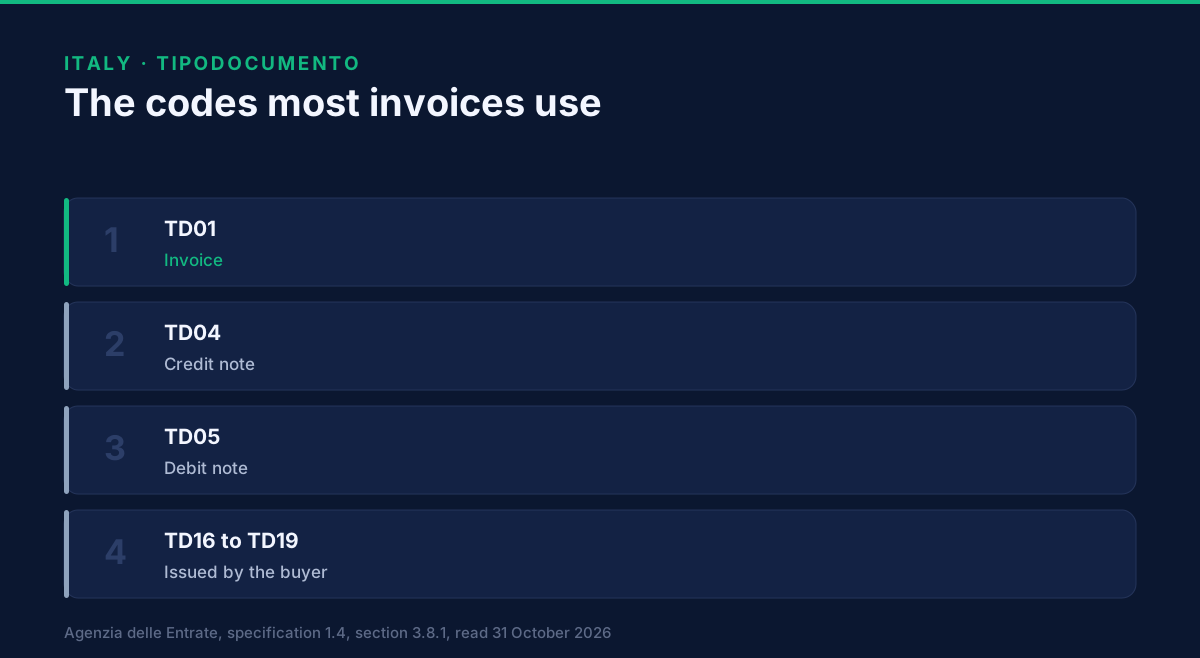
it. TD01 is an ordinary invoice, TD04 a credit note, TD05 a debit note. The others cover
advances, professional fee notes, the documents a buyer issues for purchases from abroad, and a set of
special cases. A wrong code is not a cosmetic error. It changes which checks the file has to pass.
This page is for the accountant or integration lead who has to map an accounting system's document types to Italy's, or who is reading a rejection. It lists every code the specification lists and the rules that tie a code to who the seller and buyer are. It does not say which code a particular sale needs, because that is a question of Italian VAT law. The wider file is described in FatturaPA XML Format.
What are all the codes?
Twenty, as of specification 1.4 (31 January 2025) and schema 1.2.3. The Italian names are the Agency's, the English glosses are ours.
| Code | Agency's name | In English |
|---|---|---|
TD01 |
Fattura | Invoice |
TD02 |
Acconto/anticipo su fattura | Advance payment on an invoice |
TD03 |
Acconto/anticipo su parcella | Advance payment on a professional fee note |
TD04 |
Nota di credito | Credit note |
TD05 |
Nota di debito | Debit note |
TD06 |
Parcella | Professional fee note |
TD16 |
Integrazione fattura reverse charge interno | Integration of a domestic reverse-charge invoice |
TD17 |
Integrazione/autofattura per acquisto servizi dall'estero | Integration or self-invoice for services bought from abroad |
TD18 |
Integrazione per acquisto di beni intracomunitari | Integration for intra-Community goods purchases |
TD19 |
Integrazione/autofattura per acquisto di beni ex art. 17 c. 2 DPR 633/72 | Integration or self-invoice for goods under article 17(2) of DPR 633/72 |
TD20 |
Autofattura per regolarizzazione e integrazione delle fatture | Self-invoice to regularise and integrate invoices (art. 6(9-bis) of Legislative Decree 471/97 or art. 46(5) of Decree-Law 331/93) |
TD21 |
Autofattura per splafonamento | Self-invoice for exceeding the exempt-purchase ceiling |
TD22 |
Estrazione beni da Deposito IVA | Goods extracted from a VAT warehouse |
TD23 |
Estrazione beni da Deposito IVA con versamento dell'IVA | Goods extracted from a VAT warehouse, with VAT paid |
TD24 |
Fattura differita (art. 21, comma 4, terzo periodo, lett. a) | Deferred invoice, case a |
TD25 |
Fattura differita (art. 21, comma 4, terzo periodo, lett. b) | Deferred invoice, case b |
TD26 |
Cessione di beni ammortizzabili e per passaggi interni (art. 36 DPR 633/72) | Sale of depreciable assets and internal transfers |
TD27 |
Fattura per autoconsumo o per cessioni gratuite senza rivalsa | Invoice for own use or free supplies without recharge |
TD28 |
Acquisti da San Marino con IVA (fattura cartacea) | Purchases from San Marino with VAT (paper invoice) |
TD29 |
Comunicazione per omessa o irregolare fatturazione (art. 6, comma 8, D.Lgs. 471/97) | Communication of missing or irregular invoicing by the Italian seller |
The list has gaps on purpose. There is no TD07 to TD15 in the ordinary schema, and the simplified
invoice has its own schema, which this page does not cover. Two codes arrived recently. TD28 came with
specification 1.3.2 on 1 October 2022, and TD29 with 1.4 on 31 January 2025.
Which code does an ordinary sale take?
TD01 for an invoice, and TD04 or TD05 for a document that adjusts one. These three cover most
of what a trading company issues.
TD01, an invoice, is the default.TD04, a credit note, reduces or cancels a previous invoice. The blockDatiFattureCollegatein the body is where a document names the invoice it links to.TD05, a debit note, adds to it.TD02andTD03are advance payments, on an invoice and on a professional fee note.TD06, the professional fee note (parcella), is the document a professional issues for fees.
The code a credit note carries matters for a reason that is easy to miss. SdI rejects a second
document from the same seller with the same year and number as one it has already accepted, as a
duplicate (error 00404). The exception is the credit note: two such documents are allowed only when
one of them is a TD04. A credit note sent as TD01 with the original invoice's number is therefore a
duplicate by the rule, and is rejected.
What do TD16 to TD19 mean?
They are documents the buyer issues, to complete the record of a purchase where the buyer accounts
for the VAT. The Agency's names say "integration" (integrazione) or "self-invoice" (autofattura).
The distinction is in who writes the document: not the seller, but the buyer, in its own name.
TD16: integration of a domestic reverse-charge invoice (reverse charge interno).TD17: integration or self-invoice for services bought from abroad.TD18: integration for intra-Community purchases of goods.TD19: integration or self-invoice for purchases of goods under article 17, paragraph 2, of Presidential Decree 633/72.
For a seller outside Italy these are the codes that matter most, because they describe what the Italian customer does with a foreign supplier's invoice, not what the supplier sends. The companion page Invoicing an Italian Customer From Outside Italy puts them in that setting. The page you are reading stays with the codes themselves.
What rules tie a code to the parties?
SdI checks the seller and the buyer against the code, and rejects a mismatch. The Agency's list of checks, version 2.0, gives these rules for the codes:
| Rule | Codes | Error |
|---|---|---|
| Seller and buyer must not be the same | TD16, TD17, TD18, TD19, TD20, TD29 |
00471 |
| Seller and buyer must be the same | TD21 |
00472 |
The seller's country code must not be IT |
TD17, TD18, TD19, TD28 |
00473 |
The seller's country code must be IT |
TD29 |
00473 |
| No line may have a zero rate | TD21 |
00474 |
| The buyer's VAT identifier must be present | TD16 to TD20, TD22, TD23, TD28, TD29 |
00475 |
| Seller and buyer must not both have a non-Italian country code | every code | 00476 |
These rules explain rejections that look unrelated to document types. A TD17 file whose seller block
carries an Italian VAT number fails 00473, because a document for services bought from abroad cannot
have an Italian seller. A TD16 file with the same VAT number on both sides fails 00471. A TD21
self-invoice with a zero-rate line fails 00474.
Which mistakes get a file rejected?
Four patterns, all visible in the checks list.
- Everything sent as
TD01. A system whose export template emits one type for every document breaks the credit note rule above, and cannot produce the documentsTD16toTD19at all. - The buyer's VAT identifier missing on a type that needs it (
00475). A buyer identified only by fiscal code is not enough for those types. - The seller's country code wrong for the type (
00473), most often from copying the Italian buyer's data into the seller block of aTD17. - A code outside the list. The schema is a closed list, and any other value fails the format check
with
00200.
Mapping the codes before the first send, with the finance team and an Italian tax adviser, is cheaper than reading the rejections afterwards.
What is still open?
Three things, as of 31 October 2026.
- Which code a transaction needs. The specification names the codes. It does not decide them. That depends on Italian VAT law and on the facts.
- The simplified invoice. It has its own schema and its own codes, which we have not read.
- Later changes. The list grew in 2020, 2022 and 2025. Check the Agency's page before you hard-code it.
What to do next
- List the document types your system issues and map each to a code from the table.
- Check the party rules for any type from
TD16upward before you build it. - Read the other three pages in this set: FatturaPA XML Format, What Is an SDI Code? and Invoicing an Italian Customer From Outside Italy.
- To talk through e-invoicing across several countries, book a demo. The developer documentation, the tutorials and the GoRoute API show how documents are sent.
Related reading
- E-invoicing in Italy, the country page.
- FatturaPA XML Format: Structure, File Name and Signature
- What Is an SDI Code? The Codice Destinatario Explained
- Invoicing an Italian Customer From Outside Italy
- San Marino e-invoicing, the background to
TD28.
Sources, all read on 31 October 2026: Agenzia delle Entrate, FatturaPA specification version 1.4
(31 January 2025), section 3.8.1 and the revision table, and schema Schema_VFPR12_v1.2.3.xsd
(documentation page);
the Sistema di Interscambio list of checks, version 2.0 (31 January 2025), checks 00404 and 00471 to
00476. English glosses of the Italian code names are ours and are not the Agency's.
Frequently asked questions
- What are the TD codes in FatturaPA?
- TD codes are the values of the TipoDocumento element, which declares what kind of document a FatturaPA file carries. Specification version 1.4 lists 20: TD01 to TD06 and TD16 to TD29. TD01 is an invoice, TD04 a credit note and TD05 a debit note. The rest cover advances, professional fee notes, self-invoices, integrations and special cases.
- Which TD code is a credit note?
- TD04, Nota di credito. SdI's duplicate check treats it specially: two documents from the same seller with the same year and number are allowed only when one of them is a TD04.
- What are TD17, TD18 and TD19?
- TD17 is an integration or self-invoice for the purchase of services from abroad, TD18 an integration for the purchase of intra-Community goods, and TD19 an integration or self-invoice for the purchase of goods under article 17, paragraph 2, of Presidential Decree 633/72. The buyer issues them. SdI rejects them if the seller's country code is Italy (error 00473).
- Can I send a TD code that is not in the specification?
- No. The schema lists the allowed values and a file with another value fails the format check. This page lists only the 20 that specification 1.4 and schema 1.2.3 list. The simplified invoice has its own schema, which this page does not cover.
- How do I know which code a transaction needs?
- That is a tax question, not a format question. The specification names each code. Which one applies to a transaction depends on Italian VAT law and the facts of the sale. Put it to your Italian tax adviser or the Agency.
About Dr. Syed Raza
Dr. Syed Raza is an IT Enterprise Architect at ClayDesk LLC and leads the GoRoute platform. He works across Peppol Access Point and SMP infrastructure, PINT jurisdictions (Oman, AU/NZ, EU, JP, MY, SG), and national CTC regimes, translating regulatory detail into production-grade e-invoicing systems.
Building on Peppol?
GoRoute is a certified Peppol Access Point & SMP. Book a demo or read the docs to get started.