
Keeping Italian E-Invoices: What Conservazione Requires
What Italian law requires to keep an e-invoice: the 2014 decree's archive rules, how long under the tax rule, where to keep it, and the Agency's free service.

Italian law requires an e-invoice to be kept electronically, in an archive that can be searched and ends with a time reference that can be set against third parties, until the tax assessments for its period are finally settled. The law gives no fixed number of years in the text we read. The decree that sets out the archive rules is the Ministry of Economy and Finance decree of 17 June 2014. The Agency also offers a preservation service free of charge. This page lays out what the sources say, and what we could not establish.
It is for the finance or IT lead who has sent or received a first Italian e-invoice and has to decide where the file lives. It reads the 2014 decree, the VAT act and the decree on assessment of income taxes as published on Normattiva, and the Agency's pages, on 17 November 2026. It does not cover storage products, and it gives no tax advice beyond what the Agency publishes. The file itself is described in FatturaPA XML format.
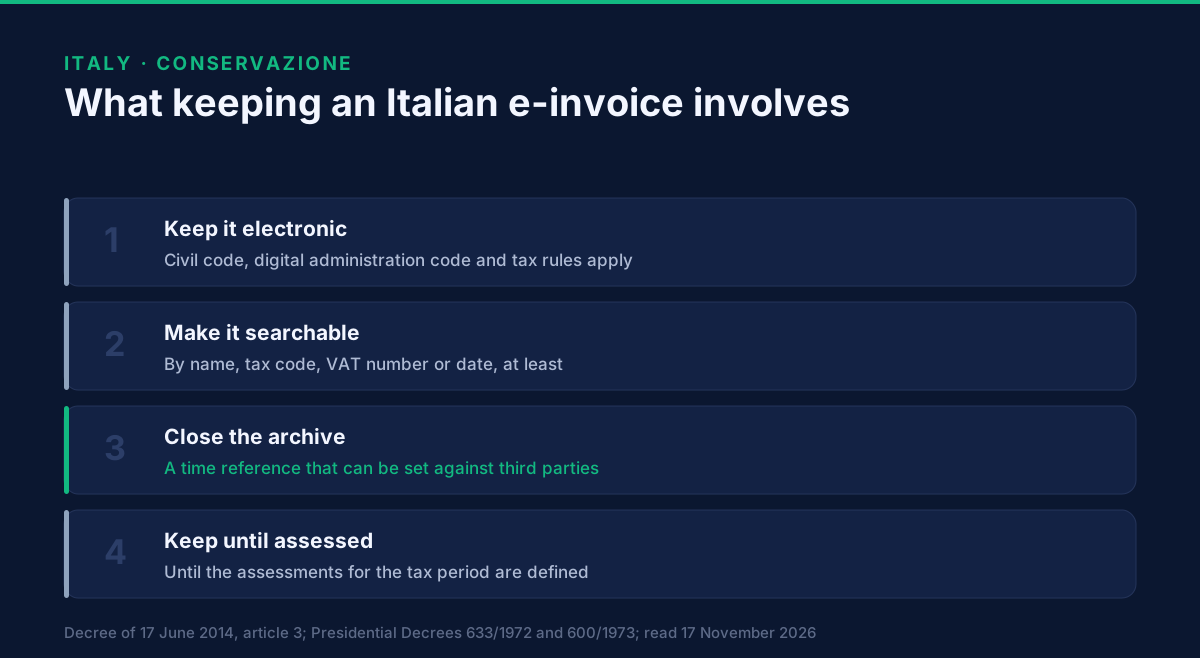
What does the archive have to do?
Three things, all in article 3 of the 2014 decree. The article is headed Conservazione dei documenti informatici, ai fini della loro rilevanza fiscale, preservation of electronic documents for tax purposes.
- Follow the rules it points to. Documents are kept so that the civil code, the digital administration code (CAD) with its technical rules, and the other tax rules on proper bookkeeping are respected. The decree does not restate them.
- Allow search and extraction. The archive must let you search and extract information at least by surname, first name, company name, tax code, VAT number, or the date, or logical associations of these, where the information is mandatory. The tax agencies may set further keys by document type.
- End with a time reference. The process ends when a time reference that can be set against third parties is applied to the archive package (pacchetto di archiviazione).
The decree adds a deadline: the process is completed within the term in article 7(4-ter) of Decree-Law 357/1994. That paragraph is now shown on Normattiva as repealed by Legislative Decree 141/2026, in force from 7 August 2026, which approved a consolidated text on tax compliance and assessment. We did not find where the deadline now sits, so this page does not state one.
How long must the invoice be kept?
Until the assessments for the corresponding tax period are defined, and that may be longer than the civil-code limit. The VAT act says invoices are kept as article 22 of Presidential Decree 600/1973, the decree on the assessment of income taxes, provides. Article 22 says the mandatory accounting records must be kept until the assessments for the corresponding tax period are defined, even beyond the term in article 2220 of the civil code or in other tax laws. It says the same for the originals of invoices received and the copies of invoices issued, which are to be kept in order, for each transaction. Where a dispute is in court, the court may limit the duty to the records relevant to it.
That is the whole of the rule in the text we read. It does not give a figure in years, and we did not read article 2220 of the civil code, so we give no figure either. Ask your Italian tax adviser for the period that applies to your business.
Two dates matter. Normattiva shows article 22 of Decree 600/1973 in the text in force until 31 December 2026, and article 39 of the VAT act, which refers to it, likewise. Legislative Decree 10/2026, the new consolidated VAT text, abrogates article 39 in the text in force from 1 January 2027. We did not read the successor provisions. Check the current article numbers before you cite either in a retention policy.
Where can the archive be?
Electronically, and it may be abroad on one condition. Article 39 of the VAT act, in the version in force on 17 November 2026, says electronic invoices are kept electronically in line with the 2014 decree, and that invoices created electronically and paper ones can both be kept electronically. The place of electronic preservation can be in another State, provided a legal instrument on mutual assistance exists with it. The taxable person established in Italy must ensure, for inspection, automated access to the archive, and that every document and datum in it can be printed and transferred to another electronic medium. That includes the data that guarantee the authenticity and integrity of the invoices.
Article 21 of the VAT act sets the duty behind it. The taxable person ensures the authenticity of origin, the integrity of content and the legibility of an invoice from the moment it is issued to the end of its preservation period. Article 39 adds that the data which guarantee authenticity and integrity must also be printable and transferable, so the archive holds more than a readable copy of the invoice.
What is the Agency's free preservation service?
A free service in the Fatture e Corrispettivi portal, offered under article 1 of Legislative Decree 127/2015. The Agency's e-invoicing site says it provides free services to generate, transmit and preserve the electronic invoices of the SdI system. Its FAQ says that someone who wants a delegate, such as an accountant, to use these free services on their behalf authenticates in the Agency's reserved area, opens the "Proposte" section and enters the delegate's tax identifier on the e-invoicing line. The Ministry of Economy and Finance separately offers free services to generate, send and preserve invoices to small and medium businesses enabled on the public procurement marketplace.
We did not read the terms of the Agency's preservation service: how a business joins it, how long files are kept, or what it returns on exit. Those are questions to put to the Agency before relying on it as your only copy. Nothing in the pages we read says SdI itself is your archive. The Agency's monitoring tool shows the messages for files you sent. It is not described as preservation.
What else is worth keeping?
The messages that show what happened to an invoice, in our view. This is our suggestion, not a rule we read. The delivery receipt carries the delivery date. The outcome from a public body and the lapse notice show how the invoice ended, and the Agency's stamp-duty guide says an invoice's duty annotation can be shown in the invoice detail on the portal and certified on request as a PDF/A. SdI notifications explained lists the messages, and stamp duty on Italian e-invoices explains the annotation.
What is still open?
Four things, as of 17 November 2026.
- The number of years. We did not read the civil-code article the tax rule refers to.
- The deadline to complete the archive. Its source in Decree-Law 357/1994 is repealed. We did not find the replacement.
- What the Agency's free service guarantees. We did not read its terms.
- The rules from 1 January 2027. The VAT and compliance acts are being replaced by consolidated texts, and the Agency's pages cite the earlier numbering.
What to do next
- Write a retention rule with your adviser: the period, the system, the owner, and the date the rule was last checked against the consolidated texts.
- Keep the XML file as received or sent, with its signature and the SdI messages for it.
- Test the search keys. Can you find an invoice by tax code, VAT number, name and date?
- Decide on the Agency's service only after you have read its terms. If an accountant uses it, do it by delegation.
- For a public customer, read invoicing the Italian public administration for what the body returns.
- To talk through archiving and statuses for invoices in several countries, book a demo. The developer documentation, the tutorials and the GoRoute API show how documents are sent on the Peppol network, where GoRoute is a certified access point (POP000991).
Related reading
- E-invoicing in Italy, the country page.
- FatturaPA XML Format: Structure, File Name and Signature
- Invoicing the Italian Public Administration
- Stamp Duty on Italian E-Invoices
- SdI Notifications Explained: Every Message After You Send
Sources, all read on 17 November 2026: Ministry of Economy and Finance Decree of 17 June 2014, article 3, in the Gazzetta Ufficiale n. 146 of 26 June 2014; Presidential Decree 633/1972, articles 21 and 39, Presidential Decree 600/1973, article 22, Decree-Law 357/1994, article 7, and Legislative Decrees 10/2026 and 141/2026, on Normattiva; Agenzia delle Entrate, fatturapa.gov.it, page "Operatori economici" and the FAQ on the MEPA tools; the Agency's stamp-duty guide of June 2026. Translations from the Italian are ours.
Frequently asked questions
- What does conservazione of an e-invoice mean?
- Keeping the invoice electronically in a way that meets the 2014 decree on tax documents in electronic form: the archive follows the civil code, the digital administration code and tax rules, can be searched and extracted by named keys, and ends with a time reference that can be set against third parties.
- How long must an Italian e-invoice be kept?
- The tax rule says invoices are kept until the assessments for the corresponding tax period are defined, even beyond the time limit in the civil code. It gives no number of years. The text we read is in force until 31 December 2026 and is replaced after that, so confirm the period with your Italian tax adviser.
- Can I keep Italian e-invoices outside Italy?
- The VAT act allows the place of electronic preservation to be in another State, if a legal instrument on mutual assistance exists with it. A taxable person established in Italy must still ensure automated access to the archive for inspection, and that its documents and data can be printed and moved to another medium.
- Does the Agency keep my invoices for free?
- The Agency says it provides, free of charge, services to generate, transmit and preserve the e-invoices of the SdI system, in the Fatture e Corrispettivi portal. We did not read the terms of the preservation service, including how long it keeps files.
- Is a PDF copy enough?
- The Agency describes a FatturaPA invoice as an XML file, the only format SdI accepts. We found nothing in the pages we read that makes a PDF copy a substitute for keeping the XML file, and this page does not say so.
About Dr. Syed Raza
Dr. Syed Raza is an IT Enterprise Architect at ClayDesk LLC and leads the GoRoute platform. He works across Peppol Access Point and SMP infrastructure, PINT jurisdictions (Oman, AU/NZ, EU, JP, MY, SG), and national CTC regimes, translating regulatory detail into production-grade e-invoicing systems.
Building on Peppol?
GoRoute is a certified Peppol Access Point & SMP. Book a demo or read the docs to get started.