
Who Must E-Invoice in the UK From 2029, and Who Is Exempt
Who the UK e-invoicing rule covers from 1 April 2029, why consumer sales fall outside it, and what the roadmap says on exemptions for digitally excluded firms.

Who has to e-invoice in the UK from 2029?
From 1 April 2029, any VAT-registered person in the UK must issue VAT invoices as e-invoices and must be able to receive them, unless a specific exemption applies. That is the government's own wording in the e-invoicing implementation roadmap of 28 October 2026. "VAT-registered persons" includes businesses, sole traders, partnerships, Scottish partnerships, charities, and public or government bodies that are registered for VAT.
The roadmap names no turnover threshold and no staged start by company size. Everyone it covers has the same date. Several things are still open, and this page marks them as open. For the dates, see HMRC's e-invoicing roadmap: what the UK decided.
Does it include me? A quick test
The rule follows the VAT invoice, not the size of the business. Ask three questions.
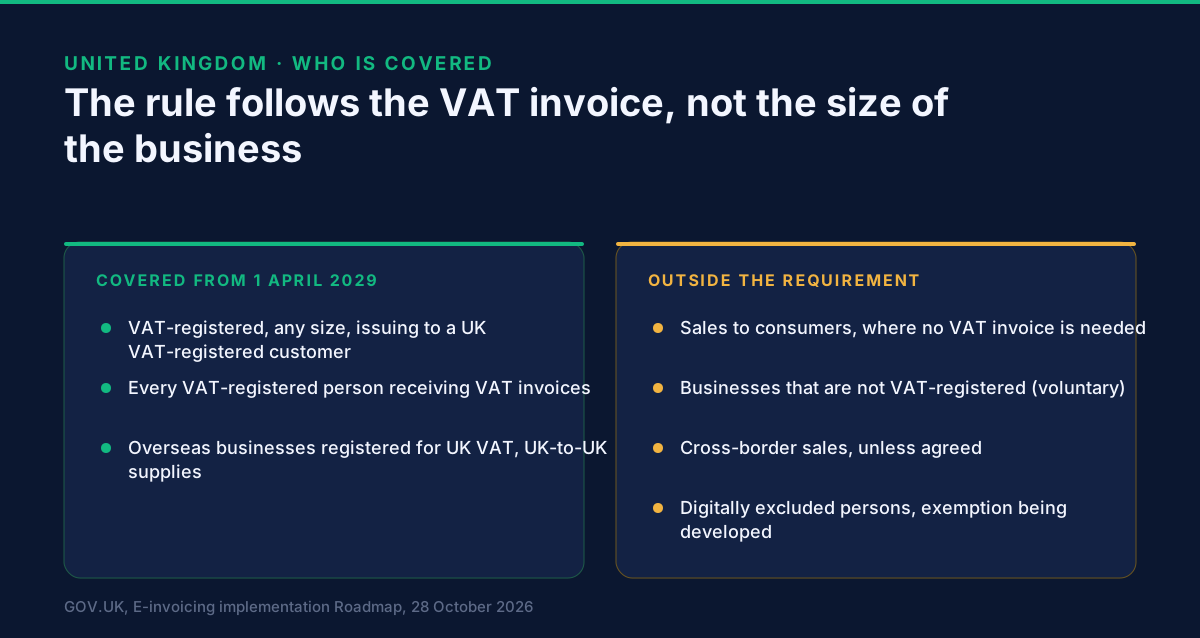
- Are you VAT-registered? If not, you are not required to issue e-invoices. The roadmap lists small businesses that are not VAT-registered among those who might send e-invoices voluntarily, as best practice.
- Is the customer another VAT-registered person in the UK? The roadmap says a VAT invoice is required when a VAT-registered person makes a taxable supply to another VAT-registered person within the UK. That is the transaction where an e-invoice will be required.
- Do you receive VAT invoices from suppliers? If yes, you need a way to receive e-invoices from 1 April 2029, even if you issue none.
If the answer to the first question is yes and to the second is no, the rule may not cover that particular sale, but it will still cover your purchases.
Who must issue, and who must receive?
The roadmap treats the two sides together. VAT-registered persons must issue VAT invoices as e-invoices and must also be able to receive them. It says: "Organisations that receive VAT invoices will also need to be able to receive e-invoices."
| Situation | Issue an e-invoice? | Receive one? |
|---|---|---|
| VAT-registered, selling to another UK VAT-registered business | Yes, from 1 April 2029 | Yes |
| VAT-registered, selling to consumers | No, no VAT invoice is required | Yes, for VAT invoices from suppliers |
| Not VAT-registered | No, but may choose to | Not required, may choose to |
| Cross-border sale | Not required, may be agreed with the customer | Not stated |
| Overseas business registered for UK VAT (NETP), UK-to-UK supply | Yes, if the customer is a VAT taxable person | Same rules as UK businesses |
| Digitally excluded VAT-registered person | Exemption being developed | Exemption being developed |
"Not stated" means the roadmap does not say. We have not guessed.
Why are consumer sales outside the rule?
Because no VAT invoice is required for them. The roadmap says VAT invoices are not required when a VAT-registered entity makes a supply to anyone who is not VAT-registered, including consumers and non-registered businesses. It adds that consumers "are unlikely to have technology to receive an e-invoice". The rule is built on the existing VAT invoice, and the roadmap says the rules on when a VAT invoice must be issued, and what it must contain, remain unchanged.
The same logic applies to supplies where no VAT invoice is needed. The roadmap says exempt, zero-rated or out-of-scope transactions between entities, where no VAT invoice is required, are not covered but may be sent as commercial e-invoices voluntarily. Check each supply type with your adviser, because the answer comes from existing VAT invoice rules, which we do not restate here. They are in VAT Notice 700, section 16, on GOV.UK.
What about people who cannot use digital tools?
The government is developing an exemption for digitally excluded VAT-registered persons. It says it will follow the approach already used for Making Tax Digital for VAT, where an exemption applies if it is not reasonable or practical to use computers, software or the internet. The roadmap lists the typical reasons: age, health conditions, disability, where someone lives, religious objections to using computers, and lack of access to the internet.
It also says there may be other reasons someone needs an exemption, and HMRC will consider those on application. Two dates matter:
- By the end of 2027: guidance for specific populations, including people unable to use digital tools.
- By April 2028: the process for applying, how to tell suppliers and customers you are exempt, and guidance for businesses on dealing with exempt trading partners, including any alternative invoicing arrangements.
So if you think you may qualify, nothing needs doing yet. If you trade with someone who may be exempt, expect guidance on how to invoice them in 2028.
The roadmap also says some exemptions will "clarify technical points where existing VAT rules have unusual or specific invoicing rules that are incompatible with e-invoicing". It does not list them. We do not know which invoicing situations this covers.
Do overseas businesses have to comply?
If they must register for UK VAT, yes. Businesses outside the UK that have to register despite having no location here are called non-established taxable persons (NETPs). The roadmap says there are no plans for different invoicing rules for them. A UK-to-UK supply of goods subject to VAT made by a NETP requires an e-invoice where the NETP's customer is a VAT taxable person.
For sales to customers outside the UK, the roadmap says e-invoices will not be required for cross-border transactions because VAT invoices are not required, though a business may issue one by agreement with its overseas customer. Existing place-of-supply rules will keep governing cross-border VAT.
What is still undecided?
The roadmap says the full scope, including exemptions, will be confirmed between October 2027 and April 2028. These points are open:
- The final list of exemptions beyond digital exclusion.
- The application process for exemptions.
- How penalties will work. The roadmap says it plans to use the existing VAT invoicing penalties framework as a basis, and will give details of taxpayer obligations by April 2028.
- Which business identifiers the UK will accept.
Anything you read that states these as fact, today, is a guess.
What can a small business do now?
The roadmap says there is no need to begin implementing before the detailed requirements appear, and that many small businesses will not need separate software. It says several accounting software providers already offer e-invoicing, including through software used for MTD obligations, and some have committed to including it at no extra cost once required. Free or low-cost invoicing products already exist.
Practical steps that do not depend on the final rules:
- Check whether you are VAT-registered, and which of your sales are to other VAT-registered UK businesses.
- Ask your accountant or software provider what they plan to offer, and when.
- If you use Sage, see the Sage connector page. Making Tax Digital is VAT reporting, not e-invoicing, so an MTD-compliant package still needs a way to send and receive.
- If you want to start earlier, you can already send Peppol invoices from Sage, Xero, QuickBooks or a spreadsheet using the GoRoute e-invoice sending service.
If you are an accountant helping several clients, book a short walkthrough. The UK summary is on the UK e-invoicing page, and a wider read of how the network works is how does e-invoicing work. Related reading: PDF, EDI or Peppol: what counts as a UK e-invoice and HMRC becomes the UK Peppol Authority. Recorded set-up guides are on the tutorials page, and the technical reference is in the developer documentation.
Sources: HMRC and the Department for Business and Trade, "E-invoicing implementation Roadmap", published 28 October 2026 (scope, exemptions, digital exclusion, NETPs). GOV.UK, VAT Notice 700 (the VAT invoice rules the roadmap refers to). This is not tax or legal advice; confirm your position with your accountant.
Frequently asked questions
- Does UK e-invoicing apply to small businesses?
- It applies to any VAT-registered business, whatever its size. The roadmap names no turnover threshold and no staged start by size. A small business that is not VAT-registered is not required to e-invoice, but the government says the standards will be built so it can choose to.
- Do I need to e-invoice if I sell to consumers?
- No. VAT invoices are not required for sales to consumers, so those sales fall outside the rule. A VAT-registered business that sells only to consumers still has to be able to receive e-invoices if it gets VAT invoices from its own suppliers.
- Who is exempt from UK e-invoicing?
- The roadmap says exemptions will be tightly defined and limited. The only group it describes in detail is digitally excluded VAT-registered persons. The full list of exemptions and the application process are due by April 2028.
- Do overseas businesses have to issue UK e-invoices?
- Overseas businesses that must register for UK VAT, known as non-established taxable persons, will follow the same invoicing rules as UK-based businesses. A UK-to-UK supply of goods by one of them needs an e-invoice if the customer is a VAT taxable person.
About Dr. Syed Raza
Dr. Syed Raza is an IT Enterprise Architect at ClayDesk LLC and leads the GoRoute platform. He works across Peppol Access Point and SMP infrastructure, PINT jurisdictions (Oman, AU/NZ, EU, JP, MY, SG), and national CTC regimes, translating regulatory detail into production-grade e-invoicing systems.
Building on Peppol?
GoRoute is a certified Peppol Access Point & SMP. Book a demo or read the docs to get started.