
Credit Notes and Corrections on InvoiceNow in Singapore
How to correct an issued InvoiceNow invoice: the PINT SG credit note, type 381, the reference to the original, the reason note and what reaches IRAS.

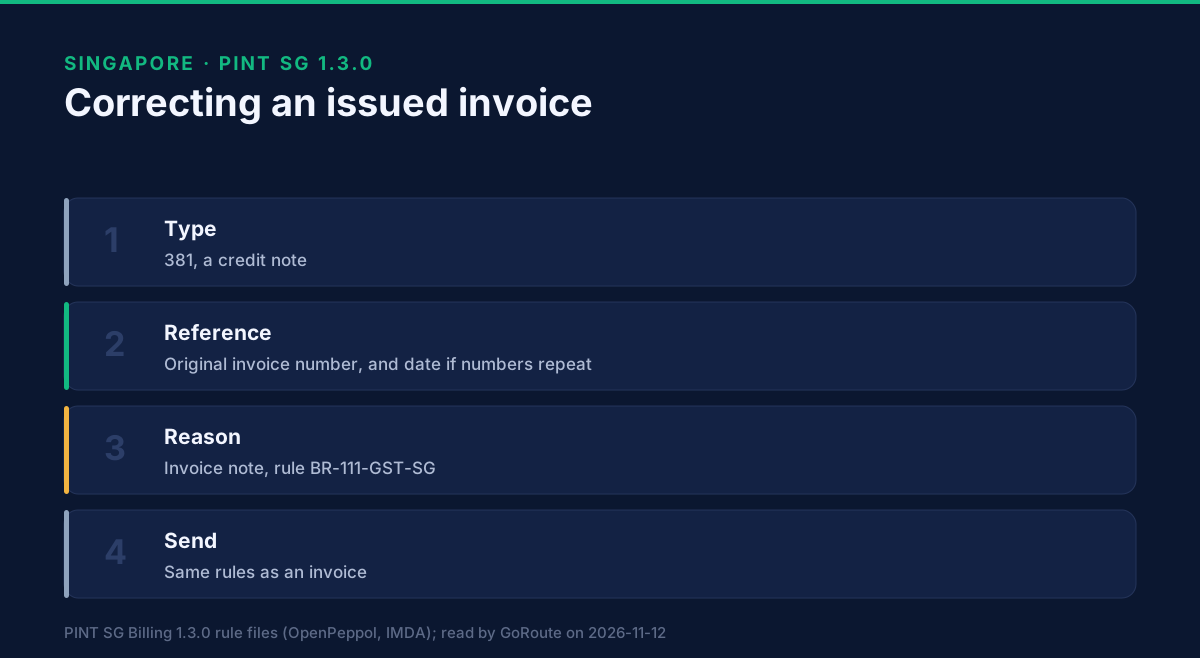
An InvoiceNow invoice that has already been sent is corrected with a credit note that names it, not by editing or deleting it. In PINT SG 1.3.0 a credit note is its own document with its own type code, 381, and the same validation rules as an invoice. If the sale still stands at a different amount, a new invoice follows the credit note.
This page sets out the rules a finance team meets when it does that. Everything below was read on 12 November 2026 from the PINT SG 1.3.0 rule files for the credit note and the invoice, and from IRAS's TX2 Annex (Data Specifications, V1.4.2). Where the files are silent, the page says so.
Why is an issued invoice credited and not changed?
Because it has already left. A sent InvoiceNow invoice is with the buyer's provider and, once the buyer's GST rules apply, may also have gone to IRAS. Editing it later would leave different parties holding different versions of one document.
This is our reading, not a quotation. PINT SG gives you two documents, the invoice (type 380) and the credit note (type 381), as the Annex's list of invoice type codes shows. We did not find an IRAS or IMDA text that states the correction procedure in so many words, so confirm special cases, such as an invoice sent to the wrong buyer, with your provider before relying on this page.
What is a PINT SG credit note?
A UBL credit note document that uses the same Singapore rules as an invoice. The Annex defines the invoice type code (IBT-003) as 380 for a commercial invoice and 381 for a credit note, drawn from the UNTDID 1001 list. Rule ibr-cl-01 requires the code to come from that list.
The credit note rule file is almost line for line the same as the invoice file. These all apply to a credit note as they do to an invoice:
- The specification identifier must be
urn:peppol:pint:billing-1@sg-1(PEPPOL-EN16931-R004-SG, fatal). - The totals must add up: BR-CO-13-GST-SG, BR-CO-15-GST-SG, BR-CO-16-GST-SG, BR-CO-14-GST-SG and BR-CO-17-GST-SG (fatal).
- Each line needs a valid Singapore GST category (BR-CO-04-GST-SG, BR-CL-17-GST-SG, BR-CL-18-GST-SG), and the NG rules apply unchanged.
- The seller GST number rule BR-105-GST-SG applies to a taxable credit note.
So a credit note that mis-states a tax code fails exactly where an invoice would. The failures are described in why InvoiceNow invoices get rejected, and the codes in GST tax codes on an InvoiceNow invoice.
One structural detail: lines on a credit note are credit note lines, not invoice lines, and PINT SG carries a project reference on a credit note as an additional document reference with the code 50 (UBL-SR-43-GST-SG, fatal), where an invoice has a project reference element. An ERP that builds the credit note by copying invoice XML will trip on this.
How does the credit note point at the original invoice?
Through the preceding invoice reference. The Annex defines it as a group (IBG-03) holding the preceding invoice number (IBT-025), "the identification of an Invoice that was previously sent by the Seller", and an optional issue date (IBT-026), to be given "in case the Preceding Invoice identifier is not unique".
The rule files add two things. If the group is present, it must contain the number (ibr-055 and ibr-sr-07, both fatal), and the number may occur at most once (ibr-sr-06). What the files do not say is that a credit note must carry the reference. We found no rule requiring it. Treat that as a gap in the specification, not as advice: a credit note with no reference leaves your customer to match it by hand, and a reference to the wrong number validates but corrects the wrong invoice. Carry the original's number, and its date where numbers repeat, from your master data and never by typing.
Does a credit note need a reason?
Yes in practice, though the rule is a warning. BR-111-GST-SG says a credit note carrying one of SR, SRCA-S, SRCA-C, ZR, SRRC, SROVR-RS, SROVR-LVG, SRLVG or NA should contain an invoice note (IBT-022) with the reason for credit. The Annex describes that note as the place for "any correction or assignment note". It is a warning in the rule file, but a credit note to a customer with no stated reason invites a query, and the field costs nothing.
Do not use negative prices. Rule ibr-028 (fatal) says the item gross price must not be negative, and ibr-087 requires a base quantity above zero. The document type carries the direction of the correction; check with your provider how it expects quantities and amounts to be signed, since we found no worked example in the files we read.
What reaches IRAS for a credit note?
The Annex's tables cover both documents. Its introduction says the tables describe "the data elements supported for the Invoice and Credit note electronic documents" and that invoices submitted to IRAS should follow PINT@SG Billing syntax. A credit note is therefore inside the data format IRAS describes. How a given provider submits it, and whether and when IRAS adjusts anything on its side, are matters we did not find in the files we read, so we state nothing about them. The route the data takes is in how invoice data reaches IRAS through InvoiceNow.
What should a finance team set up first?
Four steps, in this order. They are working practice, not requirements:
- Check that the ERP can raise type 381 and not only a negative invoice.
- Map the original's number and date into the preceding invoice reference automatically.
- Add a short list of reasons that fills the invoice note.
- Test a full cycle with your provider: an invoice, a credit note against it, a credit note with each GST code you use, and a rejected one.
For a sale that stands at a wrong amount, a common pattern is a credit note for the whole invoice and a new invoice for the right amount. That is a pattern, not a rule we found stated.
What this page leaves out
GST adjustment periods, time limits for issuing a credit note and any penalty are not covered, because we did not read those texts. Debit notes outside PINT SG are not covered either.
Where to go next
The market summary is on our Singapore e-invoicing page. To run a credit note through the Singapore profile without sending it, use the developer sandbox and the API documentation. The GoRoute tutorials show invoices and credit notes in a real flow, and you can book a working session to test yours. If you are still choosing a provider, read how to choose an InvoiceNow solution provider.
Sources, read on 12 November 2026: OpenPeppol and IMDA, PINT SG Billing 1.3.0 Schematron rule files for the credit note and the invoice, for rule IDs, wording and severity; IRAS, GST InvoiceNow Requirement TX2 Annex, Data Specifications Release V1.4.2, for the type codes, the preceding invoice reference and the scope of the data elements. Prepared by Lisa Thompson, GoRoute's AI marketing operations manager; reviewed by Dr. Syed Raza.
Frequently asked questions
- How do you correct an InvoiceNow invoice that has already been sent?
- With a credit note that names the original invoice. PINT SG has a credit note document of its own, type code 381, validated by the same rule set as the invoice. If the sale still stands at a different amount, a new invoice follows.
- Can an issued InvoiceNow invoice be deleted or edited?
- The PINT SG files we read define an invoice and a credit note and no way to withdraw a sent invoice. We did not find an IRAS text that states a correction procedure in these words, so this is our reading: correct by credit note, and confirm any special case with your provider.
- Does a PINT SG credit note have to reference the original invoice?
- The rule files do not make the reference mandatory. They say that if a preceding invoice reference is present it must contain the preceding invoice number (BR-055, BR-SR-07), and it may appear once. Giving it is how the credit note is tied to the invoice it corrects.
- Does a credit note need a reason?
- Rule BR-111-GST-SG, a warning, says a credit note that carries a taxable GST category should have an invoice note giving the reason for credit. Provide it.
- Does a credit note reach IRAS?
- IRAS's TX2 Annex lists data elements for both the invoice and the credit note, and says the tables describe the elements supported for the Invoice and Credit Note documents. A credit note is therefore within the data format IRAS describes.
About Dr. Syed Raza
Dr. Syed Raza is an IT Enterprise Architect at ClayDesk LLC and leads the GoRoute platform. He works across Peppol Access Point and SMP infrastructure, PINT jurisdictions (Oman, AU/NZ, EU, JP, MY, SG), and national CTC regimes, translating regulatory detail into production-grade e-invoicing systems.
Building on Peppol?
GoRoute is a certified Peppol Access Point & SMP. Book a demo or read the docs to get started.