
How to Choose an InvoiceNow Solution Provider in Singapore
IMDA publishes two lists: accredited Access Points and InvoiceNow-Ready solutions. How to check a provider against both, and what to ask before you sign.

The short answer
Check the provider against IMDA's own published list before you compare anything else — and check the right list, because IMDA publishes two. One names accredited Access Point providers, the service that moves your document across the network. The other names InvoiceNow-Ready solutions, the software you actually raise the invoice in. Being on one is not being on the other, and the solutions list is keyed by product name rather than company name, so a vendor can be accredited for one of its products and not for the one you are being sold.
| The question | Where the answer comes from |
|---|---|
| Who is allowed to run an Access Point here? | IMDA, Singapore's Peppol Authority. The AP list — 45 providers when updated on 2 September 2026 |
| Is this software InvoiceNow-Ready? | The IRSP list — 80 solutions on the same date, plus 199 resellers in a second table |
| By when must our invoice data reach IRAS? | The GST InvoiceNow phase table, which runs from 1 Nov 2025 to 1 Apr 2031 |
| When may a provider call itself accredited? | After IMDA's Letter of Offer and the provider's signed Letter of Acceptance — not before |
Which of IMDA's two lists should you be checking?
The one that matches what you are buying. The distinction is not pedantry; it is the commonest way a buyer ends up believing a check has been done that has not.
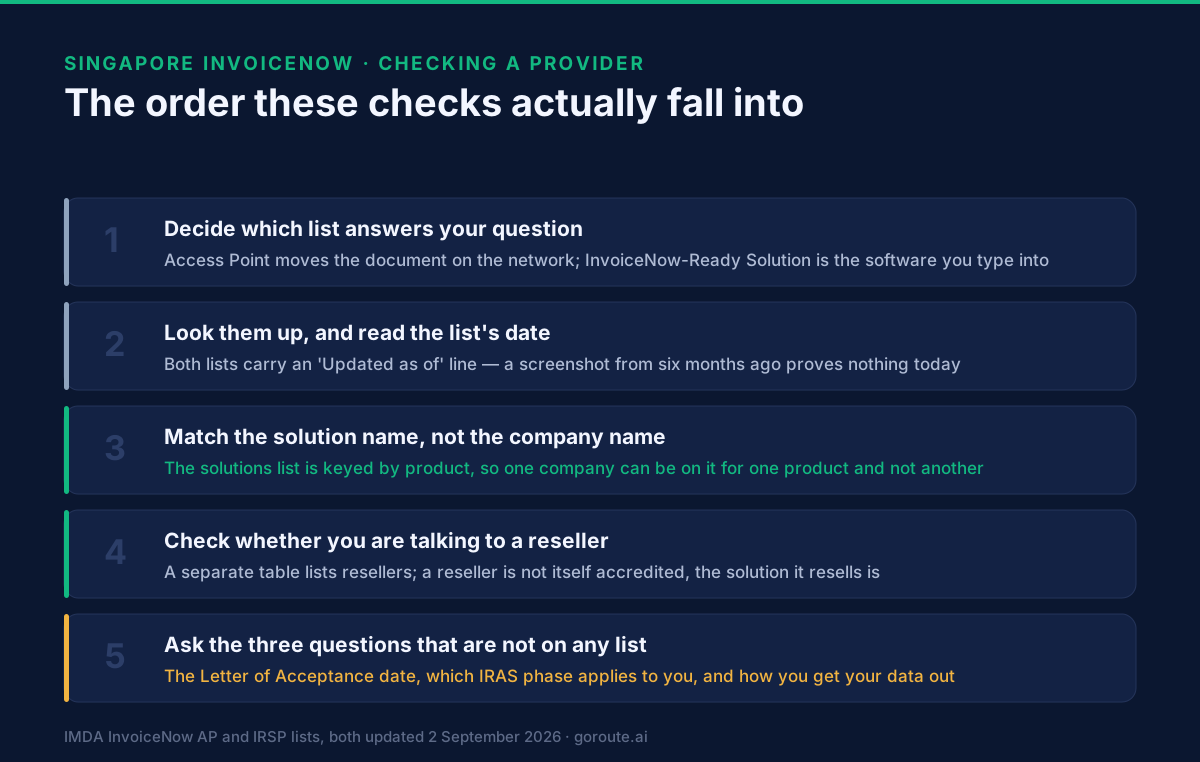
An Access Point is the network service. It takes a document from you and delivers it to your customer's Access Point, and — where the GST InvoiceNow Requirement applies — transmits the invoice data to IRAS. An InvoiceNow-Ready Solution is the accounting or ERP software you work in, accredited as able to produce and send a compliant document.
Most businesses touch both. They are frequently different companies, and IMDA's own process links them: an accredited Access Point registers each of its solution providers as a sub-organisation on the Singapore SMP, the directory that tells the network where to deliver. If you are trying to work out whether the system you already own can send at all, that is a different question with its own answer in what "InvoiceNow-ready" actually means for an ERP.
Both lists are PDFs published by IMDA and linked from IRAS's own GST InvoiceNow page, which is the reason to trust the address as well as the contents.
How do you check a provider against the list?
Four things to match, in this order. It takes minutes and it is the only part of this exercise that produces a fact rather than an impression.
Match the legal entity, not the brand
Groups trade under several names. The name on the list is the entity IMDA accredited, and the name on your contract should be the same one — not a related one. The Access Point list also carries a Local/Foreign column, which tells you whether the provider is incorporated in Singapore or accredited through IMDA's foreign-provider route. Both are on the list; they are simply different paths to it.
Match the exact solution name
This is the check most often skipped. The InvoiceNow-Ready Solution Provider list is keyed by product. One company appears once for each accredited solution, and two entries under closely related company names can be two different products — a Microsoft Dynamics 365 Business Central practice and an SAP Business One practice, for example, listed separately because they are separately accredited. "Our vendor is on IMDA's list" is therefore not an answer. "The product in our quotation appears on IMDA's list under this exact name" is.
Check whether you are talking to a reseller
The solutions PDF contains a second table, headed InvoiceNow-Ready Solution Provider (IRSP) Reseller, which listed 199 entries on 2 September 2026. A reseller sells and implements someone else's accredited solution. That is a legitimate way to buy, and it is common — but the accreditation sits with the solution upstream, not with the company signing your contract. Know which you are dealing with before you assume who is answerable when something fails.
Read the list's own date
Both PDFs carry an "Updated as of" line at the top of every page. Accreditation is valid for one year and renews automatically only while the provider keeps meeting the requirements, so the list is a statement about a moment. A screenshot in a sales deck is not a check; opening the current file is.
What does IMDA require before it accredits an Access Point?
Six things, set out in IMDA's Guide for Accreditation of InvoiceNow Access Point Service Provider:
- Membership of OpenPeppol, verified against OpenPeppol's member list and maintained throughout the accreditation period.
- Paid-up capital of SGD 10,000, or the equivalent in local currency for overseas organisations, evidenced by a company registration document.
- Compliance with IMDA's information security requirements, declared in the accreditation application form.
- Interoperability testing completed successfully with IMDA's appointed Access Point, demonstrating the ability to send and receive the documents specified in Singapore's Peppol Authority Specific Requirements, with the technical detail at peppolguide.sg.
- OpenPeppol's Reporting BIS testing completed successfully.
- Compliance testing for the GST InvoiceNow Requirement, against the specifications in IMDA's InvoiceNow Technical Playbook.
Two consequences worth carrying into a meeting. First, every accredited provider has cleared the same bar — so accreditation tells you a provider is eligible, not that it is the right one. Second, the bar includes the IRAS piece, which is the part that most often separates a provider that can move a Peppol document from one that can also satisfy the GST requirement.
When may a provider say it is accredited?
Only after IMDA has issued a Letter of Offer and the provider has signed and returned the Letter of Acceptance. IMDA's guide states this in terms, as a note against the final step of the process.
That single rule is unusually useful to a buyer, because the accreditation process has many stages that sound like arrival and are not. Registering an expression of interest, submitting the application, passing interoperability testing, receiving in-principle approval — all real, none of them accreditation. A provider partway through is not doing anything wrong by saying so accurately.
So the question to ask is specific and answerable: on what date did you sign your Letter of Acceptance? A provider that has one can give you the date. Then confirm it against the list, which is the same fact from IMDA's side.
What should you ask before signing?
Five questions the lists cannot answer for you. Ask them in writing, of every shortlisted provider, and compare the answers side by side.
Which of our systems do you connect to, and how? Be specific about your own estate first — most organisations issue invoices from more than one place, and the second place is usually the one nobody lists. Ask whether the connection is a supported connector, an integration your team builds, or a file drop.
Do you handle the IRAS transmission, or only the Peppol delivery? These are different jobs and the GST InvoiceNow Requirement needs both. How invoice data actually reaches IRAS sets out the path so you can ask about each hop rather than about the whole thing at once.
Which document types do you support today? Singapore requires more than an invoice. Beyond SG Peppol BIS Billing and PINT SG invoices and credit notes, the profile covers invoice response and the ordering documents. Ask which are live now rather than on a roadmap.
Where is our data held, and who can reach it? Ask it as a question about location and access, not about assurance, and ask what evidence you would be given if you had to demonstrate it.
How do we leave? Ask before you sign, when your leverage is at its highest. Get four things in writing: how your invoice archive is exported, in what format, how long it takes and what it costs, and how long the provider keeps your data after termination. A provider who answers precisely is describing how it will behave for the whole contract.
Which deadline are you buying against?
IRAS is phasing the GST InvoiceNow Requirement in, and your date depends on how and when you registered for GST:
| From | Who it applies to |
|---|---|
| 1 Nov 2025 | Companies registering for GST voluntarily within six months of incorporation |
| 1 Apr 2026 | Any business applying for voluntary GST registration, whatever its incorporation date or structure |
| 1 Apr 2028 | Businesses applying for compulsory registration on or after that date; existing registrants with total annual supplies of S$200,000 or less |
| 1 Apr 2029 | Existing registrants with total annual supplies of S$1,000,000 or less |
| 1 Apr 2030 | Existing registrants with total annual supplies of S$4,000,000 or less |
| 1 Apr 2031 | Existing registrants with total annual supplies above S$4,000,000 |
Total annual supplies here means the value of standard-rated, zero-rated and exempt supplies made in the accounting periods ending in calendar year 2025 — IRAS's own definition, taken from box 4 of the GST return. Overseas entities under the Overseas Vendor Registration regime, and businesses liable to register wholly because of Reverse Charge, are excluded.
Read the date as the date your data must actually be flowing, not the date you sign something. The background to the whole programme is in Singapore's InvoiceNow guide, and the country view sits on our Singapore page.
What the lists do not tell you
Worth saying plainly, because a published list invites more weight than it can carry.
They do not rank anyone. They are registers of who has met a bar, in numeric order. Position on the list means nothing.
They do not carry accreditation dates. The columns are the provider or solution name, the website, and support contacts. If the date matters to you — and it does, because accreditation runs in one-year periods — you have to ask the provider and take the list as confirmation of current status rather than of history.
They do not describe fit. Two providers on the same list can be entirely different propositions for your business. That is what the five questions above are for.
They do not tell you who is behind a reseller's service. The reseller table names the solution being resold, which is the thread to pull, but the operational arrangement behind it is something you have to ask about.
If you are buying across several countries at once rather than for Singapore alone, the general version of this decision — certification, country coverage, validation and price, without a single national list to start from — is in how to choose Peppol software providers. The same exercise for a jurisdiction that also runs an accreditation register is in choosing an e-invoicing service provider in Oman.
Frequently asked questions
- Where is IMDA's list of accredited InvoiceNow providers?
- IMDA publishes two separate lists, both linked from IRAS's GST InvoiceNow page. The Access Point provider list is at file.go.gov.sg/invoicenowap.pdf and carried 45 providers when it was updated on 2 September 2026. The InvoiceNow-Ready Solution Provider list is at file.go.gov.sg/invoicenowirsp.pdf and carried 80 solutions on the same date, followed by a second table of 199 resellers. They answer different questions, so check the one that matches what you are buying.
- What is the difference between an Access Point and an InvoiceNow-Ready Solution Provider?
- An Access Point is the service that actually moves your document across the Peppol network and, for GST purposes, on to IRAS. An InvoiceNow-Ready Solution is the software you raise the invoice in — an ERP or accounting package accredited as able to produce and send a compliant document. Many businesses need both, and they are frequently different companies. IMDA's accreditation guide has the Access Point register each of its solution providers as a sub-organisation on the Singapore SMP, which is how the two connect.
- How do I check whether a provider is IMDA accredited?
- Open the relevant list and match three things: the exact legal entity name, the exact solution name if you are buying software, and the list's own 'Updated as of' date. The solutions list is keyed by product rather than by company, so a vendor can be accredited for one of its products and not another. If the company selling to you appears only in the reseller table, the accreditation belongs to the solution it resells, not to the company you are signing with.
- What does IMDA require before it accredits an Access Point?
- IMDA's accreditation guide sets six requirements: OpenPeppol membership maintained throughout the accreditation period, paid-up capital of SGD 10,000 or the local-currency equivalent for overseas organisations, a declaration of compliance with IMDA's information security requirements, successful interoperability testing with IMDA's appointed Access Point, successful completion of OpenPeppol's Reporting BIS testing, and successful compliance testing for the GST InvoiceNow Requirement. Accreditation is valid for one year and renews automatically for further one-year periods so long as the provider keeps meeting the requirements.
- When may a provider say it is InvoiceNow accredited?
- Only after IMDA has issued it a Letter of Offer and it has signed and returned the Letter of Acceptance. IMDA's accreditation guide states this explicitly. It matters commercially because every earlier stage — expression of interest, application submitted, testing under way, in-principle approval — is real progress that is not yet accreditation. If a provider describes itself as accredited, the checkable fact is the Letter of Acceptance, and the list is where you confirm it.
- When does the GST InvoiceNow Requirement apply to my business?
- IRAS is phasing it in. It applied from 1 November 2025 to companies registering for GST voluntarily within six months of incorporation, and from 1 April 2026 to any business applying for voluntary GST registration. For existing GST-registered businesses the dates run 1 April 2028 for total annual supplies of S$200,000 or less, 1 April 2029 up to S$1,000,000, 1 April 2030 up to S$4,000,000 and 1 April 2031 above S$4,000,000, measured on supplies in accounting periods ending in calendar year 2025. Overseas entities under the Overseas Vendor Registration regime and businesses registering wholly because of Reverse Charge are excluded.
About Dr. Syed Raza
Dr. Syed Raza is an IT Enterprise Architect at ClayDesk LLC and leads the GoRoute platform. He works across Peppol Access Point and SMP infrastructure, PINT jurisdictions (Oman, AU/NZ, EU, JP, MY, SG), and national CTC regimes, translating regulatory detail into production-grade e-invoicing systems.
Building on Peppol?
GoRoute is a certified Peppol Access Point & SMP. Book a demo or read the docs to get started.