
How Invoice Data Reaches IRAS Through InvoiceNow
The invoice goes to your customer over Peppol and a data set goes to IRAS. Who sends it, what travels, and what happens to sales that never touch the network.

Last updated .
Under Singapore's GST InvoiceNow Requirement, one invoice makes two journeys. It travels from you to your customer over the Peppol network exactly as it always did, and a data set drawn from that same invoice is transmitted to IRAS by your access point — not uploaded by you, and not a portal you log into. That second journey is the fifth corner, and this page follows it end to end.
If you want the programme rather than the plumbing, the Singapore InvoiceNow guide covers the network, IMDA's role and the GST rollout. This page is the reporting leg only.
How does invoice data reach IRAS?
Through five corners. The first four are ordinary Peppol; the fifth is what Singapore's GST requirement adds.
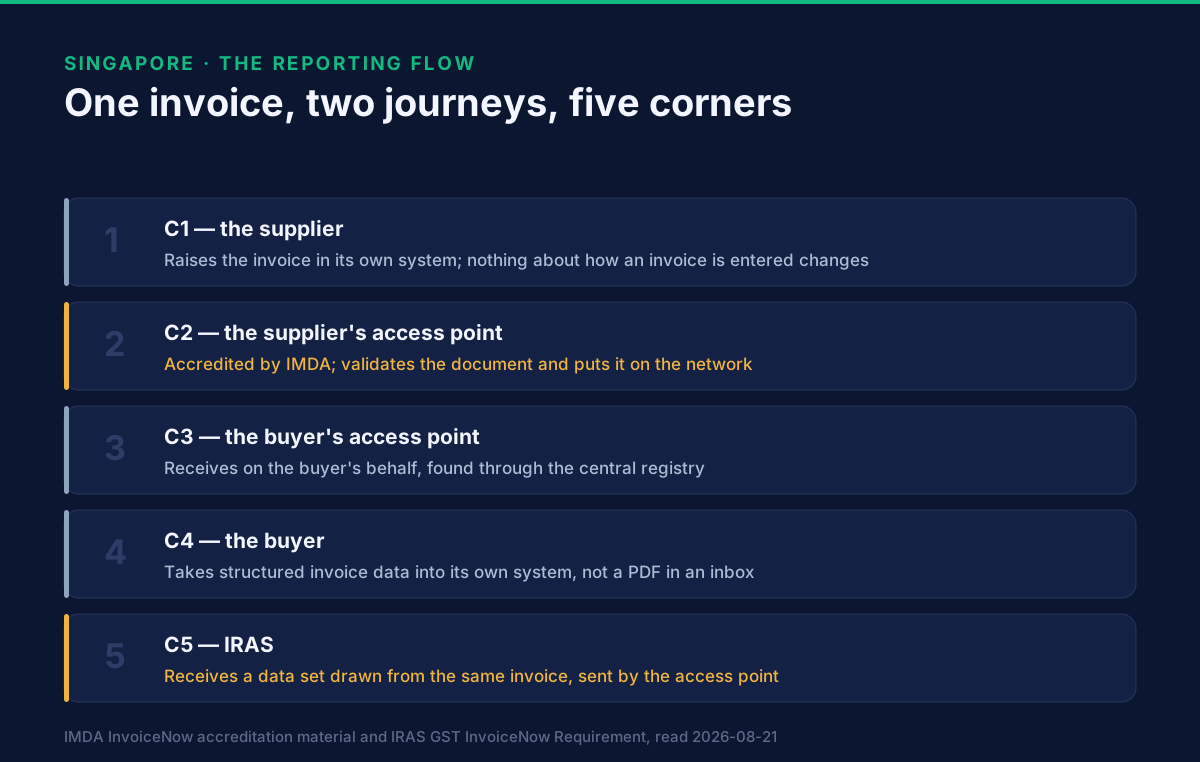
| Corner | Who | What happens |
|---|---|---|
| C1 | Supplier | Raises the invoice in its own accounting system |
| C2 | Supplier's access point | Validates against Singapore's billing profile and puts the document on the network |
| C3 | Buyer's access point | Receives on the buyer's behalf, discovered through IMDA's central registry |
| C4 | Buyer | Takes structured invoice data into its own system |
| C5 | IRAS | Receives a data set drawn from the same invoice, transmitted through the government API |
The four-corner part is the Peppol model that runs in more than forty countries. Corner five is a Singapore addition, and in IMDA's accreditation material it is named exactly that: the C5 leg, tested separately from ordinary network delivery before a provider is allowed to operate it.
Who actually sends the data?
Your access point does. It holds the connection to the government API through which IRAS receives invoice data — reached through Singapore's government API exchange, APEX — and the accreditation that permits it to use it. From the business's side there is no second submission, no upload and no reconciliation step at month-end.
What falls to you sits upstream of that, and it is not a small thing: the data has to exist in your system and be right. A missing GST category, a customer without a UEN, or a foreign-currency invoice with no Singapore-dollar tax amount will stop the document before anything reaches IRAS. Those checks belong to your ERP, and they are set out in what an InvoiceNow-ready ERP is.
What actually travels to IRAS?
A defined set of fields, rather than a copy of your invoice.
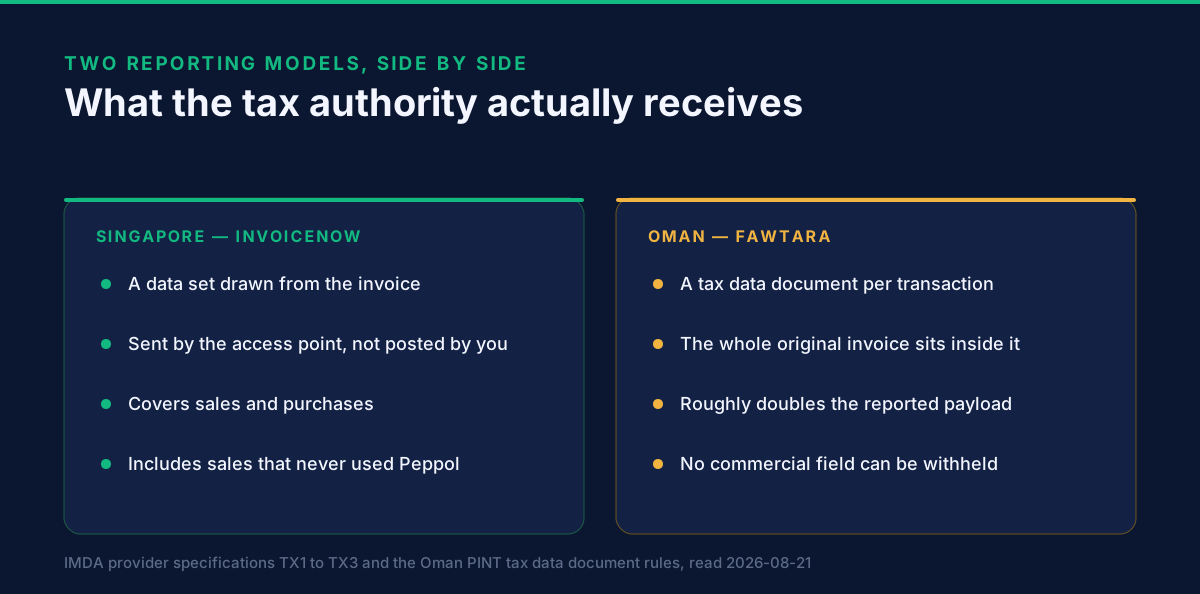
The provider-side specifications IMDA issues for this leg describe a data extraction and transformation exercise with a separate data specification annex — in other words, named fields are drawn out of the invoice and sent in a defined shape. That is different from Oman's approach, where the report submitted to the Tax Authority carries the complete original invoice embedded inside it, and it has practical consequences: no doubling of stored payload per transaction, and a field-level rather than document-level conversation with the authority.
If you work across both markets, Oman's five-corner model is the contrast worth reading — the same corner count, a materially different fifth corner.
What we are not saying: we are not publishing a field list here. The exact set is in the specifications IMDA issues to accredited providers, and a field list copied from a summary is exactly the kind of detail that goes stale without anyone noticing.
What about sales that never travel over the network?
Not every transaction goes through Peppol. A customer may not be on InvoiceNow at all; a sale may be to a consumer; a document may be a purchase you received rather than a sale you issued.
The accreditation test pack a provider works through covers these cases explicitly: it includes document types for non-Peppol invoices and credit notes, along with business-to-consumer and purchase scenarios. The reporting leg is therefore broader than "invoices you sent over InvoiceNow", which is the single most common misreading of the requirement.
That is the shape of the duty as it appears in the provider testing material. The duty itself is IRAS's to define, and the current wording is on their page — a provider summary, this one included, is not a substitute for it.
Is this a clearance model?
No, and the distinction matters when you are scoping.
- Clearance — the tax authority sits between supplier and buyer, and the invoice is not valid until it has been cleared. Delivery waits on the authority.
- Reporting alongside exchange — Singapore's shape. The commercial invoice goes to the buyer over Peppol, and the data goes to IRAS in parallel. Your customer is not waiting on a tax authority to receive their invoice.
The practical consequence: a problem in the reporting leg is a compliance problem to fix, not an interruption to your customers' invoices.
When does this apply to my business?
It already applies to some businesses. The requirement is being phased in by cohort, and the first two cohorts are past:
| From | Who it applies to |
|---|---|
| 1 May 2025 | Voluntary soft launch — any GST-registered business could start early |
| 1 November 2025 | Newly incorporated companies that register for GST voluntarily |
| 1 April 2026 | All new voluntary GST registrants |
| April 2028 – April 2031 | Extended progressively to every GST-registered business |
Two readings of that table are wrong often enough to be worth naming. It is not "voluntary in Singapore" — that stopped being true on 1 November 2025. And 1 April 2026 is not a full business-to-business switch-on; it is new voluntary GST registrants only.
IRAS sets these dates and publishes the cohort detail for the 2028–2031 phases. Confirm your own start date against IRAS's GST InvoiceNow Requirement page, which is the only version of it that is authoritative on the day you read this.
What usually goes wrong first
In our experience of Peppol markets with a reporting leg, the failures cluster upstream of the tax authority, not at it:
- The participant was never registered. In Singapore this is completed by the business authenticating itself, not by the provider alone, and an unfinished registration expires.
- A customer has no UEN. Peppol scheme
0195routes on it; without one the invoice cannot be addressed. - A line has no GST category, or the wrong one. Singapore's rules distinguish standard-rated, zero-rated, exempt, out of scope, not GST-registered, and taxable supplies where GST need not be charged.
- A foreign-currency invoice carries no Singapore-dollar tax amount, which Singapore's validation requires.
- There is no receiving path. Sending is scoped, receiving is forgotten, and the first supplier invoice that arrives has nowhere to land.
Every one of these is visible by validating a real document before you are in scope — which costs nothing and can be done today. The general failure patterns are in validation errors you can prevent.
What to do next
- Establish which cohort you are in — the table above for the shape of it, then IRAS's own page for your date.
- Validate one real invoice against the Singapore profile and read what comes back. The developer sandbox does this without sending anything.
- Ask your provider how they perform the C5 leg and what they do when a transmission fails — a reporting leg with no retry story is a reporting leg you will be chasing.
- Check the receiving side, not just sending.
For the market view see Singapore e-invoicing, and for how the same integration reaches other Peppol countries, the multi-country API. To scope it against your own system, book a working session.
Where GoRoute stands
GoRoute operates a Peppol-certified Access Point and SMP (Service Provider ID POP000991, ClayDesk LLC). Singapore adds its own requirements on top of ordinary Peppol — accreditation by IMDA, registration in the central registry, and the reporting leg described above — and those are the questions to put to any provider in writing, ours included, before a contract is signed.
Sources
- IRAS — GST InvoiceNow Requirement — who the reporting duty applies to and from when
- IMDA — nationwide e-invoicing framework — InvoiceNow and IMDA's role as Singapore's Peppol Authority
- IMDA — InvoiceNow technical playbook — the technical requirements behind the reporting leg
- SG Peppol Guide — billing specification — the Singapore billing profile and its validation rules
- OpenPeppol — the network the exchange runs on
Frequently asked questions
- How does invoice data reach IRAS through InvoiceNow?
- The invoice travels from supplier to buyer over the Peppol network in the ordinary four-corner way, and the access point separately transmits a data set drawn from that invoice to IRAS through the government API. The business does not upload anything to IRAS; the transmission is a service the accredited provider performs as part of sending or receiving the document.
- Does IRAS receive the whole invoice?
- Not in the way Oman's model does. The provider-side specification for the Singapore reporting leg is a data extraction and transformation exercise with its own data specification, so what reaches IRAS is a defined set of fields drawn from the invoice rather than the complete original document embedded whole. If the exact field list matters to your project, it is in the specifications IMDA issues to accredited providers.
- Who transmits the data — me or my provider?
- Your provider. The access point holds the connection to the government API and the accreditation that permits it. What falls to you is upstream: the invoice data has to exist in your system, correctly categorised for GST, or there is nothing correct to transmit.
- Do invoices that never travel over Peppol still have to be reported?
- The reporting leg is broader than Peppol delivery. The accreditation test pack providers work through includes document types for non-Peppol invoices and credit notes, along with business-to-consumer and purchase scenarios. Read that as the shape of the duty rather than as the rule itself, and confirm your own scope against current IRAS guidance.
- When does the GST InvoiceNow Requirement apply to my business?
- It already applies to some businesses. It opened as a voluntary soft launch on 1 May 2025, became a requirement for newly incorporated companies that register for GST voluntarily on 1 November 2025, and for all new voluntary GST registrants on 1 April 2026. From April 2028 it extends progressively to every GST-registered business, completing in April 2031. IRAS publishes the cohort detail for those later phases, so confirm your own start date against its page rather than against any provider's summary, including ours.
- What is the difference between InvoiceNow and the GST InvoiceNow Requirement?
- InvoiceNow is Singapore's e-invoicing network, governed by IMDA and built on Peppol. The GST InvoiceNow Requirement is IRAS's reporting duty carried over that network: in addition to sending your customer an invoice, invoice data is transmitted to the tax authority. One is infrastructure; the other is an obligation that uses it.
- Is Singapore's model the same as a clearance regime?
- No. In a clearance regime the tax authority stands between supplier and buyer and the invoice is not valid until it has been cleared. Singapore keeps the commercial exchange on the Peppol network and adds a reporting leg alongside it, so the invoice reaches the buyer whether or not the reporting call has completed.
- What usually goes wrong first?
- Data, not transmission. A participant that was never registered in the central registry, a customer with no UEN, a missing GST category on a line, or an invoice in a foreign currency with no Singapore-dollar tax amount. Each of these fails before anything reaches IRAS, and each is visible by validating a real invoice today.
About Dr. Syed Raza
Dr. Syed Raza is an IT Enterprise Architect at ClayDesk LLC and leads the GoRoute platform. He works across Peppol Access Point and SMP infrastructure, PINT jurisdictions (Oman, AU/NZ, EU, JP, MY, SG), and national CTC regimes, translating regulatory detail into production-grade e-invoicing systems.
Building on Peppol?
GoRoute is a certified Peppol Access Point & SMP. Book a demo or read the docs to get started.