
How to Invoice a Norwegian Company from Abroad Over Peppol
A seller outside Norway invoices a Norwegian business over Peppol using its 0192 number. What to send, the reverse charge wording, and a buyer off Peppol.

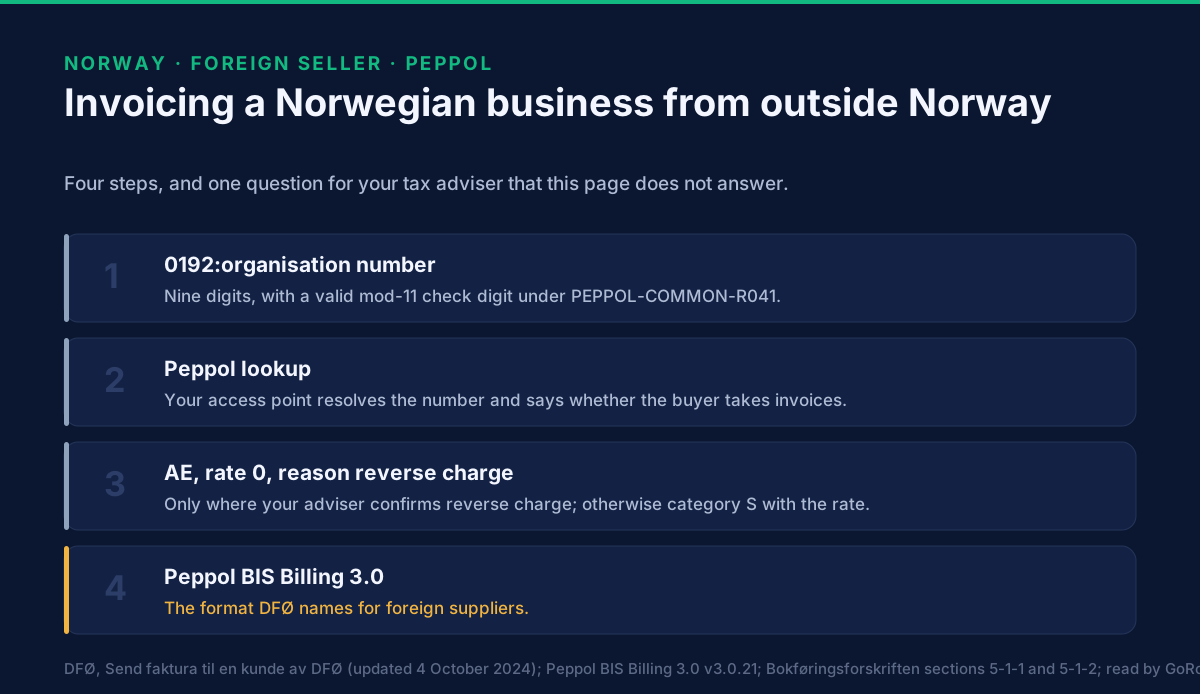
A seller outside Norway invoices a Norwegian business over Peppol the same way a Norwegian seller does: find the buyer's nine-digit organisation number, address the invoice to it under scheme 0192, and send Peppol BIS Billing 3.0 through an access point. You do not need a Norwegian company to do that. What you cannot take from this page is a ruling on VAT, because whether you must register in Norway or charge Norwegian VAT depends on what you sell, and that is for your tax adviser.
This is for a finance lead at a supplier outside Norway, selling to a Norwegian business that is not itself a public body. If your buyer is a public body, what a Norwegian public buyer will accept covers it more precisely. If you are already registered for Norwegian VAT, the section on foreign VAT-registered businesses on the Norway page is the place to start, because the rules for you are different.
How do you find the Norwegian buyer on Peppol?
By the organisation number, which the buyer can give you and which you can check yourself. A Norwegian business is identified on Peppol by the nine-digit number from the Brønnøysund Register Centre under scheme 0192. DFØ, in its guidance to foreign suppliers, gives the form some foreign portals expect: 0192:999999999.
Three checks, in this order:
- The number is well formed. Peppol rule
PEPPOL-COMMON-R041is fatal if a Norwegian organisation number under0192is not nine digits with a valid mod-11 check digit. A typo fails here, before the network is involved. - The number is the right one. The organisation number on a Norwegian letterhead is not always the VAT identifier, which carries
NO, the nine digits andMVA. For Peppol, only the bare nine digits are the address. - The buyer is reachable. Your access point resolves the number through the Peppol lookup and tells you whether the buyer receives invoices. How a Norwegian business becomes reachable for EHF invoices explains who publishes a Norwegian participant: a public body is listed in ELMA, while a private company is published by its own provider.
A well-formed number that resolves to nobody is not an error in your document. The buyer has not published a receiving address, or their provider does not carry the invoice document type.
What does your invoice need to carry?
The standard Peppol BIS Billing 3.0 invoice, with your country's identifiers on the seller side. The Norwegian national rules are written for Norwegian sellers. NO-R-001, which requires the VAT number as NO, nine digits and MVA, applies to a seller whose country is Norway, and it does not apply to you.
What does apply to you:
- Electronic addresses with schemes. Rules
PEPPOL-EN16931-R010and-R020require an address for buyer and seller, andBR-62andBR-63require a scheme identifier on each. The buyer's is0192; yours is the scheme of your own country's identifier. - A buyer reference or an order reference. Rule
PEPPOL-EN16931-R003requires one. Take it from the purchase order. - Seller identification.
BR-CO-26requires at least one of your seller identifier, legal registration identifier or VAT identifier, so the buyer can identify you automatically. - VAT treatment that matches the category. See the next section.
The format is the same one DFØ names for foreign suppliers. DFØ's instruction to state bodies is that foreign suppliers are to use PEPPOL BIS, and its note that EHF is "a Norwegian adaptation of a common European invoice format" is the reason an invoice built for Peppol elsewhere is accepted. DFØ's specification confirms the equivalence: EHF Billing 3.0 is implemented by implementing Peppol BIS Billing 3.0 without extensions or extra rules.
What about VAT and the reverse charge wording?
Whether reverse charge applies to your sale is a tax question. The Norwegian Tax Administration has a guide for businesses on VAT on services purchased from other countries, which covers sections 3-30 and 11-3 of the VAT Act and says its answers are general guidance and not a binding answer. We are not going to improve on that, and we do not say which side of the line any particular sale falls on.
What we can say is what the documents look like once the answer is known.
The wording. The Bookkeeping Regulation, section 5-1-1 no. 7, says that where the buyer is to calculate and pay VAT under section 11-1, second or third paragraph, of the VAT Act, the sales document shall be marked «Omvendt avgiftsplikt – Merverdiavgift ikke beregnet». Section 5-1-2 adds that in such a sale the buyer's organisation number is always stated, followed by MVA if the buyer is in the VAT register. Whether those sections bind a seller outside Norway is a legal question; the safe course is to ask your adviser, and the wording costs nothing to include where reverse charge is the agreed treatment.
The code. In the e-invoice, a reverse charge supply uses VAT category AE at a rate of zero. Rule BR-AE-05 requires the zero rate, BR-AE-10 requires a reason code or reason text of reverse charge in the VAT breakdown, and BR-AE-02 requires your VAT or tax registration identifier and the buyer's VAT identifier or legal registration identifier. DFØ's table for Norway lists AE as "Reversed VAT". The full set of codes is on the VAT codes page.
The currency. If Norwegian VAT is charged on the invoice, section 5-1-1 no. 6 says the VAT amount shall be stated in Norwegian kroner. Peppol carries a VAT accounting currency for exactly this case (section 11.6 of the specification), so an invoice in euros can still state the VAT in kroner.
What if the buyer is not on Peppol?
Ask how they receive invoices before you send anything. There are two cases, and they differ.
- A public body. DFØ says plainly that an invoice cannot be sent by email: it must be an electronic invoice or paper by post. A public buyer that is not reachable should be asked for the address it wants used.
- A private buyer. We found no rule in the sections we read that forces a particular channel for a private buyer today, and this page does not say there is none. Agree a format with the buyer. The Bookkeeping Regulation, section 5-2-9, requires a sales document issued electronically to be in a file format that cannot easily be edited in common word-processing, spreadsheet or email tools without the change showing, which in practice rules out a Word or Excel file.
The B2B rules are changing. The dates and the duty to issue structured invoices are covered on the Norway page, which owns that subject, and this page does not repeat them.
What does a foreign seller do next?
- Get the buyer's organisation number and check it is well formed.
- Ask your access point to look the buyer up and report whether they can receive the invoice.
- Ask your tax adviser which VAT treatment applies, and map the answer to the category and the wording.
- Run the invoice through the official validator. How to check an EHF invoice before sending it walks through it.
- Know how you will correct a mistake: how an EHF credit note works.
GoRoute is a certified Peppol access point (POP000991) with a live EHF path for Norway. The developer documentation covers the fields and the error codes, and recorded walkthroughs are on tutorials. To go through a first Norwegian invoice with someone, book a session.
Next read: how a Norwegian business becomes reachable for EHF invoices, to see what your access point looks up when it resolves the buyer.
Sources: DFØ, Send faktura til en kunde av DFØ, updated 4 October 2024, read 16 November 2026, for the address form 0192:orgnr, the use of Peppol BIS by foreign suppliers and the rule against email invoices to state bodies; DFØ, EHF Billing 3.0, usage in Norway, version 3.0.3, for the equivalence with Peppol BIS Billing 3.0 and the VAT table; Bokføringsforskriften (FOR-2004-12-01-1558) on Lovdata, sections 5-1-1, 5-1-2 and 5-2-9, read 16 November 2026; OpenPeppol, Peppol BIS Billing 3.0 version 3.0.21, rules NO-R-001, PEPPOL-COMMON-R041, PEPPOL-EN16931-R003, -R010, -R020, BR-62, BR-63, BR-CO-26, BR-AE-02, BR-AE-05, BR-AE-10 and section 11.6; the Norwegian Tax Administration, VAT on services purchased from other countries, read 16 November 2026. Last reviewed 2026-11-16.
Frequently asked questions
- Do I need a Norwegian company or Norwegian VAT number to invoice a Norwegian business over Peppol?
- No Norwegian company is needed to send over Peppol. You need an access point and the buyer's address. Whether you must register for Norwegian VAT depends on what you sell and where, and that is a tax question we do not answer. If you are registered, the hub page on Norway covers what changes for you.
- What is a Norwegian company's Peppol address?
- Its nine-digit organisation number under scheme 0192. DFØ, the Norwegian Agency for Public and Financial Management, writes it as 0192:999999999 for foreign suppliers whose portal wants the scheme in front of the number.
- Which format does a foreign supplier use?
- Peppol BIS Billing 3.0. DFØ's instruction to state buyers is that foreign suppliers are to use Peppol BIS, and EHF Billing 3.0 is Peppol BIS Billing 3.0 under its Norwegian name.
- What wording does Norwegian reverse charge require on an invoice?
- Where the buyer is to calculate and pay the VAT under section 11-1, second or third paragraph, of the VAT Act, the Bookkeeping Regulation requires the sales document to say Omvendt avgiftsplikt – Merverdiavgift ikke beregnet and to state the buyer's organisation number. Whether that applies to your sale is for your tax adviser. In the e-invoice the category is AE, the rate zero, with a reason of reverse charge.
- What if the Norwegian buyer is not on Peppol?
- Ask how they receive invoices. A public body cannot receive an invoice by email according to DFØ. For a private buyer, send a format the buyer has agreed. Norwegian bookkeeping rules require an electronically issued sales document to be in a file format that cannot easily be edited without the change showing.
About Dr. Syed Raza
Dr. Syed Raza is an IT Enterprise Architect at ClayDesk LLC and leads the GoRoute platform. He works across Peppol Access Point and SMP infrastructure, PINT jurisdictions (Oman, AU/NZ, EU, JP, MY, SG), and national CTC regimes, translating regulatory detail into production-grade e-invoicing systems.
Building on Peppol?
GoRoute is a certified Peppol Access Point & SMP. Book a demo or read the docs to get started.