
EHF Credit Notes in Norway: How to Correct an Issued Invoice
Correct an issued Norwegian invoice with an EHF credit note: type code 381, the reference to the original, and the Bookkeeping Regulation rule on replacements.

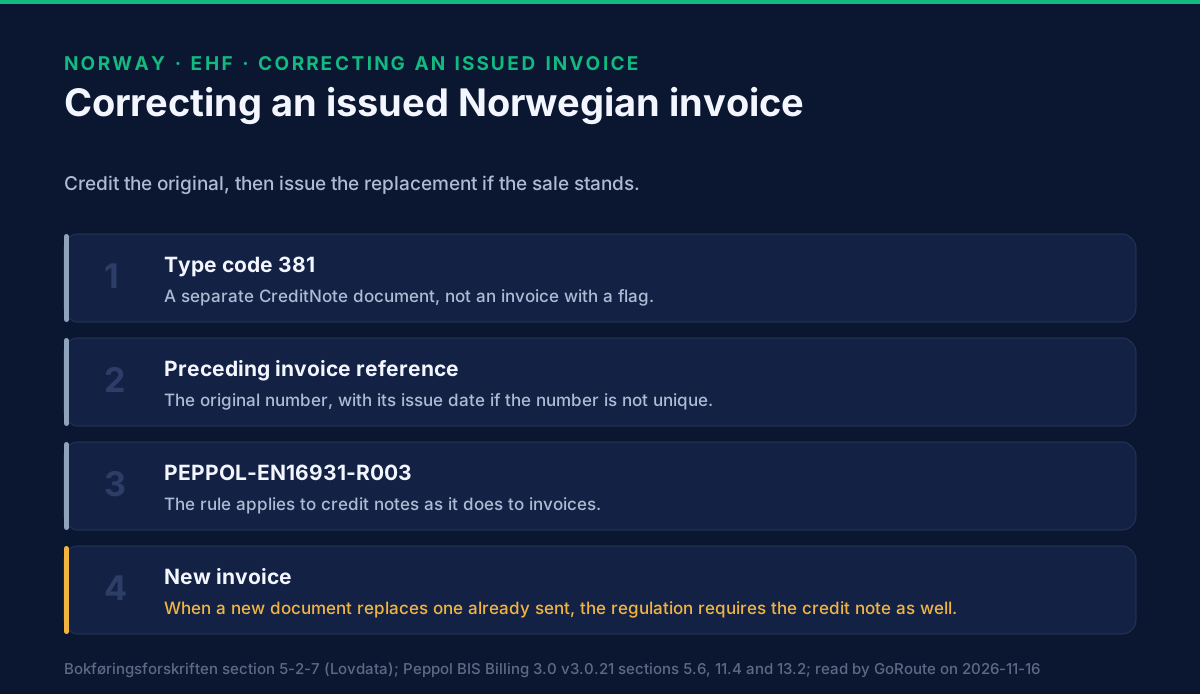
An issued Norwegian invoice is corrected with an EHF credit note: a separate document, type code 381, that names the invoice it reverses. If you then issue a new invoice in its place, the Bookkeeping Regulation says you must also issue the credit note, not just the replacement. This page covers when that applies, what the credit note must carry, and where the line is between what we can tell you and what belongs to your accountant.
When is a credit note required?
When a new sales document replaces one that has already gone out. Section 5-2-7 of the Bookkeeping Regulation (Bokføringsforskriften, FOR-2004-12-01-1558) is short: Når det utstedes nytt salgsdokument til erstatning for allerede avsendt salgsdokument, skal det også utstedes en kreditnota som reverserer opprinnelig salgsdokument. In English: when a new sales document is issued in replacement of one already sent, a credit note reversing the original must also be issued.
Two things follow. You do not edit and resend an invoice, and you do not simply send a second invoice and hope the buyer works it out. The original stays in the books, the credit note cancels it, and the replacement stands on its own.
What the regulation does not say is just as relevant. It does not address a correction that is not a replacement, such as a discount granted after the invoice, a return of part of the goods or a price adjustment on one line. Those are commonly handled by a credit note too, and nothing we read prevents it, but we cannot point you to a rule that requires it, so we do not claim one exists.
What is the document type code for an EHF credit note?
It is 381. In the UBL credit note the code sits in cbc:CreditNoteTypeCode, the field Peppol calls BT-3. The Peppol rule PEPPOL-EN16931-P0101 limits the values for the standard billing profile to 381, 396, 81, 83 and 532, and rule BR-04 requires the code to be present. For an ordinary credit note use 381. An invoice uses 380 in cbc:InvoiceTypeCode.
The credit note is its own UBL document, CreditNote-2, not an invoice with a flag. Its lines are cac:CreditNoteLine and the quantity element is cbc:CreditedQuantity. It carries the same specification identifier as the invoice, urn:cen.eu:en16931:2017#compliant#urn:fdc:peppol.eu:2017:poacc:billing:3.0, and the same business process identifier, urn:fdc:peppol.eu:2017:poacc:billing:01:1.0, so the same Norwegian rules apply. DFØ's specification says so directly: EHF Fakturering 3.0 covers "invoice and credit note".
What must the credit note reference?
The original invoice, if you want the buyer's system to match the two. Peppol's section on preceding invoice references describes the structure: a cac:BillingReference containing a cac:InvoiceDocumentReference, which holds the original invoice number and, where the number is not unique, its issue date.
<cac:BillingReference>
  <cac:InvoiceDocumentReference>
    <cbc:ID>123</cbc:ID>
    <cbc:IssueDate>2026-10-20</cbc:IssueDate>
  </cac:InvoiceDocumentReference>
</cac:BillingReference>
The group is optional in the specification, but the identifier inside it is mandatory once the group is present. Repeat the group to credit several invoices. If one correction covers a large number of invoices, the specification allows an invoicing period at document level, combined if needed with a note, instead of listing each one.
Two other references behave as they do on an invoice:
- A buyer reference or an order reference is required. Rule
PEPPOL-EN16931-R003applies to credit notes as well as invoices, and a public buyer will use the reference to route the credit. Invoicing Norwegian public bodies in EHF sets out what DFØ asks for. - The Norwegian seller rules apply.
NO-R-001still requires the seller's VAT number asNO, nine digits andMVA, and DFØ notes that most Norwegian invoices and credit notes need the word Foretaksregisteret underNO-R-002.
Full credit, partial credit or negative invoice?
A full credit reverses everything. The credit note repeats every line of the original with the same quantities and prices, and the amounts are positive. It is the document the Bookkeeping Regulation asks for when a replacement follows. A partial credit lists only the lines or quantities being reversed.
In the ordinary case the amounts on a credit note are written as positive numbers, and the document type makes them a reduction. Rule BR-27 requires the item net price not to be negative, so a negative unit price fails validation.
The third route is a negative invoice: an ordinary invoice with a negative total. Peppol BIS Billing 3.0 allows it, noting that some user communities prefer it, and it says invoice-receiving systems have to support both. For Norway, though, DFØ's instruction to suppliers of state bodies is to send "faktura og kreditnota" electronically, and the regulation's wording is credit note. Use the credit note unless a buyer tells you otherwise in writing.
What do you check before sending it?
The same things as for an invoice, and one more.
- Validate it. The credit note goes through the same official validator and the same rules. How to check an EHF invoice before sending it covers the specification to choose and how to read the result.
- Check the VAT categories match the original. A credit note that reverses a 15% line must carry the same category and rate. The category is
Swith the rate in the percentage field, as set out on the VAT codes page. - Check the buyer can receive it. The buyer must be reachable for the document you send. How a Norwegian business becomes reachable for EHF invoices explains how to check.
- Send it before the replacement, or at the same time, so the buyer's ledger never holds two live invoices for one supply. The regulation requires both documents; it does not set the order, so this is advice rather than a rule.
What this page does not cover
VAT return corrections. How a credit note feeds the VAT return is a tax matter for your accountant. Reminders and other billing documents. The EHF reminder, forward billing and payment request are covered in the three Norwegian billing documents Peppol does not have. Time limits. We found no deadline for issuing a credit note in the sections we read, and we do not state one.
What to do next
Decide in your ERP whether a correction is a full credit followed by a new invoice or a partial credit, and make sure it generates a credit note with the preceding invoice reference filled in. If you are building that, the credit note fields are in the developer documentation, and the Norway page lists the country rules we apply. Recorded walkthroughs of the ERP connectors are on tutorials. If you would like someone to look at how your system produces credit notes, book a session.
Next read: invoicing a Norwegian company from abroad, if your seller is outside Norway and the buyer is not on Peppol.
Sources: Bokføringsforskriften (FOR-2004-12-01-1558), section 5-2-7, Kreditnota, on Lovdata, read 16 November 2026; OpenPeppol, Peppol BIS Billing 3.0 version 3.0.21, sections 5.6, 11.4 and 13.2 and rules BR-04, BR-27, PEPPOL-EN16931-P0101 and PEPPOL-EN16931-R003, and the UBL credit note syntax pages; DFØ, EHF Billing 3.0, usage in Norway, version 3.0.3, for the invoice and credit note scope and NO-R-002; DFØ, Send faktura til en kunde av DFØ, updated 4 October 2024. Last reviewed 2026-11-16.
Frequently asked questions
- Do I have to issue a credit note to correct a Norwegian invoice?
- If you issue a new sales document to replace one you have already sent, yes. Section 5-2-7 of the Bookkeeping Regulation says that a credit note reversing the original must also be issued. The regulation does not say what to do about a correction that does not replace a document, and this page does not try to answer that.
- Which document type code does an EHF credit note use?
- 381 in the credit note type code field. The Peppol rules for the standard billing profile accept 381, 396, 81, 83 and 532, and 381 is the one for an ordinary credit note. An invoice uses 380 in its own field.
- What must an EHF credit note reference?
- The invoice it corrects. Peppol's preceding invoice reference group carries the original invoice number and, if that number is not unique, its issue date. The reference is optional in the specification, but without it the buyer's system has nothing to match the credit to. It also needs a buyer reference or an order reference, exactly like an invoice.
- Can I send a negative invoice instead of a credit note?
- The Peppol specification allows it, and says receiving systems must support both. For a Norwegian public buyer the guidance is to send credit notes: DFØ asks suppliers to send invoices and credit notes electronically. We recommend the credit note, since Norwegian bookkeeping language is written around it.
- Does the credit note fix my VAT return?
- That is a tax question and outside this page. The credit note is the document that corrects the invoice. How the correction is reported for VAT is for your accountant and the Norwegian Tax Administration.
About Dr. Syed Raza
Dr. Syed Raza is an IT Enterprise Architect at ClayDesk LLC and leads the GoRoute platform. He works across Peppol Access Point and SMP infrastructure, PINT jurisdictions (Oman, AU/NZ, EU, JP, MY, SG), and national CTC regimes, translating regulatory detail into production-grade e-invoicing systems.
Building on Peppol?
GoRoute is a certified Peppol Access Point & SMP. Book a demo or read the docs to get started.