
Which VAT Category Code Carries Each Norwegian Rate in an EHF Invoice
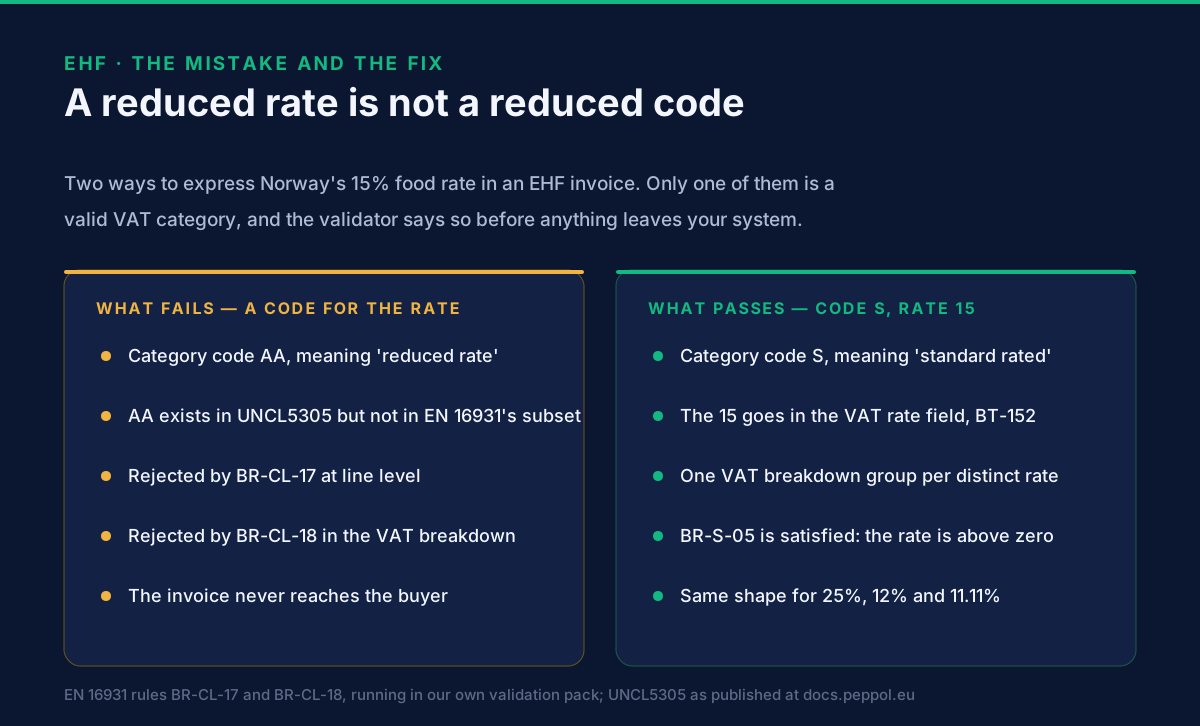
Norway's 25%, 15%, 12% and 11.11% rates all carry one VAT category code: S. The rate belongs in the percentage field, and inventing a code fails BR-CL-17.

All four of Norway's positive VAT rates — 25%, 15%, 12% and 11.11% — are carried by the
same VAT category code, S. The reduced rates are not separate codes. The code says how a
supply is treated for VAT; the rate field says how much. An EHF invoice that puts "reduced"
into the category code instead of putting the number into the rate fails validation with
BR-CL-17, and never reaches the buyer.
We know this precisely because we got it wrong. Our own renderer mapped a reduced rate to the
code AA, and the official EHF validator rejected it on 16 September 2026. This page sets out
the full code set Norway uses, what each one requires, and how to read a rejection report so
the next one takes a minute rather than an afternoon.
Which VAT category code carries each Norwegian rate?
Code S carries every rate above zero. The zero and no-tax treatments each have their own code.
| Code | Rate | What it means |
|---|---|---|
S |
25% | Standard rate |
S |
15% | Reduced — food and drink |
S |
12% | Reduced — passenger transport, accommodation, cinema |
S |
11.11% | Reduced — raw fish |
E |
0% | Exempt from VAT |
Z |
0% | Zero-rated |
AE |
0% | Reverse charge |
G |
0% | Free export item, VAT not charged |
K |
0% | Intra-community supply within the EEA |
O |
none | Outside the scope of VAT — no rate element at all |
The Norwegian Tax Administration publishes 25%, 15% and 12% as the general rates. The 11.11% raw-fish rate is a sector rate that does not appear on that general page; it appears in the EHF guidance, and we validated an invoice at each of the four rates against the official validator on 16 September 2026.
Two points of care for anyone building this. First, Z and E both produce zero tax and are
not interchangeable — exemption and zero-rating are different treatments in the Norwegian VAT
Act, and the reason text you must supply differs accordingly. Second, K is not emission
allowances: in EN 16931 it is the intra-community supply within the EEA, used at 0% with the
exemption reason VATEX-EU-IC. Export outside the EEA is G.
Why are the reduced rates not separate codes?
Because the category code classifies the treatment, and the standard deliberately keeps the amount out of it.
EN 16931 — the European semantic standard that EHF and Peppol BIS Billing 3.0 both implement —
takes a subset of the United Nations code list
UNCL5305 and permits exactly ten
values: AE, B, E, G, K, L, M, O, S and Z. None of them means "reduced". A
reduced rate is a standard-rated supply at a lower percentage, so it is S with a smaller number
in the rate field.
You can see the design in the rules themselves. BR-S-08 reads: "For each different value of
VAT category rate (BT-119) where the VAT category code (BT-118) is 'Standard rated', the VAT
category taxable amount (BT-116) in a VAT breakdown (BG-23) shall equal the sum of Invoice line
net amounts…" The rule is written on the explicit assumption that one invoice can carry several
different rates under S, each with its own VAT breakdown group. That is the mechanism that
makes a Norwegian invoice with 25% consultancy and 15% catering on it perfectly ordinary.
The practical consequence for an integration is a mapping decision, not a code hunt. Your ERP almost certainly has a tax code per rate; those codes map to the pair (category, percentage), and for everything Norway charges VAT on the category half of that pair is the same letter.
What does a BR-CL-17 error actually mean?
That the category code you sent is not in the permitted ten.
The rule's own text is short: "Invoice tax categories MUST be coded using UNCL5305 code list",
and the test behind it checks membership of the set AE L M E S Z G O K B. BR-CL-18 is the
identical check applied to the VAT breakdown rather than the invoice line, which is why the two
usually appear together — a bad code on a line produces a bad code in the breakdown that
summarises it.
The error message is unhelpfully generic, so the useful reflex is to look at the code you sent rather than at the rule. In our experience three causes account for nearly all of them:
- A code invented for a rate.
AAfor "reduced",Hfor "lower rate", or a two-letter code from a national tax table.AAis the most dangerous of these because it is a genuine UNCL5305 entry and therefore looks right in a code-list lookup; it is simply not in the EN 16931 subset. - A tax code copied from the accounting system. ERP tax codes are internal identifiers, not
UNCL5305 values, and a direct pass-through sends something like
MVA25into a field expecting one letter. - Case and whitespace. The test normalises space but not case, so a lower-case
sis not the codeS.
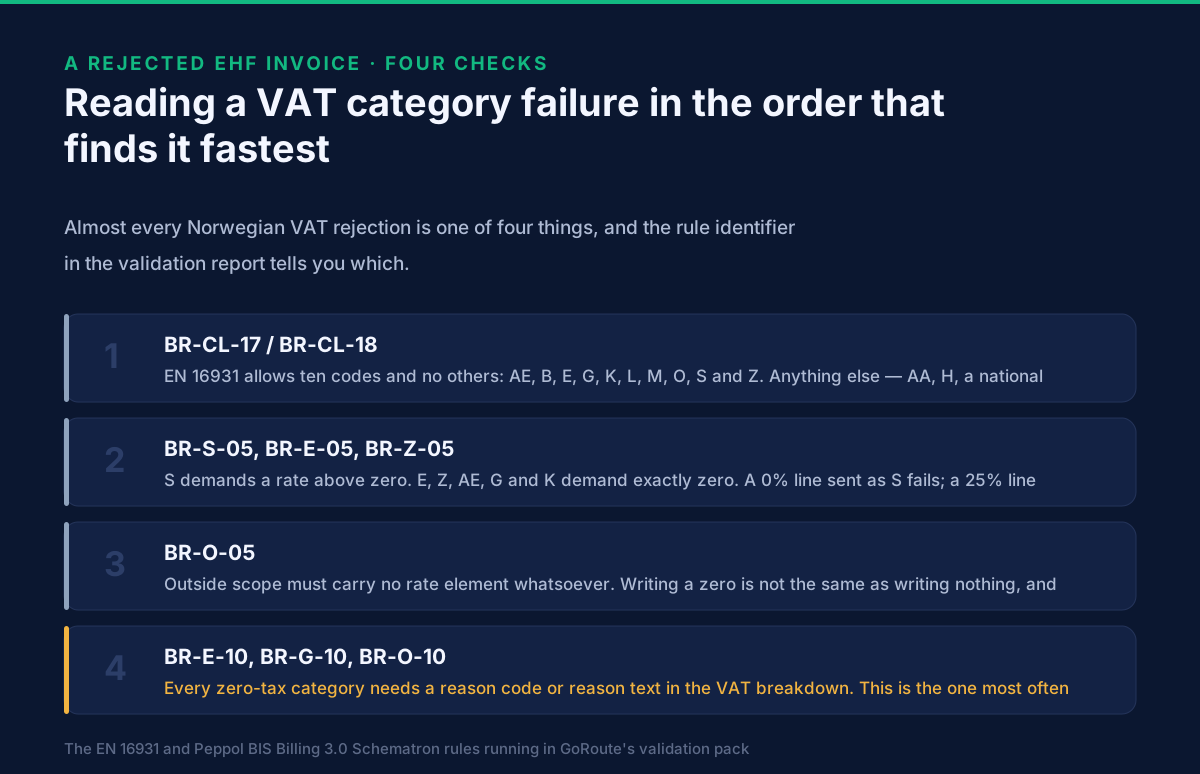
Which rate does each code require, and what fails?
The rate is not free. Each category pins it.
Srequires a rate greater than zero —BR-S-05at line level,BR-S-06for a document-level allowance. A 0% line sent asSfails, which is the mirror image of the reduced-rate mistake.E,Z,AE,GandKrequire a rate of exactly zero —BR-E-05,BR-Z-05,BR-AE-05,BR-G-05andBR-IC-05all testPercent = 0. An absent rate fails these as surely as a wrong one, because "nothing" is not "zero" to the test.Orequires no rate element at all —BR-O-05testsnot(cbc:Percent). This is the one that catches careful implementers out, because writing0looks like the safe thing to do and is precisely what the rule forbids.
This last one was our own defect. Until 16 September 2026 our renderer wrote a zero rate on
outside-scope lines; it now writes no rate element for category O, and the invoice passes.
Then there is the reason text, which is a separate failure from the code and the rate. A VAT
breakdown using E, G, K or O must carry a VAT exemption reason code or reason text —
BR-E-10, BR-G-10 and BR-O-10 each require one. Category K carries more than that: both
parties' VAT identifiers (BR-IC-02), a delivery date or invoicing period (BR-IC-11), and a
deliver-to country (BR-IC-12).
Is any of this specific to Norway?
The codes are not. The rates are, and so is one identifier rule.
EHF Billing 3.0 is Peppol BIS Billing 3.0 with Norwegian rules layered on, and the VAT category list comes from the European layer rather than the Norwegian one. So the same ten codes apply in Belgium, Germany and the Netherlands; only the rates and the national rules change. That is worth knowing because it means a correct European mapping is already most of a correct Norwegian one.
What is Norwegian is the seller's tax identifier. Rule NO-R-001 requires it in the form NO +
nine-digit organisation number + MVA — NO123456789MVA — and it is fatal, not a warning. A
limited company is additionally expected to state Foretaksregisteret under NO-R-002. These
national rules sit inside the Peppol rulebook rather than beside it: section 6 of the
Norway Peppol Authority Specific Requirements,
which OpenPeppol approved on 17 September 2025, points implementers at DFØ's local
specifications for exactly this layer. Neither
of these is a routing value: the Peppol address is the bare nine digits under scheme 0192, and
how a Norwegian business becomes reachable for EHF invoices
explains why the two are different things and who publishes which.
What is still unsettled
We cannot show you a Norwegian production invoice. Norwegian delivery went live for us on 16 September 2026 and we have carried no Norwegian production traffic since. Everything on this page is from the official rule packs and from our own validated test invoices, and we would rather say that than imply volume we do not have.
Category K is not in our public API's Norwegian guidance yet. The renderer supports it and
maps the canonical value intra_community to K with the intra-community rules applied, but our
internal Norway requirements file describes K as emission allowances, which is wrong. That file
is being corrected; this page is the accurate version.
The 2027 B2B mandate changes none of this. In March 2026 the Norwegian government moved mandatory B2B e-invoicing from 2028 to 1 January 2027 and put the bill before the Storting. Until Parliament passes it that is a government proposal, and nothing published so far touches the VAT category rules. We read their status as unchanged rather than as confirmed — that is inference, marked as inference.
What this page does not cover
Which rate applies to a supply. That is a tax question for your accountant and the Norwegian VAT Act, not an invoicing-format question. This page is about expressing a rate you have already determined.
Registration and identifiers. Who publishes a Norwegian participant, why a private company files nothing with ELMA, and which of the numbers on a Norwegian letterhead is the Peppol address are all in how a Norwegian business becomes reachable for EHF invoices.
The EHF documents beyond the invoice. Reminder, Forward Billing and Payment Request each have their own rules and their own registration, and they are covered in the three Norwegian billing documents Peppol does not have. The reminder fee, incidentally, carries a VAT category of its own as a document-level charge, so everything on this page applies there too.
Payment details. The KID reference and the IBAN-versus-BBAN question are the next page in this set, not this one.
What to do next
Map your ERP tax codes to the pair, not to a code. Write out every tax code your system uses, and against each one record the EN 16931 category letter and the percentage. If any row has a letter outside the permitted ten, you have found a rejection before it happened.
If you are building the integration, the category field, the rate field and the validation
responses are documented in the developer documentation, and the
country rules we apply for Norway — EHF, scheme 0192, the register check and these VAT
categories — are set out on our Norway page. Recorded walkthroughs of the ERP
connectors are on tutorials. The other avoidable rejections, across countries,
are in invoice validation errors you can prevent.
If you would rather have somebody sit with your tax-code table and map it with you,
book a session.
Next read: the three Norwegian billing documents Peppol does not have, which covers the EHF documents that sit outside Peppol BIS Billing entirely.
Sources: the EN 16931 and Peppol BIS Billing 3.0 Schematron rules running in GoRoute's own
validation pack for the texts of BR-CL-17, BR-CL-18, BR-S-05, BR-S-06, BR-S-08,
BR-E-05, BR-E-10, BR-Z-05, BR-AE-05, BR-G-05, BR-G-10, BR-IC-05, BR-O-05,
BR-O-09 and BR-O-10, read 4 October 2026;
UNCL5305 as published by OpenPeppol
for the permitted category set, and
the Peppol BIS Billing 3.0 rule list
for the rule identifiers; the
Norway PA Specific Requirements
(OpenPeppol, approved 17 September 2025), section 6, for the national specification layer;
anskaffelser.dev,
DFØ's specification site, for EHF Billing 3.0 and its usage in Norway, including the four rates
carried by category S; the
Norwegian Tax Administration's VAT rate page
for the 25%, 15% and 12% general rates, read 4 October 2026. GoRoute's own release record is the
source for the renderer correction of 16 September 2026 and for the four rates validated against
the official EHF validator the same day. The 1 January 2027 B2B date is the Norwegian government's
March 2026 announcement, with the legislative proposal before the Storting. Last reviewed
2026-10-04.
Frequently asked questions
- Which VAT category code do I use for Norway's 15% rate?
- Code S, with 15 in the VAT rate field. All four of Norway's positive rates — 25%, 15%, 12% and 11.11% — use the same category code S. The code says how the supply is treated for VAT; the rate says how much. There is no separate category code for a reduced rate in EN 16931, and inventing one fails validation.
- What does a BR-CL-17 error mean?
- It means the VAT category code on an invoice line is not in the list EN 16931 permits. The rule text is 'Invoice tax categories MUST be coded using UNCL5305 code list', and the permitted set is AE, B, E, G, K, L, M, O, S and Z. BR-CL-18 is the same rule applied to the VAT breakdown rather than the line. The commonest cause is a system that maps the words 'reduced rate' to a code of its own.
- Why is AA rejected when it is a real UNCL5305 code?
- Because EN 16931 uses a subset of UNCL5305, not the whole list. AA exists in the wider United Nations code list, but the European standard narrowed the permitted categories to ten, and Peppol BIS Billing 3.0 enforces that narrowing through BR-CL-17 and BR-CL-18. A code that is valid in the parent list and absent from the subset is rejected exactly like an invented one.
- Is the 11.11% raw fish rate really carried as category S?
- Yes. The EHF Billing 3.0 guidance for Norway lists 11.11% alongside 25%, 15% and 12% as rates carried by category S, and we validated an invoice at each of those four rates against the official EHF validator on 16 September 2026. The rate is unusual; the way it is expressed is not.
- How do I show a VAT-exempt Norwegian supply?
- With category E and a rate of exactly zero, plus an exemption reason. Rule BR-E-05 requires the rate to be zero, and BR-E-10 requires either a VAT exemption reason code or reason text in the VAT breakdown. Category Z is for zero-rated supplies under chapter 6 of the Norwegian VAT Act, which is a different treatment from exemption, and it carries its own reason requirement.
- What is different about category O?
- Category O, services outside the scope of VAT, must carry no VAT rate element at all. Rule BR-O-05 tests for the absence of the rate, so writing a zero fails where omitting the element passes. The VAT breakdown must also carry a reason under BR-O-10 and a tax amount of zero under BR-O-09. We were writing a zero rate on category O lines until 16 September 2026, when we stopped.
- Does code K mean emission allowances?
- No. In EN 16931, K is 'VAT exempt for EEA intra-community supply of goods and services'. It is used at a 0% rate with the exemption reason VATEX-EU-IC, and it brings extra requirements: both parties' VAT identifiers, a delivery date or invoicing period, and a deliver-to country. Free export outside the EEA is G, not K. Our own Norway requirements file described K as emission allowances, which is wrong, and that file is being corrected.
About Dr. Syed Raza
Dr. Syed Raza is an IT Enterprise Architect at ClayDesk LLC and leads the GoRoute platform. He works across Peppol Access Point and SMP infrastructure, PINT jurisdictions (Oman, AU/NZ, EU, JP, MY, SG), and national CTC regimes, translating regulatory detail into production-grade e-invoicing systems.
Building on Peppol?
GoRoute is a certified Peppol Access Point & SMP. Book a demo or read the docs to get started.