
How a Norwegian Business Becomes Reachable for EHF Invoices
A private Norwegian company does not register in ELMA. That registry is for public bodies; everyone else is published in a provider's SMP under scheme 0192.

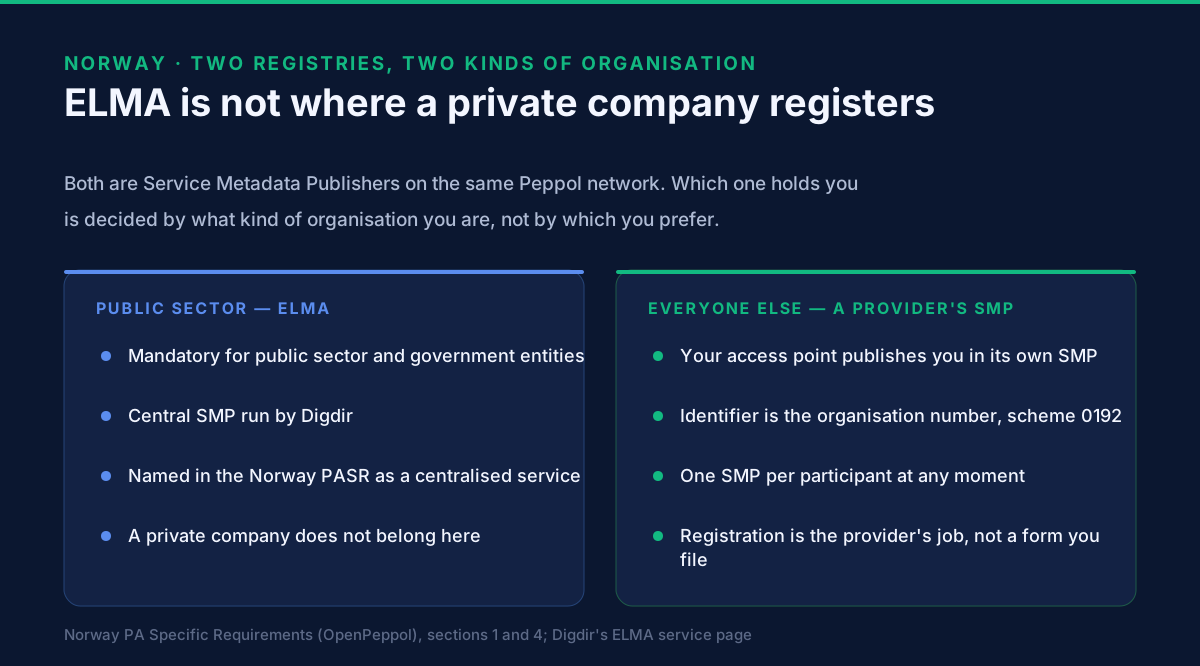
A private Norwegian company does not register itself in ELMA. ELMA is the central registry for the public sector, and the Norway Peppol Authority Specific Requirements say so directly: entities defined as public sector or government entities must be registered in the central SMP-service ELMA, hosted by Digdir. Everyone else becomes reachable a different way — a Peppol service provider publishes the company in its own Service Metadata Publisher, using the nine-digit organisation number under Peppol scheme 0192.
That distinction is the whole answer, and it is the one most often got wrong. This page sets out what ELMA is, where a private company is registered instead, what your provider is obliged to check first, and what to do when somebody else already holds your registration.
Do you register in ELMA to receive EHF invoices?
No, unless you are a public body.
Section 4 of the Norway PA Specific Requirements is headed Mandatory use of centralised services, and it applies the requirement to one group: entities defined as public sector or government entities. They must be in ELMA, which Digdir hosts. The requirement is written as an obligation on those entities, not as a route open to everyone.
For a private Norwegian company the practical consequence is straightforward. You do not file anything, with Digdir or with anybody else. You appoint a service provider, and that provider publishes you. If you search for a registration form and cannot find one, that is because there is not one to find.
We apply this as a hard rule rather than a guideline: GoRoute's SMP refuses a Norwegian organisation whose register entry marks it as a public body, sector code 6100 or 6500, and names ELMA as the place it belongs.
What is ELMA, exactly?
A Service Metadata Publisher — one of many on the Peppol network, run by the state.
This is worth being precise about, because "central registry" invites the wrong mental model. ELMA is not a gateway that invoices travel through, and it is not a national clearance system of the kind Italy or Oman operates. It is an address book. A sender's access point asks the Peppol lookup where a participant lives, and receives an endpoint and a list of accepted documents. Whether that answer came from ELMA or from a commercial provider's SMP makes no difference to how the invoice travels: it goes access point to access point, over AS4, in both cases.
If the four-corner shape is new to you, how do you join the Peppol network explains the participant identifier, the SMP and the SML in one place, and who registers you on Peppol covers the division of labour between you and your provider in general terms. This page is the Norwegian specialisation of both.
Where does a private Norwegian company get registered instead?
In its own access point's SMP, under the organisation number.
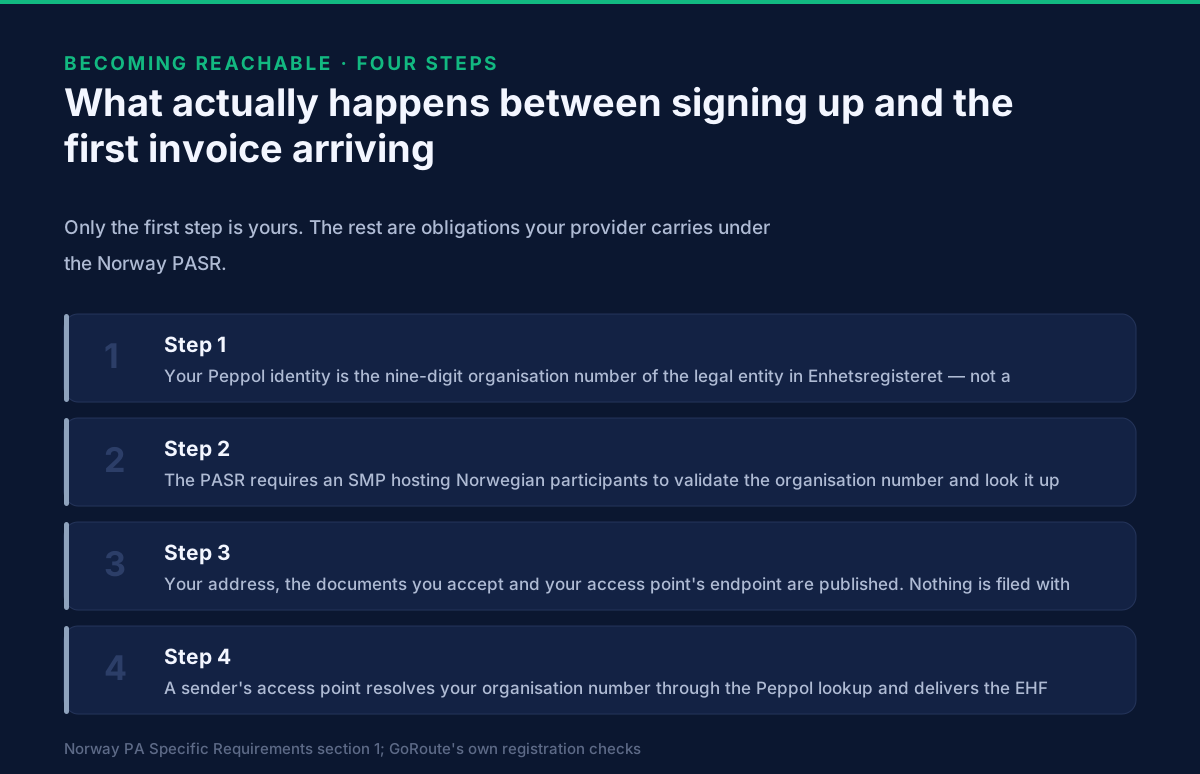
Three things about that sequence surprise people who have run a national e-invoicing registration elsewhere.
There is no national approval step. Norway accredits no service providers — section 7 of the PASR sets Service Provider Accreditation to No. A provider certified under any Peppol Authority may serve Norwegian businesses. DFØ, the Norwegian Agency for Public and Financial Management, confirmed this to us directly on 25 March 2026 (case 2698404): a provider that has already signed with Peppol as a Peppol Authority does not need to sign with a Norwegian authority to operate in the Norwegian market through the Peppol network.
Registration is an obligation on the provider, not a service it offers. The PASR requires an SMP hosting Norwegian participants to validate the organisation number, look it up, and keep routines in place for data quality — including removing entries for entities that have been deleted from the central register. A provider that publishes whatever number you type in is not meeting the Norwegian requirement.
Only receiving needs registration. Sending an EHF invoice to a Norwegian buyer needs nothing from you beyond a certified access point. The registration question only arises for invoices coming in.
Which identifier does Norway use, and why not the VAT number?
The organisation number from Enhetsregisteret, as Peppol scheme 0192.
Section 1 of the PASR allows exactly one identifier for Norwegian organisations: the organisation number issued to the legal entity by the Central Coordinating Register for Legal Entities, Enhetsregisteret at Brønnøysundregistrene. It also requires that Norwegian end users be legal entities in that register, verified by looking the number up.
Three consequences follow, and each of them has cost somebody a failed delivery:
- The Norwegian VAT number is not a Peppol identifier.
NO123456789MVAbelongs in the invoice's tax fields. The routing identifier is the bare nine digits under0192. - The older
9908scheme is deprecated. Our API refuses9908and9909for Norwegian participants outright, because the PASR permits only0192. - A sub-unit is not the invoicing party. Enhetsregisteret holds both legal entities and their sub-units (underenheter), and both have nine-digit numbers that look identical. The sub-unit number will resolve to nothing on Peppol. Where our register check finds one, it refuses the registration and names the legal entity to use instead.
If you are unsure which number on a Norwegian company's letterhead is the right one, which Peppol identifier is yours walks through the same question across the schemes we see most often.
Can two providers register the same company?
No — a participant is held by one SMP at a time.
This is a property of the network rather than a Norwegian rule, and it is the single most common reason a switch of provider stalls. Before publishing a Norwegian company, our SMP checks whether another SMP already holds it, and where one does, it refuses the registration and names the provider rather than failing silently. To move, your current provider removes its registration; the new one then publishes you.
Norway makes this more visible than most markets simply because coverage is so high. B2G invoicing has been electronic since 2012 and Norway has the highest Peppol participation of any country, so a Norwegian business asking to be registered has often been registered before — sometimes years ago, through an accounting system nobody currently uses.
What about a company that is not Norwegian?
It needs an entry in Enhetsregisteret, or it has no Norwegian Peppol identity at all.
A Norwegian-registered foreign enterprise — a NUF, norskregistrert utenlandsk foretak — holds an ordinary nine-digit organisation number and registers exactly like a Norwegian company. This is not a rare edge case: the register's own open API returned 25,821 NUF entries when we queried it on 24 September 2026.
A foreign business with no Norwegian registration is in a different position. It can still send EHF invoices to Norwegian buyers through a certified access point, because sending needs no Norwegian identity. What it cannot do is be published as a Norwegian participant, because section 1 of the PASR requires the identifier to come from Enhetsregisteret. Whether such a business will be drawn into Norway's announced B2B mandate is a scope question rather than a registration one, and our Norway page covers it.
What is still unsettled
The B2B mandate is an announcement, not law. In March 2026 the Norwegian government accelerated mandatory B2B e-invoicing from 2028 to 1 January 2027, and the legislative proposal went to the Storting. Until Parliament has passed it, the date is a government proposal and this page treats it as one. Registration, by contrast, is settled: the PASR was approved on 17 September 2025 and nothing in it depends on the bill.
Registration does not change on 1 January 2027 as far as anyone has announced. The mandate is about issuing structured invoices; nothing published so far changes who publishes a participant or where. We are reading that as unchanged rather than as confirmed, and we will say so if the final text says otherwise.
What this page does not cover
Who falls inside the 2027 mandate. That is the hub's question, and it is answered on our Norway page rather than split across two pages.
The EHF documents beyond the invoice. Norway has billing documents with no Peppol BIS Billing equivalent — Reminder, Forward Billing and Payment Request — and each needs its own opt-in in your SMP entry. That is a document-level topic, and it is the next article in this set.
Norwegian VAT treatment. Which rate applies to a supply is a tax question. The category codes that carry those rates in an EHF file are a separate matter and are summarised on our Norway page.
What to do next
Find out whether you are already registered, before you do anything else. It takes a lookup, and it decides whether your next step is a registration or a migration.
If you want to be reachable for EHF invoices, GoRoute's SMP registration publishes your organisation number under scheme 0192, runs the Enhetsregisteret check the Norwegian requirements demand, and tells you plainly when another provider holds you. The country rules we apply — EHF, scheme 0192, the register check, the VAT categories — are set out on our Norway page. The lookup, registration and delivery endpoints are in the developer documentation, and recorded walkthroughs of the ERP connectors are on tutorials. If you would rather have somebody map your entities and their organisation numbers with you, book a session.
Next read: who registers you on Peppol, which covers the same division of labour without the Norwegian specifics.
Sources: the Norway PA Specific Requirements (OpenPeppol, approved 17 September 2025) for the ELMA obligation on public sector entities (section 4), the organisation number as the only allowed identifier and the SMP validation and data-quality duties (section 1), and the absence of service provider accreditation (section 7); Digdir for ELMA itself; Brønnøysundregistrene and its open API for Enhetsregisteret and the NUF count, queried 24 September 2026; anskaffelser.dev, DFØ's specification site, for EHF; and DFØ's reply of 25 March 2026, case 2698404, for the absence of a Norwegian service-provider agreement. The 1 January 2027 date is the Norwegian government's March 2026 announcement, with the legislative proposal before the Storting. Last reviewed 2026-09-24.
Frequently asked questions
- Do I have to register my company in ELMA to receive EHF invoices?
- Only if you are a public sector or government entity. The Norway Peppol Authority Specific Requirements make registration in ELMA, the central SMP run by Digdir, mandatory for public sector and government entities. Every other Norwegian organisation is published in its own service provider's Service Metadata Publisher instead, under the organisation number as Peppol scheme 0192. There is no form for a private company to file.
- What is ELMA?
- ELMA — Elektronisk mottakerregister — is Norway's central Service Metadata Publisher, operated by the Norwegian Digitalisation Agency, Digdir. It is one SMP among many on the Peppol network rather than a national gateway that invoices pass through. A sender's access point looks up a recipient the same way whether the answer comes from ELMA or from a commercial provider's SMP.
- Which identifier does a Norwegian company use on Peppol?
- The nine-digit organisation number issued by Enhetsregisteret, the Central Coordinating Register for Legal Entities at Brønnøysundregistrene, under Peppol identifier scheme 0192. The PASR allows only that identifier for Norwegian organisations. The older 9908 scheme is deprecated, and a Norwegian VAT number is not a Peppol identifier.
- Can two providers register the same Norwegian company?
- No. A participant is held by one SMP at a time. If you want to receive through a new provider, your current provider removes its registration first and the new one publishes you. Sending an invoice to a Norwegian company requires none of this — only receiving does.
- Does a foreign company with a Norwegian entity register the same way?
- If it has an organisation number in Enhetsregisteret, yes. There were 25,821 Norwegian-registered foreign enterprises (NUF) in that register when we queried its open API on 24 September 2026, each with an ordinary nine-digit organisation number, which is the Peppol identity. A foreign business with no entry in Enhetsregisteret has no Norwegian Peppol identity to register.
- How long does registration take?
- The register lookup is immediate. The delay a business actually feels is elsewhere — deciding which legal entity is the invoicing party, and removing an old registration when one exists. Where a company has never been on Peppol and the entity is clear, publication is a same-day step.
About Dr. Syed Raza
Dr. Syed Raza is an IT Enterprise Architect at ClayDesk LLC and leads the GoRoute platform. He works across Peppol Access Point and SMP infrastructure, PINT jurisdictions (Oman, AU/NZ, EU, JP, MY, SG), and national CTC regimes, translating regulatory detail into production-grade e-invoicing systems.
Building on Peppol?
GoRoute is a certified Peppol Access Point & SMP. Book a demo or read the docs to get started.