
Invoicing Norwegian Public Bodies in EHF: What a Supplier Must Send
A Norwegian public body must require EHF or Peppol BIS Billing in its contracts. What that means for a supplier: the 0192 address, the references and the PDF.

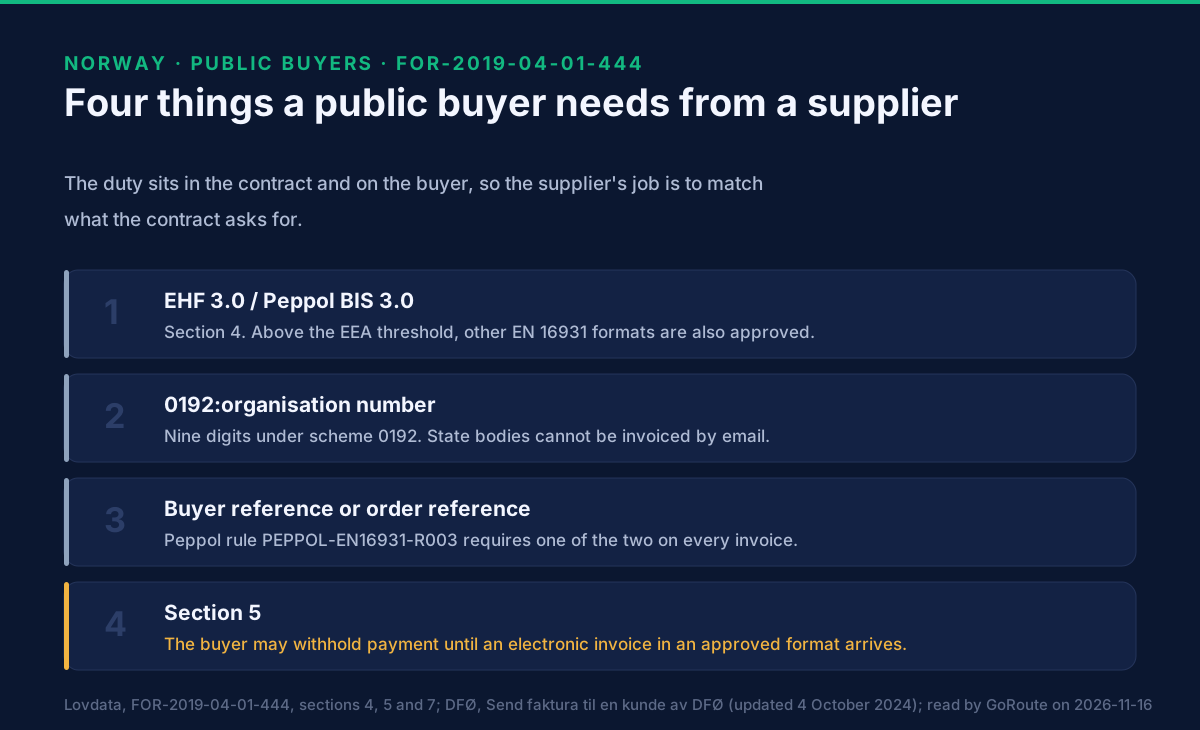
A Norwegian public body is required to ask its suppliers for electronic invoices, and it is required to be able to receive them over Peppol. The supplier's side of that is simple to state: send EHF Billing 3.0 or Peppol BIS Billing 3.0 to the buyer's nine-digit organisation number under scheme 0192, carry the buyer's reference on the invoice, and do not send a PDF by email. The legal duty sits in the contract and on the buyer, not on you directly, and that detail changes what happens when you get it wrong.
This page sets out what the regulation says, what a state buyer's invoice-receipt service asks for in practice, and where a foreign supplier usually goes wrong. It is about getting paid by a public body. Procurement rules beyond invoicing, such as how to win the contract, are outside it.
What does the regulation actually require?
The regulation is FOR-2019-04-01-444, Forskrift om elektronisk faktura i offentlige anskaffelser, and it requires contracting authorities, not suppliers, to act. Three sections carry the weight.
- Section 5, first paragraph: the contracting authority "skal i sine kontrakter stille krav om bruk av elektronisk faktura i godkjent standardformat" — it must require electronic invoicing in an approved format in its contracts.
- Section 5, second paragraph: if the supplier does not comply, the buyer may withhold payment until an electronic invoice in an approved format is delivered. The buyer must tell the supplier without undue delay, and the original payment period then runs from the day a compliant invoice is delivered.
- Section 5, third paragraph: the buyer must be able to receive electronic invoices in the standard format through the Peppol network, and must process them electronically.
Section 4 lists the approved formats. For contracts under the EEA threshold they are EHF Billing version 3.0 or newer and Peppol BIS Billing v3.0 or newer. For contracts over the threshold the list adds other standard formats that implement EN 16931, the European norm for electronic invoices.
Section 7 gives the date and the limit. The regulation took effect on 2 April 2019 and applies to invoicing for procurements started after that day. A procurement counts as started when it is announced, or, if it is not announced, when the buyer sends out a request for interest or tenders. So a supplier on a framework agreement signed before April 2019 may find the contract says nothing about electronic invoicing. The buyer's own receipt systems may still require it, but that is a matter for the contract, not this regulation.
Section 6 allows an exception: where an invoice contains information under a statutory duty of confidentiality and there is a risk of disclosure, the electronic requirement may be set aside unless a satisfactory technical safeguard exists. That is an edge case and is for the buyer to invoke.
Our Norway page states the same date and cites the same regulation. This article starts where that one-line summary stops.
Which buyers are covered?
The regulation applies to invoicing under procurements covered by the Public Procurement Act, and to the contracting authorities listed in section 2, second paragraph, of that Act. In practice that means state bodies, county authorities, municipalities and the public bodies that buy under public procurement law.
We cannot give you a definitive list of every buyer, and this page does not try to. Whether a particular organisation is a contracting authority is a legal question about the Act. The practical test for a supplier is simpler: the contract or tender documents will say whether electronic invoicing is required, and the buyer's organisation number will either be in ELMA or not.
How does a supplier invoice a state body in practice?
Through an access point, and not by email. DFØ, the Norwegian Agency for Public and Financial Management, runs invoice receipt for many state bodies and publishes the rules for suppliers on its invoicing page, last updated 4 October 2024. It says:
- You cannot send an invoice by email. It must be an electronic invoice or paper by post.
- When new agreements are made, state bodies are to require suppliers to send invoices and credit notes electronically in EHF. Foreign suppliers are to use Peppol BIS.
- The electronic address is the buyer's organisation number. If you are unsure, look the buyer up in the ELMA register.
- There are three ways to produce an EHF invoice: from your own accounting system connected to an access point, through a service attached to an access point, or in a web-based invoice portal.
The paper route still exists, with a postal address in Trondheim, but DFØ's page treats it as the exception. If an invoice fails to load in the buyer's system, the supplier receives an email with the errors and what to fix, and sends the corrected invoice again.
What references does a public buyer need on the invoice?
At least one, and Peppol will not let the invoice through without it. Rule PEPPOL-EN16931-R003 is fatal: a buyer reference or purchase order reference MUST be provided. Without one the invoice fails validation before it leaves your system.
Which reference the buyer wants is a matter for that buyer. DFØ's guidance, written for the state bodies it serves, is specific:
| What you are asked for | Where it goes in the invoice | Example DFØ gives |
|---|---|---|
| The buyer's reference ("Deres ref" or order reference), given when the order was placed and returned on the invoice | Invoice/buyerReference |
1460ABCD, 3260TRKNU |
| The customer's order number, where there was no electronic order | Invoice/OrderReference/ID |
600000010 |
| For periodic invoices such as rent or electricity, the object identifier | the buyer reference field | a telephone number or meter ID |
| Your own order number | Invoice/AdditionalDocumentReference/ID |
— |
| A framework agreement number (optional) | Invoice/ContractDocumentReference/ID |
— |
Attachments to an invoice or credit note must be PDF, and embedded attachments must also be PDF. Treat this table as the rule for DFØ's customers and as a reasonable default for others. Another public body may use a different system and ask for different references, so take the reference from the purchase order or contract, and where the contract is silent, ask.
How do I find a public body's Peppol address?
By its organisation number. The Peppol address of a Norwegian organisation is its nine-digit organisation number under scheme 0192. DFØ gives the form some foreign portals need: 0192:999999999.
Look the number up in ELMA, the central register run by Digdir. DFØ's page describes it as the register of every business that can receive EHF. Our own reading, set out in how a Norwegian business becomes reachable for EHF invoices, is narrower: ELMA is where public bodies are listed, and a private company is published by its own provider instead. For a public buyer, ELMA is the right place to look. That article also explains which of the numbers on a Norwegian letterhead is the Peppol address.
If your buyer is a public body and is not in ELMA, that is worth knowing before the first invoice, not after. Ask the buyer which address they want used.
What happens to a PDF?
For a covered contract, the buyer may hold payment. Section 5 lets the contracting authority withhold payment until a compliant electronic invoice arrives, and the payment period restarts from that day. That is the commercial consequence, and it is the reason a late-payment dispute with a Norwegian public body often turns out to be a format problem.
We have not seen how every public buyer treats a PDF in practice, and we cannot tell you that any particular one will reject it. DFØ's published instruction is that email invoices are not accepted. Read your contract, assume the stricter reading, and send EHF.
A PDF can still go inside the invoice. Attachments, such as a timesheet or a specification, travel in the invoice as PDF. The invoice itself must be the structured file.
What should a supplier do next?
- Find the clause. Read the contract for the invoicing format, the buyer's reference and the payment term. DFØ's standard state agreements use a 30-day payment term, which the parties may vary.
- Look up the buyer in ELMA and record the organisation number under scheme
0192. - Put the reference where the buyer expects it, and check the other fields with the official validator before the first live invoice. How to check an EHF invoice before sending it walks through that.
- Know how a mistake is corrected. An issued invoice is corrected by a credit note, and DFØ asks for those electronically too. How an EHF credit note works covers the references and the bookkeeping rule.
- If you sell from outside Norway, invoicing a Norwegian company from abroad covers finding the buyer, the VAT wording and what to do when the buyer is not on Peppol.
GoRoute is a certified Peppol access point (POP000991) with a live EHF path for Norway, and the Norway page lists what we check before an invoice leaves. The developer documentation covers the fields and error codes, and recorded walkthroughs of the ERP connectors are on tutorials. If you would like someone to look at your first public-sector invoice with you, book a session.
Next read: how to check an EHF invoice before sending it, because the references above are the easy part and the validator is where the rest fails.
Sources: FOR-2019-04-01-444, Forskrift om elektronisk faktura i offentlige anskaffelser on Lovdata, sections 2 to 7, read 16 November 2026 (in force 2 April 2019, last amended by FOR-2020-10-16-2063); DFØ, Send faktura til en kunde av DFØ, updated 4 October 2024, read 16 November 2026, for the invoicing channels, the reference fields and the address form; OpenPeppol, Peppol BIS Billing 3.0 version 3.0.21, rule PEPPOL-EN16931-R003; DFØ, EHF Billing 3.0, usage in Norway, version 3.0.3, for the relation between EHF Billing 3.0 and Peppol BIS Billing 3.0. Last reviewed 2026-11-16.
Frequently asked questions
- Is it illegal to send a PDF invoice to a Norwegian public body?
- The regulation does not put a duty on the supplier directly. It puts the duty on the buyer: the contracting authority must require electronic invoices in an approved format in its contracts (section 5 of FOR-2019-04-01-444). If the supplier does not comply, the buyer may withhold payment until an electronic invoice in an approved format arrives. DFØ, which runs invoice receipt for many state bodies, says plainly that you cannot send an invoice by email.
- Which format does a Norwegian public buyer accept?
- EHF Billing 3.0 or newer, or Peppol BIS Billing 3.0 or newer. For contracts above the EEA threshold the regulation also admits other standard formats that implement the European norm EN 16931. EHF Billing 3.0 is Peppol BIS Billing 3.0 under its Norwegian name, so one invoice satisfies both.
- How do I find a public body's Peppol address?
- The address is the organisation number, nine digits, under scheme 0192. DFØ writes it as 0192:999999999 for suppliers whose portal wants the scheme in front. ELMA, the central register run by Digdir, is where public bodies are listed, and you can look the number up there if you are unsure.
- Which references does a public buyer expect on the invoice?
- Peppol requires a buyer reference or an order reference on every invoice (rule PEPPOL-EN16931-R003). DFØ asks its customers' suppliers to return the buyer's reference in the buyer reference field and, where there is no electronic order, the customer's order number in the order reference field. Other public buyers may ask for different references, so take the reference from the contract or purchase order.
- Does this page cover the 2027 B2B mandate?
- No. The public-sector duty and the B2B duty are separate rules. The B2B rules, including dates, are on our Norway page.
About Dr. Syed Raza
Dr. Syed Raza is an IT Enterprise Architect at ClayDesk LLC and leads the GoRoute platform. He works across Peppol Access Point and SMP infrastructure, PINT jurisdictions (Oman, AU/NZ, EU, JP, MY, SG), and national CTC regimes, translating regulatory detail into production-grade e-invoicing systems.
Building on Peppol?
GoRoute is a certified Peppol Access Point & SMP. Book a demo or read the docs to get started.