
Belgian VAT Exemption and Reverse-Charge Wording on an Invoice
The words a Belgian invoice must carry for reverse charge and exempt supplies, in French and Dutch, and the Peppol VAT category and exemption reason for each.

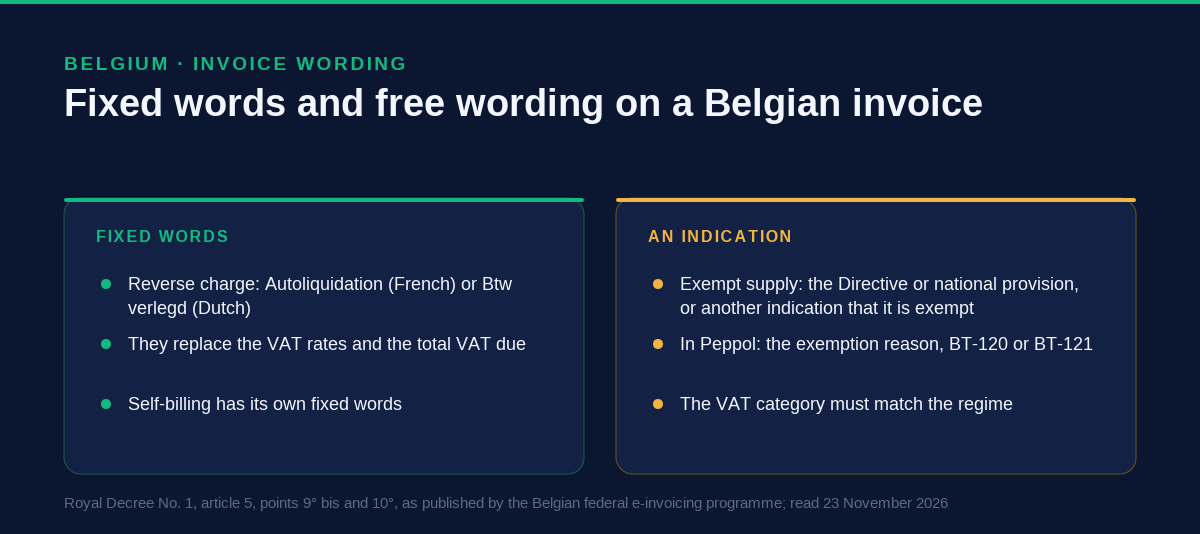
A Belgian invoice for a reverse-charge supply must carry the words "Autoliquidation" in French or "Btw verlegd" in Dutch, in place of the VAT rates and the total VAT due. An invoice for an exempt supply must give the provision of the VAT Directive or of Belgian law that exempts it, or any other indication that the supply is exempt. Both come from Article 5 of Royal Decree No. 1. In a Peppol invoice the words go in the exemption reason, and the VAT category must match the regime: AE, K, G, E or O.
This page covers the statement each regime needs and its Peppol coding. It does not cover who is entitled to an exemption or where a supply is taxed: place-of-supply rules decide that, and they are outside this page. It is not tax advice. The rest of the invoice is in Belgian VAT invoice requirements.
What does the Decree require for an exempt supply?
Point 10° of article 5, paragraph 1 asks for "the indication of the relevant provision of the directive or the corresponding national provision under which the transaction is exempt from tax, or any other indication that the transaction is exempt". The French reads "l'indication de la disposition pertinente de la directive ou de la disposition nationale correspondante en vertu de laquelle l'opération est exonérée de la taxe, ou toute autre mention indiquant que l'opération est exonérée". The Dutch reads "de vermelding van de betreffende bepaling van de richtlijn of van de overeenkomstige nationale bepaling op grond waarvan de handeling van de belasting is vrijgesteld, of enige andere vermelding dat de handeling is vrijgesteld".
So the Decree sets a requirement and not a sentence. A reference to the provision is enough, and so is a plain statement that the supply is exempt. For each rate or exemption on the invoice, point 8° also asks for the taxable amount and the unit price excluding VAT.
What words does a reverse charge need?
Point 9° bis asks for the mention "Autoliquidation" in French, or "Btw verlegd" in Dutch, "in place of the indication of the rates and of the total amount of tax due, when the tax is due by the co-contracting party". The invoice therefore does not show a VAT amount for the reverse-charged supply.
The federal FAQ adds two points in its answer 27. First, the Decree also requires detailed information under article 20, paragraph 3 of Royal Decree No. 1. We have not read that article, so we do not list its contents. The FAQ says this information may go in a field for additional, unstructured information. Second, if it is missing, it is mainly the supplier who is affected: "the clause transferring liability for the correct application of the reverse-charge system to the customer cannot take effect". The customer should not reject the invoice, provided it states "reverse-charging of VAT" or "reverse charge", and can still reverse-charge the VAT on the basis of the document.
The Peppol coding follows from rules BR-AE-02, -05, -09 and -10 in release 3.0.21:
- category AE on the line, with a rate of zero;
- a VAT breakdown of category AE with a VAT amount of zero;
- an exemption reason in BT-120 (text) or BT-121 (code) in the breakdown, for which the code is VATEX-EU-AE;
- both parties' VAT identifiers, or the buyer's legal registration identifier.
What does an intra-EU supply of goods need?
The exemption itself sits in Article 138(1) of the VAT Directive: Member States exempt goods dispatched or transported to a destination outside their territory but within the Community, for another taxable person or a non-taxable legal person acting as such. On the invoice, point 10° asks for the indication of the exemption. For the operations referred to in article 39bis, first paragraph, point 1° of the Belgian VAT Code, point 4° b) adds the number by which the acquirer is identified for VAT in another Member State.
In Peppol this is category K at a rate of zero, with the exemption code VATEX-EU-IC. The rules add three requirements that other categories do not have:
- the seller's and the buyer's VAT identifiers (BR-IC-02);
- an actual delivery date or an invoicing period (BR-IC-11);
- a deliver-to country (BR-IC-12).
What does an export outside the EU need?
Article 146(1)(a) of the Directive exempts goods dispatched or transported to a destination outside the Community by or on behalf of the vendor. The invoice again carries the indication required by point 10°. In Peppol the category is G, the rate is zero (BR-G-05), and the breakdown needs an exemption reason (BR-G-10). If you use the code VATEX-EU-G, rule PEPPOL-EN16931-P0104 requires category G.
What about the small-business exemption and other exempt supplies?
The federal e-invoicing site calls it "the exemption scheme for small businesses", for annual turnover of up to 25,000 euro, and says the e-invoicing obligation applies to it. Who qualifies is in small businesses and the Belgian e-invoicing mandate; this page gives only the wording.
We found no sentence prescribed by the government for this scheme, and we do not invent one. Under our reading it falls under point 10°'s "any other indication that the transaction is exempt". Ask your accountant for the wording they use and put it in BT-120. The expert group's guidance expects legal wording in the language of the region where the supplier's operating location is.
For any exempt supply the Peppol coding is category E at a rate of zero (BR-E-05), a VAT amount of zero in the breakdown (BR-E-09) and an exemption reason (BR-E-10). The federal FAQ says the list of VATEX codes is incomplete and that Belgium-specific exemptions are being negotiated at EU level, so "in the meantime, you can indicate the applicable exemption in the exemption free text field (business term 120)".
What about supplies outside the scope of VAT?
Peppol category O. The rules require no rate element at all (BR-O-05), a VAT amount of zero (BR-O-09) and an exemption reason (BR-O-10). Rule BR-O-02 also bars the seller's and the buyer's VAT identifiers on an invoice that holds an O line. That makes O hard to combine with taxable lines on the same invoice, and the federal FAQ (answer 8) addresses it: the European standard does not allow O to be combined with E or S, so, temporarily and exceptionally, you may use category E for the out-of-scope line and say in BT-120 that the line falls outside the scope of VAT.
How do I put several regimes on one invoice?
Peppol allows several tax category codes on the same invoice (federal FAQ, answer 7), and each category gets its own breakdown. Where an invoice has several exempt lines with different reasons, the standard requires one reason per category. The FAQ's temporary rule (answer 10) is to write the different reasons at line level in BT-127 and keep "Exempt from VAT" in BT-120.
The clauses themselves go in notes. The FAQ (answer 11) says extended VAT clauses such as the reverse charge "must be included as a note on the Peppol invoice", at document level in BT-22 or at line level. Peppol allows only one document-level note (rule PEPPOL-EN16931-R002), so our reading is to use the line note, BT-127, for anything that applies to one line.
What are the special-scheme statements?
Point 10° bis asks for "Régime particulier - Agences de voyages" (French) or "Bijzondere regeling - reisbureaus" (Dutch) under the travel agents' scheme. Point 10° ter asks for "Régime particulier - Biens d'occasion", "Régime particulier - Objets d'art" or "Régime particulier - Objets de collection et d'antiquité" for second-hand goods, art and collectors' items, and in Dutch "Bijzondere regeling - gebruikte goederen", "Bijzondere regeling - kunstvoorwerpen" or "Bijzondere regeling - voorwerpen voor verzamelingen of antiquiteiten". The expert group has published worked examples for the category codes under these schemes, which the federal FAQ points to.
Summary: which statement and which code?
| Regime | Statement the Decree asks for | Peppol category | Code | Rules |
|---|---|---|---|---|
| Reverse charge | "Autoliquidation" or "Btw verlegd", in place of rates and VAT due | AE | VATEX-EU-AE | BR-AE-02, -05, -09, -10 |
| Intra-EU supply of goods | The exemption indication, and the buyer's EU VAT number | K | VATEX-EU-IC | BR-IC-02, -05, -10, -11, -12 |
| Export outside the EU | The exemption indication | G | VATEX-EU-G | BR-G-05, -10 |
| Other exempt supply | The exemption indication | E | Free text in BT-120 | BR-E-05, -09, -10 |
| Outside the scope of VAT | Our reading: say it is outside scope | O | VATEX-EU-O | BR-O-02, -05, -09, -10 |
What to do next
Pull one invoice for each regime you use and check the words against the table. The common failure is a reverse-charge invoice that still shows a VAT amount, or an exempt line with no reason in BT-120.
GoRoute is a certified Peppol Access Point (POP000991). You can send structured invoices through the e-invoice sending service, or from your own software through the API in the developer documentation. The Belgium e-invoicing page covers the wider market, the tutorials show an invoice being sent, and a 20-minute call will test a reverse-charge invoice with you. If you sell into Belgium from another country, read Belgium e-invoicing for foreign companies next, and see how a Belgian credit note treats these statements.
GoRoute is a certified Peppol Access Point (POP000991). This is not tax or legal advice; confirm your position with your accountant.
Primary sources: Royal Decree No. 1 of 29 December 1992, article 5, French and Dutch text, and the specific questions FAQ (answers 7, 8, 9, 10, 11 and 27), published by the Belgian federal e-invoicing programme, read 23 November 2026; Council Directive 2006/112/EC, articles 138 and 146; Peppol BIS Billing 3.0, validation rules release 3.0.21 (BR-AE, BR-IC, BR-G, BR-E, BR-O rules and PEPPOL-EN16931-P0104).
Frequently asked questions
- What must a Belgian invoice say for a reverse charge?
- The words 'Autoliquidation' in French or 'Btw verlegd' in Dutch, in place of the VAT rates and the total VAT due. Royal Decree No. 1, article 5, point 9° bis requires this when the VAT is owed by the customer. The detailed information that article 20, paragraph 3 of the Decree requires may go in a free-text field of the invoice.
- What must an exempt Belgian invoice say?
- The relevant provision of the VAT Directive or the corresponding Belgian provision under which the transaction is exempt, or any other indication that the transaction is exempt. This is point 10° of article 5 of Royal Decree No. 1. The Decree prescribes no single sentence.
- Which Peppol VAT category does each regime use?
- Reverse charge uses AE, intra-EU supply of goods uses K, export outside the EU uses G, other exempt supplies use E, and services outside the scope of VAT use O. Each needs a zero VAT amount in the breakdown and an exemption reason, and the exemption code VATEX-EU-AE, -IC, -G or -O forces the matching category in the Peppol rules.
- Is there a Belgian code for the small-business exemption in Peppol?
- Not in the list. The federal FAQ says the revision of the exemption codes, including Belgium-specific exemptions, is being negotiated at EU level, and that in the meantime you indicate the exemption in the free text of BT-120.
- Should I reject a reverse-charge invoice that lacks the detailed information?
- Not if it states 'reverse charge'. The federal FAQ says you should not reject it, but you can ask the supplier to add the information. Without it, the clause that transfers liability for the correct reverse charge to the customer cannot take effect, which mainly affects the supplier.
About Dr. Syed Raza
Dr. Syed Raza is an IT Enterprise Architect at ClayDesk LLC and leads the GoRoute platform. He works across Peppol Access Point and SMP infrastructure, PINT jurisdictions (Oman, AU/NZ, EU, JP, MY, SG), and national CTC regimes, translating regulatory detail into production-grade e-invoicing systems.
Building on Peppol?
GoRoute is a certified Peppol Access Point & SMP. Book a demo or read the docs to get started.