
Belgian VAT Invoice Requirements: What an Invoice Must Show
What a Belgian VAT invoice must show under Royal Decree No. 1 article 5, which statements are mandatory in words, and where each item sits in a Peppol invoice.

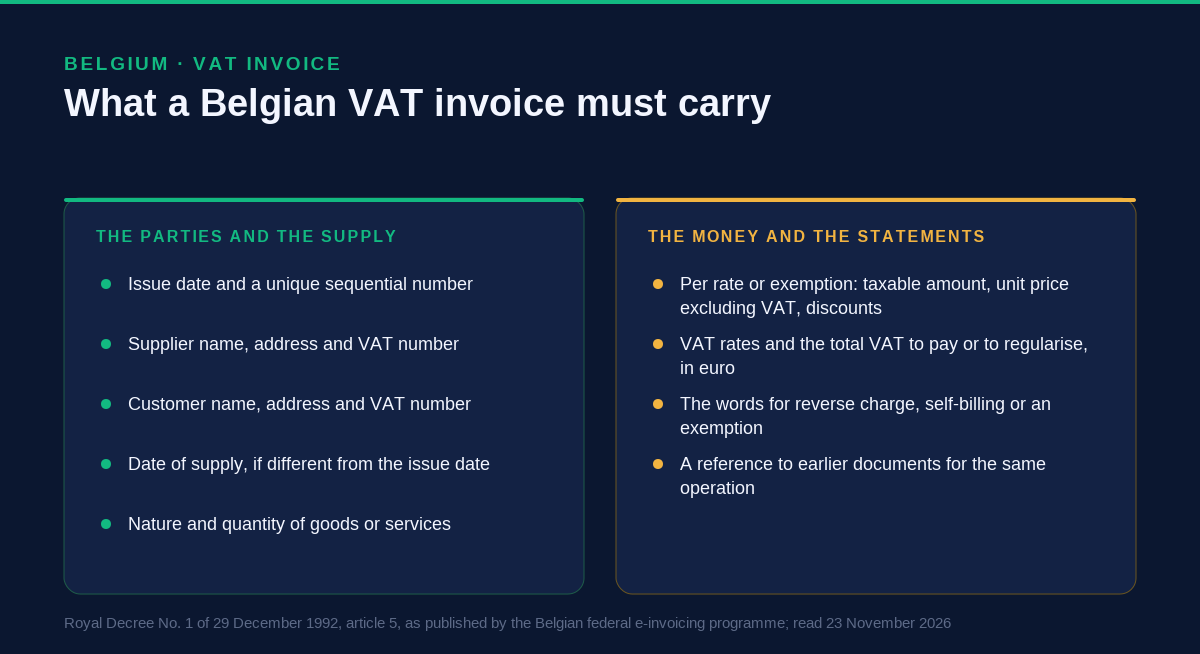
A Belgian VAT invoice must show the issue date and a unique sequential number; the supplier's and the customer's name, address and VAT number; the date of supply if it differs from the issue date; what was supplied and in what quantity; for each VAT rate or exemption, the taxable amount, the unit price without VAT and any discount; the VAT rates and the total VAT to pay or regularise; the words for a reverse charge, self-billing or an exemption where one applies; and a reference to earlier documents for the same operation. Article 5 of Royal Decree No. 1 lists them. Since 1 January 2026 most business-to-business invoices between Belgian VAT-registered companies must also be structured e-invoices.
This page covers what the invoice must contain and where each item sits in a Peppol invoice. It does not cover the deadline for issuing an invoice, which the VAT Code sets and which you should check with FPS Finance or your accountant, and it is not tax advice. The mandate itself is explained in Belgium B2B e-invoicing 2026.
What must a Belgian VAT invoice show?
Article 5, paragraph 1 of Royal Decree No. 1 gives twelve numbered points. The list below puts the French and Dutch original, as published by the federal e-invoicing programme, into plain English. Points 2bis, 3bis, 4 and 7 apply only in special cases and are summarised after the list.
- Point 1, date and number. The date of issue and a sequential number, based on one or more series, that identifies the invoice uniquely and under which it is entered in your outgoing invoice ledger.
- Point 2, supplier. Name, registered address and VAT identification number.
- Point 3, customer. Name, address and VAT identification number.
- Point 5, date of supply. The date of the taxable event, or the date payment was received in whole or in part, when that date is known and differs from the date of the invoice.
- Point 6, what was supplied. The details needed to determine the transaction and the VAT rate, including the usual name of the goods or services and their quantity.
- Point 8, amounts per rate or exemption. For each rate or exemption, the taxable amount, the unit price excluding VAT, and any discounts or rebates not already in the unit price.
- Point 9, VAT. The VAT rates and the total VAT to pay or to regularise, in the national currency of the Member State whose invoicing rules apply.
- Point 10, exemption. The provision of the VAT Directive or the matching national provision that exempts the transaction, or any other indication that it is exempt.
- Point 11, earlier documents. A reference to the earlier document or documents when several invoices or documents are issued for the same operation.
- Point 12, anything else that the VAT Code or its implementing decrees prescribe.
The special cases are these. When the supplier is not established in Belgium and has a liable representative, the representative's identity and address appear too (points 2bis and 3bis). For some cross-border services and intra-EU supplies the customer's VAT number in another Member State is required (point 4). Supplies of vehicles carry vehicle details (point 7).
Which statements must be written in words?
Four points call for fixed or specific wording instead of a data field. They are the ones most often missing from an invoice that is otherwise complete. The French and Dutch wording below is quoted from the Decree.
| Situation | French wording | Dutch wording | Decree |
|---|---|---|---|
| The customer owes the VAT (reverse charge) | "Autoliquidation" | "Btw verlegd" | 9° bis |
| The customer issues the invoice for the supplier (self-billing) | "Autofacturation" | "factuur uitgereikt door afnemer" | 9° ter |
| The transaction is exempt | The relevant Directive or national provision, or another indication that it is exempt | The same, in Dutch | 10° |
| Travel agents' special scheme | "Régime particulier - Agences de voyages" | "Bijzondere regeling - reisbureaus" | 10° bis |
For a reverse charge, the words "Autoliquidation" or "Btw verlegd" replace the VAT rates and the total VAT due. For second-hand goods, art and collectors' items, point 10° ter prescribes three further special-scheme statements. The wording for each regime, with the matching Peppol coding, is in Belgian exemption and reverse-charge wording.
The Belgian expert group's guidance adds a rule about language: legal wording is expected in the language of the region where the supplier's operating location is, citing article 52 of the Royal Decree of 18 July 1966. We have not read that decree ourselves, so treat this as the expert group's reading and check it if you invoice across language regions.
Where does each item sit in a Peppol invoice?
The Belgian Business Expert Group on E-invoicing publishes a "minimal invoice" scenario that tags each Peppol BIS Billing 3.0 element with the Belgian rule behind it. The table below follows that scenario and the Peppol validation rules, release 3.0.21. Where we go beyond the scenario, the row says so.
| Item the Decree requires | Peppol BIS Billing 3.0 element |
|---|---|
| Date of issue | BT-2 (issue date) |
| Sequential number | BT-1 (invoice number) |
| Supplier name, address, VAT number | BT-27, BG-5, BT-31 |
| Customer name, address, VAT number | BT-44, BG-8, BT-48 |
| Date of supply, if different | BT-72 (actual delivery date) or the line period, BT-134 and BT-135 |
| Description and quantity | BT-153 (item name); BT-129 and BT-130 (quantity and unit) |
| Unit price excluding VAT | BT-146 (item net price) |
| Discounts and rebates | BG-20 on the document, BG-27 on a line |
| Taxable amount, rate and category per rate | BT-116, BT-119 and BT-118 in the VAT breakdown |
| Total VAT, and the euro total on a foreign currency invoice | BT-110; BT-6 set to EUR with BT-111 (our reading) |
| Reverse charge, exemption and special-scheme words | BT-22 (note), BT-120 and BT-121 (exemption reason), BT-127 (line note) |
| Reference to earlier documents | BG-3: BT-25 (number) and BT-26 (date) |
Two entries need a comment. For the date of supply the federal FAQ names BT-72 or the line period, while the expert group's sample XML places the date in BT-7, the VAT point date. Both appear in official material; we use BT-72 because the FAQ answers this exact question. For the earlier-document reference, Peppol makes the group optional and the number mandatory inside it (rule BR-55), but the expert group's table ties both number and date to the Decree, so send both.
The expert group's table also tags items that come from company law rather than the VAT Decree: the Companies and Associations Code, article 2:20, and the Code of Economic Law, article III.25. They include the legal form (BT-33), the enterprise number (BT-30) and the bank account (BT-84). The federal FAQ says the register of legal entities, legal form and "in liquidation" data are preferably carried in BT-33.
What else does a Belgian Peppol invoice need?
Three things sit outside the VAT Decree but decide whether the invoice is delivered and accepted.
- The electronic address. The expert group's sample uses the Belgian enterprise (CBE) number with scheme 0208 as the endpoint for both parties, in BT-34 and BT-49. Why scheme 0208 is not optional is a separate page.
- A buyer reference or an order reference. Peppol rule PEPPOL-EN16931-R003 requires one of the two. The expert group's guidance for an invoice with no purchase order is to put the value "NA" in BT-13.
- One document-level note at most. Rule PEPPOL-EN16931-R002 allows a single note on the invoice, except where both parties are German. If you need several statements, our reading is to put each in its own place: exemption wording in BT-120, line-specific wording in BT-127, and the rest combined in the one BT-22 note.
Is a PDF still needed, and what about simplified invoices?
No PDF is required. The federal e-invoicing site says the structured electronic invoice is the only legally required invoice for transactions inside the mandate, and that a recipient cannot refuse an invoice because it has no PDF attached. Summary invoices are still possible, and the simplified invoice of article 13 of Royal Decree No. 1 is still available, but it must be sent at least in the Peppol BIS format.
What happens if a mandatory item is missing?
The federal FAQ says the existing tax fines continue to apply to structured e-invoices. An invoice that is missing mandatory information or contains inaccuracies attracts a proportional fine under Table C of the annex to Royal Decree No. 41 of 30 January 1987. A separate fine of 1,500 euro for a first offence applies where a business lacks the technical means to issue and receive structured e-invoices. Both are covered in what non-compliance actually costs.
What to do next
Take the last invoice you sent and check it against the twelve points, starting with the statements in words and the euro VAT total, which are the items most easily dropped by a template. Then check where your software writes each one.
GoRoute is a certified Peppol Access Point (POP000991). You can send structured invoices through the e-invoice sending service, or from your own software through the API in the developer documentation. The Belgium e-invoicing page has the rest of the market, the tutorials show an invoice being sent, and a 20-minute call will run one of your invoices through the checks. Next, read how a Belgian credit note differs, and how long to keep invoices.
GoRoute is a certified Peppol Access Point (POP000991). This is not tax or legal advice; confirm your position with your accountant.
Primary sources: Royal Decree No. 1 of 29 December 1992, article 5, French and Dutch text as published by the Belgian federal e-invoicing programme; the programme's specific questions FAQ and its "minimal invoice" scenario, all read 23 November 2026; Peppol BIS Billing 3.0, validation rules release 3.0.21 (BR-55, PEPPOL-EN16931-R002 and -R003).
Frequently asked questions
- What must a Belgian VAT invoice show?
- The issue date and a unique sequential number; the supplier's name, address and VAT number; the customer's name, address and VAT number; the date of supply if it differs from the issue date; the nature and quantity of the goods or services; for each rate or exemption, the taxable amount, the unit price excluding VAT and any discount; the VAT rates and the total VAT to pay or regularise; the words that apply to a reverse charge, self-billing or an exemption; and a reference to earlier documents for the same operation. Royal Decree No. 1, article 5, lists them.
- Does a Belgian invoice still need a PDF?
- No. The federal e-invoicing site says the structured electronic invoice is the only legally required invoice for transactions inside the mandate, and that a recipient cannot reject an invoice because no PDF was attached. You may still send a PDF or paper copy on top of it if you wish.
- What if I invoice in a currency other than euro?
- The total VAT must still be stated in euro. The federal FAQ cites article 5, paragraph 1, point 9 of Royal Decree No. 1 for this. In a Peppol invoice that means the invoice currency in BT-5, euro in BT-6 and the euro VAT total in BT-111. That mapping is our reading of the Peppol rules.
- Is there a prescribed format for a Belgian invoice number?
- The Decree asks for a sequential number, based on one or more series, that identifies the invoice uniquely and under which it is entered in the supplier's outgoing invoice ledger. The text does not prescribe a format beyond that.
- In which language must the mandatory statements be written?
- The Belgian expert group's guidance says legal wording is expected in the language of the region where the supplier's operating location is, citing article 52 of the Royal Decree of 18 July 1966 on the use of languages in administrative matters. Where the wording is fixed, such as the reverse-charge words, both the French and the Dutch forms are given below.
About Dr. Syed Raza
Dr. Syed Raza is an IT Enterprise Architect at ClayDesk LLC and leads the GoRoute platform. He works across Peppol Access Point and SMP infrastructure, PINT jurisdictions (Oman, AU/NZ, EU, JP, MY, SG), and national CTC regimes, translating regulatory detail into production-grade e-invoicing systems.
Building on Peppol?
GoRoute is a certified Peppol Access Point & SMP. Book a demo or read the docs to get started.