
Belgian VAT Credit Notes: What They Must Show and How to Send One
How a Belgian credit note works: it is a corrective document that refers to the original invoice, follows its format, and travels over Peppol as a credit note.

A Belgian credit note is a corrective document. It changes an earlier invoice and refers to it specifically and unambiguously, which under the VAT Directive makes it an invoice in its own right. If the original invoice was a structured e-invoice, the credit note must be one too and travels over Peppol as a credit note, with the original invoice's number in the preceding invoice reference. The federal e-invoicing site says so in answers 5 and 23 of its specific questions FAQ.
This page covers what a credit note must show, which format it takes, and how to code it in Peppol. It does not cover bad-debt relief, which is a separate VAT procedure, or credit notes inside a self-billing arrangement, which are in self-billing in Belgium. It is not tax advice. The contents of the original invoice are in Belgian VAT invoice requirements.
What makes a document a credit note in Belgium?
Article 219 of the VAT Directive says: "Any document or message that amends and refers specifically and unambiguously to the initial invoice shall be treated as an invoice." The federal FAQ applies the same test in Belgium. Its answer 23 says any document that makes changes to a structured electronic invoice and specifically and unambiguously refers to it also qualifies as a structured electronic invoice, "in particular" credit notes.
In practice this gives two tests for a credit note you issue: it must change the amounts of an earlier invoice, and it must point to that invoice in a way a machine and an auditor can follow.
What must a Belgian credit note show?
Because the credit note is treated as an invoice, our reading is that the items of article 5 of Royal Decree No. 1 apply to it. The Decree's own text speaks of the invoice and of the document in its article 2, and it does not list credit notes separately, so this is inference and not a quotation. On that reading the credit note shows:
- a date of issue and a unique sequential number, based on one or more series, under which it is entered in your outgoing invoice ledger (point 1);
- the name, address and VAT number of both parties (points 2 and 3);
- what is credited and the quantity (point 6);
- for each rate or exemption, the amount (point 8);
- the VAT rates and the total VAT "to pay or to regularise" (point 9). In French the Decree says "à payer ou à régulariser", in Dutch "te betalen of te herziene belasting". The second half of that phrase is the credit-note case: it is the Decree's own wording for VAT being corrected;
- a reference to the earlier document or documents when several documents are issued for the same operation (point 11).
The federal FAQ adds that amounts wrongly invoiced must be included in "a corrective document (Art. 12, § 1, RD1)", which it describes as "in practice: a credit note". We have not read article 12 itself, so we do not list further requirements from it.
Must a credit note be a structured e-invoice?
Often yes, but not always. The federal FAQ sets out the rule in three steps.
- If the original invoice was a structured e-invoice, the credit note must be issued in the same format, and "credit and debit notes must therefore also be sent via Peppol" (answer 5).
- If the original invoice was not one, for example a PDF, there is no format requirement. A 2026 credit note against a 2025 PDF invoice may still be a PDF, as long as the customer accepts it. The FAQ cites article 56, paragraph 2, point 4 of the VAT Code (answer 23).
- If the supplier chooses to issue the credit note as a structured e-invoice, the customer has to accept it, because it is not a voluntary issue of one.
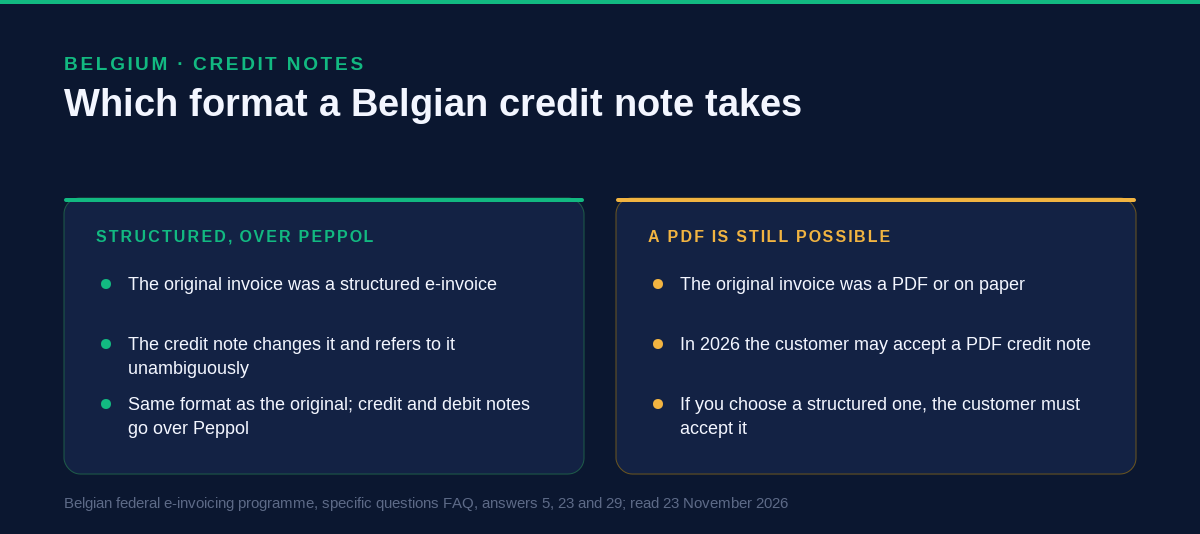
The year of the original invoice does not matter on its own. What matters is whether the document being corrected was a structured e-invoice.
How does a Belgian credit note travel as a Peppol credit note?
As a Peppol BIS Billing 3.0 credit note, a separate document type from an invoice, with document type code 381. The mapping below follows the Belgian expert group's "minimal invoice" scenario for the shared elements and the Peppol validation rules, release 3.0.21, for the rest. Where we go beyond those two, the row says "our reading".
| Credit note item | Peppol BIS Billing 3.0 element |
|---|---|
| Date and number of the credit note | BT-2 and BT-1 |
| Parties' names, addresses and VAT numbers | BT-27, BG-5, BT-31; BT-44, BG-8, BT-48 |
| What is credited, quantity and amount | BT-153; BT-129 and BT-130; BT-131 |
| Amount per rate, the rate and the category | BT-116, BT-119 and BT-118 in the VAT breakdown |
| VAT regularised | BT-117 per category; BT-110 in total |
| Euro VAT total on a foreign currency credit note | BT-6 set to EUR, with BT-111 (our reading) |
| Reference to the original invoice | BG-3: BT-25 (number) and BT-26 (date) |
| A remark about the reason | BT-22, the single document note (our reading) |
The row that matters most is the reference. In Peppol the preceding invoice group is optional, and when it is present the number inside it is mandatory (rule BR-55). The issue date, BT-26, is optional. The expert group's table ties both the number and the date to Royal Decree No. 1, and the Decree's wording requires a reference to the earlier document. A credit note can pass Peppol validation without the group, but it would then risk missing the test of referring "specifically and unambiguously" to the invoice. Send both.
Peppol also bars a negative item net price (rule BR-27). A credit is therefore expressed by the credit note document and its positive amounts, and not by negating a price. GoRoute's platform writes a credit note with type code 381, and writes the reference group with the invoice number and, when you give it, the issue date.
Because Peppol allows only one note at document level (rule PEPPOL-EN16931-R002), keep the reason for the credit short and put it in that one note.
What if I invoiced the wrong customer, or received an invoice meant for someone else?
The two cases are handled differently, and both come from the federal FAQ.
You sent an invoice to the wrong recipient (answer 29). If VAT is chargeable, the invoice must still be entered in your outgoing invoice ledger and its amounts included in your periodic VAT return, citing article 51, paragraph 1, point 3 and article 53, paragraph 1, first paragraph, point 2 of the VAT Code, and article 14, paragraph 2 of Royal Decree No. 1. The amounts wrongly invoiced then go into a corrective document, in practice a credit note.
You received an invoice that is not meant for you (answer 28). It does not qualify for deduction, and you should reject it. You can do so over Peppol by sending an Invoice Response with status code "RE" (Rejected). This is a rejection by the buyer, not a credit note by the seller.
How long must a credit note be kept?
The retention rules in how long to keep Belgian invoices speak of "all invoices and copies of invoices". Given Article 219, which treats the credit note as an invoice, our reading is that they cover credit notes too.
What to do next
Take your last credit note and check three things: that it carries its own sequential number, that BG-3 holds both the number and the date of the original invoice, and that the format matches the original. Then check how your system treats a credit note against an invoice issued in the previous year.
GoRoute is a certified Peppol Access Point (POP000991). You can send invoices and credit notes through the e-invoice sending service, or from your own software through the API in the developer documentation. The Belgium e-invoicing page covers the wider market, the tutorials show a document being sent, and a 20-minute call will test a credit note with you. If you sell online, Does your Belgian online shop have to send e-invoices? shows where refunds come from. For the other wording questions on an invoice, read exemption and reverse-charge wording.
GoRoute is a certified Peppol Access Point (POP000991). This is not tax or legal advice; confirm your position with your accountant.
Primary sources: the Belgian federal e-invoicing programme's specific questions FAQ (answers 5, 23, 28 and 29) and its expert group page, with the text of Royal Decree No. 1, article 5, read 23 November 2026; Council Directive 2006/112/EC, article 219; Peppol BIS Billing 3.0, validation rules release 3.0.21 (BR-27, BR-55, PEPPOL-EN16931-R002).
Frequently asked questions
- What must a Belgian credit note show?
- It is treated as an invoice, so our reading is that the items of article 5 of Royal Decree No. 1 apply: a date and a unique sequential number, both parties' names, addresses and VAT numbers, a description and quantity, the amounts per rate, the VAT rates and the total VAT to regularise, and a reference to the earlier invoice. The federal FAQ says a corrective document must refer to the original invoice specifically and unambiguously.
- Does a Belgian credit note have to be sent over Peppol?
- If the original invoice was a structured e-invoice, yes. The federal FAQ says any document that changes a structured e-invoice and refers to it specifically and unambiguously is itself a structured e-invoice, so credit and debit notes must also be sent via Peppol. If the original was a PDF, there is no format requirement.
- Can I still send a Belgian credit note as a PDF in 2026?
- Yes, where the original invoice was not a structured e-invoice and the customer accepts it. The FAQ cites article 56, paragraph 2, point 4 of the VAT Code. If you decide to issue the credit note as a structured e-invoice, the customer has to accept it.
- How do I refer to the original invoice in a Peppol credit note?
- In the preceding invoice reference group, BG-3. The invoice number, BT-25, is mandatory inside the group and the issue date, BT-26, is optional in Peppol. The Belgian expert group's table ties both to Royal Decree No. 1, so send both.
- I sent an invoice to the wrong customer. Do I issue a credit note?
- Yes. The federal FAQ says the invoice must still be entered in the outgoing invoice ledger and in your VAT return, and the amounts wrongly invoiced go into a corrective document under article 12, paragraph 1 of Royal Decree No. 1, in practice a credit note.
About Dr. Syed Raza
Dr. Syed Raza is an IT Enterprise Architect at ClayDesk LLC and leads the GoRoute platform. He works across Peppol Access Point and SMP infrastructure, PINT jurisdictions (Oman, AU/NZ, EU, JP, MY, SG), and national CTC regimes, translating regulatory detail into production-grade e-invoicing systems.
Building on Peppol?
GoRoute is a certified Peppol Access Point & SMP. Book a demo or read the docs to get started.