
Belgian E-Invoice Archiving: How Long, in What Form and Where
How long FPS Finance says Belgian invoices must be kept, why the structured file is the original, and where electronic invoices may be stored, including abroad.

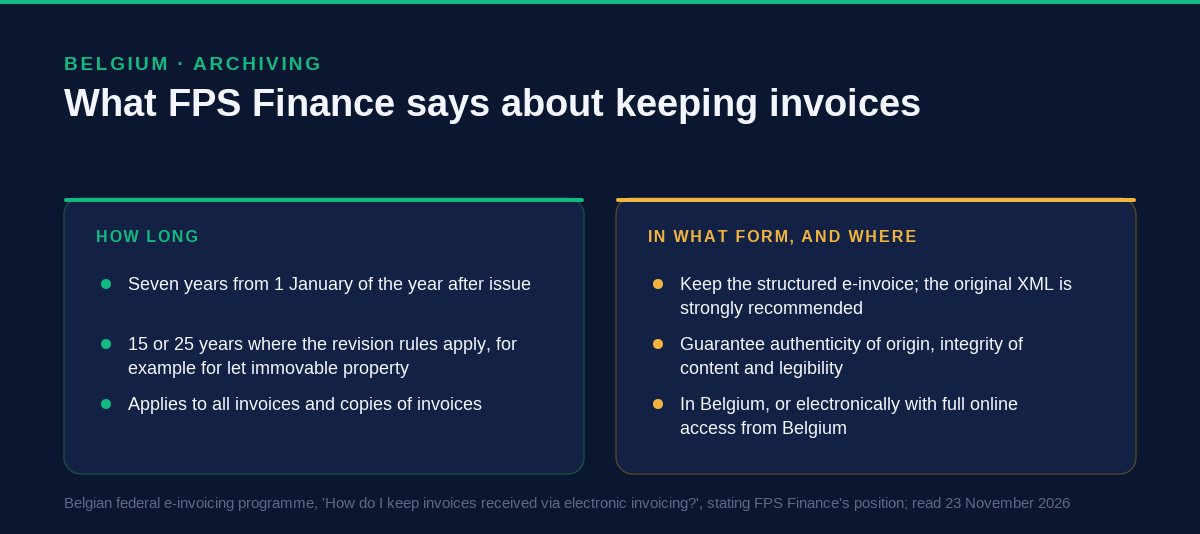
FPS Finance says you must keep all invoices and copies of invoices for seven years as from 1 January of the year following their date of issue, and for 15 or 25 years where the revision rules apply. For a structured e-invoice, the file you received or sent is the document to keep, and it must stay legible, authentic and unaltered for the whole period. The federal e-invoicing site states this in its article How do I keep invoices received via electronic invoicing?
This page covers the length of time, the form and the place of storage for VAT purposes. It does not cover retention periods set by other laws, such as accounting or company law, or the keeping of personal data, and it is not tax advice. The invoice contents are in Belgian VAT invoice requirements.
How long must a Belgian invoice be kept?
Seven years, counted from 1 January of the year after the invoice date. The federal article says "There is no difference compared to paper invoices", and that "for the FPS Finance, you must keep all invoices and copies of invoices for seven years as from 1 January of the year following their date of issue".
As an example, and this is our reading of "as from", an invoice dated 14 March 2026 starts its seven years on 1 January 2027, so it is kept until 31 December 2033.
The period is longer in one family of cases. The article says you "may be required to keep the invoices for a longer period (15 or 25 years) in the context of the application of the revision rules", which applies "in particular to all invoices relating to the right to deduction exercised in connection with immovable business assets and buildings, or parts of buildings, where applicable with the accompanying land, that are rented out subject to VAT".
The article says "the rules on archiving remain unchanged" and that the mandate "mainly creates an opportunity to optimise archiving". The period is the same for the invoices you issue and the ones you receive. The federal wording speaks of "all invoices and copies of invoices", which covers the copies of what you send.
Which file is the original?
The structured one. Answer 17 of the federal general questions says "the recipient must therefore keep the structured electronic invoice for the full storage period", and that the legibility of an invoice must be guaranteed throughout it.
In practice the invoice is read through a PDF or a viewer, which the FAQ describes as "a secure environment in which invoices can be accessed in a legible format". That is still needed for tax audits and for other parties, such as courts, banks and insurers. If the legible form is a PDF, its integrity must be guaranteed, meaning "the prescribed content of the electronic invoice may not be modified".
The storage article is blunter about format. You may change the form or format of an invoice, but only when authenticity and integrity remain guaranteed, and "retaining the original electronic format (XML) is strongly recommended, as conversion to another format will result in a significantly heavier burden of proof".
Attachments need the same care. The federal FAQ says attachments that supplement an invoice are "an integral part of that invoice" and must travel with it through the same channel, so keep them with the invoice.
What must the archive guarantee?
Three things, which the article names: the authenticity of the origin, the integrity of the content and the legibility of the invoice, from the moment it is issued or received until the end of the keeping period. "You are free to choose how to provide these guarantees."
There is no approval step. "No, you do not need prior approval from the FPS Finance on this. Nor will it decide on the choice or approval of a specific archiving system."
The risk of getting it wrong is spelled out. As with paper invoices, FPS Finance "may refuse the right to deduct VAT if it cannot be proved that the guarantees of authenticity and integrity have been met", and "an administrative fine may be imposed on both the client and the supplier/service provider".
A backup is expected. The article says the consequences of a computer problem are "the same as for the destruction of paper archives (for example in the event of fire). A back-up is therefore required (a simple backup copy, for example)".
Where can invoices be stored, including abroad?
For VAT purposes you choose, "provided that you are able to send them to the FPS Finance without delay whenever requested". One rule limits that freedom: "a person liable to tax established in Belgium must keep their invoices in Belgium, unless they keep them electronically and guarantee full online access to these invoices in Belgium". The article says this also applies where the tax on the transactions is due in Belgium, "regardless of where the person liable to tax is established".
So a Belgian company can use a server abroad if the invoices are kept electronically and are fully accessible online from Belgium. On our reading of the rule, a paper archive abroad would not meet it for a Belgian-established business.
The EU baseline is in Article 245 of the VAT Directive: the taxable person may decide the place of storage provided the invoices are made available to the authorities without undue delay, and Member States may require the place to be notified. The Belgian rule above is the national application, as FPS Finance describes it.
Cloud storage is allowed "if you meet the legal requirements", and you can use a trusted third party. If that provider cannot meet your legal obligations, for example on the length of time the archive is kept, "it is up to you to find an alternative solution or another service provider". The duty stays with you.
What happens in a tax audit?
When invoices are kept electronically with online access, FPS Finance "has the right to access, download and use them". It may also ask you to provide the data in a legible and intelligible form, to make copies in the presence of its agents and on their equipment, and to carry out any computer processing it considers necessary to check that the tax was collected correctly.
What does a Peppol access point keep?
The legal duty to keep is yours, whatever your provider does. A provider's archive can help you meet it if it holds the original file and not a rendering of it. GoRoute's e-invoice receiving service keeps the original UBL XML alongside the record of each arrival, with validation results, delivery receipts and audit logs. How long any archive holds the document is a question to put to every provider, and the answer needs to cover the seven years above. It is the same question our receiving page tells you to ask.
What to do next
Write down the date each type of invoice must be kept to, using the seven years from 1 January, and flag any invoice tied to immovable property for the longer period. Then check where your structured files are stored, that they are unaltered and that you can reach them from Belgium.
GoRoute is a certified Peppol Access Point (POP000991). The e-invoice receiving service brings supplier invoices in as structured files, and the developer documentation covers retrieval through the API. The Belgium e-invoicing page has the wider market, the tutorials show a document arriving, and a 20-minute call will check your archive against these points. For the receiving side in Belgium read Does your Belgian shop have to receive e-invoices too? next, and for corrections see Belgian credit notes.
GoRoute is a certified Peppol Access Point (POP000991). This is not tax or legal advice; confirm your position with your accountant.
Primary sources: Belgian federal e-invoicing programme, How do I keep invoices received via electronic invoicing? (page dated 8 April 2026) and the general questions FAQ, answers 17, 19, 20 and 22, read 23 November 2026; Council Directive 2006/112/EC, article 245.
Frequently asked questions
- How long must invoices be kept in Belgium?
- FPS Finance says you must keep all invoices and copies of invoices for seven years as from 1 January of the year following their date of issue. You may have to keep them 15 or 25 years where the revision rules apply, in particular for deductions on immovable business assets and on buildings let subject to VAT. Other laws, such as accounting law, may set their own periods and are not covered here.
- Is the structured e-invoice or the PDF the original?
- The federal FAQ says the recipient must keep the structured electronic invoice for the full storage period, and that the legibility of the invoice must be guaranteed throughout. A PDF or a viewer is the usual way to make it legible, and if the legible form is a PDF its content must not be modified.
- Can I store my invoices outside Belgium?
- For VAT you are free to choose where you keep them, provided you can send them to FPS Finance without delay when asked. A taxable person established in Belgium must keep them in Belgium, unless they are kept electronically with full online access from Belgium. The same applies if the tax is due in Belgium, wherever the taxable person is established.
- Can I use a cloud service or a third party to archive?
- Yes, if you meet the legal requirements. If the third party cannot meet them, for example on the length of time archives are kept, it is up to you to find another solution or provider.
- Does FPS Finance approve my archiving system?
- No. You do not need its prior approval, and it will not decide on or approve a specific archiving system. You choose how to guarantee authenticity of origin, integrity of content and legibility.
About Dr. Syed Raza
Dr. Syed Raza is an IT Enterprise Architect at ClayDesk LLC and leads the GoRoute platform. He works across Peppol Access Point and SMP infrastructure, PINT jurisdictions (Oman, AU/NZ, EU, JP, MY, SG), and national CTC regimes, translating regulatory detail into production-grade e-invoicing systems.
Building on Peppol?
GoRoute is a certified Peppol Access Point & SMP. Book a demo or read the docs to get started.