
Spanish Invoice Requirements: What a Full Invoice Must Show
What a full Spanish invoice must show under Royal Decree 1619/2012 article 6, which mentions must appear in words, how it is numbered, and its EN 16931 fields.

What must a Spanish invoice show?
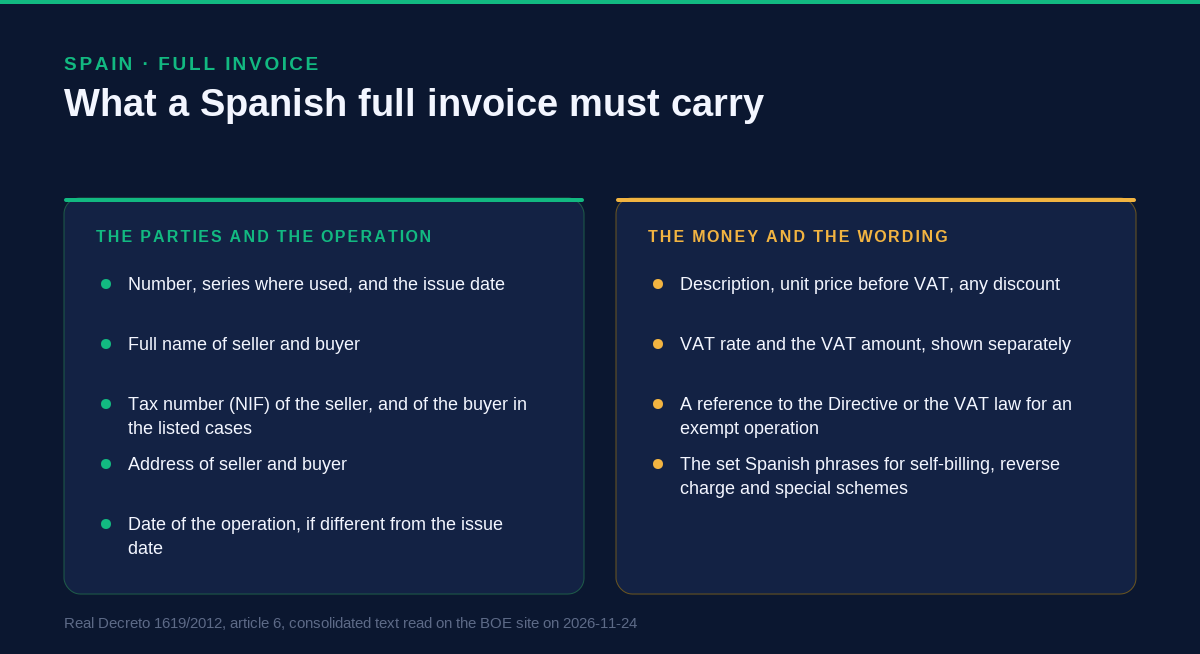
A full invoice (factura completa) in Spain must carry the items listed in article 6.1 of Royal Decree 1619/2012 (Real Decreto 1619/2012, the invoicing regulation): a number, the issue date, the names, tax numbers and addresses of both parties, a description of the operation with its unit price, the VAT rate, the VAT amount shown separately, and the date of the operation when it differs from the issue date. Where an operation is exempt, or falls under a special VAT scheme, the article adds a reference or a set phrase. A seller may add any other mention it likes; the article says so in its first sentence.
The reason to get this right is on the buyer's side. Under article 97 of the VAT law (Ley 37/1992), a document that does not meet every legal and regulatory requirement does not justify the right to deduct VAT until it is corrected. A seller who leaves out one item has handed its customer a deduction problem.
This page covers the full invoice only. It leaves the mandate dates to Spain's B2B e-invoicing mandate, simplified invoices (tickets) to the Verifactu online-shop guide, and penalties out altogether: we have not read a final text for them.
Which items are mandatory, and where do they sit in an EN 16931 invoice?
Each item of article 6.1 has a home in the EN 16931 data model, the European standard that Spain's mandatory e-invoice follows. The third column is our reading of that model and of the Peppol BIS Billing 3.0 rules that use it. It is not an official Tax Agency table.
| Article 6.1 | What it requires | EN 16931 field (our reading) |
|---|---|---|
| a) | Number and, where used, series; consecutive within each series | BT-1 invoice number. The model has no series field, so the series is part of the number |
| b) | Date of issue | BT-2 issue date |
| c) | Full name or company name of seller and buyer | BT-27 seller name, BT-44 buyer name |
| d) | NIF of the seller; NIF of the buyer in the cases below | BT-31 or BT-32 for the seller, BT-48 for the buyer |
| e) | Address of seller and buyer | BG-5 seller postal address, BG-8 buyer postal address |
| f) | Description of the operation, the data needed for the taxable base, the unit price before VAT, any discount not already in that price | BG-25 invoice line, with BT-153 item name, BT-129 quantity, BT-146 net price, BT-147 price discount |
| g) | VAT rate or rates | BT-152 line VAT rate, BT-119 rate in the VAT breakdown |
| h) | VAT amount, shown separately | BT-117 VAT category tax amount, BT-110 total VAT |
| i) | Date of the operation, or of an advance payment, if different from the issue date | BT-72 actual delivery date, or BT-7 tax point date |
| j) | For an exempt operation: a reference to the Directive 2006/112/EC or the VAT law, or a statement that it is exempt | BT-120 exemption reason text, BT-121 exemption reason code |
Three points sit behind the table.
- Items f to h are per line and per rate. Article 6.2 requires the taxable base of each operation to be shown separately when one invoice mixes exempt and taxable operations, reverse-charge and ordinary ones, or operations at different VAT rates. In EN 16931 that is one VAT breakdown (BG-23) for each category and rate.
- The buyer's NIF is mandatory in three cases. They are an exempt supply of goods to another EU country; an operation where the buyer is the person liable for the VAT; and an operation in Spain's VAT territory by a seller who is established there (article 6.1.d). Our reading is that the third case covers ordinary domestic sales by a Spanish seller, so a full invoice to a business carries the buyer's NIF.
- The addresses matter beyond identification. If either party has several fixed places of business, the invoice must name the one the operation relates to when that decides how it is taxed (article 6.1.e).
Which mentions must appear in words?
Article 6.1 requires five set phrases for particular situations, and a reference or statement for exempt operations. They are worded in Spanish in the regulation, and the safe course is to print them exactly. The English gloss is ours.
| Situation | Phrase required | Gloss |
|---|---|---|
| The buyer or a third party issues the invoice | «facturación por el destinatario» (letter l) | invoicing by the recipient |
| The buyer is liable for the VAT | «inversión del sujeto pasivo» (letter m) | reverse charge |
| Travel agents' special scheme | «régimen especial de las agencias de viajes» (letter n) | special scheme for travel agencies |
| Second-hand goods, art, antiques | «régimen especial de los bienes usados», «de los objetos de arte» or «de las antigüedades y objetos de colección» (letter o) | special scheme for used goods, art objects, antiques and collectors' items |
| Cash-accounting scheme | «régimen especial del criterio de caja» (letter p) | special cash-accounting scheme |
| Exempt operation | A reference to the Directive or the VAT law, or a statement that it is exempt (letter j) | exemption reference |
In an EN 16931 invoice there is no field dedicated to these phrases. Our reading is that they belong in the free-text invoice note (BT-22), and that a self-billed invoice also carries invoice type code 389. For exemptions and reverse charge, the VAT category and the exemption reason (BT-120, BT-121) carry the same fact in structured form. A structured invoice that carries the category and not the Spanish words is a case we have not found an official answer for, so print both.
How are Spanish invoices numbered?
Numbers must be consecutive within each series, and some invoices must have a series of their own. Article 6.1.a allows separate series where there is a reason, for example several establishments or different kinds of operation. It makes separate series compulsory for five kinds of invoice. Two are the ones most sellers meet: invoices issued by the buyer or a third party (a distinct series for each issuer) and corrective invoices (rectificativas). The other three are tied to specific VAT rules named in the article.
The practical effect is that a corrective invoice cannot be numbered from the ordinary sales series. The guide to the factura rectificativa covers how to number and reference one.
When must the invoice be issued?
At the moment of the operation, and no later than the 16th of the following month when the buyer is a business. Article 11.1 of the Royal Decree sets the general rule: issue the invoice when the operation takes place. When the buyer is a business or professional acting as such, the invoice must be issued before the 16th day of the month after the month in which VAT became due.
Two variants sit in the same article. For goods sent to another EU country (the case in article 75.Uno.8 of the VAT law) the deadline runs from the month in which the shipping starts. Under the cash-accounting scheme the invoice is issued at the time of the operation, with the same 16th-of-the-month allowance for business buyers.
An example: a service finished and accrued on 12 March to a Spanish company must be invoiced before 16 April. This is our worked example of the article, not an official one.
Which language and currency may be used?
Any language, and any currency as long as the VAT is also stated in euros. Article 12 of the Royal Decree allows an invoice in any language. The Tax Agency may require a translation into Castilian, or another official language of Spain, of an invoice in a non-official language, when it needs one to check a taxpayer. The same applies to invoices received by Spanish businesses.
For amounts, article 12.1 lets the invoice be drawn up in any currency, on condition that the VAT amount is stated in euros using the exchange rate named in article 79.Once of the VAT law. In EN 16931 terms that is the document currency (BT-5), the VAT accounting currency (BT-6) and the VAT amount in that currency (BT-111). The mapping is our reading.
What does the e-invoice mandate change?
It changes the format, not the content. From the dates in the Royal Decree 238/2026, an invoice between Spanish businesses must be a structured message following EN 16931, in UBL, CII, EDIFACT or Facturae. Article 6 above still says what the invoice has to show. The mandate decides how that content travels. The dates and the scope are in our mandate guide, and article 8 bis of the invoicing regulation, as amended, exempts simplified invoices from the electronic duty except the qualified ones of article 7.2.
Invoices issued through invoicing software also have to meet the Verifactu rules, including a QR code (article 6.5). That is a separate regime with its own dates, set out in Is Verifactu postponed to 2028?
What should a seller do now?
Check the invoice template against the table, then check that the same data reaches the structured file. A short working order:
- Compare each line of your current invoice with article 6.1, letter by letter. The usual gaps are the buyer's NIF, the date of the operation and the exemption wording.
- Check that your series are right: one for sales, one for corrective invoices, one for each issuer if the buyer invoices on your behalf.
- Map each item to an EN 16931 field in your invoicing or ERP system, and test with real invoices that include an exempt line and a foreign buyer.
- Decide how invoices will be sent. E-invoice sending with GoRoute describes our own sending service over the Peppol network, and the developer documentation shows how an invoice reaches the network from an API.
To go through your own invoice template, book a session. Recorded walkthroughs are on the tutorials page, and E-invoicing in Spain keeps the wider picture.
Related guides
- How to invoice the Spanish public sector through FACe
- The factura rectificativa: when a correction needs a corrective invoice
- How long to keep invoices in Spain
- Spain's B2B e-invoicing mandate: the 2027 and 2028 dates
- E-invoicing in Spain
Sources, all read on 24 November 2026: the consolidated text of Real Decreto 1619/2012 (BOE-A-2012-14696), articles 6, 8 bis, 11 and 12; the consolidated Ley 37/1992 on VAT, articles 97 and 164; and the Peppol BIS Billing 3.0 documentation for the field names. The EN 16931 mapping, the use of the invoice note and type code 389, and the worked date example are our reading. This page describes the rules; it is not tax or legal advice. GoRoute operates certified Peppol Access Point POP000991.
Frequently asked questions
- What must a Spanish invoice contain?
- Under article 6.1 of Royal Decree 1619/2012: a number and, where used, a series; the issue date; the full names or company names of seller and buyer; the seller's tax number (NIF) and, in the cases the article lists, the buyer's; both addresses; a description of the operation with the unit price before VAT and any discount; the VAT rate; the VAT amount shown separately; and the date of the operation when it differs from the issue date. Exempt operations and special schemes add a reference or a set phrase.
- How soon must a Spanish invoice be issued?
- At the moment the operation takes place. When the buyer is a business or professional acting as such, the invoice must be issued before the 16th of the month after the month in which VAT became due on the operation (article 11 of the Royal Decree). Goods sent to another EU country and the cash-accounting scheme have their own variants in the same article.
- Can a Spanish invoice be in English?
- Yes. Article 12 allows any language. The Tax Agency can ask for a translation into Castilian or another official language of Spain for an invoice in a non-official language, when it needs one for a check. Amounts may be in any currency, provided the VAT amount is also stated in euros.
- Does a missing item make the invoice invalid?
- A missing item means it is not a complete invoice under article 6, and a buyer cannot deduct the VAT on it until it is corrected (article 97 of the VAT law, Ley 37/1992). The seller fixes it with a corrective invoice (factura rectificativa), which is covered in a separate guide.
- Where does each item go in an EN 16931 invoice?
- Most items have a direct field: the number is BT-1, the issue date BT-2, the seller and buyer names BT-27 and BT-44, their tax numbers BT-31 and BT-48, the VAT rate BT-152 or BT-119, and the VAT amount BT-117. The table on this page lists each one. The mapping is our reading of the EN 16931 data model, not a Tax Agency table.
About Dr. Syed Raza
Dr. Syed Raza is an IT Enterprise Architect at ClayDesk LLC and leads the GoRoute platform. He works across Peppol Access Point and SMP infrastructure, PINT jurisdictions (Oman, AU/NZ, EU, JP, MY, SG), and national CTC regimes, translating regulatory detail into production-grade e-invoicing systems.
Building on Peppol?
GoRoute is a certified Peppol Access Point & SMP. Book a demo or read the docs to get started.