
Factura Rectificativa: Spain's Corrective Invoice Rules
When a Spanish invoice needs a factura rectificativa under Royal Decree 1619/2012 art. 15, what it must show, the four-year limit and the credit-note format.

When does a correction need a factura rectificativa?
A corrective invoice (factura rectificativa) is compulsory in Spain in two situations: the original invoice does not meet the content rules, or the tax amounts or taxable base were wrong. Article 15 of Royal Decree 1619/2012 (Real Decreto 1619/2012, the invoicing regulation) sets both. Anything else that is called a "rectification" without one of those causes is not a corrective invoice in the regulation's sense (article 15.6).
The correction is made with a new invoice. The original is not altered or deleted: article 15.4 says the rectification is carried out by issuing a new invoice that carries the identifying data of the invoice being rectified.
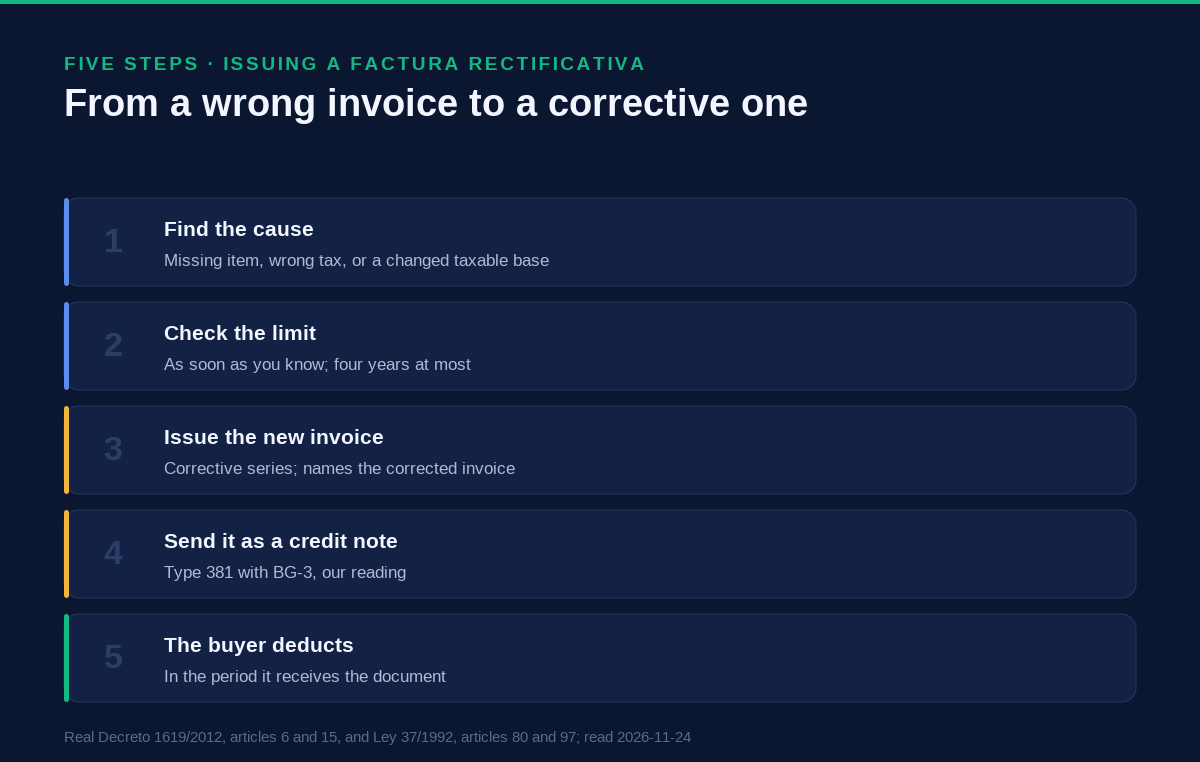
This page covers the rules of the regulation and the VAT law and how a correction travels as a structured invoice. It leaves what a complete invoice contains to the invoice-requirements guide. It leaves refunds on a shop's orders and the Verifactu records to Verifactu for online shops, which is where the Verifactu questions are answered.
What are the two compulsory cases?
Case one is a defective invoice. Case two is a wrong tax amount or a change in the taxable base.
- The invoice lacks a required item. If the original does not meet article 6 (a full invoice) or article 7 (a simplified one), a corrective invoice must be issued (article 15.1).
- The tax or the base changed. It is also compulsory when the VAT charged was calculated incorrectly, or when a circumstance listed in article 80 of the VAT law (Ley 37/1992) modifies the taxable base (article 15.2).
Article 80 of the VAT law changes the taxable base in several events. They include the return of reusable packaging; discounts and bonuses granted after the operation, if properly justified; a firm judicial or administrative decision, or the rules of law and trade usage, that cancels the operation in whole or part or alters its price; and, under conditions of its own, the customer's insolvency or an uncollectable debt. The conditions and deadlines for the last case are in article 80 itself, and this page does not restate them.
When is a corrective invoice not needed?
Two exceptions are written into the regulation.
- Goods or packaging returned and offset against a later supply. If the taxable base falls because goods, containers or packaging are returned on the occasion of a later supply to the same buyer, and an invoice was issued for the first operation, no corrective invoice is needed. The seller may subtract the returned items from the invoice for the later supply. This works only when the VAT rate is the same on all the operations, whether the result is positive or negative (article 15.2).
- Swapping a ticket for a full invoice. An invoice issued in place of an earlier simplified invoice is not a corrective invoice, provided the simplified invoice met article 7.1 (article 15.6).
A seller who is unsure whether it is in one of these cases should ask its adviser before relying on either exception.
What must a factura rectificativa show?
It must meet the ordinary content rules, identify what it corrects, and show the correction. Article 15.5 requires a corrective invoice to meet article 6 or 7 as appropriate. Three points are specific to it.
- Which invoice is corrected. The new invoice must carry the identifying data of the corrected one (article 15.4). Several invoices may be corrected in a single document if every one is identified. Where the correction comes from volume discounts or bonuses, or from a case the Tax Agency has authorised, naming the period is enough. The Agency may also authorise other correction procedures on request.
- What changed. The description, rate and VAT items (article 6.1, letters f, g and h) must express the correction. Article 15.5 allows two ways: state the amount of the correction directly, whatever its sign, or state the figures as they stand after the correction and also give the amount of the correction.
- A series of its own. Corrective invoices are one of the kinds that must have a specific series (article 6.1.a), with consecutive numbers. Our guide to Spanish invoice requirements lists the other cases.
A simplified corrective invoice follows article 7.1.h: an express and unambiguous reference to the corrected invoice and to the items that are modified.
How long does the seller have?
As soon as it knows, and within four years. Article 15.3 requires the corrective invoice to be issued as soon as the person obliged to issue it learns of the circumstance, provided four years have not passed since the VAT became due or since the event described in article 80 occurred. The four-year figure matches the general limitation period in article 66 of the General Tax Law (Ley 58/2003). A seller should not read the four years as a period to wait.
How does it travel as an EN 16931 invoice?
Our reading is that a correction that reduces the amounts travels as a credit note, with a pointer to the invoice it corrects. The mapping below is not a Tax Agency table. It uses the EN 16931 data model and the Peppol BIS Billing 3.0 documentation.
| What the correction needs | EN 16931 field (our reading) |
|---|---|
| A document of its own, in its own series | BT-1 credit note number, carrying the corrective series |
| It is a credit note | BT-3 document type code 381 |
| The corrected invoice | BG-3 preceding invoice reference: BT-25 number, BT-26 issue date |
| The amounts corrected | The credit note lines and VAT breakdown, with amounts stated as positive values |
| The reason | BT-22 invoice note, free text |
Two cautions follow. First, the choice between "the amount of the correction" and "the figures after the correction" in article 15.5 is a presentation choice for the document. A credit note in EN 16931 carries the correction as positive amounts that reduce the original, which is the first of the two. Second, a correction that increases the amount, such as a VAT rate that was too low, is a case we have not found official guidance for, so this page does not say how to encode it. Ask your buyer's system or adviser before sending one.
The Spanish B2B mandate requires structured invoices in four syntaxes: see the mandate guide for the dates and formats. Whether the mandate adds rules specific to corrective invoices is a point we did not read for this page.
What does the buyer do?
The buyer deducts on the corrective invoice, in the period it receives it. Article 97.Dos of the VAT law says a document that fails the requirements does not justify the deduction unless it is corrected. The right to deduct the VAT justified by a corrective document can be exercised only in the tax period in which the business receives it or in later ones, as long as the time limit of article 100 of the same law has not passed. For a buyer receiving invoices over Peppol, the practical point is to match each credit note to its original by BT-25 and BT-26 before booking it.
What should a bookkeeper do first?
Find the cause, pick the case, then issue the document in the right series. In order:
- Write down why the original is wrong: missing item, wrong tax, or a change in the price after the sale.
- Check the date. Four years from the VAT becoming due is the outer limit, and the rule is to issue as soon as you know.
- Issue the corrective invoice from the corrective series, naming the original's number and date.
- Send it by the same route as the original. E-invoice sending with GoRoute describes our service for sending structured invoices over Peppol, and the developer documentation shows the credit-note message from an API.
For a session on your own corrections process, book a demo, see the tutorials, or read E-invoicing in Spain. The separate Verifactu timetable is in Is Verifactu postponed to 2028?
Related guides
- Spanish invoice requirements: what a full invoice must show
- How to invoice the Spanish public sector through FACe
- How long to keep invoices in Spain
- Verifactu for online shops: tickets, QR codes and refunds
- E-invoicing in Spain
Sources, all read on 24 November 2026: the consolidated Real Decreto 1619/2012 (BOE-A-2012-14696), articles 6, 7 and 15; the consolidated Ley 37/1992 on VAT, articles 80 and 97; the consolidated Ley 58/2003, the General Tax Law, article 66; and the Peppol BIS Billing 3.0 documentation for field names. The EN 16931 mapping and the credit-note reading are ours. Not covered: the Verifactu record codes, penalties, and the conditions of article 80 for insolvency and uncollectable debts. This page describes the rules; it is not tax or legal advice. GoRoute operates certified Peppol Access Point POP000991.
Frequently asked questions
- When must a factura rectificativa be issued in Spain?
- When the original invoice lacks an item that article 6 or 7 of Royal Decree 1619/2012 requires, when the VAT charged was calculated wrongly, or when a circumstance listed in article 80 of the VAT law changes the taxable base. Article 15 of the Royal Decree makes it compulsory in those cases.
- How long does a seller have to issue it?
- As soon as the seller knows of the circumstance, provided that four years have not passed since the VAT became due or since the event that changes the taxable base (article 15.3).
- Does it need its own number series?
- Yes. Article 6.1.a makes a specific series compulsory for corrective invoices, separate from the ordinary sales series, and the numbers within it must be consecutive.
- Can one corrective invoice correct several invoices?
- Yes, as long as every corrected invoice is identified in it. For volume discounts and bonuses, and where the Tax Agency has authorised it, naming the period is enough (article 15.4).
- How is it sent as an EN 16931 invoice?
- Our reading is that a correction which reduces the amounts is sent as a credit note, document type code 381, with the original invoice's number and date in the preceding-invoice reference (BG-3). We have not found official guidance on encoding a correction that increases the amount.
About Dr. Syed Raza
Dr. Syed Raza is an IT Enterprise Architect at ClayDesk LLC and leads the GoRoute platform. He works across Peppol Access Point and SMP infrastructure, PINT jurisdictions (Oman, AU/NZ, EU, JP, MY, SG), and national CTC regimes, translating regulatory detail into production-grade e-invoicing systems.
Building on Peppol?
GoRoute is a certified Peppol Access Point & SMP. Book a demo or read the docs to get started.