
How to Invoice the Spanish Public Sector Through FACe
How a supplier invoices a Spanish public body: Law 25/2013, the FACe entry point, three office codes, Facturae 3.2.x with a signature, and who may use paper.

How do you invoice the Spanish public sector through FACe?
You issue the invoice as a signed Facturae file that names three office codes, send it to the entry point of the administration you supplied, and follow its status there. For the State that entry point is FACe. The duty comes from Law 25/2013 (Ley 25/2013, on the electronic invoice and the accounting register of invoices in the public sector). The government's Facturae site states that since 15 January 2015 invoices addressed to the public administrations must be electronic, in the structured Facturae format.
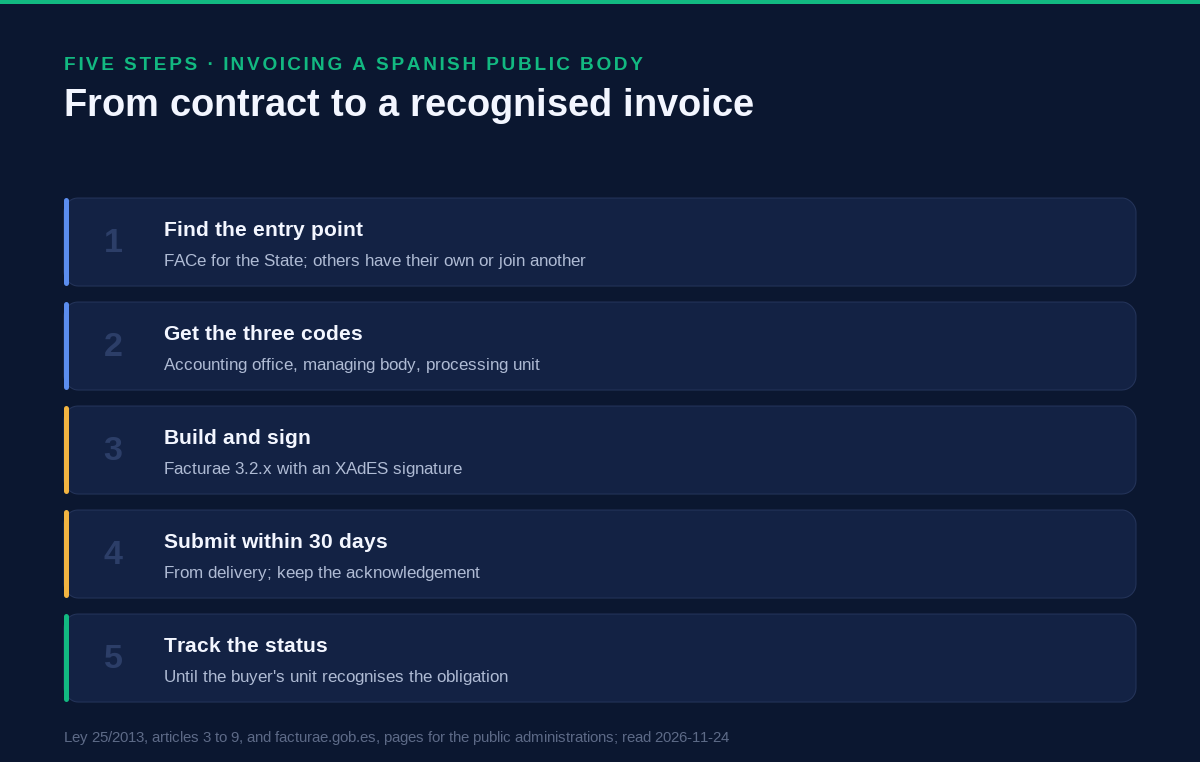
The steps in order:
- Find out which administration is the buyer and which entry point it uses.
- Get the three codes that identify the receiving offices.
- Produce a Facturae 3.2.x file, signed with an advanced electronic signature or seal.
- Submit it, within 30 days of delivery, and read the acknowledgement.
- Track its status until the buyer's unit has recognised the obligation.
This page covers that route. It leaves the content of a Spanish invoice to the invoice-requirements guide and the business-to-business rules to the B2B mandate guide.
Who must send an electronic invoice, and who may still use paper?
Companies and several other entities must send electronically. Everyone outside that list may choose. Article 4 of Law 25/2013 lets every supplier issue an electronic invoice and makes it compulsory, together with submission through the entry point, for:
- public limited companies (sociedades anónimas) and limited companies (sociedades de responsabilidad limitada);
- legal persons and entities without legal personality that do not have Spanish nationality;
- permanent establishments and branches of non-resident entities;
- joint ventures (uniones temporales de empresas);
- economic-interest groupings, pension funds, venture-capital, investment and several other funds.
That leaves a sole trader, or an entity not on the list, free to use another route. Two limits apply. Article 4 lets the administrations exclude by regulation invoices of up to EUR 5,000, and invoices from suppliers to Spain's offices abroad. We have not checked which administrations have used that power, so a small invoice needs a question to the buyer. The Facturae site also states that where an administration is bound to accept electronic invoices, it must accept one even if the amount is EUR 5,000 or less: the choice then belongs to the supplier.
Some public buyers are outside the law altogether. The Facturae site names state public business entities, commercial companies owned by the public sector and public foundations as not bound to accept electronic invoices under it.
What are the three codes, and where do you find them?
The invoice must identify the accounting office (oficina contable), the managing body (órgano gestor) and the processing unit (unidad tramitadora). Article 9 of the law requires the invoice to identify the administrative bodies it is addressed to, and the Facturae site lists exactly these three. The administration provides them: the contract or purchase order normally names them.
These are often called DIR3 codes, after DIR3, the Government's common directory of organisational units and offices. We did not find a government page that states in one sentence that the three codes come from DIR3, so treat the name as common usage and take the actual codes from the buyer. The FACe portal offers a directory of units, where the identification code of the receiving unit can be looked up. A wrong or missing code is the commonest reason an invoice goes to the wrong office, because the accounting register that receives the invoice is chosen by the office on the invoice (article 9.1). That last sentence is our reading of the article rather than a statement from the portal.
What format and signature do the public bodies expect?
Facturae 3.2.x, signed with an XAdES electronic signature. The Facturae site states that from 15 January 2015 invoices to the administrations follow Facturae 3.2.x with an XAdES signature. Law 25/2013 article 5 requires a structured format and an advanced electronic signature based on a recognised certificate, as set out in article 10.1.a of the invoicing regulation. It also accepts an advanced electronic seal, whose certificate must identify the company by name and tax number.
If a third-party service issues the invoice for you, the Facturae site says that service signs it. We did not find a source in this research that names UBL, CII or any other format for FACe, so this page states Facturae only. A Peppol UBL invoice is a different file from a Facturae one, and whether a given public body can receive it is something to confirm with that body.
What happens after you submit?
The entry point registers the invoice, acknowledges it with a date and time, and routes it to the accounting office. Article 6 of the law describes it in four effects:
- the invoice is admitted and enters a register of the administration automatically;
- an electronic acknowledgement proves the date and time of presentation;
- an automatic service sends it to the competent accounting office;
- the supplier can check the processing status.
Article 9 then takes it into the accounting register of invoices, where it is given an identification code. The invoice can be rejected at that stage only when it does not meet the requirements of the law and its basic implementing rules. Once the obligation is recognised by the competent body, the payment order cites the invoice by that code. The recognition itself is a separate step, checked against the delivery of goods or services.
Article 11 is worth knowing: receipt at the entry point and entry in the register have only the effects that the general administrative procedure law attaches to presenting a document at an administrative register. In other words, submission proves you presented the invoice; it does not by itself mean the administration accepted the work.
Is there a deadline?
Yes: 30 days from the actual delivery of the goods or the provision of the service. Article 3 requires the supplier to present the invoice at an administrative register within thirty days of that date. Until the time and form requirements of the law are met, the duty to present is not considered fulfilled. Sending through the entry point meets the registration requirement, because the Facturae site states that submission produces an automatic entry in an administrative electronic register.
One more consequence from the Facturae site: electronic invoices to consumers and to the public sector cannot be paid by direct debit and do not carry enforcement action.
What about regional and local administrations?
Each level has an entry point of its own or joins another's. Article 6 says the State, the autonomous communities and the local entities each have a general entry point, and that local entities may join the one of their provincial council, their community or the State, and communities may join the State's. When an administration has neither its own point nor a membership, the supplier may present the invoice at the State's point, which deposits it in a repository for the administration to collect (article 6.7). The government's search tool at face.gob.es and the Facturae site's directory of entry points show which one a given body uses. We name the regional portals here without describing them, because we have not read their individual rules.
What should an accounts-receivable team do first?
Collect the three codes before the first invoice, and build the Facturae file with them in it. Put the codes on the purchase order or contract record, test one signed file with the buyer's unit, and keep the acknowledgement. The same invoices must also be kept as the retention guide describes, and a later correction is a factura rectificativa.
GoRoute operates a certified Peppol Access Point. This page makes no claim that GoRoute delivers to FACe or is an approved Spanish platform. If you invoice other buyers in Spain over Peppol, E-invoice sending with GoRoute describes that service, and the developer documentation shows how an invoice reaches the network from an API. For a walk through your own case, book a session, see the tutorials, or read E-invoicing in Spain. Verifactu, the separate rule for invoicing software, is covered in Is Verifactu postponed to 2028?
Related guides
- Spanish invoice requirements: what a full invoice must show
- The factura rectificativa: when a correction needs a corrective invoice
- How long to keep invoices in Spain
- Spain's B2B e-invoicing mandate: the 2027 and 2028 dates
- E-invoicing in Spain
Sources, all read on 24 November 2026: the consolidated Ley 25/2013 (BOE-A-2013-13722), articles 2 to 11; the government's Facturae site, pages for invoicing the public administrations and for the Facturae format; the common directory DIR3 on the e-administration portal; and the FACe portal. The FACe portal itself is a script-driven site we could not read as text, so nothing here is taken from its screens. The remark on how the accounting register is chosen is our reading. This page describes the rules; it is not tax or legal advice. GoRoute operates certified Peppol Access Point POP000991.
Frequently asked questions
- What is FACe?
- FACe is the general entry point for electronic invoices of the Spanish State (Administración General del Estado). A supplier sends an invoice there, the portal registers it, gives an electronic acknowledgement with the date and time, passes it to the right accounting office and shows its processing status. Other administrations may join it or run their own entry point.
- What are the three codes on an invoice to a Spanish public body?
- The accounting office (oficina contable), the managing body (órgano gestor) and the processing unit (unidad tramitadora). They are often called DIR3 codes. The administration provides them: the contract or purchase order normally names them, and the directory of units on FACe gives the identification code of the receiving unit.
- Which format does a Spanish public body accept?
- Facturae, version 3.2.x, signed with an XAdES electronic signature. The government's Facturae site says that since 15 January 2015 invoices sent to the public administrations are electronic and follow this structured format. We did not find a source that names another format for FACe.
- Can a supplier still send a paper invoice to a Spanish public body?
- Only a supplier outside the list in article 4 of Law 25/2013 can choose. That list covers limited companies (S.A. and S.L.), entities without Spanish nationality, permanent establishments and branches of non-residents, joint ventures and certain funds. An administration may also exclude invoices of up to EUR 5,000 by regulation, so the answer for a small invoice depends on the buyer.
- Is an invoice to a Spanish public body also a B2B e-invoice?
- No. The public-sector rules come from Law 25/2013 and have applied since 2015. The B2B mandate of Royal Decree 238/2026 covers invoices between businesses, with its own dates, and is a separate regime.
About Dr. Syed Raza
Dr. Syed Raza is an IT Enterprise Architect at ClayDesk LLC and leads the GoRoute platform. He works across Peppol Access Point and SMP infrastructure, PINT jurisdictions (Oman, AU/NZ, EU, JP, MY, SG), and national CTC regimes, translating regulatory detail into production-grade e-invoicing systems.
Building on Peppol?
GoRoute is a certified Peppol Access Point & SMP. Book a demo or read the docs to get started.