
Spain's B2B E-Invoicing Mandate: The 2027 and 2028 Dates
Spain's B2B e-invoicing mandate applies from October 2027 above EUR 8 million of turnover and from 6 October 2028 for all others. Scope, formats, reporting.

When does B2B e-invoicing become mandatory in Spain?
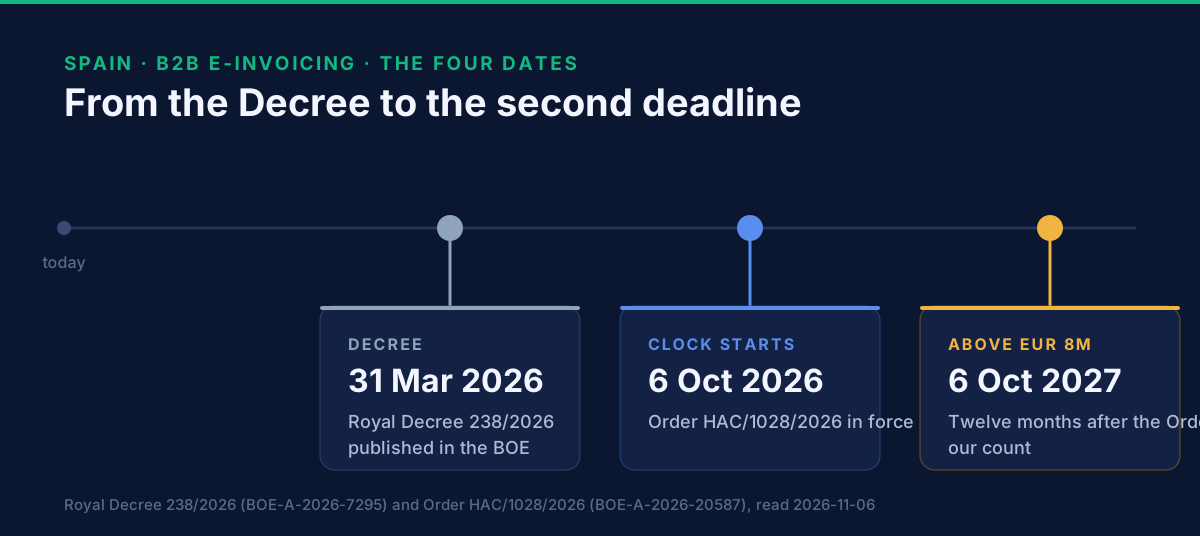
Twelve months after 6 October 2026 for large businesses, twenty-four months after for everyone else. Royal Decree 238/2026 (Real Decreto 238/2026) set the rule in March 2026, and the Ministry of Finance's Order HAC/1028/2026, published in the official gazette (BOE) on 5 October 2026 and in force from 6 October, started the clock. Counting the months from that day gives 6 October 2027 for businesses whose turnover exceeded EUR 8 million in the previous calendar year, and 6 October 2028 for every other business and professional. The BOE text states the months and the start day; the two calendar dates are our count.
| Who | Obligation applies from | Where it is set |
|---|---|---|
| Businesses and professionals whose turnover exceeded EUR 8 million in the previous calendar year | 12 months after 6 October 2026, so 6 October 2027 | Final provision 4.1(a), Royal Decree 238/2026 |
| Every other business and professional | 24 months after 6 October 2026, so 6 October 2028 | Final provision 4.1(b), Royal Decree 238/2026 |
| Private exchange platforms: sending a copy to the public solution, interconnection, operating requirements | 12 months after 6 October 2026 | Final provision 4.2, Royal Decree 238/2026 |
Spain has had a law on this since 2022, the Crea y Crece law (Ley 18/2022), but the law deliberately waited for two things before any clock started: an implementing decree and an order from the Ministry of Finance. Both now exist. Until 2026 this was a law with no date; since 6 October 2026 it has two. Our Spain e-invoicing page keeps the wider picture, and the 2026 e-invoicing mandates tracker puts Spain next to the other countries that moved this year.
Who is in scope?
Any business or professional who has to issue an invoice, when the buyer is also a business or professional based in Spain. Article 3 of the Decree says the invoice must be electronic when the recipient has its place of business, a permanent establishment or, failing that, its domicile or habitual residence in Spain. Where the parties agree that the buyer or a third party issues the invoice on the seller's behalf, the same rule applies, and the party legally obliged to issue it stays responsible.
The turnover test for the larger group is the "volume of operations" as defined in article 121 of the VAT law (Ley 37/1992), measured over the previous calendar year. A business that crossed EUR 8 million in 2026 is therefore tested on its 2026 figure when the first date arrives.
What the Decree leaves out:
- Simplified invoices. Operations documented with a simplified invoice (the ticket a consumer receives) are exempt, unless it is a qualified simplified invoice (article 4.1).
- Three named sectors. The Decree does not apply to the regulated activities of the electricity market operator, to the organised gas market operator, or to invoices settled through the IATA clearing systems (additional provision 2).
- Other exclusions by order. The Minister of Economy, Trade and Business may exclude further operations where the sector's functioning requires it. Such exclusions are normally temporary (article 4.2). None is in the Decree itself.
- Basque Country and Navarre. The public solution for taxpayers under the foral regimes will follow the agreements between the regional treasuries and the Tax Agency (additional provision 3). We have not found those agreements published; if your tax domicile is there, ask your adviser.
Consumers are not in scope: the rule covers invoices between businesses and professionals.
How does the invoice have to be sent?
Through a private exchange platform, through the Tax Agency's free public solution, or through both. Article 5 of the Decree builds the Spanish system from those two parts. A business that has not agreed with its suppliers to receive invoices on a named private platform is treated as having chosen the public solution without having to say so (article 6). A business that does choose a private platform has to publish its invoice entry point on its communications and, if it has one, its website.
Three rules shape how the parts fit together:
- A copy goes to the public solution. A platform or invoicing system that does not use the public solution to issue its invoices must send a faithful electronic copy of each one in UBL to the public solution at the moment of issue, marked as a copy (article 6.2). The public solution is also described as a "universal and mandatory repository" of all electronic invoices.
- Platforms must interconnect. An operator has to connect to any other private platform when a customer asks, accept every interconnection request, and have the link working within one month, without charging the requesting platform (articles 8 and 9).
- Invoices on private platforms are signed. They carry an advanced electronic signature, from the issuer or a delegated signer (article 7.3).
The Tax Agency must also provide a free form that lets any business or professional issue an electronic invoice and report its status (additional provision 1). Access to the public solution and its uses is free of charge.
Which formats are accepted?
EN 16931 data, in one of four syntaxes: CII, UBL, EDIFACT or Facturae. Article 7 requires a structured message following the European semantic model in one of those four. The Decree's preamble adds that Peppol BIS messages are equally valid on private platforms, since they use the UBL syntax and follow EN 16931. The public solution accepts UBL, in the terms of the Order, and an invoice is admitted when its syntax is UBL and the seller's and buyer's tax numbers (NIF) are properly filled in (article 11).
Operators of private platforms must be able to transform an invoice between all the permitted formats while preserving the authenticity of its origin and the integrity of its content (article 7.2). For a company on a Peppol network this is the relevant sentence: Peppol messages are not a separate regime in Spain's rules, they are one of the accepted shapes. This page makes no claim that GoRoute operates as a Spanish private exchange platform under the Decree; what GoRoute operates is a certified Peppol Access Point.
What does the buyer have to report?
Whether the invoice was accepted or rejected, and when it was paid in full. Article 10 requires the recipient to tell the issuer about two statuses: commercial acceptance or rejection with its date, and full payment with the actual payment date. Each has to be reported within four calendar days, excluding Saturdays, Sundays and national holidays. Partial acceptance, partial payment and assignment of the invoice to a third party are voluntary.
Article 12 adds a separate duty: recipients must report full payment to the public solution run by the Tax Agency, whichever route the invoice took. The Decree states the purpose elsewhere as watching payment periods, and a statistics rule (additional provision 7) fixes how the payment period is counted: from the date the buyer received the invoice, or, failing that, the date of issue.
Two transitional rules soften the start:
- For the first twelve months after the date applies to them, businesses above EUR 8 million must attach a readable PDF to each electronic invoice, unless the buyer expressly agrees to the original format. The PDF is sent to the buyer, not to the public solution (transitional provision 2).
- Sole traders and income-attribution entities at or below EUR 8 million may treat status reporting as voluntary until twelve months after their own date (transitional provision 3).
How is this different from Verifactu?
Verifactu regulates the software that issues an invoice. The B2B mandate regulates the invoice itself. Verifactu, under Royal Decree 1007/2023, requires an invoicing system to produce a tamper-evident record for each invoice and a QR code on the document. The B2B mandate requires a structured electronic message exchanged between businesses. A business can be inside one and outside the other: a shop's consumer tickets are inside Verifactu and outside the B2B mandate, while a large manufacturer invoicing a Spanish distributor is inside both.
On 5 October 2026, the same day the Order was published, the Ministry of Finance announced that it plans to postpone the pending Verifactu obligations to October 2028 so that they coincide with e-invoicing for businesses up to EUR 8 million. That is an announcement, not a change in law. Is Verifactu postponed to 2028? separates the two. The other two Verifactu questions have their own pages: who is outside Verifactu (SII, TicketBAI, the Basque Country and Navarre) and what Verifactu does to an online shop's orders.
What is not decided yet?
The technical detail of the public solution, and the day-to-day behaviour of status reporting, sit in the Order and in later Tax Agency documents. This page follows the Decree for the rules and the Order only for the start of the clock. Three things we have not read a final text for, and do not state:
- Any fine or penalty for missing the dates.
- Whether any sector will be excluded under article 4.2.
- Whether the Verifactu announcement will change the B2B dates. It speaks of aligning Verifactu with the B2B calendar, not the other way round.
What should a Spanish business do now?
Decide which route the company will use, and check that its accounting or ERP system can produce EN 16931 invoices. There are roughly eleven months before the first date and almost two years before the second. A sensible order of work:
- Work out which group you are in. Your 2026 volume of operations decides whether your date is October 2027 or October 2028.
- Check what your invoicing software can emit: UBL or another allowed syntax, with the buyer's and seller's NIF.
- Choose the route: the free public solution, a private platform, or both.
- Plan the buyer side as well. Someone has to report acceptance and payment inside four working days.
A company that already invoices abroad over Peppol has most of the format work done, because UBL on EN 16931 is the same family. Our Spain page lists what GoRoute connects today, and the developer documentation shows how an invoice reaches the network from an API. For a walk through your own set-up against these dates, book a session; recorded walkthroughs are on the tutorials page. For a mandate that has already started and shows how such a rollout plays out, read Poland's KSeF mandate, where both waves are live.
Related guides
- Is Verifactu postponed to 2028? The dates that are law today
- Verifactu for online shops: tickets, QR codes and refunds
- Verifactu, SII or TicketBAI: which system applies to you
- E-invoicing in Spain
Sources, all read on 6 November 2026: the Real Decreto 238/2026, de 25 de marzo (BOE-A-2026-7295, published 31 March 2026) for scope, formats, platforms, statuses and the two periods; the Orden HAC/1028/2026, de 2 de octubre (BOE-A-2026-20587, published 5 October 2026) for its entry into force on 6 October 2026, which starts the periods; the Ministry of Finance's note of 5 October 2026 for the planned Verifactu postponement; and the Tax Agency's Verifactu page. The 6 October 2027 and 6 October 2028 dates are our calendar count from the BOE's twelve and twenty-four months. This page describes the rules; it is not tax or legal advice. GoRoute operates certified Peppol Access Point POP000991.
Frequently asked questions
- When does B2B e-invoicing become mandatory in Spain?
- Twelve months after 6 October 2026 for businesses whose turnover exceeded EUR 8 million in the previous calendar year, which is 6 October 2027 by calendar count, and twenty-four months after for everyone else, which is 6 October 2028. The Ministry of Finance's Order HAC/1028/2026 entered into force on 6 October 2026, and Royal Decree 238/2026 counts both periods from that day.
- Is Verifactu the same thing as Spain's B2B e-invoicing mandate?
- No. Verifactu is about the software that issues an invoice: it must create a tamper-evident record and a QR code. The B2B mandate is about the invoice itself being a structured electronic message sent between businesses. They are separate rules with separate dates, and the Ministry has announced that it plans to align them in October 2028.
- Which formats are allowed?
- An invoice must follow the EN 16931 data model in one of four syntaxes: CII, UBL, EDIFACT or Facturae. Peppol BIS messages count as valid on private platforms because they are UBL and follow EN 16931. The Tax Agency's free public solution uses UBL.
- Do I have to use a private platform?
- No. The Decree allows private exchange platforms, the Tax Agency's free public solution, or both together. A business that has not agreed otherwise with its suppliers is treated as choosing the public solution.
- Does a simplified invoice (ticket) have to be an e-invoice?
- No. Article 4 of the Decree exempts operations documented with simplified invoices, unless they are qualified simplified invoices. That is why a shop's consumer tickets are outside the B2B mandate even though they are inside Verifactu.
- What does a buyer have to report?
- Commercial acceptance or rejection of the invoice and its full payment, each within four calendar days excluding weekends and national holidays. Partial acceptance, partial payment and assignment of the invoice can be reported voluntarily.
About Dr. Syed Raza
Dr. Syed Raza is an IT Enterprise Architect at ClayDesk LLC and leads the GoRoute platform. He works across Peppol Access Point and SMP infrastructure, PINT jurisdictions (Oman, AU/NZ, EU, JP, MY, SG), and national CTC regimes, translating regulatory detail into production-grade e-invoicing systems.
Building on Peppol?
GoRoute is a certified Peppol Access Point & SMP. Book a demo or read the docs to get started.