
Oman E-Invoicing from Oracle Applications: The APEX Walkthrough
A recorded walkthrough follows a live transaction out of an Oracle APEX application, and names the Oman rules the resulting tax report has to satisfy.

Last updated .
The short answer
If your finance systems run on Oracle and you are preparing for Oman's e-invoicing programme, the invoice does not travel from Oracle to the Tax Authority. Oracle raises the document exactly as it does now. The data then leaves Oracle as structured data, is validated against Oman's published rule packs, is rendered as UBL 2.1 XML conforming to the Peppol PINT Oman profile, and goes to your buyer over the Peppol network — while a separate tax data document, carrying that invoice inside it, is what reaches the Authority.
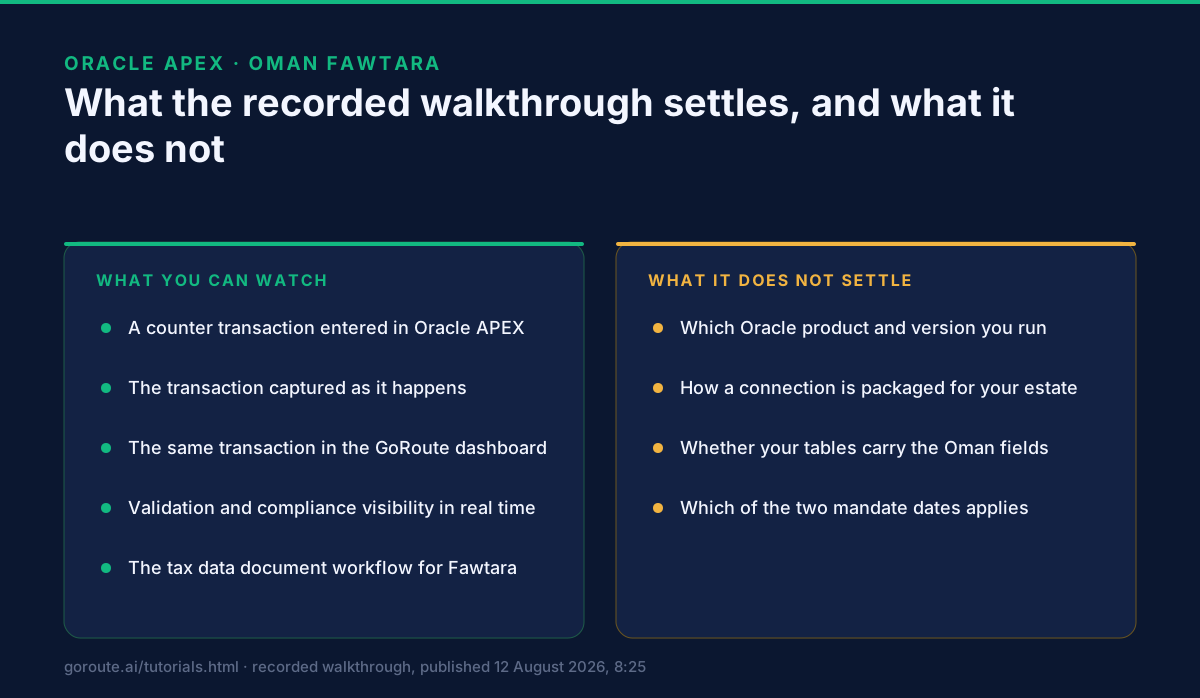
We have published a recorded walkthrough of that path for an application built in Oracle APEX. It runs 8 minutes 25 seconds, it is chaptered, and you can watch it without speaking to anyone. This page describes what it shows, says plainly what it does not settle, and names the values an Oracle record has to carry before Oman's rules will accept it.

- 00:00 — Introduction
- 00:25 — Money-exchange branch scenario
- 00:55 — Customer requests remittance abroad
- 01:25 — Teller starts the transaction in Oracle APEX
- 02:10 — Oracle APEX transaction data entry
- 03:00 — The connector captures the transaction
- 03:45 — Transaction appears in GoRoute transactions page
- 04:35 — Real-time validation and compliance visibility
- 05:20 — Tax Data Document (TDD) workflow
- 06:10 — Reporting flow for Oman Fawtara readiness
- 06:55 — End-to-end transaction visibility
- 07:35 — Why this matters for finance, ERP and compliance teams
- 08:00 — Book a GoRoute.ai demo
Which Oracle are we talking about?
Oracle is not one product, and the difference decides the whole shape of the work. Oracle Fusion Cloud ERP, E-Business Suite, NetSuite and applications your own team built in Oracle APEX are four different starting points. Treating them as one is how an integration estimate goes wrong in week one.
The walkthrough is the APEX case: a custom application at a service counter, the kind a business writes for itself because no packaged product fits how it trades. A teller enters a remittance transaction; the transaction is captured as it happens; the same transaction appears in the GoRoute transactions page; and it moves into the tax data document workflow used for Oman Fawtara reporting. The chapter at 01:25 is where the teller starts in APEX; 03:00 is where the capture happens; 05:20 is the tax data document.
This page makes no claim about a shelf product for Oracle. What exists is the recording. How a connection would be built, packaged and supported for your own estate is a scoping conversation, and the answer to it should arrive in writing.
Why the custom-application case is different
Because a packaged ERP localised for Oman already has somewhere to put Oman's fields, and an application you wrote yourself does not. That is the real difference between this walkthrough and the same story told for SAP S/4HANA or Microsoft Dynamics 365. In a packaged system the work is configuration. In an APEX application the work starts with columns that do not exist yet.
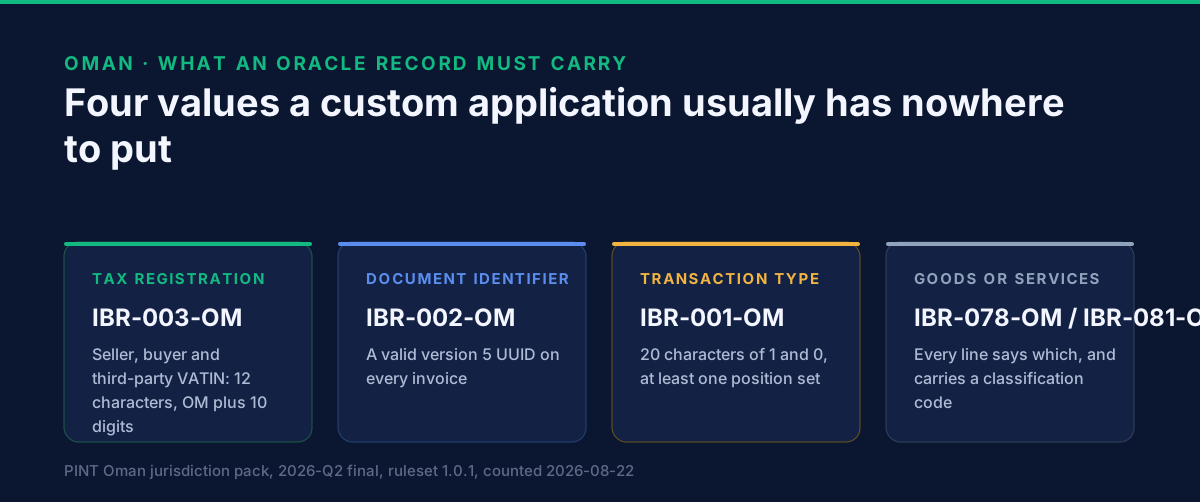
Four values decide whether Oman's rule packs accept the document:
- The tax registration numbers. Rule
IBR-003-OMrequires the seller VATIN, the buyer VATIN and any third-party VATIN to be exactly 12 characters:OMfollowed by ten digits. A free-text customer reference field will not survive it. - A document identifier. Rule
IBR-002-OMrequires a unique identifier on the invoice that is a valid UUID version 5. Not a sequence number, not any UUID — version 5, which is generated from a namespace and a name rather than at random. - The transaction type. Rules
IBR-001-OMandALIGNED-IBRP-000-OMrequire a 20-character string of1and0with at least one position set. It is an enumeration, not free text: a full tax invoice is10000000000000000000, a self-billed document00100000000000000000, a third-party invoice00010000000000000000, a summary invoice00001000000000000000, a continuous supply00000100000000000000, an export00000010000000000000. The type then decides which other rules apply to the document, which is why it cannot be defaulted and forgotten. - What each line is. Rule
IBR-078-OMrequires every line to say whether it is goods or services, andIBR-081-OMrequires an industrial classification code on each item, taken from the classification list published by the Omani authorities. Where the line is goods,IBR-079-OMandIBR-080-OMrequire a Harmonized System code of exactly 12 digits; service-type codes are validated separately underCL-12-OM.
Amounts have their own constraint worth knowing before anyone designs a table:
IBR-DEC-03-OM refuses any amount carrying more than three decimal places, which is
the Omani rial's own precision rather than the two most systems default to.
Start with your own company record and one customer. Getting those two right removes most of the noise from early test results. Then count the gap: how many active customers in your Oracle data have no usable VAT identifier. That number is the size of the data work, and it is much cheaper to know in week one than in week nine.
What does "real-time" actually mean here?
One report per transaction, carrying the time it happened. Real-time is not a
marketing adjective in Oman's model; it is a property of the report format. The tax data
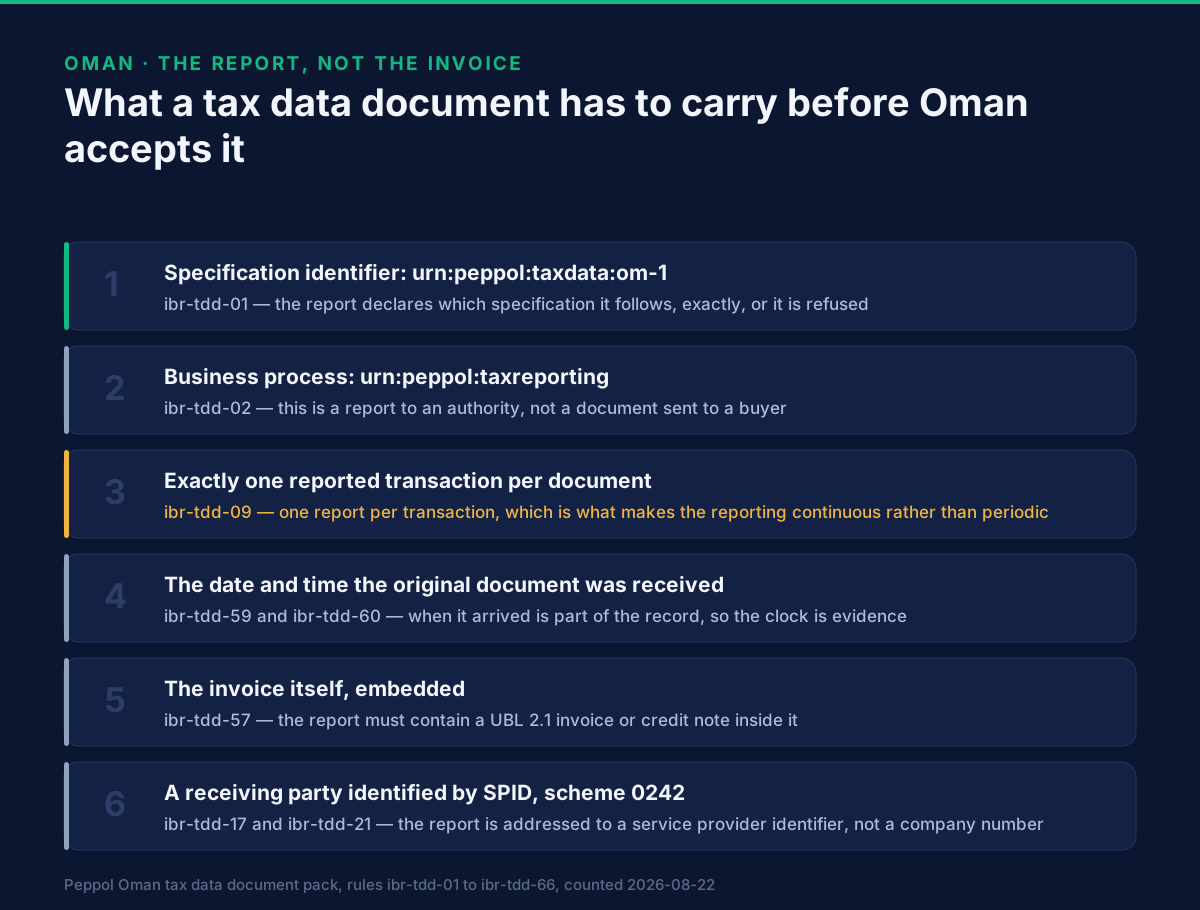
document pack allows exactly one reported transaction per document (ibr-tdd-09),
and requires the date and time the original document was received to be present
(ibr-tdd-59 and ibr-tdd-60). A design that batches a day's transactions into one
report does not satisfy that shape.
Four more rules describe the report itself, and each one refuses the document if it is
wrong. The specification identifier must be exactly urn:peppol:taxdata:om-1
(ibr-tdd-01). The business process must be urn:peppol:taxreporting (ibr-tdd-02) —
this is a report to an authority, not a document to a buyer. The report must contain
the invoice itself, as a UBL 2.1 invoice or credit note (ibr-tdd-57). And the
receiving party is identified by a service provider identifier in scheme 0242
(ibr-tdd-17), not by a company registration number.
That is also why the walkthrough spends time on the transactions page rather than only on the send. A transaction whose status nobody can see is not auditable, and from the mandate date the record is what has to stand up, not the send.
How do you know a document will be accepted?
By validating a real one, early. GoRoute checks a document against the full PINT OM 1.0.1 rule set, including its Schematron rules, and returns a compliance score with human-readable errors rather than a bare pass or fail. An error that names the field and the rule is a ticket a developer can act on; a rejection code is a conversation.
Three layers can refuse the document, and it is worth knowing the size of each. Counted in the packs we ship on 22 August 2026: the shared Peppol PINT layer holds 170 rules, every one of them fatal; Oman's own jurisdiction pack holds 155, of which exactly two are warnings; and the tax data document has its own pack of 66 rules, all fatal. Any fatal finding refuses the document before anything is sent, and the response names the rule by its own identifier.
Severity comes from the rule file, not from how the sentence reads. Three Oman rules are worded should and are flagged fatal, so a message that sounds like advice can still refuse the document. Why that happens, and how to read a rejection, is set out in why Oman e-invoices get rejected.
Two things make validating properly cheap. Validation-only calls carry no per-call charge, so validating the same document forty times while an APEX mapping is corrected costs nothing. And you can validate long before you can send, so the development work and the commercial work run in parallel rather than in sequence.
For volume, batch submission takes between 1 and 1,000 invoices in a single request, with separate validate and process stages — useful for backfilling and for month-end, even where the live path reports one transaction at a time.
What has to be in the document, field by field?
That question has its own page rather than a summary here: what an Oman e-invoice must contain is set out in the Oman e-invoice format, and the exchange model behind it — who sends what to whom — is in Oman's Fawtara five-corner model. If you would rather test than read, how to test an Oman e-invoice before sending it is the shortest route to a real validation result.
Which Oman deadline applies to an Oracle user?
The same one that applies to everybody else — it depends on annual supplies, not on your technology. Decision 189/2026 makes electronic tax invoices mandatory from 1 April 2027 for taxable persons whose annual supplies exceed OMR 5,000,000, and from 1 October 2027 for those at or below that figure.
The full detail of what the Decision changed is on the page that covers Oman's e-invoicing dates. This page states no further dates, on purpose — one page should own that question.
Where do the invoices live?
For Oman, in Oman. GoRoute operates in-country data residency on Otech's Tier III Oracle Cloud Infrastructure region, covering invoices, keys, tax data documents and audit logs, and operates ISO 27001-aligned practices on certified cloud infrastructure.
For an Oracle estate that is usually the easiest part of the security review to answer, and it is a much cheaper question in week one than in month six.
What to do this week
- Watch the capture at 03:00 and the tax data document workflow at 05:20. Five minutes, and together they show what your application has to produce.
- Look at your own tables. Is there anywhere to store a 12-character VATIN, a version 5 UUID, a 20-character transaction type, and a classification code per line? If not, that is the first ticket.
- Check your amount precision. Three decimal places, not two.
- Count your identifier gap — active customers with no usable VAT identifier.
- Establish which date applies to you by annual supplies, not by headcount or sector.
- Ask any shortlisted provider for their accreditation in writing, along with what they would actually build for your Oracle product and version.
Running a different system?
The same question, answered for the systems next to Oracle in most Omani finance functions: Oman e-invoicing from SAP S/4HANA, Oman e-invoicing from Microsoft Dynamics 365, Odoo e-invoicing in Oman, TallyPrime and Oman's e-invoicing programme, and, where there is no integration at all, sending Oman e-invoices from a spreadsheet.
For the product view of the Oracle connection rather than the regulatory one, see the Oracle integration page; for the interfaces themselves, the API services page; for the market as a whole, the Oman page. If it is easier to talk it through against your own Oracle estate, book a working session.
The recording described above has its own page — the Oracle APEX real-time e-invoicing walkthrough — which is where the video plays, where its chapters are listed and where its description lives; the index of all of them is the tutorials page.
Where GoRoute stands
GoRoute is an e-invoicing service provider accredited in Oman by the Oman Tax Authority, on 29 July 2026, through Union Digital Technologies SPC. It operates a Peppol-certified Access Point (Service Provider ID POP000991, ClayDesk LLC), and re-certified PINT OM v1.0.1 conformance in July 2026 with all suites passed — Billing and tax data document 7/7, self-billing 7/7, reporting 2/2, eDelivery 7/7, and BIS Billing 5/5.
Those are checkable facts rather than adjectives, which is the point: ask any provider for the equivalent. How to check an Oman provider's claim sets out the seven questions to ask.
Sources
- GoRoute tutorials — the recorded Oracle APEX walkthrough described on this page, published 12 August 2026, 8 minutes 25 seconds, thirteen chapters as published by the uploader
- PINT OM Billing Process v1.0.1 — the Oman specification the validation rules come from
- Oman Tax Authority tax portal
- OpenPeppol — the network the exchange runs on
Rule identifiers, counts and field constraints on this page were read from the Oman rule packs GoRoute ships, on 22 August 2026. The chapter marks were re-read from the video's own page on the same day.
Frequently asked questions
- How does an invoice from an Oracle system reach Oman's Tax Authority?
- It does not go there directly. Oracle raises the document as it always did. The data then leaves Oracle as structured data, is validated against Oman's rule packs, is rendered as UBL 2.1 XML conforming to the Peppol PINT Oman profile, and travels to the buyer over the Peppol network — while a separate tax data document, carrying that invoice inside it, is what reaches the Authority. The recorded walkthrough shows that path for an application built in Oracle APEX.
- Which Oracle products does this cover?
- Oracle is not one product. Oracle Fusion Cloud ERP, E-Business Suite, NetSuite and applications your own team built in Oracle APEX each take a different integration path, and the published walkthrough is the APEX case — a custom application at a service counter. Which product and version apply to your estate is a scoping question to ask and get answered in writing rather than inferred from a demonstration.
- Is there a GoRoute connector product for Oracle?
- This page claims none. What exists and can be watched is a recorded integration between an Oracle APEX application and GoRoute, published on 12 August 2026. How a connection would be built, packaged and supported for Fusion Cloud ERP, E-Business Suite, NetSuite or your own APEX application is a question for a scoping conversation, and the answer should arrive in writing.
- Where can I watch the Oracle APEX walkthrough?
- It is embedded on this page and on GoRoute's tutorials page at goroute.ai/tutorials.html. It runs 8 minutes 25 seconds and the uploader published thirteen chapter marks, so you can go straight to the capture at 03:00, real-time validation at 04:35, or the tax data document workflow at 05:20 rather than watching the whole thing.
- What does a custom Oracle application have to carry that a packaged ERP usually already has?
- Columns. Oman's rule pack requires the seller, buyer and third-party VAT identification numbers to be exactly twelve characters — OM followed by ten digits — under IBR-003-OM; a version 5 UUID on every invoice under IBR-002-OM; a twenty-character transaction type of ones and zeros under IBR-001-OM; and, on every line, whether it is goods or services under IBR-078-OM with an industrial classification code under IBR-081-OM. A packaged ERP localised for Oman ships fields for these. An application your team wrote has them only if somebody adds them.
- What is a tax data document, and how is it different from the invoice?
- The invoice is what your buyer receives. The tax data document is the report that goes to the Authority, and it carries the invoice inside it — rule ibr-tdd-57 requires the report to contain a UBL 2.1 invoice or credit note. It has its own pack of 66 rules, all of them fatal, including exactly one reported transaction per document under ibr-tdd-09 and the date and time the original was received under ibr-tdd-59 and ibr-tdd-60. That is why a validation result can be clean on the invoice and still leave work to do.
- How many rules can refuse an Oman invoice raised in Oracle?
- Counted in the packs GoRoute ships on 22 August 2026: 170 in the shared Peppol PINT layer, all of them fatal; 155 in Oman's own jurisdiction pack, of which exactly two are warnings; and 66 in the tax data document pack, all fatal. Any fatal finding refuses the document, and the response names the rule that fired by its own identifier.
- Can a services business skip the goods classification codes?
- Partly. Rule IBR-080-OM applies the twelve-digit Harmonized System code to a goods line, so a service line does not carry one — but rule IBR-078-OM still requires every line to state whether it is goods or services, and IBR-081-OM still requires an industrial classification code on each item, taken from the classification list the Omani authorities publish. Service-type codes are validated separately under CL-12-OM.
- Which Oman e-invoicing date applies to an Oracle user?
- The same dates as everyone else, and they depend on annual supplies rather than on which system you run. Decision 189/2026 makes electronic tax invoices mandatory from 1 April 2027 for taxable persons whose annual supplies exceed OMR 5,000,000, and from 1 October 2027 for those at or below that figure.
- Where are the invoices stored?
- For Oman, in Oman. GoRoute operates in-country data residency on Otech's Tier III Oracle Cloud Infrastructure region, covering invoices, keys, tax data documents and audit logs, and operates ISO 27001-aligned practices on certified cloud infrastructure.
About Dr. Syed Raza
Dr. Syed Raza is an IT Enterprise Architect at ClayDesk LLC and leads the GoRoute platform. He works across Peppol Access Point and SMP infrastructure, PINT jurisdictions (Oman, AU/NZ, EU, JP, MY, SG), and national CTC regimes, translating regulatory detail into production-grade e-invoicing systems.
Building on Peppol?
GoRoute is a certified Peppol Access Point & SMP. Book a demo or read the docs to get started.