
Oman E-Invoicing from Microsoft Dynamics 365: The Connector Walkthrough
A recorded walkthrough shows how an invoice leaves Microsoft Dynamics 365 Business Central, is validated against Oman's rules and reaches the Tax Authority.

Last updated .
The short answer
If your finance team runs Microsoft Dynamics 365 and you are preparing for Oman's e-invoicing programme, the invoice does not go from Dynamics to the Tax Authority. It goes from Dynamics as structured data, is validated against Oman's published rule packs, is rendered as UBL 2.1 XML conforming to the Peppol PINT Oman profile, travels to your buyer over the Peppol network — and a separate tax data document, derived from that invoice, is what reaches the Authority. Nobody in your finance team has to work differently; what changes is what happens after they press post.
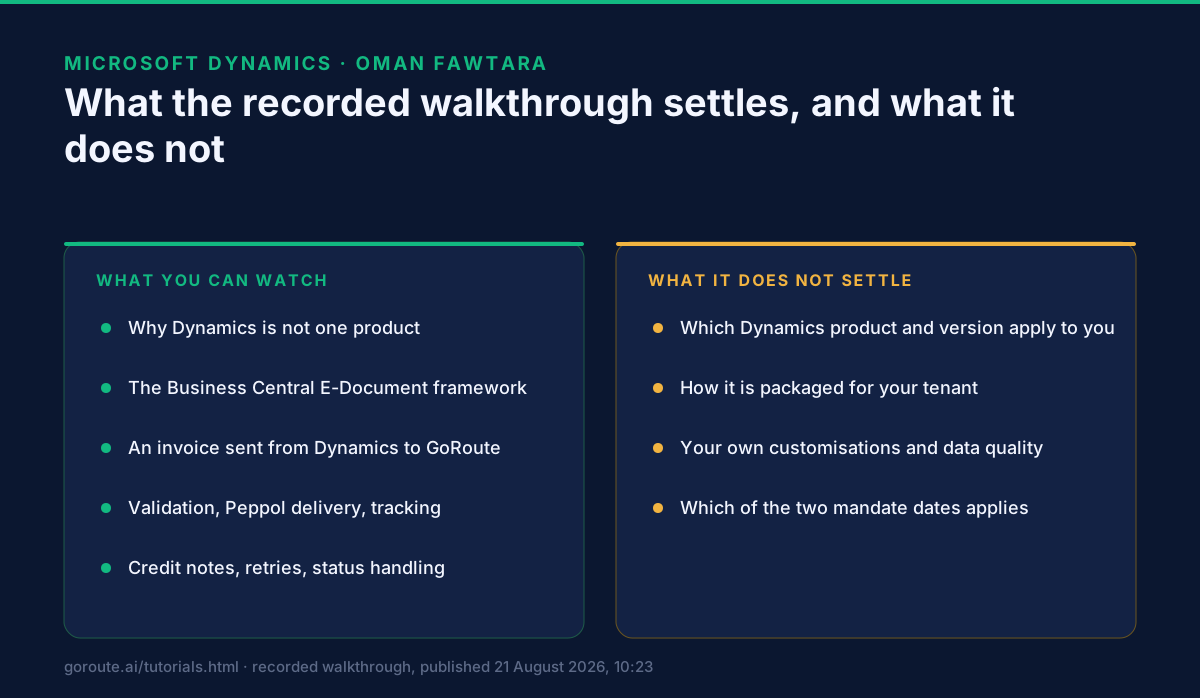
We have published a recorded walkthrough of that path for Dynamics. It runs 10 minutes 23 seconds, it is chaptered, and you can watch it without speaking to anyone. This page describes what it shows, says plainly what it does not settle, and names the four fields in your Dynamics master data that decide whether a document is accepted.

- 00:00 — Introduction — GoRoute connector for Microsoft Dynamics ERP
- 00:25 — Why Microsoft Dynamics e-invoicing needs the right approach
- 00:55 — Dynamics is not one product: Business Central, Finance & Operations, CRM, and legacy ERP
- 01:35 — Why GoRoute starts with Dynamics 365 Business Central
- 02:15 — How the Business Central E-Document framework works
- 03:00 — Sending invoices from Microsoft Dynamics ERP to GoRoute
- 03:45 — Validation, Peppol delivery, and transaction tracking
- 04:35 — Oman Fawtara readiness for Microsoft Dynamics users
- 05:20 — Credit notes, retries, and invoice status handling
- 06:05 — Why webhook-only integrations can fail
- 06:50 — How GoRoute supports ERP, finance, and compliance teams
- 07:30 — Next steps for Microsoft Dynamics e-invoicing
- 07:55 — Book a GoRoute demo
Which Microsoft Dynamics are we talking about?
Dynamics is not one product, and that is the first thing the walkthrough says. Business Central, Finance & Operations, Sales and Customer Service, and older on-premise systems each take a different integration path. Treating a Dynamics estate as one thing is how integration projects arrive at the wrong estimate.
The walkthrough starts with Dynamics 365 Business Central and its E-Document framework, and follows a single invoice from there: out of Business Central, into GoRoute, through validation, over Peppol, with the transaction and its status findable afterwards. The chapter at 02:15 is where the framework itself is explained; the one at 03:00 is where the invoice leaves Dynamics.
What has to be right in Dynamics before anything is sent?
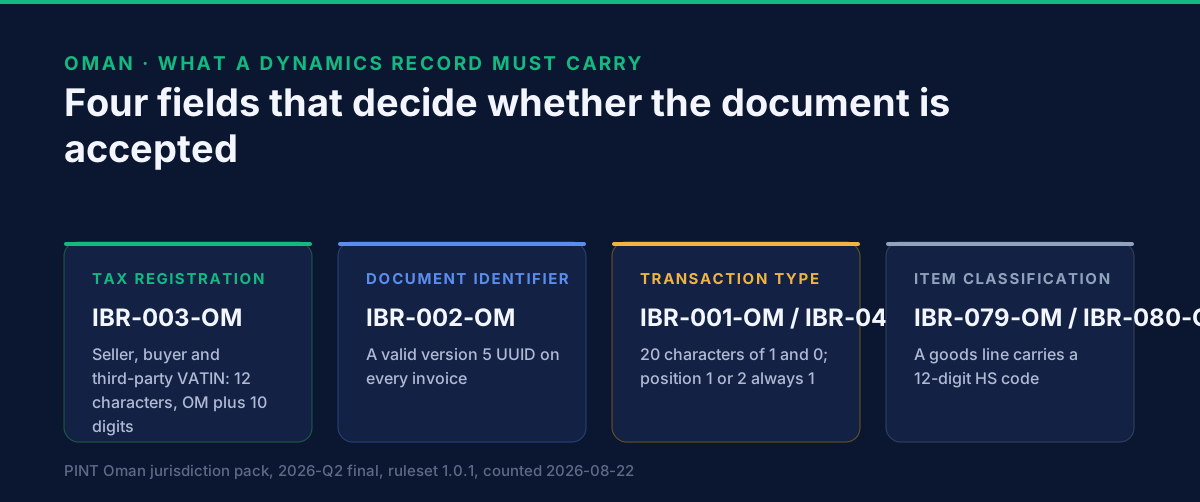
Master data, not the integration. This is the part almost every project underestimates, and none of it is technical work. Four values decide whether Oman's rule packs accept the document, and each one lives in an ordinary Dynamics record:
- The tax registration numbers. Rule
IBR-003-OMrequires the seller VATIN, the buyer VATIN and any third-party VATIN to be exactly 12 characters:OMfollowed by ten digits. That sits on your company record and across your customer records. - A document identifier. Rule
IBR-002-OMrequires a unique identifier on the invoice that is a valid UUID version 5. Not any UUID — version 5. - The transaction type. Rules
IBR-001-OMandIBR-043-OMrequire a 20-character string of1and0, with the first or second position always set to1. It is how Oman distinguishes a full tax invoice from a simplified one, an export, a summary invoice or a self-billed document, and it has no equivalent field in a stock Dynamics install. - Item classification on goods lines. Rules
IBR-079-OMandIBR-080-OMrequire a goods line to carry a Harmonized System code of exactly 12 digits, andIBR-081-OMrequires an industrial classification code on each item. Both are item master data.
Amounts have their own constraint worth knowing before anyone builds a mapping:
IBR-DEC-03-OM refuses any amount carrying more than three decimal places, which is
the Omani rial's own precision and not the two most ERP configurations default to.
Start with your own company record. It is a handful of entries and entirely within your control, and getting it right removes most of the noise from early test results. Then count the gap: how many active customers in Dynamics have no usable VAT identifier. That single number is the size of the data work, and it is much better known in week one than in week nine.
How do you know an invoice will be accepted?
By validating a real one, early. GoRoute checks a document against the full PINT OM 1.0.1 rule set, including its Schematron rules, and returns a compliance score with human-readable errors rather than a bare pass or fail. An error that names the field and the rule is a ticket someone can act on; a rejection code is a conversation.
Three layers can refuse the document, and it is worth knowing the size of each. Counted in the packs we ship on 22 August 2026: the shared Peppol PINT layer holds 170 rules, every one of them fatal; Oman's own jurisdiction pack holds 155, of which exactly two are warnings; and the tax data document has its own pack of 66 rules, all fatal. Any fatal finding refuses the document before anything is sent, and the response names the rule by its own identifier.
Severity comes from the rule file, not from how the sentence reads. Three Oman rules are worded should and are flagged fatal, so a message that sounds like advice can still refuse the document. Why that happens, and how to read a rejection, is set out in why Oman e-invoices get rejected.
Two things make validating properly cheap. Validation-only calls carry no per-call charge, so validating the same Dynamics invoice forty times while a mapping is being corrected costs nothing. And you can validate long before you can send, so the technical work and the commercial work run in parallel rather than in sequence.
For volume, batch submission takes between 1 and 1,000 invoices in a single request, with separate validate and process stages. That shape matters at month-end, when the invoices arrive in an hour rather than across a day.
Does the Tax Authority receive the same file?
No. Your buyer receives the invoice; a tax data document, derived from that invoice and carrying it, is what goes to the Authority. It has its own rule pack of 66 rules and it is a separate document, which is why a validation result can be clean on the invoice and still leave work to do. What an Oman e-invoice has to be, field by field, is in the Oman e-invoice format; the exchange model behind it is in Oman's Fawtara five-corner model.
What the walkthrough shows that most integration decks skip
Two chapters are worth the time even if you watch nothing else.
Credit notes, retries and invoice status, at 05:20. This is where most integrations turn out to be incomplete. An invoice that sends is easy; a credit note that references the right preceding document, a retry that does not duplicate, and a status your finance team can see are the parts that decide whether the system is usable in month three.
Why webhook-only integrations can fail, at 06:05. A webhook that is missed is a document whose status nobody knows, and a design that has no second way to ask is a design that quietly loses things. This is a genuine architectural warning rather than a product pitch, and it applies whichever provider you choose.
Which Oman deadline applies to a Dynamics user?
The same one that applies to everybody else — it depends on annual supplies, not on your accounting system. Decision 189/2026 makes electronic tax invoices mandatory from 1 April 2027 for taxable persons whose annual supplies exceed OMR 5,000,000, and from 1 October 2027 for those at or below that figure.
The full detail of what the Decision changed is on the page that covers Oman's e-invoicing dates. This page states no further dates, on purpose — one page should own that question.
Where do the invoices live?
For Oman, in Oman. GoRoute operates in-country data residency on Otech's Tier III Oracle Cloud Infrastructure region, covering invoices, keys, tax data documents and audit logs, and operates ISO 27001-aligned practices on certified cloud infrastructure.
Data residency is usually raised late, by a security review, at the point where changing the answer is expensive. It is a much cheaper question in week one.
What to do this week
- Watch the validation chapter at 03:45 and the Fawtara chapter at 04:35. Fifteen minutes, and together they determine how your project will feel.
- Count your identifier gap in Dynamics — active customers with no usable VAT identifier. That single number sizes the data work.
- Check your amount precision. Three decimal places, not two.
- Establish which date applies to you by annual supplies, not by headcount or sector.
- Ask any shortlisted provider for their accreditation in writing, along with the Dynamics product and version support you would be relying on.
Running a different system?
The same question, answered for the systems next to Dynamics in most Omani finance functions: Oman e-invoicing from SAP S/4HANA, Odoo e-invoicing in Oman, TallyPrime and Oman's e-invoicing programme, and, where there is no integration at all, sending Oman e-invoices from a spreadsheet.
For the product view of the Microsoft connection rather than the regulatory one, see the Microsoft integration page; for the market as a whole, the Oman page. If it is easier to talk it through against your own Dynamics estate, book a working session.
The recording described above has its own page — the Dynamics connector walkthrough — which is where the video plays, where its chapters are listed and where its description lives; the index of all of them is the tutorials page.
Where GoRoute stands
GoRoute is an e-invoicing service provider accredited in Oman by the Oman Tax Authority, on 29 July 2026, through Union Digital Technologies SPC. It operates a Peppol-certified Access Point (Service Provider ID POP000991, ClayDesk LLC), and re-certified PINT OM v1.0.1 conformance in July 2026 with all suites passed — Billing and tax data document 7/7, self-billing 7/7, reporting 2/2, eDelivery 7/7, and BIS Billing 5/5.
Those are checkable facts rather than adjectives, which is the point: ask any provider for the equivalent. How to check an Oman provider's claim sets out the seven questions to ask.
Sources
- GoRoute tutorials — the recorded Microsoft Dynamics walkthrough described on this page, published 21 August 2026, 10 minutes 23 seconds, thirteen chapters as published by the uploader
- PINT OM Billing Process v1.0.1 — the Oman specification the validation rules come from
- Oman Tax Authority tax portal
- OpenPeppol — the network the exchange runs on
Rule identifiers, counts and field constraints on this page were read from the Oman rule packs GoRoute ships, on 22 August 2026. The chapter marks were re-read from the video's own page on the same day.
Frequently asked questions
- How does an invoice get from Microsoft Dynamics 365 to Oman's Tax Authority?
- Dynamics raises the invoice as it always did. The invoice data then leaves Dynamics as structured data, is validated against Oman's rule packs, is rendered as UBL 2.1 XML conforming to the Peppol PINT Oman profile, travels to the buyer over the Peppol network, and a separate tax data document derived from that invoice is what reaches the Oman Tax Authority. The recorded walkthrough shows that path for Dynamics 365 Business Central.
- Which Microsoft Dynamics products does this cover?
- Microsoft Dynamics is not one product. Business Central, Finance & Operations, Sales and Customer Service, and older on-premise systems each take a different integration path, which is why the walkthrough starts with Dynamics 365 Business Central and its E-Document framework rather than treating every Dynamics estate the same way. Which product and version apply to you is a question to ask and get answered in writing.
- Where can I watch the Microsoft Dynamics e-invoicing walkthrough?
- It is embedded on this page and on GoRoute's tutorials page at goroute.ai/tutorials.html. It runs 10 minutes 23 seconds and the uploader published thirteen chapter marks, so you can go straight to validation at 03:45, Oman Fawtara readiness at 04:35, or credit notes and retries at 05:20 rather than watching the whole thing.
- What has to be right in Dynamics before any of this works?
- Master data, not the integration. Oman's own rule pack requires the seller, buyer and third-party VAT identification numbers to be exactly twelve characters — OM followed by ten digits — under rule IBR-003-OM, a version 5 UUID on every invoice under IBR-002-OM, a twenty-character transaction type of ones and zeros under IBR-001-OM, and a twelve-digit Harmonized System code on goods lines under IBR-079-OM and IBR-080-OM. Those values live in your Dynamics customer, company and item records.
- How do we know a Dynamics invoice will be accepted before we send it?
- By validating a real one. GoRoute checks a document against the full PINT OM 1.0.1 rule set including its Schematron rules and returns a compliance score with human-readable errors rather than a bare pass or fail. Validation-only calls carry no per-call charge, so validating the same invoice repeatedly while a Dynamics mapping is being corrected costs nothing.
- How many rules can refuse an Oman invoice raised in Dynamics?
- Counted in the packs GoRoute ships on 22 August 2026: 170 in the shared Peppol PINT layer, all of them fatal; 155 in Oman's own jurisdiction pack, of which exactly two are warnings; and 66 in the tax data document pack, all fatal. Any fatal finding refuses the document, and the response names the rule that fired by its own identifier.
- Can we send a month of Dynamics invoices in one go?
- Yes. Batch submission takes between 1 and 1,000 invoices in a single request, with separate validate and process stages. That shape matters at month-end, which is when a design that sends one invoice per call tends to fail.
- Which Oman e-invoicing date applies to a Microsoft Dynamics user?
- The same dates as everyone else, and they depend on annual supplies rather than on which system you run. Decision 189/2026 makes electronic tax invoices mandatory from 1 April 2027 for taxable persons whose annual supplies exceed OMR 5,000,000, and from 1 October 2027 for those at or below that figure.
- Where are the invoices stored?
- For Oman, in Oman. GoRoute operates in-country data residency on Otech's Tier III Oracle Cloud Infrastructure region, covering invoices, keys, tax data documents and audit logs, and operates ISO 27001-aligned practices on certified cloud infrastructure.
About Dr. Syed Raza
Dr. Syed Raza is an IT Enterprise Architect at ClayDesk LLC and leads the GoRoute platform. He works across Peppol Access Point and SMP infrastructure, PINT jurisdictions (Oman, AU/NZ, EU, JP, MY, SG), and national CTC regimes, translating regulatory detail into production-grade e-invoicing systems.
Building on Peppol?
GoRoute is a certified Peppol Access Point & SMP. Book a demo or read the docs to get started.