
Odoo E-Invoicing in Oman: What Our Fawtara Demo Shows
A recorded demo shows an invoice raised in Odoo validated against Oman PINT OM rules and cleared. What it covers, what it does not, and how to watch it.

Last updated .
The short answer
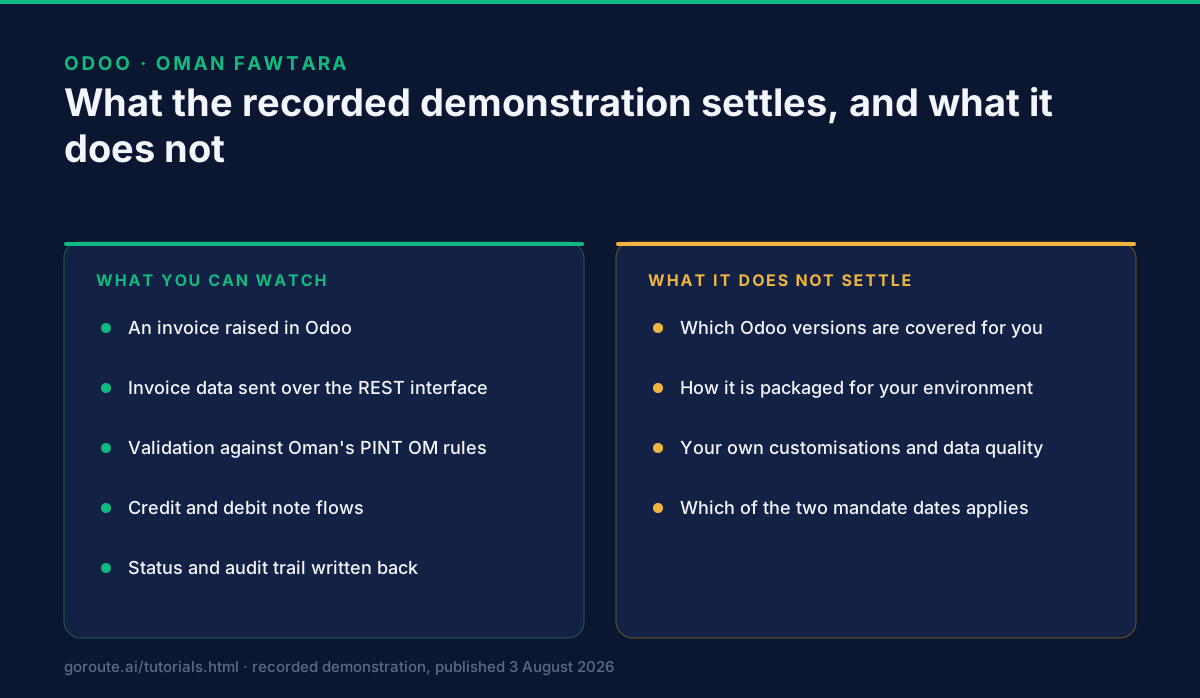
If your finance team runs Odoo and you are preparing for Oman's e-invoicing mandate, the question is not whether Odoo can produce an invoice — it is what happens to that invoice afterwards. We have published a recorded demonstration of that path for Oman: an invoice raised in Odoo, sent over a REST interface to GoRoute, validated against Oman's PINT OM rules, and its status and audit trail written back. It runs about eleven and a half minutes, it is chaptered, and you can watch it without speaking to anyone — as can the shorter recording published on 19 August 2026, which covers the connection itself in under four minutes.
This page describes what that recording shows, states plainly what it does not settle, and points you at the two things you can start on today regardless: your party identifiers, and which of the two mandate dates applies to you.
Where do I watch the Odoo to Fawtara demonstration?
On our tutorials page: goroute.ai/tutorials.html. The full Odoo recording sits there alongside the other integration demonstrations, and it is divided into twelve chapters so you can go straight to the part you care about. Each link below opens the recording at that point.
The three chapters worth watching if you only watch three are real-time validation at 03:15, credit notes and debit notes at 06:30, and the audit trail at 07:35. The first tells you how errors reach you, the second is where most integrations turn out to be incomplete, and the third is what your auditor will ask about.
Is there a shorter version?
Yes — one that runs 3 minutes 46 seconds. How To Connect Odoo in Minutes, published on 19 August 2026, covers the connection rather than the whole integration: opening the invoicing workflow in Odoo, connecting Odoo to GoRoute, sending the invoice data across, the validation and processing that follows, and finding the transaction and its status afterwards. It is on the tutorials page with the others, and on YouTube.
Watch the short one to decide whether the integration is worth your team's time. Watch the eleven-minute one when you are scoping the work.
What the short recording shows, in words
If video is blocked where you are reading this, the sequence is the substance, and writing it out is worth more than the recording to anyone building a plan:
- The invoice is raised in Odoo the ordinary way. Nothing changes about how a person enters an invoice. That matters more than it sounds: the commonest objection to e-invoicing projects is that finance staff will have to work differently, and here they do not.
- Odoo is connected to GoRoute once, as a setup step, rather than per invoice or per user.
- The invoice data leaves Odoo as structured data, not as a PDF. This is the whole point of the exercise. A tax authority and a buyer's system both read fields; neither reads a picture of an invoice.
- GoRoute validates and processes it, and answers. The result comes back as a status you can act on rather than as silence you have to chase.
- The transaction is findable afterwards, with its status. That is the part an auditor asks about, and the part a manual process cannot produce a year later.
As with the longer recording, this is a demonstration of the path rather than a statement about your particular Odoo installation. The next section says what it does not settle.
What the demonstration does not settle
A recording is evidence of a path, not a statement about your installation. Three things it deliberately does not answer, and it is better to hear that here than to discover it in a procurement meeting:
- Which Odoo versions are covered for you. Version support and packaging depend on your environment and your Odoo edition. Ask, and get the answer in writing — from us or from any other provider.
- What your own customisations do. Most Odoo estates that have been in use for a few years carry local modifications to invoicing. Those are found by running your own documents through validation, not by watching a demonstration.
- Whether your data is ready. That is the next section, and it is the part almost every project underestimates.
What has to be right in Odoo before any of this works?
The party identifiers. Oman uses Peppol scheme 0248, and the identifier is the VAT identification number carried with an OM prefix. It is required for the seller and for the buyer, which means it has to be present in your own company records and across your customer records in Odoo.
This is the task to start first, because it is not a technical task and it does not sit with the people doing the integration. Two habits save weeks:
- Fix your own side first. Your company records are a handful of entries and entirely within your control. Getting them right removes most of the noise from early test results.
- Count the gap before you plan around it. Run a count of active customers with no usable VAT identifier. That number is the size of the data work, and it is much better known in week one than in week nine.
How do you know an invoice will be accepted?
By validating a real one, early. GoRoute validates a document against the full PINT OM 1.0.1 rule set, including its Schematron rules, and returns a compliance score with human-readable errors rather than a bare pass or fail. An error that names the field and the rule is a ticket someone can act on; a rejection code is a conversation.
Two things make this cheap enough to do properly. Validation-only calls carry no per-call charge, along with status lookups and webhooks — billing is per document exchanged, so validating the same invoice forty times while getting a mapping right costs nothing. And you can validate long before you can send, so the technical work and the commercial work run in parallel rather than in sequence.
For volume, batch submission takes between 1 and 1,000 invoices in a single request, with separate validate and process stages. That shape matters at month-end, when the invoices arrive in an hour rather than across a day.
Which Oman deadline applies to an Odoo user?
The same one that applies to everybody else — it depends on your annual supplies, not on your accounting system. Decision 189/2026 makes electronic tax invoices mandatory from 1 April 2027 for taxable persons whose annual supplies exceed OMR 5,000,000, and from 1 October 2027 for those at or below that figure.
Ahead of both, the Tax Authority's Fawtara FAQ placed a voluntary pilot of 100 large VAT-registered companies in August 2026, a month that has now passed. That is a statement by the Authority rather than a phase written into the Decision, and it should not be planned around as though it were law. Limited, application-based exemptions also exist: the Chairman may grant a time-limited exemption on a documented application, conditional on returns and payments being on time.
The full detail of what the Decision changed is on the page that covers Oman's e-invoicing dates. This page states no further dates, on purpose — one page should own that question.
Where do the invoices live, and who can see them?
For Oman, in Oman. GoRoute operates in-country data residency on Otech's Tier III Oracle Cloud Infrastructure region, covering invoices, keys, tax data documents and audit logs, and operates ISO 27001-aligned practices on certified cloud infrastructure.
Documents issued before the Authority's production environment opens are preserved with their original issue time and released when it opens. The issue time on the document stays the issue time — a document held is not a document re-dated. No date has been announced for that opening. Any provider quoting you one should be asked where it came from.
Data residency is usually raised late, by a security review, at the point where changing the answer is expensive. It is a much cheaper question in week one.
What to do this week
- Watch the validation chapter at 03:15. Ten minutes, and it is the part that determines how your project feels.
- Count your identifier gap in Odoo — active customers with no usable VAT identifier. That single number sizes the data work.
- Establish which date applies to you by annual supplies, not by headcount or by sector.
- Ask any shortlisted provider for their accreditation in writing, along with the version support you would be relying on.
Running a different system?
The same question, answered for the systems next to Odoo in most Omani finance functions: Oman e-invoicing from SAP S/4HANA, TallyPrime and Oman's e-invoicing programme, connecting TallyPrime to the Peppol network, and, where there is no integration at all, sending Oman e-invoices from a spreadsheet.
For the product view of the Odoo connection rather than the regulatory one, see the Odoo integration page; for the market as a whole, the Oman page. If it is easier to talk it through against your own system, book a working session.
Where GoRoute stands
GoRoute is an e-invoicing service provider accredited in Oman by the Oman Tax Authority, on 29 July 2026, through Union Digital Technologies SPC. It operates a Peppol-certified Access Point (Service Provider ID POP000991, ClayDesk LLC), and re-certified PINT OM v1.0.1 conformance in July 2026 with all suites passed — Billing and tax data document 7/7, self-billing 7/7, reporting 2/2, eDelivery 7/7, and BIS Billing 5/5.
Those are checkable facts rather than adjectives, which is the point: ask any provider for the equivalent. How to check an Oman provider's claim sets out the seven questions to ask.
Sources
- GoRoute tutorials — the two recorded Odoo demonstrations described on this page: the full API integration demonstration published 3 August 2026, and the short connection walkthrough published 19 August 2026
- PINT OM Billing Process v1.0.1 — the Oman specification the validation rules come from
- Oman Tax Authority tax portal
- OpenPeppol — the network the exchange runs on
Every external source above was requested on the day this page was prepared and answered normally.
Frequently asked questions
- Does Odoo work with Oman's Fawtara e-invoicing programme?
- Odoo is the accounting system; Oman's programme is satisfied by what happens to the invoice after Odoo issues it. The recorded demonstration on GoRoute's tutorials page shows that path end to end for Oman: an invoice raised in Odoo, sent over a REST interface, validated against the PINT OM rules, and its status written back. It is a demonstration of the path rather than a statement about your particular Odoo installation.
- Where can I watch the Odoo to Fawtara demonstration?
- On GoRoute's tutorials page at goroute.ai/tutorials.html. There are two recordings. The full demonstration runs about eleven and a half minutes and is divided into twelve chapters, so you can jump to validation, credit notes or the audit trail rather than watching the whole thing. A shorter one published on 19 August 2026 covers the connection itself in 3 minutes 46 seconds.
- Is there a short version of the Odoo demonstration?
- Yes. "How To Connect Odoo in Minutes", published on 19 August 2026, runs 3 minutes 46 seconds and covers connecting Odoo to GoRoute, sending invoice data across, the validation and processing that follows, and finding the transaction and its status afterwards. It is the version to watch before deciding whether the integration is worth your team's time; the eleven-minute recording is the one to watch when scoping the work.
- Which Oman e-invoicing date applies to an Odoo user?
- The same dates as everyone else, and they depend on annual supplies rather than on which system you run. Decision 189/2026 makes electronic tax invoices mandatory from 1 April 2027 for taxable persons whose annual supplies exceed OMR 5,000,000, and from 1 October 2027 for those at or below that figure.
- What has to be right in Odoo before any of this works?
- The party identifiers. Oman uses Peppol scheme 0248, and the identifier is the VAT identification number carried with an OM prefix, for the seller and for the buyer. That data lives in your Odoo contact and company records, and populating it across an existing customer base is usually the longest task in the project.
- How do we find out whether an invoice will be accepted before sending it?
- Validate it. GoRoute checks a document against the full PINT OM 1.0.1 rule set including its Schematron rules and returns a compliance score with human-readable errors rather than a bare pass or fail. Validation-only calls carry no per-call charge, so validating repeatedly during a build costs nothing.
- Can we send a month of Odoo invoices in one go?
- Yes. Batch submission takes between 1 and 1,000 invoices in a single request, with separate validate and process stages. That matters at month-end, which is when a design that sends one invoice per call tends to fail.
- Where are the invoices stored?
- For Oman, in Oman. GoRoute operates in-country data residency on Otech's Tier III Oracle Cloud Infrastructure region, covering invoices, keys, tax data documents and audit logs, and operates ISO 27001-aligned practices on certified cloud infrastructure.
- What happens to invoices issued before the Authority's production environment opens?
- They are preserved with their original issue time and released when the Authority's production environment opens. No date for that opening has been announced, and anyone quoting you one should be asked for their source.
About Dr. Syed Raza
Dr. Syed Raza is an IT Enterprise Architect at ClayDesk LLC and leads the GoRoute platform. He works across Peppol Access Point and SMP infrastructure, PINT jurisdictions (Oman, AU/NZ, EU, JP, MY, SG), and national CTC regimes, translating regulatory detail into production-grade e-invoicing systems.
Building on Peppol?
GoRoute is a certified Peppol Access Point & SMP. Book a demo or read the docs to get started.