
Invoicing French Customers From Outside France
A supplier with no French establishment invoicing a French business: what the tax administration says on the e-invoice duty, e-reporting and VAT numbers.

Whether the French e-invoicing duty reaches a supplier with no base in France is not answered in one sentence by the tax administration, and this page does not pretend otherwise. What the administration's documents do show is the shape of the arrangement. The e-invoice, sent through an approved platform (plateforme agréée), is framed around businesses established in France. Dealings with operators abroad are handled as e-reporting, a data return. A foreign supplier's job is mostly to make its French customer's reporting possible.
This page is for the finance lead at a company in the United States, the United Kingdom or elsewhere that sells to French businesses and has been told it "needs a French platform". It sets out what the administration's documents say, what the French customer reports, what the sources leave open, and what to ask. It does not give VAT registration advice or say where any supply is made. GoRoute is a certified Peppol Access Point and SMP (POP000991). It is not a plateforme agréée; the list is published on impots.gouv.fr.
Does a foreign supplier have to e-invoice a French customer?
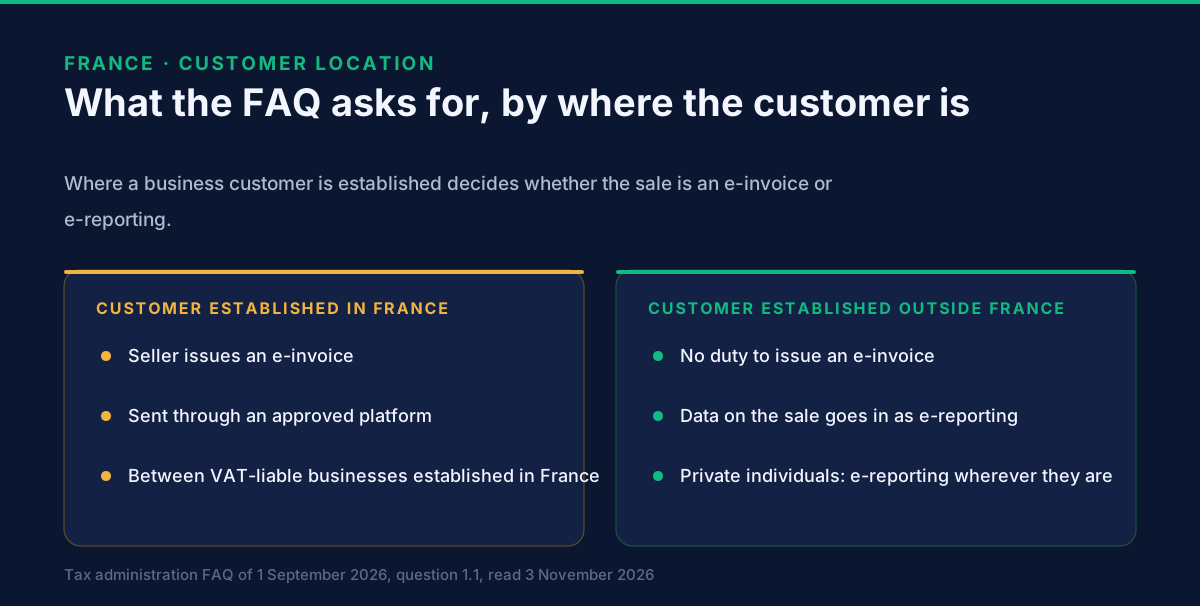
The administration's wording ties the e-invoice to businesses established in France, and says there is no e-invoice duty for customers established outside France. Its FAQ (version of 1 September 2026) sorts a sale by who the customer is.
- A private individual or a non-taxable legal person, in France or abroad: the seller reports data as e-reporting.
- A business customer established in France: the seller issues an e-invoice. The FAQ says precisely that e-invoicing applies to sales (i) between VAT-liable businesses established in France, (ii) within the scope of French VAT, and (iii) to which French invoicing rules apply.
- A business customer established outside France: there is no duty to issue an e-invoice, but data on the sale must be sent electronically as e-reporting.
None of that is a statement that a supplier outside France need not use an approved platform for a French customer. The conditions say "established in France", and they are written for French suppliers. Our reading is that a supplier without a French establishment is not in the e-invoice regime for those sales. Treat it as our reading, and get the answer in writing from a French tax adviser before a project plan rests on it.
What does the French customer do?
It reports its purchase from you as an acquisition, through its own platform, where the rules require it. The administration's discovery page lists, as the second strand of the reform, transactions "with operators established abroad (exports, intra-Community acquisitions and supplies...)". The FAQ gives the same examples for French businesses that deal with foreign operators. The sales covered are those listed in article 290 of the Code général des impôts.
Whether your supply is one of them depends on what you sell and where it is taxed. We do not say. The specification adds that e-reporting covers operations to or from a taxable legal person not established in France, and also operations between persons not established in France that are subject to French VAT.
The French customer's platform sends the data. You do not. What your customer needs from you is a complete invoice. The sources do not list what a foreign supplier must hand over, so ask the customer which identifiers its platform expects.
Can a foreign company have e-reporting duties of its own?
Yes, in some cases. The FAQ says that certain foreign companies not established in France can be subject to e-reporting, if the operation is deemed located in France and subject to French VAT. Its usual example is a sale to a person who is not liable to VAT, most often a private individual, taxable in France, such as intra-Community distance sales of goods.
Two details from the specification apply to such companies:
- Size is judged on the foreign establishment as a whole, whatever was done in France. This sets which date on the calendar applies.
- Acquisition e-reporting for non-established taxable persons starts on 1 September 2027, whatever the company's size. The specification says the other flows keep the calendar for the company's size. The calendar itself is in France's e-invoicing mandate.
What if the supplier has a French VAT number?
The pages we read do not say that a French VAT number brings a non-established supplier into the e-invoicing regime, and they do not say it keeps it out. We found only what the data tables show. The table of invoice data lists the supplier's intra-Community VAT number, a fiscal representative's number where there is one, and the country of the supplier's head office.
Establishment, for the purposes of the e-invoicing duty, is worded by the administration as "established in France". How a French VAT registration bears on that is a VAT question for an adviser. Ask it before assuming either answer.
What is still open?
Three things, as of 3 November 2026.
- Whether a supplier with no French establishment is outside the e-invoice duty, in the administration's own words. We read it that way and could not find the sentence.
- The effect of a French VAT number or a fiscal representative on that position.
- Whether your supplies are inside the French rules at all. That depends on where they are made and who accounts for the tax.
What to do next
- Put three questions in writing to a French tax adviser: whether your sales to French customers fall under the e-invoice duty, who reports them, and whether any e-reporting falls to you.
- Send your French customers your legal name, country and VAT number, and keep their SIREN on file. See The Four New Mentions on French Invoices.
- If a customer is on a platform that needs something from you, ask what. The directory that routes French invoices is described in France's E-Invoicing Directory, and the messages that come back in French E-Invoice Statuses.
- To discuss e-invoicing across several countries, book a demo. The tutorials, the developer documentation and the GoRoute API show how documents are sent to customers on the Peppol network.
Related reading
- E-invoicing in France, the country page.
- France E-Invoicing Mandate 2026
- Belgium: e-invoicing for foreign companies, the same question for Belgium.
- Belgium vs France vs Germany
Sources, all read on 3 November 2026: impots.gouv.fr, Foire aux questions, je découvre la facturation électronique, version of 1 September 2026, questions 1.1 and 7.1; impots.gouv.fr, the same page ("modifié le 26/05/2026"), section on the three strands of the reform; impots.gouv.fr, Spécifications externes et normes pour la facturation électronique (page modified 2 July 2026), external specifications version 3.2 of 30 April 2026, the notes on the size criteria for foreign companies, on the postponement to 1 September 2027 and on e-reporting scope; impots.gouv.fr, "Facturation électronique - Données de facture". Translations from the French are ours. Passages marked as our reading are not the administration's.
Frequently asked questions
- Does a foreign supplier have to issue French e-invoices through an approved platform?
- The administration's FAQ says the e-invoicing duty covers sales between VAT-liable businesses established in France, within French VAT and under French invoicing rules. It does not say, in one sentence, that a supplier with no French establishment is outside it. That conclusion is our reading, so confirm it in writing.
- What does the French customer report about my invoice?
- The administration lists acquisitions from operators established abroad among the transactions its customers report as e-reporting. Whether a particular purchase is covered depends on article 290 of the tax code, which is a question for the customer's adviser.
- Can a foreign company have to do e-reporting in France?
- Yes, in some cases. The FAQ says certain foreign companies not established in France can be subject to e-reporting where the operation is deemed located in France and subject to VAT. Its most common example is a sale to a private individual, such as intra-Community distance selling.
- Does a French VAT number change the position?
- The pages we read do not say that it moves a non-established supplier into the e-invoicing regime. The invoice data table has fields for the supplier's VAT number and a fiscal representative's. Whether you should hold a French VAT number is a VAT question this page does not answer.
- How is a foreign company's size judged for the calendar?
- For foreign companies not established in France that have e-reporting duties, the specification says the criteria are assessed at the level of the foreign establishment as a whole, whatever was done in France.
About Dr. Syed Raza
Dr. Syed Raza is an IT Enterprise Architect at ClayDesk LLC and leads the GoRoute platform. He works across Peppol Access Point and SMP infrastructure, PINT jurisdictions (Oman, AU/NZ, EU, JP, MY, SG), and national CTC regimes, translating regulatory detail into production-grade e-invoicing systems.
Building on Peppol?
GoRoute is a certified Peppol Access Point & SMP. Book a demo or read the docs to get started.