
Article 143 bis 1: What Oman's E-Invoicing Mandate Requires of Your Systems
Oman's Article 143 bis 1 obliges taxpayers to secure the invoicing system, handle breakdowns and recover lost data. What it means for IT, and who carries it.

Last updated .
What does Article 143 bis 1 actually require?
Article 143 bis 1 is not about invoices. It is a security and business-continuity obligation, it sits on the taxable person, and it lands on the same dates as the rest of the mandate. Four duties, every one of them about the system that issues the document rather than the document itself.
The taxable person must:
- ensure secure issuance of the electronic tax invoice through an electronic system
- comply with the prescribed technical specifications to protect that system against breach or unauthorised access
- take measures and procedures to address emergencies, breakdowns or technical malfunctions
- establish mechanisms ensuring the recovery of data in the event of loss for any reason whatsoever, so that the system does not cease operation and continues to function efficiently and effectively
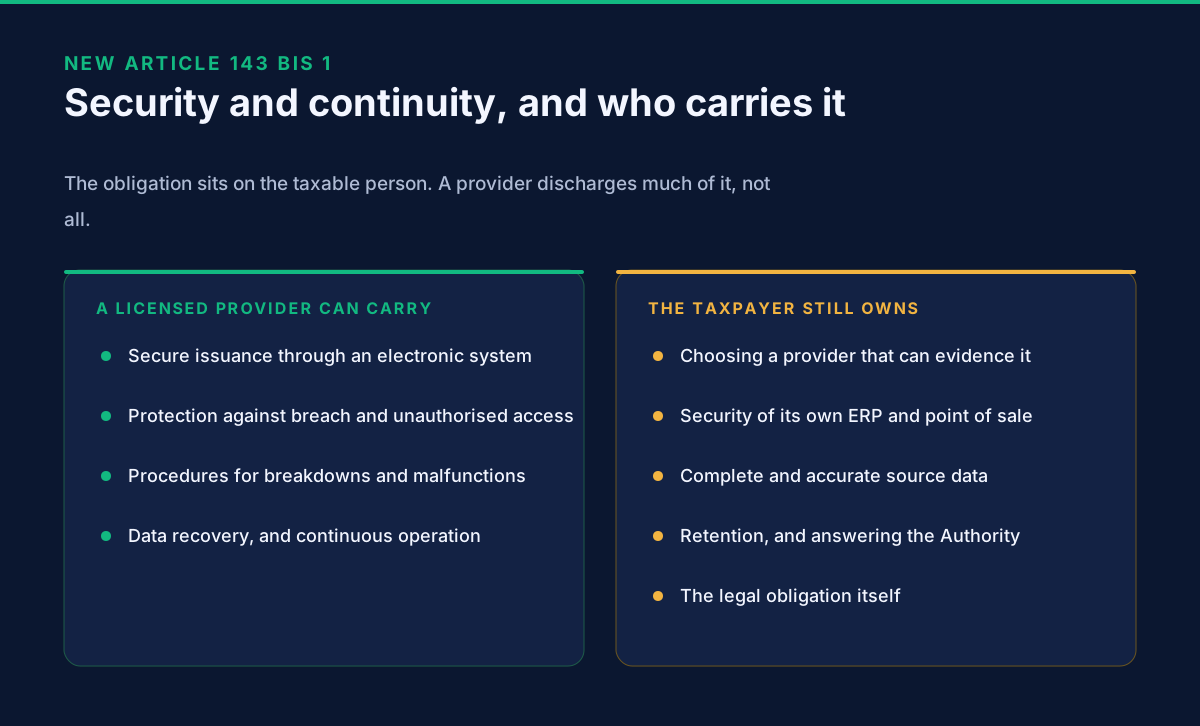
Read as a workplan, that is four separate programmes: access control, incident response, disaster recovery, and availability.
The rest of this page is about what those four programmes have to survive contact with. Oman's e-invoicing flow is not a file drop. It is a network with named roles, deterministic identifiers, acknowledgement messages and service levels measured in minutes, and every one of those things has a failure mode your continuity plan should already have a page about.
Why is this the article IT owns and finance misses?
Because it is the only part of Decision 189/2026 that says nothing about invoices. Article 143 covers the document — its fields, its format, its triggers. Article 143 bis 1 covers the machine that produces the document, and no amount of correct formatting satisfies it. They are separate obligations sharing one deadline.
That distinction decides who owns the work. A finance team reading the decision sees new invoice types, new mandatory fields and a new numbering discipline, and hands the whole thing to whoever owns the ERP configuration. Article 143 bis 1 does not fit in that queue. It is an information-security and disaster-recovery programme wearing a tax-law heading.
The phrasing repays attention. "Recovery of data in the event of loss for any reason whatsoever" admits no cause-based exception — not a supplier failure, not a cloud region, not an accident, not a mistake made by your own administrator. And "so that the system does not cease operation" frames availability as an obligation rather than an aspiration, which inverts the usual reading of an outage: it is a compliance failure, not an excuse for one.
One honest caveat, marked as inference rather than fact: the article requires compliance with "the prescribed technical specifications", and the decision text does not itself enumerate them. In practice the technical layer Oman has published is the PINT OM billing specification, the Tax Data Document specification, the Solution Reference Architecture and the Peppol Authority Specific Requirements. Treating those as the specifications in question is a reading, not a quotation, and we mark it as such.
Who carries the duty when you buy a platform?
A licensed provider can carry most of the operational weight — secure issuance, protection against unauthorised access, redundancy, recovery, keeping the platform running. That is what buying a platform is for. The legal duty does not transfer with the contract. The Authority's counterparty is the taxable person, and it stays that way whoever operates the servers.
Two consequences follow, and they are the ones worth putting in front of your IT lead.
Your own systems are in scope. The obligation is on issuance, and issuance starts in your ERP and at your point of sale. A hardened provider platform behind an unpatched till does not satisfy the article. Neither does a well-run provider connected to a billing system where four people share one administrator login.
"Our vendor handles it" is not an answer unless the vendor can evidence it. If you cannot produce evidence of the controls, you are the one who cannot produce it. That is why Article 143 bis — the Authority notifying taxpayers of licensed providers — matters more than it first appears. The provider list becomes a regulatory instrument, and choosing from it is itself part of discharging 143 bis 1.
There is a structural point here that most buyers never ask about. In Oman's model the Authority's own access point is a separate corner of the network, and the Solution Reference Architecture requires the organisation running it either to be organisationally separate from any sending or receiving access point, or to segregate those functions logically from its other access point services. The same document requires the taxpayer portal and the central service registry to be clearly segregated, and says the portal must not update the registry directly but manage requests and approvals. Segregation is designed into the national architecture. It is a fair question to ask of your own provider's architecture too.
What does "secure issuance" mean inside Oman's five-corner flow?
It means the document is created, validated, identified and reported by systems whose behaviour is specified in advance. Oman's model separates the invoice you send your customer from the tax data document your provider sends the Authority, and both journeys carry acknowledgements. Secure issuance is a property of that whole chain, not of your outbound file.
The five-corner model sets out the roles in full. For continuity planning, four properties of it matter.
Validation happens before delivery, and it is fail-closed. The PINT OM rule packs that run in production are Schematron rule sets — machine-readable validation rules that a document either passes or fails. The Oman invoice pack carries 154 assertions, and the credit note, self-billing invoice and self-billing credit note packs carry 154 each as well. They are published under the title PINT Oman E-Invoice Validation Rules (IBR-OM), version 1.0.1, with the Tax Authority of Oman named as the authority. Each rule emits a stable rule identifier and a structured diagnostic — why the rule fired, what was found, what was expected, and what to do — so a rejection is a specific, quotable, fixable thing rather than a generic error.
The document is identified before it is sent. The sending access point must generate the invoice identifier and include it in the tax data document. It must be able to enrich an invoice supplied by the taxpayer with that identifier, create the tax data document from the invoice, and confirm that any tax data document the taxpayer supplies is a correct representation of the matching invoice.
Acknowledgements are part of the flow, not a courtesy. Oman requires message level status support — the standard Peppol acknowledgement — and requires an accredited provider to send one for every invoice, credit note, self-billing invoice and self-billing credit note it receives, whether validation passed or failed. Silence is not a pass.
Reporting is separate from delivery. The tax data document reaches the Authority on its own path. That is why a domestic buyer who is not on the network does not stop the transaction from being reported: the specification directs the sending provider to generate the identifier, exchange a tax data document with the Authority's access point, and not exchange the invoice with a receiving provider. The invoice goes to the buyer by other means; the reporting still happens.
What clocks does your system have to keep?
Oman's requirements for accredited providers set explicit service levels. A business-to-business tax data document must reach the Authority within 15 minutes of the sending provider validating the invoice. A business-to-consumer one has 30 minutes. The receiving side owes its own within 15 minutes, and an acknowledgement must return to the sender within 15 minutes.
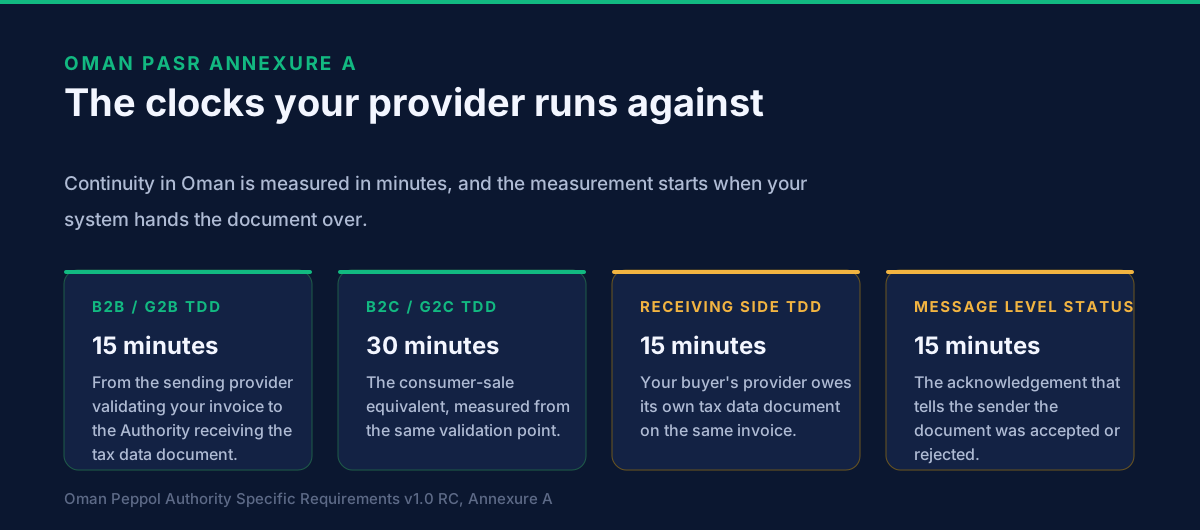
Those are the numbers in Annexure A of the Peppol Authority Specific Requirements for Oman. The Solution Reference Architecture reproduces a testbed variant of the same table for conformance testing — 15 minutes, 30 minutes, and 20 minutes for the acknowledgement in the test environment — and notes explicitly that production timings are the ones in the Authority Specific Requirements, and that Oman aligns to the Peppol network's own service level requirements for acknowledgements. Those network requirements are expressed as a monthly measurement: 99.5% of acknowledgements for documents under 10 megabytes must complete inside a maximum duration.
Read that as an IT lead rather than a lawyer and the consequence is immediate. Your provider's clock starts when your document arrives. Every minute your own estate spends holding a document — a nightly batch, a queue nobody drains at the weekend, a till that syncs when the shop closes — is a minute outside anyone's service level and entirely your own exposure. For consumer sales the architecture is explicit that the supplier should send the invoice to their access point within 24 hours, which is generous compared with the provider's 30 minutes and is exactly the kind of gap where a store network outage quietly becomes a compliance event.
There is also a retention duty on the provider with a number attached: accredited providers must retain transmission and transaction metadata for the electronic tax invoices and adjustment notes they process — at a minimum the sender and receiver identifiers, transmission timestamps, and acknowledgement and delivery confirmations — for 12 months. We come back to why that number matters below.
What happens when a document fails validation?
The receiving side returns a negative acknowledgement naming the rule that failed. The sending provider has to resolve the problem, exchange the corrected invoice, and send the Authority a tax data document marked "disregard" against the earlier one. Nothing is silently dropped, and nothing is silently duplicated — but somebody has to act, and inside your working hours.
This is the part of the architecture that most continuity plans have no page for, so it is worth being concrete about the states involved. The Authority's side recognises three kinds of tax data document: submit, resubmit and disregard. Where a document arrives on an invoice with no prior document, it is used. Where one arrives replacing an earlier one, the earlier one is marked as disregarded and the new one becomes current. Where an older one arrives after a newer one — which happens when a message is delayed rather than lost — the older one is the one marked disregarded, so a late-arriving message cannot overwrite a correct record.
The exception table also handles the cases where the two sides disagree. A "submit" arriving when a document already exists is treated as a resubmission. A "resubmit" arriving when nothing exists is treated as a first submission. A "disregard" arriving against a document that was never received produces no action. The design assumption is that providers will occasionally get this wrong, and the Authority's side absorbs it rather than failing.
For your side of the boundary, three questions follow, and they belong in a written procedure rather than in someone's memory:
- Who reads the rejections, and within how long? A rejection is a document that has not been issued. If nobody is watching the queue on a Thursday afternoon, the working week ends with unissued invoices.
- What happens to trade while issuance is down? This is a commercial decision, not a technical one, and it needs making before it is needed.
- Who is allowed to reissue? Correcting and resubmitting a tax document is a privileged action. It needs the same access control as issuing one.
What happens when the acknowledgement never arrives?
Then the sending provider has an unresolved exception and must retry the exchange. Missing acknowledgements are treated as a distinct failure from rejections, with their own path, because the two mean different things: a rejection says the document is wrong, and silence says you do not know whether the document arrived at all.
That distinction is the whole reason acknowledgements exist, and it is worth carrying into your own architecture. In practice the difference between a mature integration and an immature one is not whether it handles the happy path — everyone handles the happy path — it is whether it can tell "rejected" from "unknown", and whether it does something different in each case.
The two failure modes also decay differently. A rejection is stable: the document is wrong, it will still be wrong in an hour, and the fix is the same fix. An unknown is time-sensitive: the underlying document may have arrived, may arrive shortly, or may never arrive, and every retry risks creating a duplicate that somebody must later disregard. Systems that treat the two identically tend to generate exactly the mess the disregard machinery exists to clean up.
Which identifiers survive a restore, and which do not?
Two of Oman's four identifiers are computed from invoice content and can be recreated from a restored record. Two are random values generated at the moment of transmission and cannot be recreated at all. If your recovery plan restores the invoices but not the transmission log, you have restored the documents and lost the proof of what happened to them.
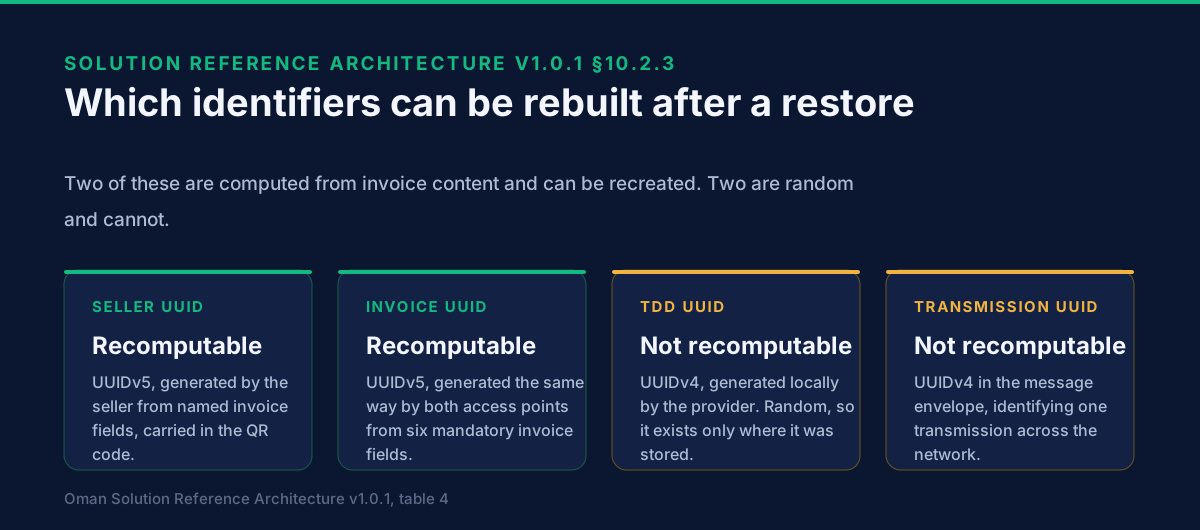
The detail is worth having, because it decides what your backups actually need to contain.
The invoice identifier is deterministic. It is a version 5 UUID — a hash-based identifier derived from named input values rather than a random one — and the Solution Reference Architecture specifies precisely which values: the seller identifier and its scheme, the invoice type code, the invoice number, the invoice date, the invoice total tax amount and the invoice total amount including tax, with the total amount due added for profit-margin invoices. All of those are mandatory fields, so an invoice missing any of them would already have been rejected. Both the sending and the receiving access point derive it the same way, from a fixed namespace, which is what makes the two sides agree without exchanging anything.
The architecture draws the consequence out explicitly: the same content invoice has the same invoice identifier, so if the content changes a new identifier is determined. That is a useful property and a sharp edge at the same time. It means an identifier can be recomputed from a restored invoice. It also means that any change to those six fields — including a correction someone makes with good intentions — produces a different identifier, and the reference held by every other document pointing at that invoice becomes stale.
The seller identifier in the QR code is also deterministic, built from the QR version, invoice type, seller name, VAT identification number, date, timestamp, total amount and total VAT, uppercased and hashed against the same fixed namespace. The uppercasing matters: version 5 identifiers are case-sensitive, so a mixed-case string produces a different value and a QR code that does not reconcile.
The tax data document identifier and the transmission identifier are version 4 — random. They are generated locally by the access points at the moment of use, and there is no algorithm that recreates one from the invoice. They exist in exactly one place: whatever system recorded them.
The recovery consequence is the practical point of this whole section, and it is inference from the specification rather than a rule anyone has written down: a restore that recovers your invoice archive but not your transmission records recovers the documents and loses the trail. You can prove what you issued. You cannot prove when it was reported, under which transmission, or what came back. Test the restore of both, or you have tested half of it.
How long must the records last, and who keeps what?
Oman's VAT Law requires tax records to be kept for 10 years, and 15 years for real-estate-related tax invoices. Accredited providers are separately required to retain transmission and transaction metadata for 12 months. Those two numbers are not in conflict, but the gap between them is where an audit in year three goes wrong.
Read them together and the division of labour is clear enough. The provider's 12-month duty covers the network-level record: who sent what to whom, when, and what acknowledgement came back. The taxpayer's 10-year duty covers the tax records themselves. Nothing obliges your provider to hold your transmission metadata for the ten years your own records must survive, and it would be an unusual contract that did.
So the questions to ask are ordinary procurement questions with a specific answer required:
- What exactly is retained, and for how long, beyond the 12-month minimum? "Indefinitely, subject to our data policy" is not an answer you can put in front of an auditor.
- How do you get it out? Metadata you can only see in a provider's dashboard is metadata you do not have. An export you have actually run is worth more than an export that exists in the documentation.
- What happens at the end of the contract? Migration is the most common way a retention obligation quietly fails, because the old provider's duty ends and the new one's began too late.
Article 143 bis 1's recovery requirement and that retention period interact directly. A document you cannot retrieve in year seven is a retention failure whether the cause was deletion, a lapsed storage configuration or a migration. If your archive is a bucket nobody has ever restored from, you do not yet know whether you can produce those records. That is worth testing while it is cheap.
Does an outage excuse a missed invoice?
No — the article points the other way. It requires measures and procedures for emergencies, breakdowns and technical malfunctions precisely so that operation continues. An unplanned outage is therefore evidence that the required procedures were absent or ineffective, which makes it a compliance failure rather than a defence against one.
That reading is uncomfortable and it is the plain sense of the words. It does not mean every incident is a breach; it means the question an auditor asks after an incident is not "was the system down" but "what were the measures, and did they work". Those are answerable questions, and they are answerable in advance.
Practically, that shifts the useful artefact from an uptime number to a tested procedure. Uptime is retrospective and, for a taxpayer, largely a property of somebody else's platform. The procedure is yours: what you do when issuance stops, who decides, what you tell customers, how you catch up, and how you evidence the catch-up afterwards. A business that can show a drill is in a very different position from one that can show a service credit.
The same logic applies to planned work. An upgrade window that stops issuance is still a period when the system has ceased to operate, and it is entirely within your control to schedule and document it. Oman's requirements for accredited providers ask for hardware and software details including current versions and an upgrade plan; asking the same question of your own estate is a reasonable way to find out whether anybody owns the answer.
What evidence should you be able to show the Authority?
The decision does not prescribe an evidence format. Oman's published requirements for accredited providers do name a concrete list, and it is the best available guide to what "good" looks like: multifactor authentication, encryption at rest, encryption in transit, security monitoring, and ISO/IEC 27001 certification, submitted with supporting evidence.
The same requirements ask providers for a technical design document covering the high-level architecture across application, integration, infrastructure and data; hardware and software details including current versions and an upgrade plan; hardware and software support and service-level details; and the data hosting location together with the backup and retention policy.
That is a provider-facing list, and no taxpayer is being asked to submit it. Its value is as a template. If your own evidence pack answers those same headings for your ERP and point-of-sale estate, you have an answer to Article 143 bis 1 that is specific rather than assertive:
- Access control. Who can issue an invoice, in the ERP, in the point-of-sale estate and in the provider platform. Named accounts, no shared credentials, multifactor authentication on the paths that matter, and scoped API keys so a compromised integration cannot issue in your name.
- Encryption. At rest and in transit, stated for each system that holds or moves an invoice, including the ones nobody thinks of as invoicing systems — the reporting replica, the data warehouse, the backup.
- Monitoring. Not just infrastructure alerting: something that notices when issuance volume drops to zero on a working day, which is the signal a silent failure produces.
- Incident response. A written procedure for a breakdown during business hours, with an escalation path to the provider and a decision already made about what happens to trade while issuance is down.
- Recovery. Not "we have backups" — a tested restore, with a known recovery point and recovery time, covering the documents themselves, the transmission records, and not only the database.
- Certification and assurance. Independent assurance from your provider rather than a contractual assertion. Ask what the infrastructure is certified to, what the provider's own practices are aligned to, and where the data sits.
On that last point, for completeness about our own position: GoRoute operates ISO/IEC 27001:2022-aligned information security and ISO 22301:2019-aligned business continuity practices, and in-country data residency for Oman on Otech's Tier III Oracle Cloud Infrastructure region — invoices, keys, tax data documents and audit logs. The detail is on data residency and compliance in Oman and hosted infrastructure.
What should you do first?
Decide what evidence looks like, before you need it. It is the slowest item on the list and the only one that cannot be bought late. Everything else — access control, monitoring, incident procedure, tested restore — becomes easier once you know what you are going to have to show, and to whom, and in what form.
After that, treat the article as four workstreams with owners rather than a checklist item:
Access control. Inventory every place an invoice can be issued. The ERP is the obvious one. The unobvious ones are the point-of-sale estate, the e-commerce checkout, the projects team's spreadsheet-driven billing, and whichever integration a developer built against the provider API two years ago. Every one of them needs named accounts and scoped credentials.
Incident response. Write the procedure for issuance being unavailable during business hours. Name the escalation path to your provider, and the internal decision-maker for whether trade continues. Rehearse it once. The rehearsal is where you find that the escalation contact left the company.
Recovery. Run a real restore. Restore the invoice archive and the transmission records, and check that you can reconcile a day's issuance end to end from the restored copies. Record the recovery point and recovery time you actually achieved rather than the ones in the contract.
Availability. Understand the failure modes of your own estate, not just the provider's. A single till with local-only storage is a data-loss event waiting to be discovered at audit. So is a queue that only drains when someone is logged in.
One sequencing note. All four are easier before your wave date than after, and the wave dates are fixed: 1 April 2027 for annual supplies above OMR 5,000,000, 1 October 2027 at or below. The security programme does not need the invoice format work to be finished before it starts, which makes it the obvious thing to run in parallel while the ERP configuration is being scoped.
Where does this sit in the rest of the mandate?
Article 143 bis 1 is the systems obligation. The other parts of the same decision govern documents: which wave you are in, which events require an invoice, and what a simplified invoice must carry. They are separate pieces of work, and only this one belongs to IT.
The rest of the mandate: which wave you are in, the advance-payment and deemed-supply triggers, and simplified invoices on the same clock. For the exchange architecture, see the five-corner model and the Tax Data Document deep dive. If you are scoping the integration itself, connecting your own software to Fawtara covers what your code has to produce.
The Oman compliance page covers the requirements, the Peppol API the integration, and you can book a review if you want the security and continuity questions walked through with your IT lead rather than left to the contract.
Sources
- Decision of the Chairman of the Tax Authority No. 189/2026, new Article 143 bis 1 and Article 143 bis
- Oman VAT Law promulgated by Royal Decree No. 121/2020 (record retention)
- Oman Solution Reference Architecture v1.0.1, 22 May 2026, OpenPeppol AISBL — sections 5, 8, 10.2.3 and 12, appendices C and D
- Oman Peppol Authority Specific Requirements v1.0 RC, OpenPeppol AISBL — information security section and Annexure A
- PINT Oman specification and the Oman Tax Data Document specification; PINT OM v1.0.1 validation rule packs as deployed in GoRoute production
- Peppol Message Level Status specification
- Oman Tax Authority and the Fawtara portal
Frequently asked questions
- What does Article 143 bis 1 require?
- The taxable person must ensure secure issuance through an electronic system, comply with prescribed technical specifications protecting it against breach and unauthorised access, take measures for emergencies, breakdowns and technical malfunctions, and establish mechanisms for recovering data lost for any reason - so the system does not cease operation.
- Does using a licensed service provider satisfy it?
- It discharges most of the operational burden but not the legal duty. The obligation is placed on the taxable person. Your own ERP and point-of-sale systems remain in scope, and you are answerable to the Authority for the whole chain.
- Is this the same as the invoice format requirement?
- No. Article 143 governs the document. Article 143 bis 1 governs the system that produces it - access control, incident response, disaster recovery and availability. They are separate obligations with the same deadline.
- Does an outage excuse a missed invoice?
- The article points the other way. It requires procedures for emergencies, breakdowns and malfunctions precisely so that operation continues, which makes an unplanned outage a compliance failure rather than an excuse for one.
- What evidence should we keep?
- The article does not prescribe an evidence format. Oman's requirements for accredited providers name multifactor authentication, encryption at rest, encryption in transit, security monitoring and ISO/IEC 27001 certification, and that list is a reasonable shape for your own evidence pack.
- When does it apply?
- On the same dates as the rest of the mandate - 1 April 2027 above OMR 5,000,000 of annual supplies, 1 October 2027 at or below.
About Dr. Syed Raza
Dr. Syed Raza is an IT Enterprise Architect at ClayDesk LLC and leads the GoRoute platform. He works across Peppol Access Point and SMP infrastructure, PINT jurisdictions (Oman, AU/NZ, EU, JP, MY, SG), and national CTC regimes, translating regulatory detail into production-grade e-invoicing systems.
Building on Peppol?
GoRoute is a certified Peppol Access Point & SMP. Book a demo or read the docs to get started.