
Credit and Debit Notes Under ZATCA Phase 2
How to correct a Saudi e-invoice under ZATCA Phase 2: the billing reference, clearance or reporting for each note, and cancelling an invoice by credit note.

How do you correct a Saudi e-invoice?
You correct a Saudi e-invoice with a credit note or a debit note that cites the original invoice. You never edit or delete the invoice itself. A credit note refunds the buyer or corrects an invoice issued in error. A debit note increases the value or the VAT of the original. Both are sent to ZATCA the same way as the invoice they correct. These are the definitions in ZATCA's E-Invoicing Detailed Guideline, which says notes "follow the same format as the invoice" they are issued against.
This page is for the accounts lead who needs to know what the billing system must do when a sale changes. If your business is in Wave 25, the Wave 25 page explains the deadline. Corrections have to work by then too.
What is the billing reference?
The billing reference is the link from a note back to the original invoice. ZATCA's Technical Guideline FAQ says it is mandatory. It rests on Article 54 of the KSA VAT Regulations, which says every debit and credit note should refer to the original invoice. The FAQ adds that this "is not a new requirement, it existed since 1 Jan 2018".
The Detailed Guideline says the adjustment itself is made under Article 40(1) and Article 54(3) of the VAT Implementing Regulations. A note issued with no reference to an invoice breaks Article 54, which is ZATCA's own answer to the question.
When one credit note covers several invoices, ZATCA says to list the original invoice numbers. The field accepts text, so you can give a range, such as "from 001 to 100 issued between 1 January and 31 March". UBL does not allow several supply dates on a note. ZATCA's answer is to use one supply date range that covers all the original invoices.
Is a note cleared or reported?
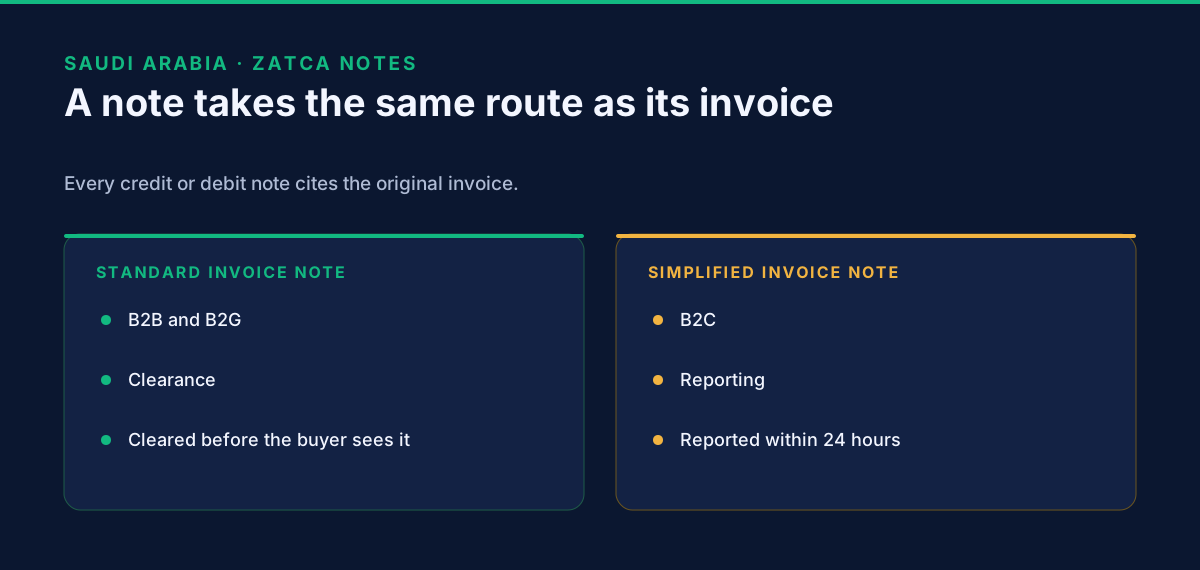
It follows the invoice. The Detailed Guideline says "the type of credit/debit note follows the type of invoice that they are issued against", and that clearance applies to "all Tax Invoices and their associated credit/debit notes".
| Original document | Note | Route | Timing |
|---|---|---|---|
| Standard tax invoice (B2B, B2G) | Standard credit or debit note | Clearance | Cleared by ZATCA before it is shared with the buyer |
| Simplified tax invoice (B2C) | Simplified credit or debit note | Reporting | Reported within 24 hours |
For standard notes the platform returns the document with ZATCA's stamp and QR code, as it does for the invoice. The QR code page explains tags 6 to 9, which apply to notes too. For simplified notes the seller stamps and builds the QR code itself, as with simplified invoices.
Self-billing is the exception to who submits. Where buyer and seller have a ZATCA-approved self-billing agreement, the buyer submits the standard documents.
If ZATCA has disabled clearance, the platform answers with a 303 response, and standard invoices and notes are then sent through the reporting API. ZATCA's platform does not stamp them in that case.
How do you cancel an invoice?
You issue a credit note and, if needed, a new invoice. ZATCA's Detailed Guideline says people subject to the regulation are not allowed to modify or delete invoices once issued, whether generated by the system or outside it. "If a user wishes to 'cancel' an invoice, this may only be done through issuing an associated credit note and reissuance of a new invoice."
Rejection is different from cancellation, and ZATCA's documents treat two cases separately:
- Rejected on clearance or reporting. The Detailed Guideline FAQ says "Invoices cannot be cancelled. If invoice is rejected by ZATCA, then tax payers can fix the errors and submit the XML just like a new invoice having its own Invoice Counter Value and Hash." The Technical Guideline adds that the new document needs its own UUID, counter and hash. For a rejected standard invoice the date should be updated, because a non-cleared invoice is not a valid tax invoice. For a rejected simplified invoice the date stays as the date of the transaction.
- Not reported. The Technical Guideline FAQ says that where a reporting call returns "NOT_REPORTED", "the invoice should be cancelled via a credit note and a new invoice generated".
These two answers address slightly different situations, and we cannot fully reconcile them from the documents. If your system meets a rejection and you are unsure which route applies, ask ZATCA or your solution provider.
How do notes fit the invoice sequence?
Notes are part of the same chain as invoices. The Detailed Guideline says the counter "must increment for each generated Electronic Invoice or associated note". The Technical Guideline says a unit produces documents in a single sequence, covering standard and simplified documents and, we read, their notes. Each document's previous-invoice hash must equal the hash of the document generated just before it. Documents need not be submitted in the order they were generated, as long as the hash chain is correct.
A rejected document's UUID and counter value must not be reused.
What about refunds of advance payments?
ZATCA's guideline gives a worked case. A customer pays SAR 115,000 in advance (100,000 plus 15,000 VAT), and a later invoice is SAR 92,000. If the whole advance is deducted, the amount due is minus SAR 23,000. To refund that, a credit note for 23,000 must be issued, and "such Credit Note should also be sent for Clearance / Reporting". Both ways of showing the prepaid amount are valid, so the choice is a reconciliation decision.
Do corrections count in the ZATCA onboarding test?
Yes. During the compliance checks, each unit submits a tax invoice, a debit note and a credit note for its invoice type before it receives its production CSID. So a billing system that cannot produce a note cannot get live. The onboarding page sets out the full sequence.
What this page does not cover
Two things. First, VAT adjustment periods and when a note is due, which are VAT questions. Second, field-level rules. ZATCA's XML Implementation Standard and the validation sheets in its SDK set out the rule numbers for notes, including how the reason for issuing one is recorded. We could not open them when writing this page, so we quote no rule numbers and do not state the reason rule. Check them before you build.
Where does GoRoute stand?
Our ZATCA integration is in development on ZATCA's developer sandbox. It is not live, there is no trial for Saudi Arabia, and we promise no date. If you want to know how notes will be handled, read our Saudi Arabia page and talk to us before your wave deadline. You can book a call. Recorded guides are on the tutorials page, and the technical reference is at docs.goroute.ai.
For the same problem in Oman, see how we handle corrections to self-billed invoices in Oman. The Saudi background is in our Fatoora guide. Read next: what ZATCA Wave 25 requires by 1 February 2027.
Sources: ZATCA, E-Invoicing Detailed Guideline, sections 2, 4.3, 8 and the FAQ. ZATCA, E-invoicing Detailed Technical Guideline, sections 3, 4 and the FAQ. Both read 2 November 2026. This is not tax or legal advice.
Frequently asked questions
- Can I cancel or delete an invoice under ZATCA Phase 2?
- No. ZATCA says invoices cannot be modified or deleted once issued. To cancel one, you issue an associated credit note and reissue a new invoice.
- Does a credit note need to refer to the original invoice?
- Yes. The billing reference is a mandatory field. ZATCA says a credit note issued without reference to the original invoice would violate Article 54 of the KSA VAT Regulations.
- Are credit notes cleared or reported?
- It follows the original invoice. Notes attached to standard tax invoices go to ZATCA for clearance. Notes attached to simplified tax invoices are reported within 24 hours.
- What if one credit note covers several invoices?
- Cite each original invoice number in the reference field. ZATCA says the field is text, so a range can be given when there are too many invoices to list.
- Does the ZATCA onboarding test include credit notes?
- Yes. For each invoice type, the unit must submit a tax invoice, a debit note and a credit note during the compliance checks before it gets a production CSID.
About Dr. Syed Raza
Dr. Syed Raza is an IT Enterprise Architect at ClayDesk LLC and leads the GoRoute platform. He works across Peppol Access Point and SMP infrastructure, PINT jurisdictions (Oman, AU/NZ, EU, JP, MY, SG), and national CTC regimes, translating regulatory detail into production-grade e-invoicing systems.
Building on Peppol?
GoRoute is a certified Peppol Access Point & SMP. Book a demo or read the docs to get started.