
Luxembourg B2B E-Invoicing from 2028: What Bill 8815 Would Require
Luxembourg bill 8815, filed on 30 July 2026, would make e-invoicing compulsory between Luxembourg businesses from 2028. It is a bill, not law. What it says.

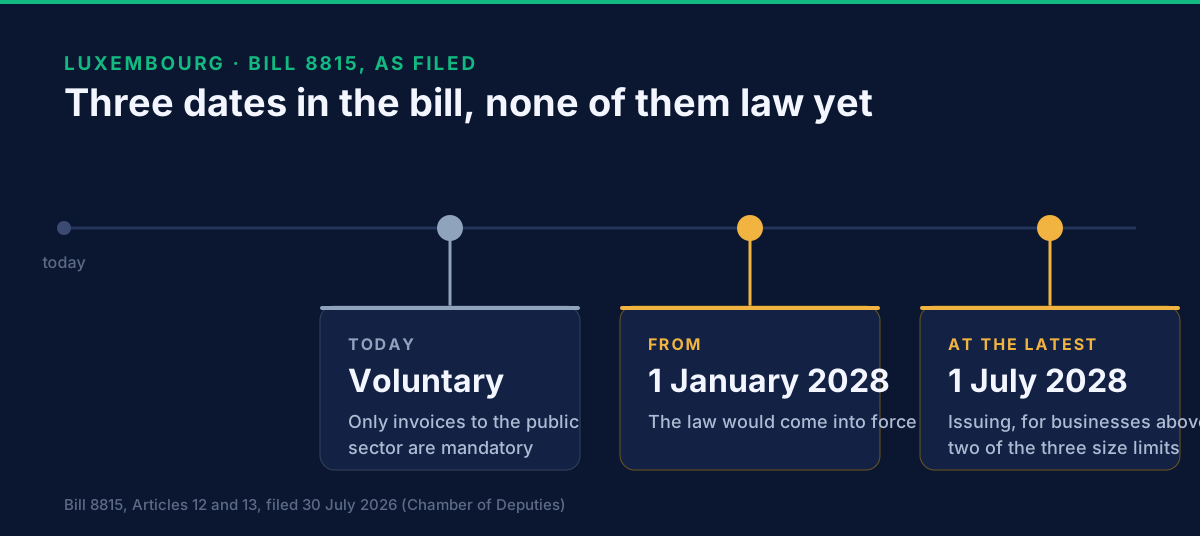
Bill 8815 would make e-invoicing compulsory between businesses established in Luxembourg, with the law in force from 1 January 2028 and issuing required by 1 July 2028 (larger businesses) or 1 January 2029 (all others) at the latest. It is a bill, not law. The government filed it in the Chamber of Deputies on 30 July 2026, and on 30 October 2026 the Chamber's page showed it still in committee. Today, e-invoicing between Luxembourg businesses is voluntary. Only invoices to the public sector are mandatory, and have been for every supplier since 18 March 2023.
This page is for the finance lead at a Luxembourg business who wants to know what the bill says, when it would bite, and what is worth doing before it passes. It sets out the bill's own words and marks what is our reading. It does not cover the public sector rules already in force, which are on our Luxembourg e-invoicing page.
What is bill 8815?
A government bill that widens Luxembourg's e-invoicing law from public contracts to ordinary business-to-business invoices. Its full title says it amends the law of 16 May 2019 on electronic invoicing in public procurement and concession contracts, and the amended law of 12 February 1979 on VAT, to transpose Article 1 of Directive (EU) 2025/516, the "VAT in the Digital Age" (ViDA) directive. The Council of Government approved it on 17 July 2026. Finance Minister Gilles Roth filed it on 30 July 2026.
The 2019 law would be renamed "Law of 16 May 2019 on electronic invoicing", dropping the reference to public contracts. The Chamber's file lists two opinions so far, from the Luxembourg Bar Council and the Chamber of Commerce, and the Finance Committee named a rapporteur on 18 September 2026. We did not find an opinion from the Council of State on the Chamber's page. Read the Chamber of Deputies file for the current stage.
Which invoices would it cover?
Invoices from a business established in Luxembourg to a customer established in Luxembourg, for supplies whose place of supply is in Luxembourg. The bill's new paragraph 2 of Article 1 applies the law to invoices issued under the VAT law by an issuer established in the Grand Duchy to a recipient established there, for goods or services taxable in Luxembourg, and that are subject to an invoicing obligation.
Three things are left out:
- Operations already covered by the reporting obligation in Article 262 of the VAT Directive. The bill's explanatory memorandum says it targets domestic operations that have no such reporting duty.
- Invoices from private individuals who occasionally sell new means of transport, invoices to people who temporarily hold taxable status under the "TVA logement" housing scheme, and invoices for B2C distance sales of goods deemed made in Luxembourg.
- Anything outside Luxembourg. A sale to a customer in another country is not in this bill.
One further rule reaches wider than the issuing duty. Every recipient in scope would have to receive and process any compliant e-invoice from an issuer established in Luxembourg, even where that issuer was not itself obliged to send one. The commentary gives State and municipal bodies, which are not treated as taxable persons for their official activities, as an example.
When would it apply?
The law would come into force on 1 January 2028. The dates for issuing depend on size. The filed text is built from three limits: a balance sheet total of EUR 7.5 million, net turnover of EUR 15 million, and an average of 50 full-time staff. The test is made on the 2026 accounts.
| Size of the business, tested on its 2026 accounts | Latest date to issue e-invoices | Latest date to rely on the State's alternative route to receive |
|---|---|---|
| Above at least two of the three limits at the close of 2026 | 1 July 2028 | 30 June 2028 |
| Not above two of the three limits | 1 January 2029 | 31 December 2028 |
| Cannot give 2026 figures for at least one limit | 1 January 2029 | 31 December 2028 |
These come from Articles 9 and 12 of the bill, and the same size test applies to an issuer and to a recipient. Both articles say "at the latest" (au plus tard). We do not read the text as telling you what applies between 1 January 2028 and the later date, and neither does the explanatory memorandum, so do not plan around the gap. The simplest safe plan is to be ready to receive on 1 January 2028.
Our Luxembourg page gives the same three dates in summary. The detail on receiving here is fuller: the bill lets larger recipients lean on the State's alternative solutions until 30 June 2028, and the rest until 31 December 2028.
What would the bill require of an issuer?
An invoice in scope must be issued and sent as a compliant electronic invoice, over one common network. The bill's new Article 4bis adds the following:
- The e-invoice is the invoice. An attachment may travel with it, but no attachment counts as an invoice. The bill's memorandum says a PDF, a Word file or an image is not an e-invoice, however readable by a person.
- No extra charge for issuing electronically. An issuer may not bill specific additional fees for the simple fact of issuing an electronic invoice in place of paper or a non-structured file.
- Return messages. An issuer established in Luxembourg must also be able to receive, over the common delivery network, the return messages the recipient sends back about that invoice.
- No acceptance step. An invoice issued under the new rules would not need the recipient's acceptance.
A "compliant electronic invoice" is defined as one that follows the European standard on e-invoicing (EN 16931) and one of the syntaxes on the list published in the EU's Official Journal. Those two syntaxes are UBL and UN/CEFACT CII. The bill does not choose between them.
Does the bill name Peppol?
No, not in the articles we read. It says a grand-ducal regulation will name "the common delivery network" that must be used for issuing, sending and receiving. It sets criteria for that network: interoperability within the country and across borders, openness, security, privacy by default, wide use, and conformity with the EU definition of a registered electronic delivery service.
Peppol is the network the State uses for public-sector invoices today, and the State runs its own access point for it. It is therefore the likely candidate. That is our inference. If you are choosing a system now, read the regulation when it appears. The wording of the criteria is what will decide.
What would small businesses pay?
Possibly a usage fee, if they rely on the State's web-form route past a ceiling. The bill provides for alternative solutions for businesses that cannot yet issue or receive over the common network. Those solutions allow only manual, one-at-a-time issuing. A regulation will set a ceiling for the number of invoices a small issuer or recipient may handle this way. Above the ceiling, the bill sets a fee, excluding VAT:
- EUR 2 for each of the first 20 e-invoices over the ceiling;
- EUR 3 for each of the next 30;
- EUR 4 for each of the next 50;
- EUR 5 for each after the first 100.
The same scale applies to received invoices. The ceiling is not in the bill, so we cannot say how many invoices a small business could handle before the fees start. The route today is the MyGuichet.lu web form, and we compare it with Peppol in MyGuichet.lu or Peppol: sending an invoice to a Luxembourg public body.
Why now, and what is around it?
Luxembourg's neighbours have moved, and so has volume. The bill's explanatory memorandum says the number of e-invoices received in Luxembourg rose from a marginal volume in 2021 to more than 1.54 million in 2025, and that volume grew by about 25% in the first quarter of 2026. It attributes most of that rise to Belgium's B2B mandate, in force since 1 January 2026. It describes France as phasing in a general obligation by 1 September 2027 at the latest and Germany by 1 January 2028 at the latest.
Our own pages cover those neighbours: Belgium, France and Germany, and the 2026 mandates tracker puts Luxembourg beside them. The memorandum also names 1 July 2030, the date from which the ViDA directive requires digital reporting of intra-EU transactions, as the reason Luxembourg businesses should be used to e-invoicing before then. The Commission's ViDA page has the EU side.
What could still change?
Everything in the bill. It is in committee. The Council of State has yet to give an opinion we could find, the Chamber could amend it, and the entry-into-force date could move. The bill also leaves three things to regulations that do not exist yet: the common delivery network, the ceilings for the alternative solutions, and how fees are collected. We do not state any penalty for non-compliance, because the filed text contains none.
What should a finance lead do now?
Four low-cost steps, none of which depends on the bill passing unchanged.
- Check whether you are in scope. Are you established in Luxembourg, invoicing customers established in Luxembourg for Luxembourg supplies? If most of your invoices go abroad, the bill touches little of your flow.
- Find your size position at the close of your 2026 accounts. Compare balance sheet total, net turnover and average staff with the three limits above. This decides your latest issuing date.
- Find out whether your accounting system produces a structured invoice. A PDF generated from your ERP is not one. If the system cannot, find out what a connector or an API would add.
- Plan to receive first. Every recipient in scope would have to receive e-invoices from Luxembourg issuers, and the bill's first firm date is 1 January 2028.
If you want to see how a Luxembourg business receives and sends over Peppol, GoRoute is a certified Peppol access point (POP000991). Book a demo and bring one customer and one supplier flow. Our e-invoice receiving page shows how an invoice arrives in your system, and the tutorials and developer documentation show how a system connects. If you already invoice Luxembourg public bodies, the same connection would serve your business customers, as our Luxembourg page notes.
Related Luxembourg guides
- Luxembourg e-invoicing: the public-sector mandate — what has applied since 2023.
- Which e-invoice formats Luxembourg public bodies accept — XRechnung, Peppol BIS Billing 3.0 and what has been refused since 1 October 2026.
- Luxembourg Peppol ID: scheme 9938, VAT number or matricule — which identifier to register and where to find a public body's.
- MyGuichet.lu or Peppol — the web form against a network connection.
Sources, read 30 October 2026: the filing document of bill 8815 with its explanatory memorandum (Chamber of Deputies, dossier 8815, filed 30 July 2026); the Luxembourg government's eFacturation portal; Directive (EU) 2025/516 on EUR-Lex. Translations from the French are ours. Passages marked as inference, and the points under "What could still change", are not the legislator's. This page describes a bill and is not legal advice.
Frequently asked questions
- Is B2B e-invoicing mandatory in Luxembourg?
- Not today. Between businesses it is voluntary. Bill 8815, filed in the Chamber of Deputies on 30 July 2026, would make it compulsory for invoices between businesses established in Luxembourg. It is a bill. The Chamber's page showed it in committee on 30 October 2026, so its text and dates can still change.
- When would Luxembourg B2B e-invoicing start?
- The bill says the law would come into force on 1 January 2028. Issuing would follow by 1 July 2028 at the latest for businesses above two of three size limits at the close of their 2026 accounts, and by 1 January 2029 at the latest for all others. Those are the bill's dates as filed, not law.
- Who is in scope of bill 8815?
- Invoices issued by a business established in Luxembourg to a customer established in Luxembourg, for supplies whose place of supply is in Luxembourg and where an invoice is required. Operations already covered by the reporting obligation in Article 262 of the VAT Directive are left out. So are three narrow cases: occasional sales of new vehicles by private individuals, invoices to people who temporarily hold taxable status under the housing VAT scheme, and B2C distance sales.
- Would a PDF invoice still be allowed between Luxembourg businesses?
- Not as the invoice. The bill's explanatory memorandum says a PDF, Word file or image is not an electronic invoice, however readable. Only the compliant electronic invoice would be the invoice. A PDF could travel with it as an attachment, but no attachment would count as an invoice.
- Does bill 8815 name Peppol?
- Not in the articles we read. It says a grand-ducal regulation will name a common delivery network that all issuing, sending and receiving must use. Peppol is the network used for public-sector invoices today, so it is the likely candidate. That is our inference, not a statement in the bill.
- Will there be penalties for not e-invoicing?
- The filed text of the bill contains no penalty provision in its thirteen articles. It does set usage fees, from EUR 2 to EUR 5 per invoice, for businesses that use the State's alternative solutions beyond a ceiling that a regulation will set.
About Dr. Syed Raza
Dr. Syed Raza is an IT Enterprise Architect at ClayDesk LLC and leads the GoRoute platform. He works across Peppol Access Point and SMP infrastructure, PINT jurisdictions (Oman, AU/NZ, EU, JP, MY, SG), and national CTC regimes, translating regulatory detail into production-grade e-invoicing systems.
Building on Peppol?
GoRoute is a certified Peppol Access Point & SMP. Book a demo or read the docs to get started.