
Verifactu, SII or TicketBAI: Which System Applies to You
Who is outside Verifactu: businesses on the SII, domiciled in the Basque Country or Navarre, or exempt. The Canary Islands, Ceuta and Melilla are in scope.

Which system applies to my business?
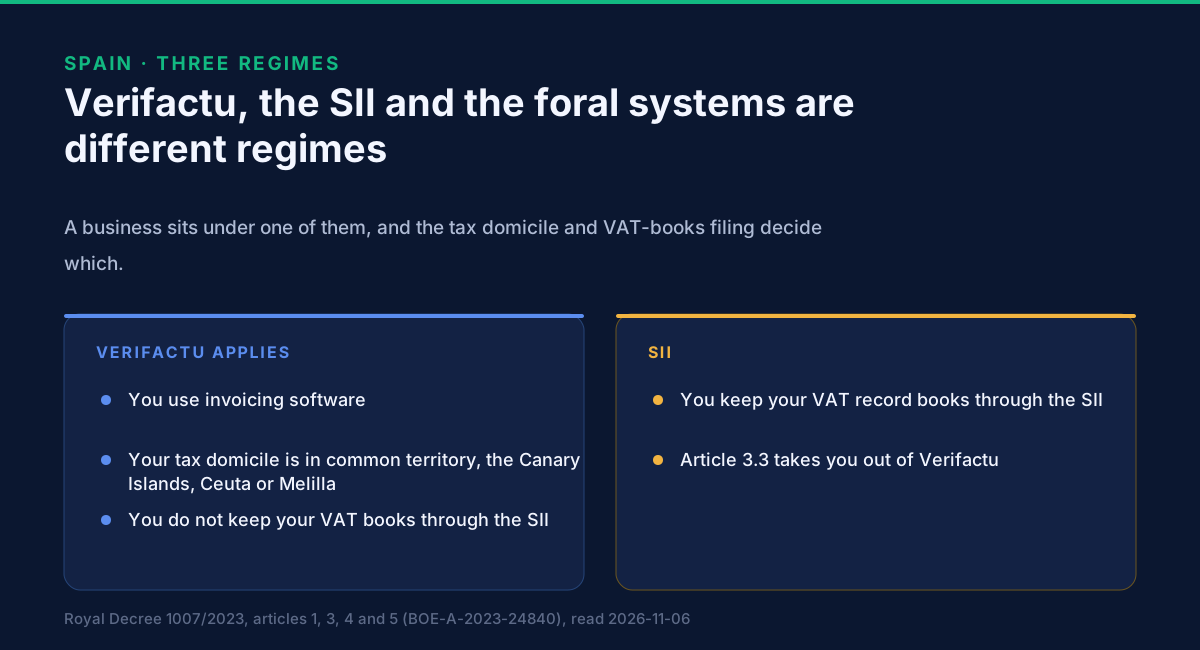
Most Spanish businesses that issue invoices from software are in Verifactu's scope, with three main ways out: you keep your VAT books through the SII, your tax domicile is in the Basque Country or Navarre, or you are an entity fully exempt from corporate income tax. Spain has three regimes that look alike from the outside and are not. Verifactu is the national regulation of invoicing systems (Royal Decree 1007/2023). The SII is a separate system in which larger businesses report invoice data to the Tax Agency. TicketBAI and the Navarre system are the regional equivalents in the territories with their own tax regimes. A business is under one of them, not all three.
This page sets out who is where. It does not cover how to file under the SII. The dates for businesses in scope are in Is Verifactu postponed to 2028?.
Who is in scope for Verifactu?
Taxpayers who use an invoicing system, even for only part of their activity. Article 3 of the regulation lists them:
- Corporate income tax payers (Impuesto sobre Sociedades).
- Personal income tax payers who carry on economic activities, such as the self-employed.
- Non-resident income tax payers with a permanent establishment in Spain.
- Income-attribution entities (entidades en régimen de atribución de rentas) that carry on economic activities.
Producers and sellers of invoicing software are also covered, for their own production and sale of the systems.
Who is outside it?
Five cases come straight from the regulation. None of them depends on size.
- Taxpayers on the SII. Article 3.3: the regulation does not apply to taxpayers who keep their VAT record books under article 62.6 of the VAT regulation, which is the SII.
- Taxpayers domiciled in the Basque Country or Navarre. Article 1.3: the regulation applies to taxpayers whose tax domicile is in common territory, without prejudice to the foral regimes in force there.
- Fully exempt entities. Article 3.1.a: entities fully exempt under article 9.1 of the corporate tax law are not subject to the obligations. Partially exempt entities are subject only for the operations that generate taxed, non-exempt income.
- Certain operations. Article 4 excludes four kinds: receipts that satisfy the invoice duty under the agricultural, livestock and fishing special VAT regime; operations for which no invoice has to be issued under the invoicing regulation; operations covered by additional provisions 3 and 6 of that regulation; and invoices for operations carried out through permanent establishments abroad.
- A decision on request. Article 5: the head of the Tax Agency's financial and tax inspection department may decide, on application, that the regulation does not apply to certain sectors or taxpayers where commercial or administrative practice justifies it, or to operations with exceptional technical obstacles. A decision can be temporary and conditional.
If the second case applies to you, the Basque territories' TicketBAI or Navarre's own scheme applies in place of Verifactu; the Tax Agency's regulation does not set those rules, and the details are for the regional treasury. GoRoute's Shopify app documentation draws the same line: it says Verifactu does not apply to companies on the SII or to those with tax domicile in the Basque Country or Navarre, "which use TicketBAI or the system of their Foral Treasury", and the app asks the merchant to confirm both.
What about the Canary Islands, Ceuta and Melilla?
They are in scope. Article 1.3 applies the regulation throughout Spanish territory, taking into account the specific rules of the Canary Islands, Ceuta and Melilla. The regulation adds that its references to VAT are read as references to the Canary Islands general indirect tax (IGIC) and to the Ceuta and Melilla production, services and import tax (IPSI). A business in the Canaries issues Verifactu invoices that carry IGIC; GoRoute's Shopify app supports a Canary Islands tax domicile for that reason, and says its VAT-correction function is currently for common-territory VAT.
Is the SII an alternative to Verifactu?
It takes you out of Verifactu, but it is not a lighter regime. Under the SII a business reports invoice data to the Tax Agency within the system's own deadlines, which this page does not cover. The regulation treats a taxpayer who keeps its VAT books through the SII as outside Verifactu; the likely reason, which the text does not state, is that the Tax Agency already receives the invoice data. Whether you are on the SII is something you know from your own filing; if you do not know, your adviser (gestor) does.
The two systems share a direction. The preamble to the regulation says that, after several years of SII experience, it is time to consider widening the reporting of invoice contents. The Ministry's note of 5 October 2026 mentions the EU's digital reporting requirements (ViDA) as the reason for a later change to scope. Read together, that says the boundary between the two may move; it does not say how.
Can I keep issuing paper invoices?
Verifactu does not ban them, but Spain's B2B e-invoicing mandate will. Article 1 of the regulation covers a "computer system" that supports the invoicing process, so an invoice not produced by a system is not what the regulation governs. That is our reading, and a business with any doubt should ask the Tax Agency. The Tax Agency also provides a free application that produces a printable invoice with its QR code for the smallest businesses.
The other mandate is different. Royal Decree 238/2026 requires invoices between businesses and professionals to be electronic, from October 2027 for businesses above EUR 8 million of turnover and from October 2028 for the rest, with simplified invoices exempt. Spain's B2B mandate guide has the details. So a business can be outside Verifactu today and still need to move to structured invoices later.
What is the order of checks?
Work down the list and stop at the first yes.
- Do you keep your VAT books through the SII? If yes, Verifactu does not apply to you.
- Is your tax domicile in the Basque Country or Navarre? If yes, your regional system applies instead.
- Are you an entity fully exempt from corporate income tax? If yes, you are outside the obligations.
- Do you produce invoices with software? If not, the regulation has nothing to govern, on our reading.
- Otherwise you are in scope. Corporate income tax payers have until before 1 January 2027 and other taxpayers before 1 July 2027, subject to the announced postponement.
If you are in scope and sell online, Verifactu for online shops shows what happens to each paid order. E-invoicing in Spain covers the wider picture, and the Verifactu documentation covers the Shopify app. For a check of your own case, book a session, or watch the recorded walkthroughs on the tutorials page.
Related guides
- Is Verifactu postponed to 2028? The dates that are law today
- Verifactu for online shops: tickets, QR codes and refunds
- Spain's B2B e-invoicing mandate: the 2027 and 2028 dates
- E-invoicing in Spain
Sources, read on 6 November 2026: Real Decreto 1007/2023, de 5 de diciembre (the regulation), articles 1, 3, 4 and 5, for scope and exclusions; Real Decreto-ley 15/2025 for the dates; Real Decreto 238/2026 for the B2B mandate; the Ministry of Finance's note of 5 October 2026; the Tax Agency's Verifactu page; GoRoute's Verifactu (Shopify) guide for the Shopify app's own limits. This page describes the rules; it is not tax or legal advice. GoRoute operates certified Peppol Access Point POP000991.
Frequently asked questions
- Does Verifactu apply to businesses on the SII?
- No. Article 3.3 of the regulation says it does not apply to taxpayers who keep their VAT record books through the immediate VAT information system (Suministro Inmediato de Información, SII), the system described in article 62.6 of the VAT regulation.
- Does Verifactu apply in the Basque Country and Navarre?
- Not to taxpayers domiciled there. The regulation applies to taxpayers whose tax domicile is in common territory, without prejudice to the foral regimes of the Basque Country and Navarre. Businesses there are under TicketBAI or their regional treasury's own system.
- Does Verifactu apply in the Canary Islands, Ceuta and Melilla?
- Yes. The regulation applies throughout Spanish territory, taking into account the specific rules for the Canary Islands, Ceuta and Melilla, and its references to VAT are read as references to the Canary Islands general indirect tax (IGIC) and the Ceuta and Melilla tax (IPSI).
- Can I keep issuing paper invoices?
- Verifactu governs computer systems used to produce invoices, so an invoice not produced by such a system is not what it regulates. That is our reading of article 1 of the regulation. Separately, Spain's business-to-business e-invoicing mandate will require electronic invoices between businesses from October 2027 or October 2028, with simplified invoices exempt.
- Are charities and other exempt entities in scope?
- Entities fully exempt from corporate income tax under article 9.1 of the corporate tax law are not subject to the obligations. Partially exempt entities are subject only for operations that generate income that is taxed and not exempt.
- Can the Tax Agency exempt a business?
- On request, the head of the Tax Agency's financial and tax inspection department can decide that the regulation does not apply to certain sectors or taxpayers, or to operations with exceptional technical obstacles. Such a decision can be temporary and can carry conditions.
About Dr. Syed Raza
Dr. Syed Raza is an IT Enterprise Architect at ClayDesk LLC and leads the GoRoute platform. He works across Peppol Access Point and SMP infrastructure, PINT jurisdictions (Oman, AU/NZ, EU, JP, MY, SG), and national CTC regimes, translating regulatory detail into production-grade e-invoicing systems.
Building on Peppol?
GoRoute is a certified Peppol Access Point & SMP. Book a demo or read the docs to get started.