
Invoicing an Italian Customer From Outside Italy
A supplier with no Italian base invoicing an Italian customer: what the Agency's SdI documents say, what the customer reports, and what to get in writing.

Whether an Italian invoicing rule reaches a supplier with no base in Italy is not answered in one sentence by the Agenzia delle Entrate, and this page does not pretend otherwise. What the Agency's documents do show is the shape of the arrangement. Invoicing through the Sistema di Interscambio (SdI), Italy's exchange system, is framed around persons resident or established in Italy. Purchases from abroad are handled on the Italian customer's side, with its own document types and a separate cross-border data service. A foreign supplier's job is mostly to make that handling possible.
This page is for the finance lead at a company in the United Kingdom, the United States, Spain or elsewhere that invoices Italian customers and has been told it "needs FatturaPA". It sets out what the Agency's documents say, what the Italian customer reports, and what to ask. It does not give VAT registration advice, and it does not say where any particular supply is made. The file format itself is in FatturaPA XML Format.
What do the Agency's documents say about foreign suppliers?
They draw the line at Italian residence or establishment, and say less about the rest. Three things are on the record.
- The titles of the rules. The Agency's page of legislation lists the SdI technical rules of 30 April 2018 as covering supplies "between persons resident, established or identified in the territory of the State". The version of 24 November 2022 is titled for supplies "between persons resident or established in the territory of the State". Both add "and for the electronic transmission of data on cross-border supplies". We have not read the full 2022 text, so we do not say what the change of wording means. Ask.
- The service pages. The Agency's "Fatture e corrispettivi" page, updated 9 May 2025, lists invoices through SdI under article 1, paragraph 3, of Legislative Decree 127/2015, and the data on cross-border invoices, which it calls the "esterometro", under paragraph 3-bis. It also offers a form and a checking program for cross-border data.
- The specification. It allows a foreign seller to appear in the file. In the seller's block, the VAT identifier takes an Italian VAT number for foreign operators identified in Italy through a permanent establishment, a fiscal representative or directly. In other cases it takes the identifier assigned by the supplier's own country.
None of this is a statement that a supplier outside Italy need not issue FatturaPA. It is a structure from which that follows, and it is our reading. Get the answer in writing from the Agency or an Italian tax adviser before a project plan rests on it.
What does the Italian customer do?
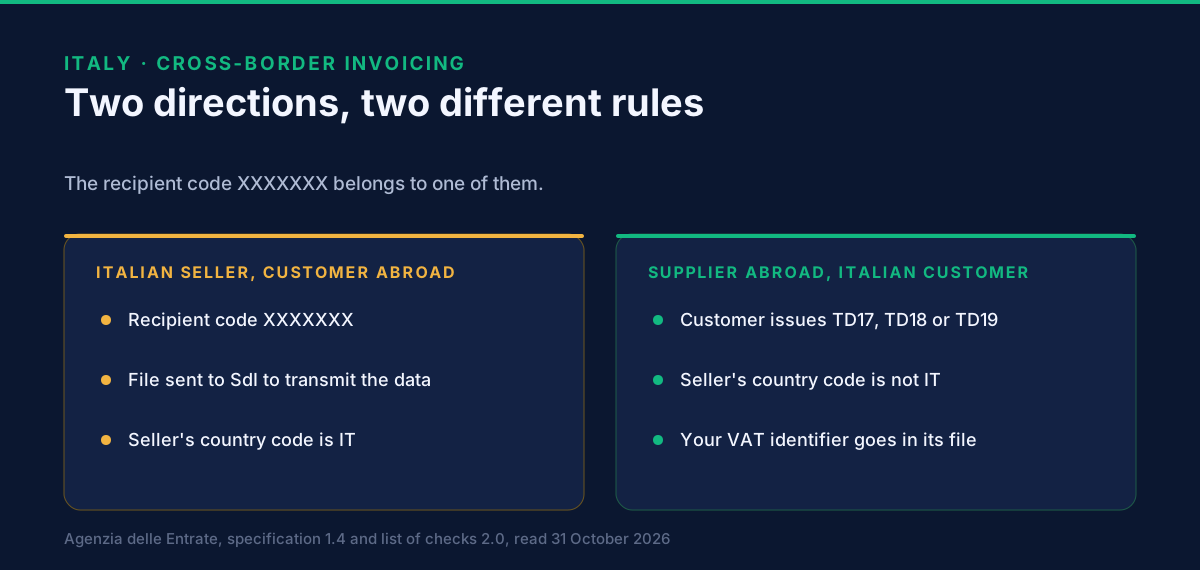
It completes its own record of the purchase, with a document type reserved for the buyer. The specification lists three that matter here, and the companion page FatturaPA Document Types: The TD Codes gives the whole table:
| Code | Agency's name | When |
|---|---|---|
TD17 |
Integrazione/autofattura per acquisto servizi dall'estero | Services bought from abroad |
TD18 |
Integrazione per acquisto di beni intracomunitari | Goods bought from another EU country |
TD19 |
Integrazione/autofattura per acquisto di beni ex art. 17 c. 2 DPR 633/72 | Goods under article 17(2) |
The Agency's checks show how these documents treat a foreign supplier. For all three, SdI requires the
seller's country code to be anything but Italy (error 00473) and the buyer's VAT identifier to be
present (error 00475). On our reading of those checks, the seller block of the
customer's document names your company, with the identifier your country gave it. That is why a
foreign supplier is asked for its VAT number with the country prefix.
Which of the codes your customer uses, and whether the purchase is one the customer must report at all, is its own tax question. We do not say.
What does a supplier actually need to hand over?
The identifiers and amounts the customer's document has to reproduce. From what the specification and checks require of the file, the useful list is short:
- Your VAT or tax identifier with its country prefix, as your own country issued it. SdI does not check foreign identifiers against the Italian register, so a mistake is not caught on its side.
- The customer's Italian VAT number, which its document must carry.
- Invoice date, number and currency, and the amounts and tax treatment shown on your invoice.
- An invoice the customer can read. The Agency's documents we read do not tell a foreign supplier to send XML. Which format a customer accepts from you is a matter for the two of you.
Your invoicing system's own requirements, and your own country's, still apply. Nothing here replaces them.
What if you do issue through SdI?
Then the file's rules apply, and four of them are worth knowing first. A supplier identified in Italy, or one that chooses to issue FatturaPA, meets the same file as an Italian company.
- The file name. For a sender outside Italy the tax identifier in the file name is 2 to 28 characters, against 11 to 16 for an Italian one (SdI technical specification 1.8.4, section 2.2).
- The recipient code. The Italian customer's own Codice Destinatario, or
0000000with its certified email address. See What Is an SDI Code?. - The country-code rule. SdI rejects a file in which both seller and buyer carry a non-Italian
country code (error
00476). A foreign seller's invoice to an Italian customer passes it. A foreign seller's invoice to a customer in a third country does not. - The tax identifier. Italian identifiers are checked against the Italian register. Foreign ones are not.
What does XXXXXXX have to do with this?
Nothing, for your invoices to Italy. It is the code for the opposite direction. The Agency's
specification gives XXXXXXX as the recipient code for an invoice issued to subjects who are not
resident, not established and not identified in Italy, sent to SdI to transmit the data of those
invoices. It is what an Italian seller writes when it sells to a customer abroad. A foreign supplier
invoicing an Italian customer has no use for it, and since SdI rejects a file where both parties have
non-Italian country codes, a XXXXXXX file always has an Italian seller.
What is still open?
Three things, as of 31 October 2026.
- What the 2022 change of wording means. The rules' title dropped "identified". We have not read the full text to see the effect on a supplier identified in Italy.
- The current scope of the cross-border data rule. The Agency's page still lists the service. We have not read the current rules on who must report what, or any exemption.
- Whether your supplies are inside the Italian rules at all. That depends on where they are made and who accounts for the tax, which is a VAT question.
What to do next
- Put three questions in writing to an Italian tax adviser or the Agency: whether your supplies to Italian customers fall under the SdI invoicing rule, who reports them, and with which document type.
- Send your Italian customers your VAT identifier with its country prefix, and keep their Italian VAT numbers on file.
- If you will issue through SdI, read FatturaPA XML Format and What Is an SDI Code?.
- To talk through e-invoicing across several countries, book a demo. The developer documentation, the tutorials, the GoRoute API and Peppol show how documents are sent to customers on the network.
Related reading
- E-invoicing in Italy, the country page.
- FatturaPA XML Format: Structure, File Name and Signature
- What Is an SDI Code? The Codice Destinatario Explained
- FatturaPA Document Types: The TD Codes
- Invoicing Portuguese customers from outside Portugal, the same question for the neighbouring market.
Sources, all read on 31 October 2026: Agenzia delle Entrate, Fatture e corrispettivi: che cos'è (updated 9 May 2025) and Normativa e prassi, for the titles of the rules of 30 April 2018 and 24 November 2022; the FatturaPA specification version 1.4, section 1.1 and 1.2; the Sistema di Interscambio technical specification version 1.8.4, section 2.2 and the content checks, and the list of checks version 2.0, codes 00473, 00475 and 00476, on fatturapa.gov.it. Translations from the Italian are ours. Passages marked as our reading are not the Agency's.
Frequently asked questions
- Does a foreign supplier have to send FatturaPA to an Italian customer?
- The Agency's pages we read frame invoicing through SdI around persons resident or established in Italy, and treat transactions with abroad through a separate service for cross-border data. We did not find one sentence saying a supplier with no Italian base is outside the SdI rule, so that is our reading and not the Agency's. Ask in writing before you rely on it.
- What does the Italian customer do with my invoice?
- For a purchase from abroad, the Italian buyer completes its own record. The specification has document types for this: TD17 for services bought from abroad, TD18 for intra-Community goods and TD19 for goods under article 17, paragraph 2, of Presidential Decree 633/72. The buyer issues them and SdI requires the seller's country code to be non-Italian.
- What does XXXXXXX mean in a codice destinatario?
- It is the recipient code for an invoice an Italian seller issues to a customer who is not resident, established or identified in Italy. It is not a code a foreign supplier uses for an Italian customer. For an Italian customer, the right value is the customer's own code or 0000000 with its certified email address.
- Can a foreign supplier have an Italian VAT number in the file?
- Yes. The specification says the VAT identifier block takes an Italian VAT number for foreign operators identified in Italy through a permanent establishment, a fiscal representative or directly, and the foreign tax identifier in other cases. Whether you should be identified in Italy is a VAT question this page does not answer.
- Does SdI check a foreign tax identifier?
- No. SdI's specification says its check of tax codes and VAT numbers against the Italian tax register is not done for identifiers assigned by foreign authorities. SdI does reject a file in which both seller and buyer carry a non-Italian country code, with error 00476.
About Dr. Syed Raza
Dr. Syed Raza is an IT Enterprise Architect at ClayDesk LLC and leads the GoRoute platform. He works across Peppol Access Point and SMP infrastructure, PINT jurisdictions (Oman, AU/NZ, EU, JP, MY, SG), and national CTC regimes, translating regulatory detail into production-grade e-invoicing systems.
Building on Peppol?
GoRoute is a certified Peppol Access Point & SMP. Book a demo or read the docs to get started.