
San Marino E-Invoicing: Two Rules, and a 2027 Deadline
San Marino has two e-invoicing rules: cross-border trade with Italy via HUB-SM, live since October 2021, and a domestic mandate compulsory on 1 January 2027.

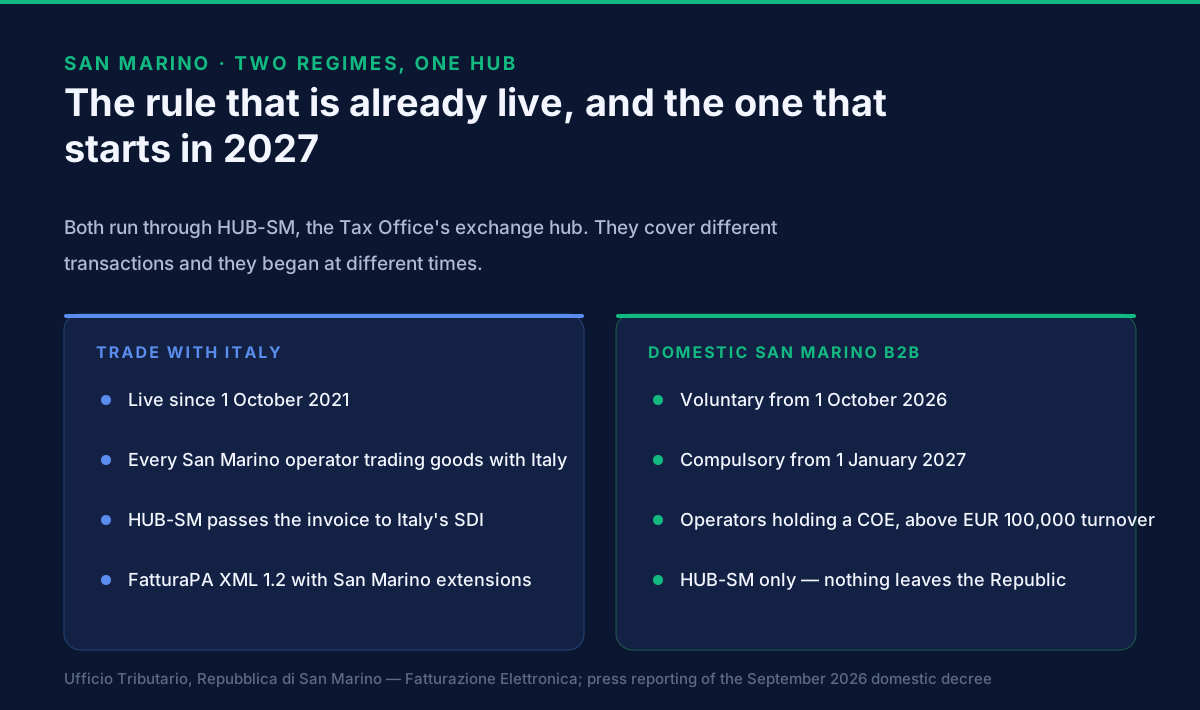
San Marino has two electronic invoicing rules, and most confusion about the country comes from treating them as one. Invoicing between San Marino and Italy has been electronic since 1 October 2021. Invoicing inside San Marino becomes electronic on 1 January 2027, voluntarily from 1 October 2026. Both run through HUB-SM, the exchange hub operated by the Republic's Ufficio Tributario — and neither runs over Peppol.
This page separates the two regimes, sets out what each asks of an invoice, and says plainly which parts are settled law and which are still press reporting.
What are San Marino's two e-invoicing rules?
One covers trade with Italy. The other covers trade inside the Republic.
The cross-border rule has been in force since 1 October 2021 and applies to every San Marino economic operator trading goods with Italy, in both directions, as well as to services where the Italian side raises the invoice. Its legal basis is a set of 2021 delegated decrees and regulations, underpinned by an exchange of letters between the two states in May 2021. Sales to private customers stay on paper, and customs flows into and out of the European Union stay on paper too.
The domestic rule is new. Reporting of the September 2026 decree describes an obligation on all operators, farms, the State and public and private bodies holding a Codice Operatore Economico — the Republic's business registration number — for domestic supplies of goods and services. Businesses whose prior-year revenue was below EUR 100,000 are outside it. They may opt in, and the opt-in is permanent: once inside the regime you stay there.
The practical consequence is that a San Marino business can be inside one rule and outside the other. A small local supplier that has never traded with Italy is untouched today and may still be untouched in 2027. A manufacturer shipping to Rimini has been filing electronically for five years and gains a second, separate obligation in January.
Who has to act, and by when?
If you hold a COE and your prior-year revenue exceeded EUR 100,000, your domestic invoicing has to be structured and travelling through HUB-SM by 1 January 2027.
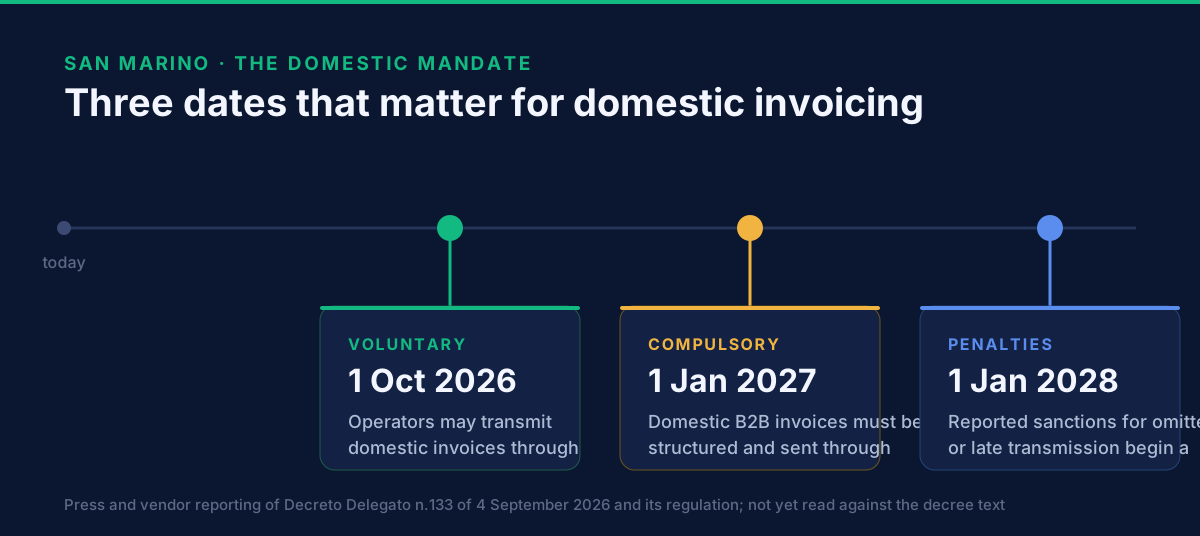
Two details in that timetable are worth separating. The first is that the voluntary window runs from 1 October 2026 to 31 December 2026 — three months in which you can be wrong cheaply, which is the only sensible time to find out how your ERP behaves. The second is that the reported sanctions do not begin with the obligation. Press and vendor summaries place them at 1 January 2028, with one vendor summary quoting EUR 100 per invoice for omitted or late transmission. We have not read that figure in the decree, so treat it as reporting rather than as law until the text is published.
Domestic transmission is not immediate. The reported deadline is the end of the second month following delivery for goods, completion for services, or receipt for advance payments. That is a materially gentler clock than Italy's, and it is the kind of difference that gets lost when a group applies its Italian process to a San Marino subsidiary.
How does an invoice travel between San Marino and Italy?
Through HUB-SM, which hands it to Italy's SDI. A San Marino operator never talks to SDI directly.
This is the single most useful fact about the country for anyone building or buying a system. Italy's Sistema di Interscambio is a clearance checkpoint: nothing reaches the customer until SDI has passed it. San Marino sits one step behind that checkpoint. The operator submits to HUB-SM, HUB-SM submits onward, and the Italian side sees an ordinary SDI delivery.
The routing detail matters in the other direction too. Italian suppliers invoicing a San Marino
customer address the invoice using a single recipient code — one codice destinatario
issued by Agenzia delle Entrate, the Italian revenue
agency, to the Ufficio Tributario itself, rather than a code per company. The
San Marino buyer gives that value to its Italian suppliers. It is published in an Italian
revenue circular rather than on the Tax Office's own page, which is why suppliers so often ask
for it and get a shrug.
Two deadlines govern the receiving side. An invoice received from Italy must be presented within 60 days. A document SDI rejects must be corrected and resubmitted within 5 days — the same five-day fix window Italian issuers work to.
What does a San Marino invoice file have to contain?
Italy's FatturaPA XML 1.2, with San Marino's own extensions on top.
The official technical documentation sets out the differences from an ordinary Italian invoice, and they are specific enough to break an integration that assumes otherwise:
IdPaese=SMidentifies the San Marino party.TipoDocumentomust beTD01. The self-billing and integration types an Italian issuer reaches for — TD07, TD08, TD09 — are refused.Natura=N3.1(esportazioni) applies on sales to Italy.- A goods classification — tipo merce 1, 4 or 7 — travels in the line's
AltriDatiGestionaliblock as<TipoDato>TM</TipoDato>. - A delivery-note reference is mandatory on every line, checked semantically rather than merely structurally.
- Accompanying invoices and financial advance invoices are not accepted.
- A credit note must populate
DatiFattureCollegate, tying it to the document it corrects.
The domestic regime uses the same structured-invoice shape through HUB-SM. Its own code lists sit in the regulation accompanying the September 2026 decree, and we have not read them: if your project depends on the domestic enumerations, get the regulation rather than inferring them from the cross-border rules.
Transport is a per-operator web service or the Tax Office's TribWEB portal, and a test environment is reachable through TribWEB. Vendor documentation describes authentication by a token issued to each operator, a test flag that switches to the simulation environment, and four hub states — acquired, in HUB-SM, rejected, and discarded as non-compliant. The same vendor documentation notes that the XML signature is optional. That is vendor material, not the authority's, and it is marked here as such.
One obligation is easy to miss because it is an absence rather than a requirement: the Tax Office does not provide storage. Legal archiving of the documents is the operator's own job.
Is San Marino on Peppol?
No — and it is worth being precise about why, because the answer decides what you build.
Peppol is a four-corner network: you are identified by a participant identifier, discovered through a Service Metadata Publisher, and documents travel over AS4 between certified access points. San Marino has none of that. HUB-SM is a national clearance hub with a proprietary web service, an Italian-derived XML format and a token issued per operator. Access is tied to a COE, which means a provider transmits on behalf of a San Marino operator using that operator's credentials. There is no accreditation scheme to join.
So "are you certified for San Marino?" is not a question with an answer, in the way it is for Oman or the United Arab Emirates. The honest framing for a project plan is that San Marino is an adapter to a single national endpoint, sitting alongside the country's real interface to the outside world, which is Italy's SDI.
GoRoute does not transmit to HUB-SM. Where we work on this route is the Italian side — the FatturaPA document, its clearance through SDI and the receipt that comes back — which is set out on our Italy page. If your San Marino entity needs domestic transmission, that is a HUB-SM connection and we would tell you so rather than sell around it.
What is still unsettled
Three things, stated as gaps rather than smoothed over.
The decree's own identity. Vendor summaries name Decreto Delegato n.133 of 4 September 2026 with an accompanying regulation numbered 28/2026; press reporting names a delibera n.27 of 1 September 2026. Those may be the decision and the decree that followed it, but we have not reconciled them against the official text, so this page cites neither as the authority for a date.
The penalty amount. EUR 100 per invoice is a vendor summary, repeated here as reporting.
The domestic code lists. Not published on the Tax Office's page at the time of writing.
Where a compliance date carries money, read the decree. This page is a map, not a citation you should put in a board paper.
What this page does not cover
Italian VAT treatment. Whether a given supply is zero-rated, how it is reported, and what your Italian customer must do with it are tax questions rather than document-exchange ones. Nothing here is inferred about them.
Any suggestion that GoRoute submits to HUB-SM. We do not, and a page that implies otherwise would cost a customer a month.
The other European mandates. Each has its own model and its own dates — the 2026 country-by-country tracker is the index, and San Marino now has a row in it.
What to do next
Establish which of the two rules you are in, and whether you are in both. Almost every sensible decision follows from that one answer, and it takes a finance lead about ten minutes.
If your work is on the Italian side of this — clearing FatturaPA through SDI, handling a rejection inside the five-day window, routing by recipient code — that is what our Italy page covers, and the document types, statuses and identifier formats are in the developer documentation. Recorded walkthroughs of the connectors are on tutorials. To map your own scope, including whether a San Marino entity needs anything from us at all, book a session and we will say so either way.
Sources: the Ufficio Tributario of the Republic of San Marino, Fatturazione Elettronica (Fiscalità), for the cross-border regime, its 2021 legal basis, the format extensions, the 60-day and 5-day deadlines, the single recipient code and the absence of a storage service; press and vendor reporting of the September 2026 domestic decree for the 1 October 2026, 1 January 2027 and 1 January 2028 dates, the EUR 100,000 threshold, the end-of-second-month transmission deadline and the EUR 100 penalty figure, each attributed as reporting in the text above. Italian clearance behaviour is described on our Italy page. Last reviewed 2026-09-23.
Frequently asked questions
- Is San Marino on the Peppol network?
- No. San Marino runs a national clearance hub called HUB-SM, operated by the Ufficio Tributario. It has no Peppol participant identifier, no Service Metadata Publisher entry and no AS4 transport. An invoice reaches a San Marino operator through HUB-SM and, for trade with Italy, through Italy's SDI — never over Peppol.
- When does San Marino's domestic e-invoicing mandate start?
- Transmission of domestic invoices through HUB-SM is voluntary from 1 October 2026 and compulsory from 1 January 2027, according to reporting of the September 2026 decree. Sanctions for omitted or late transmission are reported to begin on 1 January 2028. Operators whose prior-year revenue was below EUR 100,000 are outside the obligation and may opt in, and an opt-in cannot be reversed.
- How does a San Marino operator send an invoice to an Italian customer?
- As FatturaPA XML 1.2 with San Marino extensions, submitted to HUB-SM, which passes it to Italy's Sistema di Interscambio. San Marino operators do not connect to SDI directly. The document type must be TD01, sales to Italy carry Natura N3.1, and each line carries a mandatory delivery-note reference.
- How long does a San Marino business have to handle an invoice from an Italian supplier?
- Invoices received from Italy must be presented within 60 days. Where SDI rejects a document, the corrected file must be resubmitted within 5 days.
- Does the San Marino Tax Office archive the invoices for you?
- No. The Tax Office does not provide storage, so each operator is responsible for archiving its own documents. That is a separate obligation from transmitting them, and it does not disappear because the hub holds a copy.
About Dr. Syed Raza
Dr. Syed Raza is an IT Enterprise Architect at ClayDesk LLC and leads the GoRoute platform. He works across Peppol Access Point and SMP infrastructure, PINT jurisdictions (Oman, AU/NZ, EU, JP, MY, SG), and national CTC regimes, translating regulatory detail into production-grade e-invoicing systems.
Building on Peppol?
GoRoute is a certified Peppol Access Point & SMP. Book a demo or read the docs to get started.