
UAE E-Invoicing: Who Must Appoint an ASP by 30 October 2026
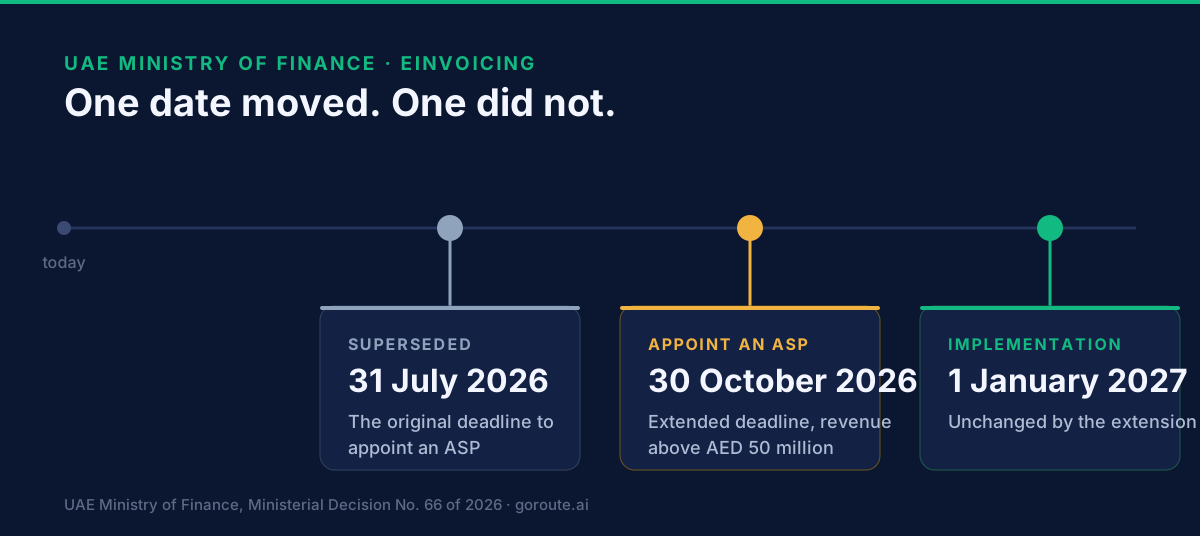
The UAE deadline to appoint an Accredited Service Provider moved to 30 October 2026 for revenue above AED 50 million. Implementation is still 1 January 2027.

Last updated .
When is the UAE deadline to appoint an Accredited Service Provider?
30 October 2026, for persons subject to the UAE eInvoicing system whose annual revenue exceeds AED 50 million. The Ministry of Finance extended it from 31 July 2026. Mandatory implementation did not move and remains 1 January 2027, so the gap between appointing a provider and going live is now shorter.
Both dates carry the same revenue threshold, and quoting either one without it turns a targeted obligation into a national one. If your revenue sits below the line, no dated obligation for you has been published that we can point you at — that gap is set out below rather than filled with an inference.
| What | Date | Status |
|---|---|---|
| Appoint an Accredited Service Provider | 30 October 2026 | Extended from 31 July 2026 |
| Mandatory implementation | 1 January 2027 | Unchanged by the extension |
Both apply to persons subject to the eInvoicing system with annual revenue exceeding AED 50 million. The instrument that moved the first date is Ministerial Decision No. 66 of 2026, amending Ministerial Decision No. 244 of 2025.
What is an Accredited Service Provider?
An Accredited Service Provider, usually shortened to ASP, is a provider the UAE Ministry of Finance has accredited to handle electronic invoices on a business's behalf. The Ministry maintains and publishes the list of who is accredited. The obligation the October date creates is the appointment itself: an in-scope business has to have one of those providers appointed by then.
That is why the appointment carries its own deadline, ahead of the implementation date. Appointing is the step that makes everything after it possible, and it takes ordinary procurement time — shortlisting, a security and data review, contracting, and then connecting the provider to whatever systems issue your invoices today.
What does "appoint" mean in practice?
The Ministry's decisions set the obligation, and the linked texts are where its exact terms live. What the word means for the people doing the work is more prosaic, and worth being blunt about, because "appoint a provider by a date" sounds like a signature and is not.
In practice it is a shortlist, a due-diligence pass that finance and IT both sign off, a contract, and then an integration. The contract is the part that meets the October deadline. The integration is the part that meets the January date, and in most organisations it is the longer of the two by a wide margin. Treating them as one task is the commonest way a project that started early still finishes late.
Who exactly has to appoint one by 30 October 2026?
Persons subject to the eInvoicing system whose annual revenue exceeds AED 50 million. The threshold and the date belong together. Quoted on its own, "30 October 2026" reads as a general UAE e-invoicing deadline for everybody, and it is not that. If working out which side of that line you are on is the question you actually have, the AED 50 million threshold is covered on its own page.
Two things follow, and they matter more than they look.
The threshold test is the one written in the Ministry's decision, not the one in anybody's summary — including this page. The decisions are linked above and below. If your revenue is anywhere near the line, that is the text to read, with whoever advises you on tax.
Group structures are where this gets decided in practice. If you run several entities, the question is which of them is a person subject to the system in its own right. That is a question about your structure, answered from the decision and your own advice, not from an article.
Was the deadline always 30 October 2026?
No. It was 31 July 2026, and the Ministry extended it to 30 October 2026.
This matters for one specific reader: anyone who planned around the old date and has since stopped paying attention. If a project plan still carries 31 July 2026 as a live date, that plan is out of date — the date moved outward, so there is more time than the plan shows, not less. The old date should now be cited only as the date that was extended, never as a current obligation.
Does the extension delay the rest of the timetable?
No. The deadline that moved is the deadline to appoint a provider. The Ministry states that the timeline for the commencement of mandatory implementation remains unchanged, and that date is 1 January 2027 for the same population.
That combination is the single most useful thing on this page, so it is worth stating flatly: the appointment date moved and the implementation date did not, so the gap between them narrowed. An organisation that reads "extension" as "the whole thing is delayed" ends up with less integration time than it had before, not more.
How many accredited providers are there to choose from?
60, on the Ministry's published list read on 4 October 2026 — plus 6 more shown separately as pre-approved and undergoing the final production assessment.
Date that figure whenever you use it, including when you read it here. It was 32 at the Ministry's May 2026 announcement, so the list has roughly doubled in five months, which is the clearest evidence available that reading a count from an article rather than from the list is a mistake. The Ministry's own page states it was last updated on 2 October 2026.
The list exists under Article 16 of Ministerial Decision No. 64 of 2025, on the eligibility criteria and accreditation procedure for service providers, and the Ministry publishes it in alphabetical order with each provider's accreditation number, website and contact. The list of Accredited Service Providers — not a comparison article, and not this page — is the authority on who is accredited today.
Three practical notes for a shortlist. First, read the list on the day you shortlist, because a provider that was in assessment last month may be accredited this month. Second, the second table matters: a pre-approved provider has completed the initial requirements and is still in the final production assessment, so it is not yet accredited, and appointing one does not meet the October obligation. Third, check the exact name on the list against the exact legal entity you would be contracting with. Groups trade under several names, and the accredited one is the name on the list — which is also why each row carries an accreditation number, and that number is the thing to quote back to a provider that tells you it is accredited.
What if your revenue does not exceed AED 50 million?
Here is what is settled and what is not, kept apart on purpose.
Settled: the appointment deadline of 30 October 2026 and the implementation date of 1 January 2027 apply to persons subject to the eInvoicing system with annual revenue exceeding AED 50 million.
Not settled, as far as we can source it: a dated obligation for everyone else. We have not found one published by the Ministry that we can point you at, and we will not infer a date from the shape of the timetable. If you see a date quoted for businesses below the threshold, ask where it was published before you build a plan around it.
That distinction is not pedantry. Planning a project around an inferred date is how organisations spend money early and then discover the requirement was different.
What should an in-scope business do between now and the deadline?
Nothing in this list is a compliance opinion about your business. It is the order the work tends to fall into.
- Establish whether you are in scope, from the decision text and your own tax advice. Everything else depends on this answer, and it is the cheapest step to get right early.
- Find out what actually issues your invoices today. In most organisations it is more than one thing: an ERP, a billing system, a point-of-sale estate, and a spreadsheet somebody maintains. The last one usually causes the trouble.
- Shortlist from the Ministry's published list. Ask each provider how they connect to the systems you named in step 2, and ask for the answer in writing. The five questions worth asking a provider before you sign are set out on their own page, with the reason each one matters.
- Leave time for the connection, not just the signature. Appointing a provider by 30 October 2026 is the deadline; being able to issue compliant invoices by 1 January 2027 is the outcome, and it takes longer.
- Write down who owns it. E-invoicing lands between finance and IT, which is exactly where work sits unowned until a date arrives — a problem worth settling deliberately rather than by default.
How long does it take to appoint an Accredited Service Provider?
Plan on months rather than weeks, and budget most of that time for the connection rather than the contract. The signature is the fast part. What sits in front of it is a shortlist from the Ministry's published list, a security and data review that finance and IT both have to sign off, and a commercial negotiation; what sits behind it is an integration to every system that issues an invoice today.
There is no published minimum. What can be said is which of the two dates each activity belongs to. Appointing a provider is the obligation carrying 30 October 2026. Being able to issue compliant invoices is the outcome required on 1 January 2027, and that is the one that takes the longer run at it — roughly two months, on the current calendar, between the two.
Two things routinely add time that nobody planned for. The first is discovering, part way through, that invoices are issued by more systems than the project list contained. The second is master data: Tax Registration Numbers missing on counterparties, inconsistent country and currency codes, party names that do not match the register. Neither is difficult work, and both are slow when they start late.
If you are choosing between providers rather than working out whether you are in scope, the five questions worth asking before you sign is the page to read next; the UAE Peppol access point page sets out what the provider actually operates on your behalf.
Three ways this deadline gets misread
Each of these can be checked against the Ministry's own text, which is why they are worth naming.
"The UAE e-invoicing deadline is 30 October 2026." Only for the population above the AED 50 million revenue threshold. Stated without the threshold, a targeted obligation becomes a national one, and businesses go shopping for a provider on a timetable that may not be theirs.
"It has all been pushed back." The appointment deadline moved from 31 July 2026 to 30 October 2026. Mandatory implementation remains 1 January 2027. Reading the first as though it moved the second is how an organisation quietly loses integration time.
"There are 32 providers to choose from." That was the position at the Ministry's May 2026 announcement. The list read 60 on 4 October 2026, with 6 more pre-approved and still in final assessment. It is a dated figure, not a standing one, and any count you read in an article is only as current as the day it was written. Read the Ministry's list on the day you shortlist.
Where do these rules come from?
From the Ministry of Finance's own decisions and announcement, linked so you can read them rather than take our word for it:
- The Ministry's announcement of targeted amendments to the eInvoicing system decisions, which is where the extension and the unchanged implementation timeline are stated.
- Ministerial Decision No. 244 of 2025 on the implementation of the electronic invoicing system.
- Ministerial Decision No. 66 of 2026, the instrument that moved the appointment deadline.
- The Ministry's list of Accredited Service Providers.
If a page tells you a UAE e-invoicing date and does not link the decision that sets it, that is a reason to check before acting on it.
Where GoRoute stands, plainly
GoRoute is not on the UAE Ministry of Finance's list of Accredited Service Providers. If you are appointing an ASP for the UAE, appoint one from that list.
What GoRoute is: an e-invoicing service provider accredited in Oman by the Oman Tax Authority, through Union Digital Technologies SPC, and a Peppol-certified Access Point (Service Provider ID POP000991, ClayDesk LLC). We publish this explainer because the same finance teams ask us the same questions across the Gulf, and because the Ministry's decisions are easier to act on when somebody links them.
If the Gulf picture as a whole is what you are planning against, the GCC e-invoicing comparison sets the countries side by side, the UAE compliance page covers the UAE specifically, and the Oman page covers the market where we operate as an accredited provider. You can also book a working session.
Sources
- UAE Ministry of Finance, announcement of targeted amendments to the eInvoicing system decisions
- Ministerial Decision No. 66 of 2026 amending Ministerial Decision No. 244 of 2025
- UAE Ministry of Finance, eInvoicing Accredited Service Providers — read on 4 October 2026: 60 accredited providers, published under Article 16 of Ministerial Decision No. 64 of 2025, plus 6 pre-approved providers in final production assessment. The page states it was last updated on 2 October 2026.
Each source above was re-checked and returned normally before this page was prepared. The provider count was re-read from the Ministry's list on 4 October 2026 and the figure on this page updated from 32 to 60.
Frequently asked questions
- When is the UAE deadline to appoint an Accredited Service Provider?
- 30 October 2026, for persons subject to the UAE eInvoicing system with annual revenue exceeding AED 50 million. The Ministry of Finance extended it from 31 July 2026 in Ministerial Decision No. 66 of 2026.
- Does the UAE deadline of 30 October 2026 apply to every business?
- No. It applies to persons subject to the eInvoicing system whose annual revenue exceeds AED 50 million. Quote the revenue threshold with the date, because without it the date reads as a general national deadline that it is not.
- Was the UAE e-invoicing deadline extended?
- The appointment deadline was. It was 31 July 2026 and the Ministry of Finance extended it to 30 October 2026. Cite 31 July 2026 only as the date that was extended, never as a current obligation.
- Does the extension delay mandatory implementation in the UAE?
- No. The Ministry states that the timeline for the commencement of mandatory implementation remains unchanged. That date is 1 January 2027 for the same population, so the gap between appointing a provider and going live is now shorter, not longer.
- How many Accredited Service Providers has the UAE approved?
- 60, on the Ministry of Finance's published list read on 4 October 2026, with a further 6 pre-approved providers shown separately as undergoing the final production assessment. The Ministry's page states it was last updated on 2 October 2026. Date the figure whenever you use it and read the list on the day you shortlist, because the count rises — it was 32 at the Ministry's May 2026 announcement.
- Is GoRoute an Accredited Service Provider in the UAE?
- No. GoRoute is not on the UAE Ministry of Finance's list of Accredited Service Providers. GoRoute is accredited in Oman by the Oman Tax Authority, through Union Digital Technologies SPC, and is a Peppol-certified Access Point.
About Dr. Syed Raza
Dr. Syed Raza is an IT Enterprise Architect at ClayDesk LLC and leads the GoRoute platform. He works across Peppol Access Point and SMP infrastructure, PINT jurisdictions (Oman, AU/NZ, EU, JP, MY, SG), and national CTC regimes, translating regulatory detail into production-grade e-invoicing systems.
Building on Peppol?
GoRoute is a certified Peppol Access Point & SMP. Book a demo or read the docs to get started.