
How to Choose a UAE Accredited Service Provider
Shortlist only from the Ministry of Finance's published list, then compare providers on integration, onboarding time, support hours, pricing and exit.

Last updated .
The short answer
Shortlist only from the UAE Ministry of Finance's own published list of Accredited Service Providers, then choose between them on five things: how the provider connects to the systems that issue your invoices today, how long onboarding takes, whether support covers your working hours, how the pricing is structured, and what happens to your data if you leave. The deadline to appoint one is 30 October 2026 for persons subject to the eInvoicing system with annual revenue exceeding AED 50 million. The list is the hard filter and it is short work; the five questions are where the decision is actually made. Our UAE e-invoicing page sets out the dates and links the rest of our UAE coverage.
| The question | Where the answer comes from |
|---|---|
| Who is accredited? | The Ministry of Finance's published list — nowhere else |
| By when must one be appointed? | 30 October 2026, for revenue exceeding AED 50 million |
| By when must invoices actually flow? | 1 January 2027, unchanged by the extension |
| Which of the accredited providers suits us? | The five questions below, asked of each one in writing |
Where is the official list of accredited providers?
The UAE Ministry of Finance publishes it. The list of Accredited Service Providers sits on the Ministry's own eInvoicing pages, and it is the authority on who is accredited today.
This is worth stating plainly because it is commonly got wrong. Accreditation of service providers is often attributed to the tax authority, which sends buyers looking in the wrong place and, worse, makes them willing to accept a provider's own word about its status. If a provider's name is not on the Ministry's list, no amount of confidence in a sales meeting puts it there.
Two habits are worth building into the shortlist itself:
- Read the list on the day you shortlist. A provider in final assessment last month may be accredited this month, and a list you saved to a slide in June is not evidence in September.
- Check the exact legal name. Groups trade under several names, and the accredited one is the name the Ministry published. The entity on your contract and the entity on the list should be the same entity, not two names that look related.
Is an Accredited Service Provider the same as a Peppol access point?
Not quite, and the difference is the thing that trips up a shortlist. A Peppol access point is a technical role: the gateway that sends and receives documents on the Peppol network, certified by OpenPeppol. An Accredited Service Provider is a national status: a provider the UAE Ministry of Finance has approved to deliver those regulated functions to UAE taxpayers. In the UAE you need both, in the same supplier, and Peppol certification alone does not get a provider onto the Ministry's list.
Read that as two filters applied in order. The Ministry's list tells you who may serve you at all. Peppol certification and the OpenPeppol directory tell you what that provider can actually do on the network — which is a separate question, and one worth checking rather than assuming, because the two registers are maintained by different bodies for different purposes.
The confusion has a practical cost in a procurement. A provider can be entirely genuine as a certified access point somewhere else in the world and still not be an option for a UAE taxpayer; a shortlist assembled from Peppol directories rather than from the Ministry's list will contain names that cannot be appointed. Build the shortlist from the Ministry's list first, then use the network directory to compare the ones on it.
What the provider then operates on your behalf — issuance, exchange, registration, the tax view sent to the Federal Tax Authority, archival and day-two support — is set out on the UAE Peppol access point page.
How many providers is that, realistically?
32 were approved as at the Ministry's May 2026 announcement, with more in final stages.
Date that figure whenever you use it, including when you read it here — the count rises as the Ministry accredits more providers, and an undated number goes stale without anyone noticing. What matters for a procurement is not the exact number but its shape: this is a real shortlist, not a monopoly and not a free-for-all. There are enough providers to run a genuine comparison and few enough to read the whole list in an afternoon.
What are the five questions worth asking?
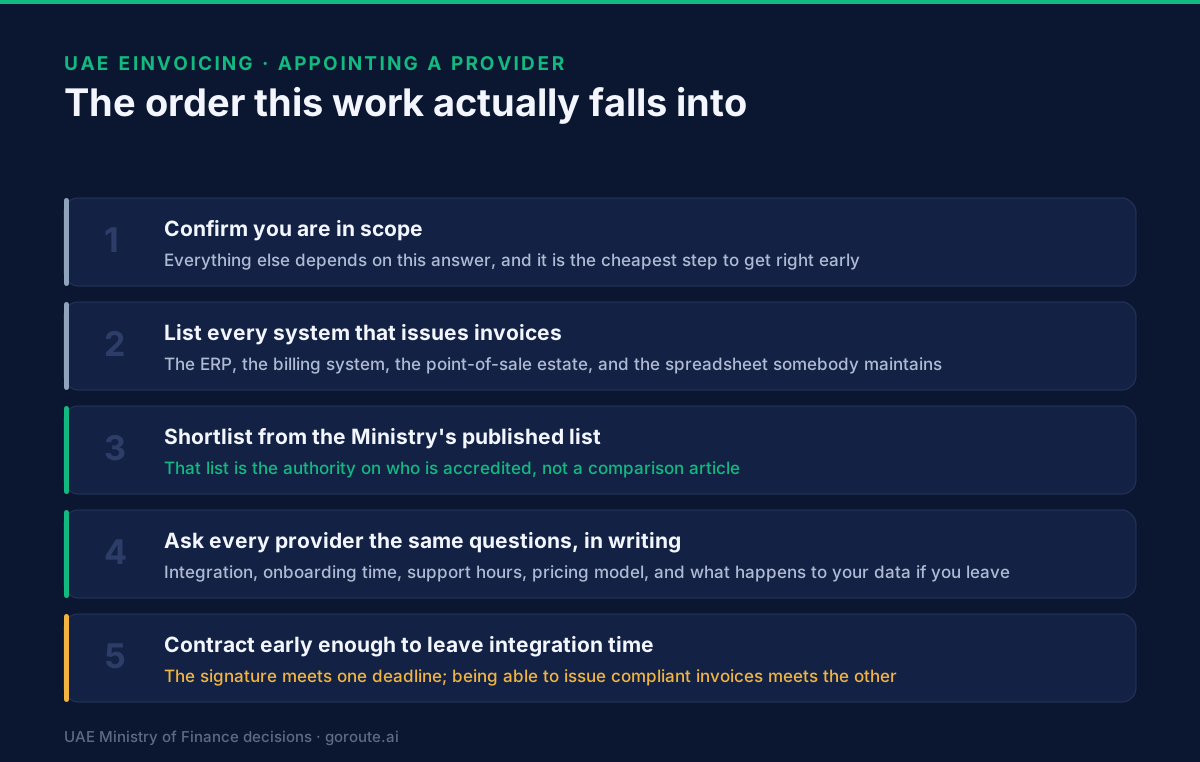
Ask each shortlisted provider the same five questions, in writing, and compare the answers side by side. Written answers are not a formality — they are what you will be reading in twelve months when something behaves differently from how it was described.
1. How do you connect to the systems that issue our invoices today?
Ask this before anything else, and be specific about your own estate. Most organisations issue invoices from more than one place: an ERP, a separate billing system, a point-of-sale estate, and at least one spreadsheet somebody maintains. The spreadsheet is usually where the trouble is, because it is the system nobody lists when asked what issues their invoices.
What to listen for: whether the provider has done your exact system before, what the connection actually is — a standard connector, an interface your team builds, or a file drop — and what the provider needs from your team to make it work. "We integrate with everything" is not an answer to this question. "We have a connector for that version, here is what it needs from your side" is.
2. How long does onboarding take, and what does that time depend on?
Two dates matter and they are not the same date. Appointing a provider is what 30 October 2026 requires. Being able to issue compliant invoices is what 1 January 2027 requires, and in most organisations the second is the longer piece of work by a wide margin.
So the useful question is not "can you onboard us in time" — everyone says yes — but "what does your onboarding timeline depend on, and what has made it slip for customers like us?" A provider who can name the things that go slowly is a provider who has done it. Ask for the timeline in weeks and ask what your team has to supply at each stage, because most delays are on the customer's side and are invisible until they happen.
3. Does support cover the hours we actually work?
Check the working week as well as the clock. Invoicing fails at month end and quarter end, and a provider whose support desk is closed on a Sunday is a poor fit for a business whose working week starts on one. Ask for the hours, the escalation path, and what qualifies as an incident rather than a question. Ask what happens at 4pm on the last working day of a quarter, and see whether the answer is a process or a reassurance.
4. How is the pricing structured, and what makes it move?
The headline number is rarely where the cost lives. Ask what the unit is — per document, per participant, per user, per connection — and what falls outside it. Ask specifically about onboarding and setup, additional legal entities, extra connections, validation-only or test traffic, archiving and retrieval, and support above the standard tier.
Then ask the question that separates a quote from a budget: what does this cost look like at twice our current volume, and at half? A pricing model you can predict at both ends is worth more than a low starting price you cannot.
5. What happens to our data if we leave?
Ask this before you sign, when you have the most leverage you will ever have, rather than at the point where you want to leave. Get four things in writing: how the invoice archive is exported, in what format, how long the export takes and what it costs, and how long the provider retains your data after termination.
This question does more work than its subject suggests. A provider who answers it precisely and without friction is telling you how they will behave for the whole contract. One who treats it as a strange thing to ask has already answered it.
What should we not choose on?
Three things that feel like differentiators in a meeting and are not.
Being told the provider is "in accreditation". Either a name is on the Ministry's published list or it is not. An expected accreditation is not a status you can contract against, and a deadline is a poor moment to be relying on someone else's timeline.
A demonstration of the parts you were going to get anyway. Every accredited provider clears the same regulatory bar; that is what accreditation means. The demonstration worth asking for is of your own awkward case — the credit note, the multi-entity invoice, the one system nobody wants to talk about.
The lowest quoted number, read on its own. See question four. A price is only comparable once you know the unit and what sits outside it.
Who has to appoint a provider, and by when?
Persons subject to the UAE eInvoicing system with annual revenue exceeding AED 50 million must appoint an Accredited Service Provider by 30 October 2026. The Ministry of Finance extended that date from 31 July 2026; the old date should now be cited only as the date that was extended, never as a current obligation. Mandatory implementation was not moved by that extension and remains 1 January 2027.
The threshold belongs in the same sentence as the date every time. Quoted bare, "30 October 2026" reads as a general national deadline, which it is not — and businesses that were never in the first group go shopping on a timetable that is not theirs. If working out which side of the line you sit on is the question you actually have, the AED 50 million threshold has its own page, and the deadline guide covers what the October date requires in full.
Because the appointment date moved outward and the implementation date did not, the gap between signing and going live is now shorter than it was. That is the single most useful thing to carry into a procurement timetable, and it argues for contracting earlier rather than later within the window.
What is not settled, and we will not pretend otherwise
Penalties. We have not read the decision text that sets them, so this page does not state them. If a provider or an article quotes you a fine, ask which instrument it comes from before you repeat it in a board paper.
Any dated obligation for businesses at or below the threshold. The two dates above govern the population above AED 50 million. We have not found a published date for anyone else that we can link, and we will not infer one from the shape of the timetable.
Your own scope position. Whether a particular entity is a person subject to the eInvoicing system is a question for the decision text and for whoever advises you on tax. It is not a question an article can answer about your group, and any page that tells you it can is overreaching.
Where do these rules come from?
From the Ministry of Finance's own decisions and announcement, linked so you can read them rather than take our word for it:
- The Ministry's announcement of targeted amendments to the eInvoicing system decisions, which is where the extension and the unchanged implementation timeline are stated.
- Ministerial Decision No. 244 of 2025 on the implementation of the electronic invoicing system.
- Ministerial Decision No. 66 of 2026, the instrument that moved the appointment deadline.
- The Ministry's list of Accredited Service Providers.
If a page gives you a UAE e-invoicing date or a provider's status without linking the source, that is a reason to check before acting on it.
Where GoRoute stands, plainly
GoRoute is not on the UAE Ministry of Finance's list of Accredited Service Providers. We read that list again on the day this page was written, and our name is not on it. If you are appointing a provider for the UAE, appoint one from that list — including if you already work with us.
What GoRoute is: an e-invoicing service provider accredited in Oman by the Oman Tax Authority, through Union Digital Technologies SPC, and a Peppol-certified Access Point (Service Provider ID POP000991, ClayDesk LLC). We publish this checklist because the questions above are the ones finance teams ask us across the Gulf, and because they are worth asking of any provider, us included.
If the wider Gulf picture is what you are planning against, the GCC e-invoicing comparison sets the countries side by side, the PINT AE readiness guide covers how UAE invoices are exchanged, and the Oman page covers the market where we operate as an accredited provider. You can also book a working session.
Sources
- UAE Ministry of Finance, announcement of targeted amendments to the eInvoicing system decisions
- Ministerial Decision No. 66 of 2026 amending Ministerial Decision No. 244 of 2025
- UAE Ministry of Finance, eInvoicing Accredited Service Providers
Each source above was fetched and returned normally on the day this page was prepared.
Frequently asked questions
- Where is the official list of UAE Accredited Service Providers?
- The UAE Ministry of Finance publishes it, on its own eInvoicing pages. That list is the authority on who is accredited. It is commonly attributed to the tax authority instead, which sends buyers looking in the wrong place — the accreditation of service providers sits with the Ministry of Finance.
- How do I choose between UAE Accredited Service Providers?
- Shortlist only from the Ministry's published list, then compare on five things a contract actually turns on: how the provider connects to the systems that issue your invoices today, how long onboarding takes, whether support covers your working hours, how the pricing is structured, and what happens to your data and your invoice archive if you leave.
- When must a UAE business appoint an Accredited Service Provider?
- By 30 October 2026, for persons subject to the UAE eInvoicing system with annual revenue exceeding AED 50 million. The Ministry of Finance extended that date from 31 July 2026. Mandatory implementation was not moved and remains 1 January 2027.
- How many Accredited Service Providers can I choose from in the UAE?
- 32 were approved as at the Ministry's May 2026 announcement, with more in final stages. Date that figure whenever you use it and read the Ministry's list on the day you shortlist, because the count rises as more providers are accredited.
- What should I ask a provider about leaving them?
- Ask it before you sign, not afterwards. Get in writing how you export your invoice archive, in what format, how long the export takes, what it costs, and how long they keep your data after termination. A provider that answers this clearly is telling you something about how they will behave for the whole contract.
- Is GoRoute an Accredited Service Provider in the UAE?
- No. GoRoute is not on the UAE Ministry of Finance's list of Accredited Service Providers. If you are appointing a provider for the UAE, appoint one from that list. GoRoute is accredited in Oman by the Oman Tax Authority, through Union Digital Technologies SPC, and is a Peppol-certified Access Point.
About Dr. Syed Raza
Dr. Syed Raza is an IT Enterprise Architect at ClayDesk LLC and leads the GoRoute platform. He works across Peppol Access Point and SMP infrastructure, PINT jurisdictions (Oman, AU/NZ, EU, JP, MY, SG), and national CTC regimes, translating regulatory detail into production-grade e-invoicing systems.
Building on Peppol?
GoRoute is a certified Peppol Access Point & SMP. Book a demo or read the docs to get started.