
UAE E-Invoicing Threshold: Are You in the AED 50 Million Wave?
Does the UAE's 30 October 2026 deadline apply to your business? It covers persons subject to the eInvoicing system with revenue above AED 50 million a year.

Last updated .
The short answer
The UAE's 30 October 2026 deadline applies to you if two things are true: you are a person subject to the UAE's eInvoicing system, and your annual revenue exceeds AED 50 million. If both hold, you must appoint an Accredited Service Provider by that date, and mandatory implementation follows on 1 January 2027. If your revenue is at or below the threshold, neither of those published dates is aimed at you — and no dated obligation for businesses below the line appears in the Ministry's material we can point you at, so this page does not invent one.
| Test | What it means |
|---|---|
| Are you a person subject to the eInvoicing system? | Set by the Ministry's decisions, linked below |
| Does your annual revenue exceed AED 50 million? | The threshold that carries both published dates |
| Both true? | Appoint an Accredited Service Provider by 30 October 2026; mandatory implementation 1 January 2027 |
The instrument that moved the appointment date is Ministerial Decision No. 66 of 2026, amending Ministerial Decision No. 244 of 2025. The full account of the deadline itself is in our guide to who must appoint an ASP by 30 October 2026.
Why the threshold matters more than the date
A date without its threshold turns a targeted obligation into a national one. That is not a pedantic distinction: it decides whether a finance team spends the next ten weeks running a procurement or spends it reading.
The Ministry's dates travel far better than the sentence that qualifies them. "30 October 2026" fits in a headline, a slide and a supplier email; "for persons subject to the eInvoicing system with annual revenue exceeding AED 50 million" does not. So the date arrives everywhere and the threshold arrives sometimes, and businesses well below the line end up planning against a deadline that was never theirs — while businesses above it hear a general announcement and assume somebody else's project.
Both dates carry the same threshold. The appointment deadline of 30 October 2026 and mandatory implementation on 1 January 2027 apply to the same population. Neither is a general UAE e-invoicing date.
Is the AED 50 million test on group revenue or entity revenue?
This is the question we are asked most, and the honest answer is that the decision text settles it, not an article. What the threshold attaches to is a person subject to the eInvoicing system — so the real question for a group is which of your entities is such a person in its own right.
We are deliberately not paraphrasing the definition here. A summary of a legal test reads like the test and is not it, and this is precisely the kind of sentence that gets copied into a board paper. The decisions are linked at the top of this page and again at the bottom. Read them with whoever advises you on tax.
Two practical notes that are safe to give:
- Answer this first, before anything else. Scope determines whether the rest of the work is a ten-week project or a watching brief, and getting it wrong in either direction is expensive.
- Write down the answer and who gave it. In twelve months somebody will ask why the group concluded what it concluded, and "we thought so at the time" is a poor record.
Is the threshold measured on revenue or on taxable supplies?
The Ministry's decision says annual revenue, and we are not going to restate it as taxable supplies. Those are different numbers in most businesses, and for a company sitting near the line the difference decides whether it is in the first wave or not.
This is worth being explicit about, because the two phrases get used interchangeably in commentary and they are not interchangeable. Taxable supplies is a VAT concept with its own inclusions and exclusions. Revenue is an accounting figure. A business with substantial zero-rated or out-of-scope activity can be well above one line and below the other.
What we can point you at: the decisions themselves — Ministerial Decision No. 244 of 2025 and the amending Ministerial Decision No. 66 of 2026. What we cannot: a published Ministry clarification resolving how the figure is computed in edge cases. We have not found one we can link, and inventing an interpretation to fill the gap would be worse than leaving it open.
If your number is anywhere near AED 50 million, that ambiguity is the reason to take the question to whoever advises you on tax rather than to an article — including this one. Write down the answer and who gave it.
What if our revenue is just below AED 50 million?
Here is what is settled and what is not, kept apart on purpose.
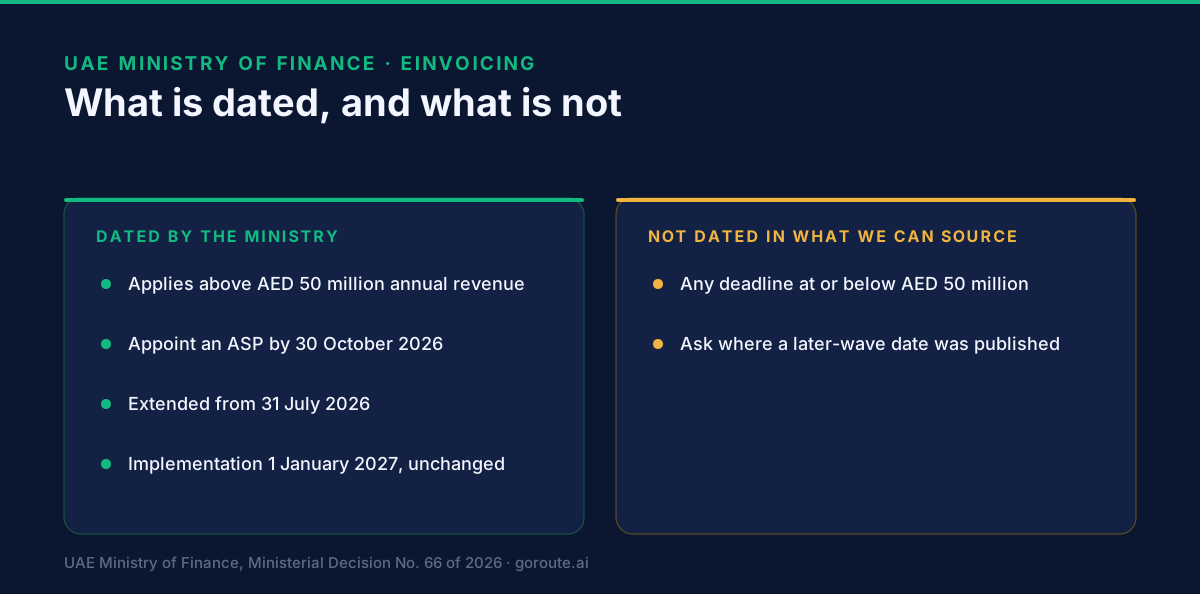
Settled: the appointment deadline of 30 October 2026 and mandatory implementation on 1 January 2027 apply to persons subject to the eInvoicing system with annual revenue exceeding AED 50 million.
Not settled, as far as we can source it: a dated obligation for anyone else. We have not found one published by the Ministry that we can link, and we will not infer a date from the shape of the timetable. A later wave being widely expected is not the same as a later wave having a published date, and the difference matters to anyone building a plan.
If your revenue sits near the line, the useful question is not "what is the date for us" but "which side of the test are we on, and who decides that". That is the same scope question as the section above.
What has to happen by 30 October 2026 if you are in scope?
One thing: an Accredited Service Provider has to be appointed. That is what the October date requires. Being able to issue compliant invoices is the January outcome, and it is the longer piece of work.
In practice the appointment is a shortlist, a due-diligence pass that finance and IT both sign off, a contract, and then an integration. The contract meets the October date; the integration meets the January one. Treating them as a single task is the commonest way a project that started early still finishes late — and because the appointment deadline moved outward while implementation did not, the gap between them is now shorter than it was. If you are already past the scope question and into the shortlist, how to choose an Accredited Service Provider covers where the official list is and what to ask each provider.
How many providers are there to choose from?
32 were approved as at the Ministry's May 2026 announcement, with more in final stages.
Date that figure whenever you use it, including when you read it here. The count rises as the Ministry accredits more providers, and an undated number goes stale without anyone noticing. The Ministry publishes the list of Accredited Service Providers itself, and that list — not a comparison article, and not this page — is the authority on who is accredited today.
Two notes for a shortlist. Read the list on the day you shortlist, because a provider in final assessment last month may be accredited this month. And check the exact name on the list against the exact legal entity you would be contracting with: groups trade under several names, and the accredited one is the name the Ministry published.
If you are not in the first wave, is there anything to do?
Nothing on this page is a compliance opinion about your business, and nothing here says a business below the threshold has an obligation, because we cannot source one. What follows is ordinary preparation that costs little and is not wasted either way.
- Find out what actually issues your invoices today. In most organisations it is more than one thing: an ERP, a billing system, a point-of-sale estate, and a spreadsheet somebody maintains. The last one usually causes the trouble.
- Ask your largest customers what they will need from you. Businesses inside the first wave change how they receive invoices, and that lands on their suppliers regardless of who the rule names.
- Keep the scope answer current. Revenue moves. A business below the threshold this year may not be next year, and the test is worth re-running rather than remembered.
Three ways this threshold gets misread
Each can be checked against the Ministry's own text, which is why they are worth naming.
"The UAE e-invoicing deadline is 30 October 2026." Only for the population above the AED 50 million revenue threshold. Stated bare, a targeted obligation becomes a national one.
"We are under the threshold, so there is a later date for us." There may well be a later wave. What we can source is not a date for it, and planning around an unpublished date is how money gets spent against the wrong requirement. Ask where any such date was published.
"It has all been pushed back." The appointment deadline moved from 31 July 2026 to 30 October 2026. Mandatory implementation remains 1 January 2027. Reading the first as though it moved the second is how an organisation quietly loses integration time.
Where do these rules come from?
From the Ministry of Finance's own decisions and announcement, linked so you can read them rather than take our word for it:
- The Ministry's announcement of targeted amendments to the eInvoicing system decisions, which is where the extension and the unchanged implementation timeline are stated.
- Ministerial Decision No. 244 of 2025 on the implementation of the electronic invoicing system.
- Ministerial Decision No. 66 of 2026, the instrument that moved the appointment deadline.
- The Ministry's list of Accredited Service Providers.
If a page gives you a UAE e-invoicing date without linking the decision that sets it, that is a reason to check before acting on it.
Where GoRoute stands, plainly
GoRoute is not on the UAE Ministry of Finance's list of Accredited Service Providers. If you are appointing an ASP for the UAE, appoint one from that list.
What GoRoute is: an e-invoicing service provider accredited in Oman by the Oman Tax Authority, through Union Digital Technologies SPC, and a Peppol-certified Access Point (Service Provider ID POP000991, ClayDesk LLC). We publish this explainer because the same finance teams ask us the same scope question across the Gulf, and because the Ministry's decisions are easier to act on when somebody links them.
Next steps that may be more use than this page: the deadline guide for what the October date requires, the GCC e-invoicing comparison if you operate in more than one Gulf market, the PINT AE readiness guide for how UAE invoices are exchanged, and the UAE compliance page for what we do. You can also book a working session.
Sources
- UAE Ministry of Finance, announcement of targeted amendments to the eInvoicing system decisions
- Ministerial Decision No. 66 of 2026 amending Ministerial Decision No. 244 of 2025
- UAE Ministry of Finance, eInvoicing Accredited Service Providers
Each source above was fetched and returned normally on the day this page was prepared.
Frequently asked questions
- Does the UAE deadline of 30 October 2026 apply to my business?
- It applies if you are a person subject to the UAE eInvoicing system and your annual revenue exceeds AED 50 million. Both parts have to be true. The date on its own is not a general UAE deadline, and quoting it without the revenue threshold is the commonest way it is misread.
- What is the UAE e-invoicing revenue threshold?
- Annual revenue exceeding AED 50 million. That threshold governs both published dates — appointing an Accredited Service Provider by 30 October 2026, and mandatory implementation on 1 January 2027. The Ministry of Finance set it in its decisions, which are linked on this page.
- Is the AED 50 million test based on group revenue or entity revenue?
- The decision text is what settles it, and we do not paraphrase it here. The question turns on which entity is a person subject to the eInvoicing system in its own right. If you run several entities, take that question to the decision and to whoever advises you on tax before assuming the answer.
- What happens if our revenue is below AED 50 million?
- The two published dates we can point you at are for the population above the threshold. We have not found a dated obligation for anyone else published by the Ministry, so we do not state one. If you see such a date quoted, ask where it was published before planning around it.
- Was the UAE appointment deadline always 30 October 2026?
- No. It was 31 July 2026 and the Ministry of Finance extended it to 30 October 2026. Cite the old date only as the one that was extended. Mandatory implementation was not moved by that extension and remains 1 January 2027.
- Is GoRoute an Accredited Service Provider in the UAE?
- No. GoRoute is not on the UAE Ministry of Finance's list of Accredited Service Providers. GoRoute is accredited in Oman by the Oman Tax Authority, through Union Digital Technologies SPC, and is a Peppol-certified Access Point.
About Dr. Syed Raza
Dr. Syed Raza is an IT Enterprise Architect at ClayDesk LLC and leads the GoRoute platform. He works across Peppol Access Point and SMP infrastructure, PINT jurisdictions (Oman, AU/NZ, EU, JP, MY, SG), and national CTC regimes, translating regulatory detail into production-grade e-invoicing systems.
Building on Peppol?
GoRoute is a certified Peppol Access Point & SMP. Book a demo or read the docs to get started.