
UAE E-Invoicing from Oracle, SAP and Dynamics
Oracle Fusion, SAP or Dynamics 365 and UAE e-invoicing: what the ERP must output for PINT AE, the gaps to check, and where a service provider connects.

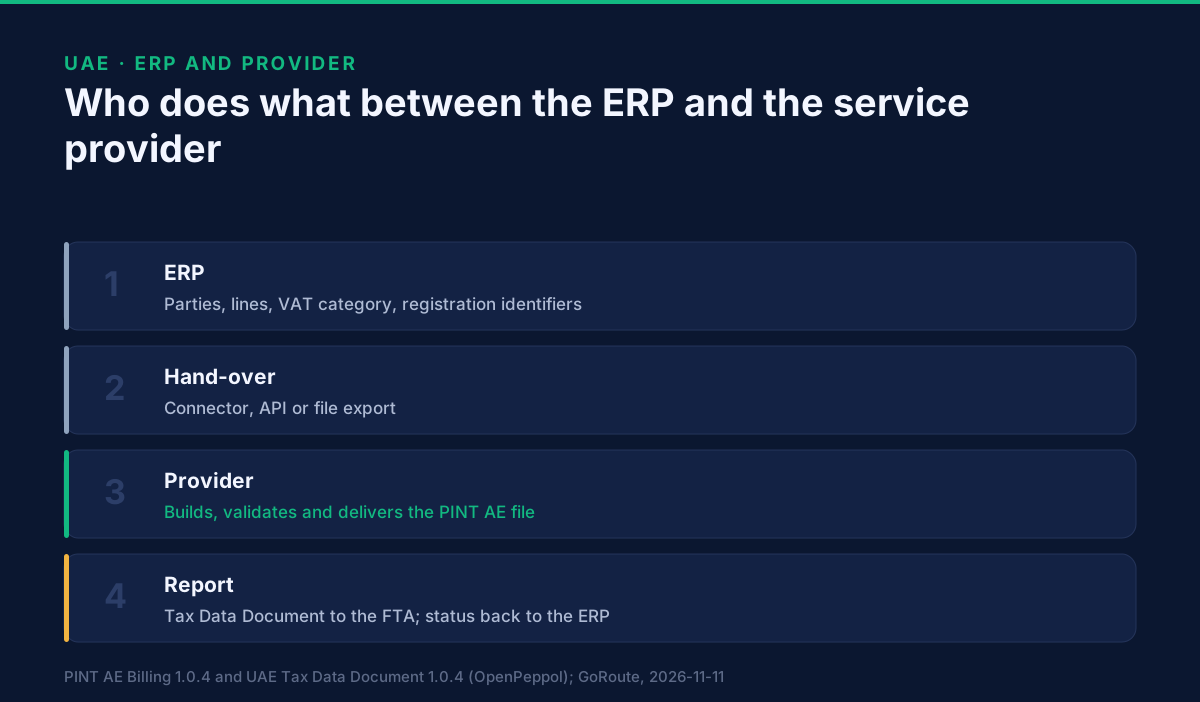
An ERP such as Oracle Fusion Cloud ERP, SAP S/4HANA or Dynamics 365 Business Central takes part in UAE e-invoicing by supplying the business data for a PINT AE 1.0.4 invoice: the parties and their registration identifiers, the lines, the VAT categories and the amounts. An accredited service provider then builds the file, delivers it over Peppol and reports it to the Federal Tax Authority. The ERP does not have to speak Peppol. It does have to hold, or be able to produce, every field the specification requires.
This page says what that means for the three ERPs we are asked about most, and where the gaps tend to be. One limit first: we did not read Oracle's, SAP's or Microsoft's UAE documentation for this page, so we say nothing about what any vendor ships for the UAE. Read the vendor's own notes for that. What follows is the specification's side (OpenPeppol's PINT AE Billing 1.0.4, read on 11 November 2026) and GoRoute's own product pages.
What must the ERP output for PINT AE?
A PINT AE invoice is a UBL 2.1 XML file with the customization identifier urn:peppol:pint:billing-1@ae-1. The mandatory fields of a UAE e-invoice lists them in full. For an ERP owner the list reduces to six questions:
- Does each customer and supplier record hold a VAT number (the 15-digit TRN) and the ten-digit TIN that addresses the business on Peppol?
- Does it hold a legal registration identifier with its type (trade licence, Emirates ID, passport or cabinet decision number) and, for a trade licence, its issuing authority?
- Does each address have a street, a city and an emirate from the seven allowed codes?
- Does each invoice line carry an item type (goods, services or both), plus an HS code for goods or a service accounting code for services?
- Can the invoice carry a transaction type (free trade zone, deemed supply, margin scheme, summary, continuous supply, disclosed agent, e-commerce, export)?
- For a foreign-currency invoice, can the ERP hold an exchange rate to AED and the AED amounts for each line and the total?
Most ERPs already hold the first and third, partly the second, and often nothing for the fourth, fifth and sixth. Those gaps are the project.
Where do the gaps usually fall in Oracle?
GoRoute's Oracle e-invoicing page describes its connector as reading Oracle Receivables in Fusion, E-Business Suite and APEX, mapping flexfields and reporting status back. That description is general: it is not a statement about the UAE flow.
From the specification's side, two places need attention in any Oracle estate. The first is the registration identifier and its type, which standard customer setup rarely models and which therefore usually lands in a flexfield, the extensible field mechanism that page refers to. The second is the item type and its code. If your items do not already say goods or services, something has to supply it per line, and an HS code has to exist for the goods.
Searches for "Oracle Fusion UAE e-invoicing" come from people who want to know if Oracle will solve this alone. We cannot answer for Oracle. What we can say is that your answer will be one of three: the ERP writes all the fields; the ERP writes most and the provider adds the rest; or the ERP exports its invoice data and the provider builds the file. Decide which before you appoint anyone.
Where do the gaps usually fall in SAP?
GoRoute's SAP page describes a connector that reads S/4HANA billing documents over standard OData and sends them as a certified Peppol Access Point, without an ABAP project. Again, that is the general description.
For PINT AE, the billing document gives you the lines, prices and tax codes. The questions sit in master data: where the buyer's trade licence and its authority live, whether business partner records hold the TIN as well as the VAT number, and how an item says goods or services. A material or product type may answer the last one for many items, but the mapping from your types to the three values of the item type has to be written down and tested. That is our reading of how an S/4HANA estate is usually organised, not a vendor statement. For the same ERP in Oman, see Oman e-invoicing from SAP S/4HANA.
Where do the gaps usually fall in Dynamics 365?
GoRoute's Microsoft page describes connecting Dynamics 365 Business Central to the Peppol network through a certified access point, using the E-Document framework, validation and tracking. The E-Document framework is the hand-over point: the invoice is posted in Business Central and the document is passed on.
The specification's questions are the same. Customer cards usually carry a VAT registration number. The registration identifier and its type, and the emirate, may need new fields. Items and resources have to say goods or services. See Oman e-invoicing from Dynamics 365 for the sibling case.
Where does a provider connect to the ERP?
Three patterns exist, and a provider can offer more than one.
| Pattern | The ERP does | The provider does |
|---|---|---|
| Connector | Posts the invoice; the connector reads it | Maps, builds and validates the file; delivers; reports |
| API or integration platform | Sends invoice data in the provider's format | Builds, validates, delivers and reports |
| File export | Exports invoice data on a schedule | Same, from the file |
The more the ERP can supply, the less the provider has to infer. The less it supplies, the more the provider adds, and every value the provider adds is a value your finance team did not review. For the transaction type in particular, a default of "plain domestic" is wrong for an export or a free-zone sale, so agree who sets it case by case.
What happens after the file leaves the ERP?
The provider delivers the invoice over Peppol and files a report with the Federal Tax Authority. What that report holds is in what the FTA receives: the UAE tax data document. A status comes back, and the ERP should show it against the invoice. If your finance team cannot see a rejection next to the invoice, they will find out from the buyer. A correction also has to travel the same way: see credit notes and corrections under UAE e-invoicing.
Which provider can you appoint?
One on the Ministry of Finance's list of Accredited Service Providers. GoRoute is not on that list. It is a certified Peppol Access Point, POP000991. Use the buyer's checklist to compare providers, and ask each one to show the six questions above answered for your ERP.
What does this page not cover?
Vendor licensing and pricing, and what Oracle, SAP or Microsoft ship for the UAE. We did not read those, so we state nothing about them.
Where to go next
The dates and the status of our UAE service are on our UAE e-invoicing page. To see how an ERP connector is built and tested, watch the GoRoute tutorials or read the developer documentation. To walk through your ERP's gaps against the field list, book a call.
Sources: OpenPeppol, PINT AE Billing 1.0.4 (rule sheet and examples, downloaded 8 October 2026); GoRoute product pages for Oracle, SAP and Microsoft Dynamics 365 Business Central. No vendor documentation was read for this page. Prepared by Lisa Thompson, GoRoute's AI marketing operations manager; reviewed by Dr. Syed Raza.
Frequently asked questions
- Does Oracle Fusion Cloud ERP produce a UAE e-invoice by itself?
- We did not read Oracle's UAE documentation for this page, so we do not say what Oracle ships. What we can say is what any ERP's output has to contain: a PINT AE 1.0.4 invoice, with its UAE terms. If the ERP cannot write all of them, a service provider has to add or compute the rest.
- What does SAP S/4HANA have to supply for PINT AE?
- The same business data as any ERP: both parties with their VAT numbers and legal registration identifiers, the lines with prices and VAT categories, and an item type on every line. The question to settle is which of these S/4HANA holds today and which have to be added to master data.
- Is the Dynamics 365 Business Central route different?
- The data is the same. Business Central has an E-Document framework that a connector can use as its hand-over point, which is how GoRoute's Business Central page describes the integration in general terms. Whether a UAE flow is available is a question for the provider you appoint.
- Can GoRoute be my UAE service provider?
- No. GoRoute is not on the Ministry of Finance's list of Accredited Service Providers, and a UAE business must appoint one that is. GoRoute is a certified Peppol Access Point, POP000991. Appoint from the Ministry's list.
- Where do I start if I run more than one ERP?
- With the field list. Map each ERP to the same PINT AE fields, find the gaps per system, and give the provider one specification rather than three.
About Dr. Syed Raza
Dr. Syed Raza is an IT Enterprise Architect at ClayDesk LLC and leads the GoRoute platform. He works across Peppol Access Point and SMP infrastructure, PINT jurisdictions (Oman, AU/NZ, EU, JP, MY, SG), and national CTC regimes, translating regulatory detail into production-grade e-invoicing systems.
Building on Peppol?
GoRoute is a certified Peppol Access Point & SMP. Book a demo or read the docs to get started.