
Exporting from Taiwan: When a Foreign Buyer Asks for Peppol
Taiwanese exporters need not issue a uniform invoice for exports, but a buyer abroad may want Peppol. What each side needs and how one invoice gets there.

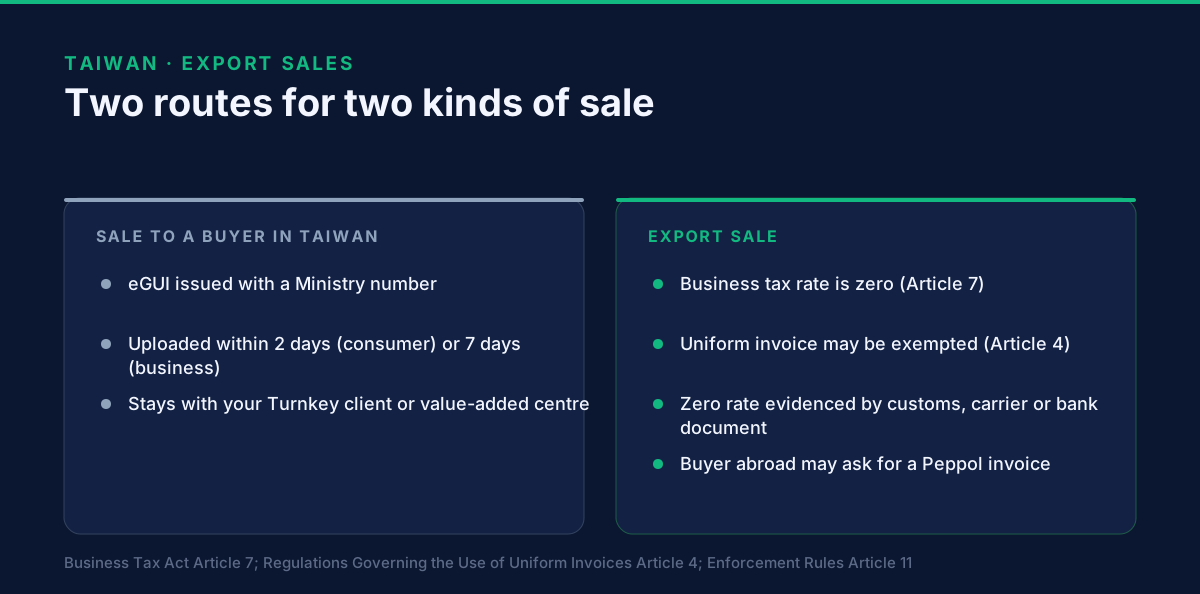
A Taiwanese exporter does not have to issue a uniform invoice (eGUI) for an export sale, and the sale carries a zero business tax rate. If your buyer abroad asks for a Peppol e-invoice, that is the buyer's requirement, not a Taiwanese one, and you meet it with a separate document sent over the Peppol network. This page sets out what each side needs and how one invoice gets from a Taiwanese seller to a buyer in Europe or Asia-Pacific.
GoRoute carries the Peppol leg. We are not a value-added centre, we do not run the Ministry of Finance's Turnkey software, and we do not issue or upload eGUIs. Everything below about Taiwanese tax comes from the statutes and is linked to them, so you can read the same text your tax adviser will.
Does a Taiwanese exporter have to issue an eGUI for an export?
No. The Regulations Governing the Use of Uniform Invoices, Article 4, lists operations that "may be exempted from the use or issuance of uniform invoices". Item 33 of that list reads: "Goods exported by business entities or services related to exports or services supplied within the territory of the ROC but used in foreign countries and provided by business entities."
The wording is "may be exempted", not "must not issue". An exporter can also have domestic sales, and those stay on the eGUI route with the 2-day and 7-day upload windows described on our Taiwan e-invoicing page. Article 8 of the same Regulations tells a business entity to issue separate uniform invoices for taxable, zero-rate and tax-free items, so if you do issue a uniform invoice for a zero-rate sale, it carries its own tax classification box.
Read the exemption as permission, then confirm with your tax adviser or your local tax bureau whether your own export flow uses it. We state the rule; we do not decide your filing position.
What tax rate applies to an export sale?
Zero. Article 7 of the Value-added and Non-value-added Business Tax Act says the rate is zero for "exported goods" and for "services relating to export or services provided in the R.O.C. but used in a foreign country". A zero rate is not an exemption. The seller still reports the sale and can still deduct tax paid on its purchases, which is why the evidence matters.
What evidence supports the zero rate?
Article 11 of the Enforcement Rules of the Act lists the documents. In short:
- Goods declared with Customs for export: the rule says no documentary evidence needs to be submitted.
- Small consignments by post or express: where the free-on-board value is NT$50,000 or less, a photocopy of the receipt slip from the postal institution or the registered express carrier. Above NT$50,000 the goods must still be declared with Customs.
- Services relating to export, or provided in Taiwan but used overseas: proof that the foreign exchange was sold or deposited with a designated bank, or, if it was not, a copy of the original foreign exchange receipt showing the amount.
The list is longer than this. It also covers duty-free shops, bonded zones and international transport, none of which this page treats. The point for an invoicing team is that the evidence is a customs, carrier or bank document. A Peppol invoice is not part of it, and sending one does not replace any of it.
What does a buyer in Belgium, Germany, Singapore or Australia require?
It depends on the buyer's country, and on whether the rule binds the buyer or the seller. Our country pages hold the detail; this is the short form.
- Belgium: structured e-invoicing between Belgian VAT-registered businesses runs over Peppol. A Taiwanese seller is not itself a Belgian business, so we read the request as coming from the buyer's accounts-payable setup. That is inference. Ask the buyer to confirm what it will accept.
- Germany: businesses must be able to receive structured e-invoices. A buyer may therefore ask for XRechnung or a Peppol delivery rather than a PDF.
- Singapore: InvoiceNow is Singapore's Peppol-based network, so a buyer on InvoiceNow receives invoices through its own access point.
- Australia: the buyer's accounts-payable system may take invoices over the Australian Peppol network.
The common thread is that the buyer's system is built to receive a structured invoice. A PDF attached to an email gets typed in by hand, or rejected. Taiwan's own Ministry of Digital Affairs named Australia, Singapore, Japan, New Zealand and Malaysia as the trading partners it had in mind when it joined Peppol, and our Taiwan page has that announcement.
Taiwan has not published a date for any Peppol mandate, and neither do we imply one.
How does one invoice reach the buyer over Peppol?
A Peppol delivery needs two things the PDF does not: a structured invoice and a Peppol address for the buyer. The steps are these.
- Get the buyer's Peppol identifier. The buyer gives it to you, or you look it up in the Peppol Directory. GoRoute checks whether a participant is registered before you send.
- Prepare one invoice as data. You post the invoice as JSON to the GoRoute API, or a connector such as Odoo or SAP does it for you.
- Let the profile follow the buyer. GoRoute renders the same invoice to the format the receiving country expects: Peppol BIS 3.0 for Europe, PINT for Singapore, Japan, Malaysia, Australia and New Zealand. Peppol BIS 3.0 versus PINT explains the difference.
- Send through the access point and keep the receipt. The document travels from our certified access point, POP000991, to the buyer's, and a delivery receipt comes back.
Set the tax category on the invoice to match the zero-rate treatment you have settled with your adviser. The Peppol document describes the sale; it does not decide how Taiwan taxes it.
What stays outside GoRoute?
The domestic eGUI. A sale to a buyer in Taiwan still needs an eGUI number from the Ministry of Finance's allocation and an upload through your own Turnkey client or a certified value-added centre. The page on voids and allowances covers correcting one, and the page on the MIG format covers the file your ERP produces.
A supplier abroad who invoices a Taiwanese business has the mirror-image question, which invoicing a Taiwanese business from abroad answers.
What to do next
List your export customers by country and ask each finance team one question: does your payables system accept invoices over Peppol, and what is your Peppol identifier? Start with the one that has asked. Then test one real invoice in the free developer sandbox before anything goes to production.
For the larger picture, the Taiwan page covers eGUI and the Peppol route. The tutorials show an invoice going out, and the documentation has the API. To see a Taiwanese seller's invoice arrive at a buyer in Singapore or Germany, book a demo. For how Peppol works in general, read what Peppol is, and for the next question, what a Peppol access point is.
GoRoute is a certified Peppol Access Point (POP000991).
Primary sources: Value-added and Non-value-added Business Tax Act, Article 7 (zero rate); Enforcement Rules of the Act, Article 11 (evidence); Regulations Governing the Use of Uniform Invoices, Articles 4 and 8, all from the Laws & Regulations Database of the Republic of China (Taiwan); Ministry of Finance E-Invoice Platform.
Frequently asked questions
- Does a Taiwanese exporter have to issue an eGUI for an export sale?
- Not under the Regulations Governing the Use of Uniform Invoices. Article 4 lists goods exported by business entities, and services related to exports, among the operations that may be exempted from the use or issuance of uniform invoices. Sales to buyers inside Taiwan remain on the eGUI route.
- Is an export sale taxed in Taiwan?
- The business tax rate is zero. Article 7 of the Value-added and Non-value-added Business Tax Act puts exported goods, and services related to export, at a zero rate.
- What proves that an export sale is zero rated?
- Goods declared with Customs for export need no further documentary evidence. Other cases need a document: for small consignments by post or express, the carrier's receipt slip, and for export-related services, bank proof of the foreign exchange received. These are in Article 11 of the Enforcement Rules.
- Does a foreign buyer have to receive a Peppol invoice from a Taiwanese seller?
- No rule we have found obliges a Taiwanese seller to use Peppol, and Taiwan has set no Peppol mandate date. The pressure comes from the buyer, whose own accounts-payable system may only accept invoices over Peppol.
- Can GoRoute issue the Taiwanese eGUI?
- No. GoRoute carries the Peppol leg only. It is not a value-added centre, does not run Turnkey and does not issue or upload eGUIs. A domestic sale still goes through your own eGUI process.
- Is there a Taiwanese Peppol format yet?
- Not one we can point to. The Ministry of Digital Affairs has said it will write localised Peppol specifications, and none had been published when GoRoute's Taiwan page was last reviewed. Until one exists, the invoice goes in the profile the receiving country expects.
About Dr. Syed Raza
Dr. Syed Raza is an IT Enterprise Architect at ClayDesk LLC and leads the GoRoute platform. He works across Peppol Access Point and SMP infrastructure, PINT jurisdictions (Oman, AU/NZ, EU, JP, MY, SG), and national CTC regimes, translating regulatory detail into production-grade e-invoicing systems.
Building on Peppol?
GoRoute is a certified Peppol Access Point & SMP. Book a demo or read the docs to get started.