
Invoicing a Taiwanese Business From Abroad: Who Pays the Tax
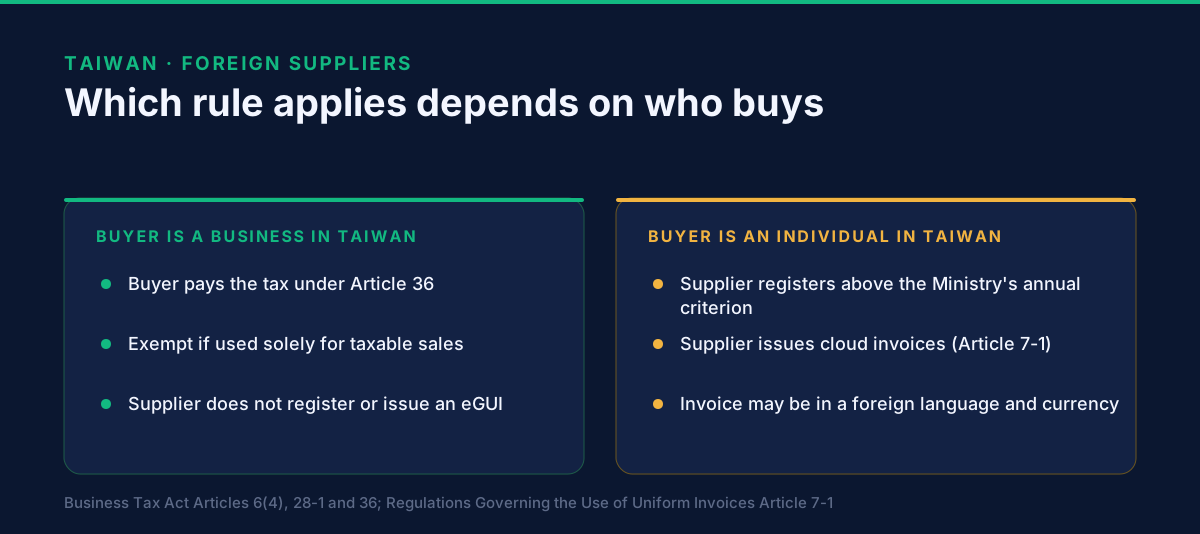
A foreign supplier invoicing a Taiwanese business: the buyer self-assesses business tax under Article 36. Registration applies to sales to individuals.

If you sell a service from outside Taiwan to a Taiwanese business, the business pays the Taiwanese business tax itself under Article 36 of the Business Tax Act. You do not register for business tax or issue an eGUI to make that sale. Registration and cloud invoices apply to a different case: a foreign supplier selling electronic services to individuals in Taiwan. This page separates the two, and shows how a Peppol invoice reaches a Taiwanese buyer that is on the network.
We quote the statutes and link them. Whether a particular sale is a service, and whether your buyer qualifies for the Article 36 exemption, is for your tax adviser. GoRoute carries the Peppol leg only: we are not a value-added centre and we do not issue or upload eGUIs.
Who pays the business tax on a service sold by a foreign company?
The buyer does. Article 36 of the Value-added and Non-value-added Business Tax Act reads that "a purchaser of services sold by foreign enterprises, institutions, groups or organizations having no fixed place of business within the territory of the R.O.C. shall, prior to the fifteenth day of the period following the period in which the payment is made, compute the business tax based on the payment amount in accordance with the tax rate provided in Article 10 and pay the tax".
Article 10 sets a range for the rate, no less than 5% and no more than 10%, with the Executive Yuan fixing the rate that applies. Check the current figure with the Ministry of Finance rather than taking it from us.
In practice that is a reverse-charge arrangement. The mechanism is the buyer's, and the invoice from the foreign supplier shows the price without Taiwanese tax added. If your Taiwanese customer asks you to add tax, point them to Article 36.
Is there an exemption for the buyer?
Yes, a narrow one. The same Article says that where the purchaser calculates its tax under the general method in Section 1 of Chapter 4, and the purchased services are used solely in conducting business in taxable goods or services, "such services are exempted from the business tax". Where the buyer also has tax-exempt sales, the proportion payable is set by the Ministry of Finance.
So for many Taiwanese companies the tax is nil in the end. They still handle the matter inside their own return, which is why it helps to give them a clean invoice that names the service and the payment amount.
When does a foreign supplier register and issue cloud invoices?
When it sells electronic services over the internet or another digital network to an individual in Taiwan. Article 6(4) of the Act names that case: "a foreign enterprise, institution, group, or organization having no fixed place of business within the territory of the R.O.C., but which sells electronic services over the internet or other digital network to an individual in the territory of the R.O.C." is treated as a business entity. Article 28-1 then requires it to apply for taxation registration, or appoint a tax-filing agent in Taiwan, once its annual sales exceed criteria the Ministry of Finance sets.
GoRoute's Taiwan page gives the criterion as annual Taiwan sales above NT$600,000, in force from 1 May 2017, and the cloud invoice duty as from 1 January 2019. The Act leaves the amount to the Ministry, so confirm the figure at the Ministry before relying on it.
Two points follow from the text of the Act:
- The registration rule is written for sales to individuals. A software firm selling only to Taiwanese businesses is under Article 36 instead, with the buyer paying.
- A firm that sells to both groups has both rules, one per customer type.
What does a cloud invoice look like for a foreign supplier?
Article 7-1 of the Regulations Governing the Use of Uniform Invoices says "the business entity prescribed in Subparagraph 4, Article 6 of the Act shall issue cloud invoices to the purchaser". Article 9 of the same Regulations lets those invoices use a foreign language, show the date in the Christian Era, and list the unit price, item subtotal and total in foreign currency, with the source added.
A cloud invoice is the consumer-side electronic invoice, tied to a carrier, with no paper copy. It is an eGUI in the Ministry's system, and it belongs to the registered supplier. It does not apply to the business customer who is paying tax under Article 36.
Registration steps are out of scope for this page. The tax bureau that handles foreign businesses has English guidance, linked from our Taiwan page.
How does a Peppol invoice reach a Taiwanese buyer?
Over the Peppol network, as long as the buyer has a participant ID. Taiwan has not published a date for any Peppol mandate, and no Taiwanese Peppol specification existed when our Taiwan page was last reviewed, so this is a voluntary route that the buyer has to have set up. Three steps:
- Ask the buyer for its Peppol identifier, or look it up. GoRoute checks that the participant is registered before you send.
- Send the invoice from your system. Post it as JSON to the GoRoute API or use a connector such as Odoo or Dynamics 365 Business Central. The invoice goes out in the profile the receiving side expects.
- Keep the delivery receipt with the invoice.
The Peppol invoice carries the price and the service, and no Taiwanese tax unless your adviser says otherwise. It does not replace the buyer's Article 36 return, and it does not create an eGUI.
What goes on the invoice itself?
Keep it plain. Name the service in words the buyer's accountant can match to the contract, state the amount paid or payable and the currency, and show your own legal name and address. Put the buyer's legal name and, where it has one, its Taiwanese uniform serial number on the document, because the buyer needs it for the Article 36 return. If your invoice shows a tax line at all, make sure it is not Taiwanese business tax, or the buyer may pay twice.
A payment reference helps. Article 36 runs from the period in which the payment is made, so the buyer's finance team will look for the payment date next to your invoice.
What about the other direction?
A Taiwanese exporter selling abroad has its own rules: no uniform invoice needed for an export, and a zero rate. That is the subject of exporting from Taiwan when a foreign buyer asks for Peppol. For how a Taiwanese seller corrects an eGUI after issue, read voids and allowances, and for the file format behind it, the MIG format.
What to do next
Sort your Taiwanese customers into two lists: businesses, and individuals. For businesses, confirm the buyer pays under Article 36 and ask for its Peppol ID. For individuals, check your annual Taiwan sales against the registration criterion. Then try a document in the free developer sandbox.
The Taiwan page covers the whole picture, the documentation covers the API, and the tutorials show an invoice being sent. To see a Peppol invoice delivered to a buyer, book a demo. For what a Peppol access point does, read what a Peppol access point is.
GoRoute is a certified Peppol Access Point (POP000991).
Primary sources: Value-added and Non-value-added Business Tax Act, Articles 6, 10, 28-1 and 36; Regulations Governing the Use of Uniform Invoices, Articles 7-1 and 9 — both from the Laws & Regulations Database of the Republic of China (Taiwan); Ministry of Finance E-Invoice Platform.
Frequently asked questions
- Who pays Taiwanese business tax when a foreign company sells a service to a Taiwanese business?
- The buyer. Article 36 of the Business Tax Act makes the purchaser of services sold by a foreign enterprise with no fixed place of business in Taiwan compute and pay the business tax, by the fifteenth day of the period after the payment. The foreign seller does not add Taiwanese tax to its invoice for this purpose.
- Can the Taiwanese buyer be exempt from that tax?
- In one case. Where the buyer calculates its tax under the general method and uses the service solely for taxable goods or services, Article 36 exempts the service from the business tax. A buyer that also makes tax-exempt sales pays a proportion set by the Ministry of Finance.
- When must a foreign supplier register for business tax in Taiwan?
- When it sells electronic services over the internet or another digital network to an individual in Taiwan, above the annual sales criteria the Ministry of Finance sets. The Act (Articles 6 and 28-1) is written for sales to individuals, not to businesses. GoRoute's Taiwan page gives the threshold as NT$600,000 a year.
- What is a cloud invoice and who issues one?
- A cloud invoice is an electronic uniform invoice issued to a purchaser who holds a carrier, with no paper copy. A foreign enterprise registered under Article 6(4) of the Act must issue cloud invoices to its purchasers, and those invoices may be in a foreign language and currency.
- Can I send a Peppol invoice to a Taiwanese business?
- Yes, once that business has a Peppol participant ID. Taiwan has set no date for any Peppol mandate, and the invoice does not replace the buyer's own tax steps. GoRoute checks whether the buyer is registered before you send.
- Does the foreign supplier issue an eGUI to a Taiwanese business?
- Not if it has no Taiwanese tax registration. An eGUI belongs to a business registered for Taiwanese business tax. A seller without one issues an ordinary cross-border invoice, and the Taiwanese buyer handles the tax.
About Dr. Syed Raza
Dr. Syed Raza is an IT Enterprise Architect at ClayDesk LLC and leads the GoRoute platform. He works across Peppol Access Point and SMP infrastructure, PINT jurisdictions (Oman, AU/NZ, EU, JP, MY, SG), and national CTC regimes, translating regulatory detail into production-grade e-invoicing systems.
Building on Peppol?
GoRoute is a certified Peppol Access Point & SMP. Book a demo or read the docs to get started.