
Correcting a Taiwan eGUI: Voids and Allowances
How to correct an issued Taiwan eGUI: void and reissue, or issue an allowance certificate. Who must agree, the three files, and the reporting window.

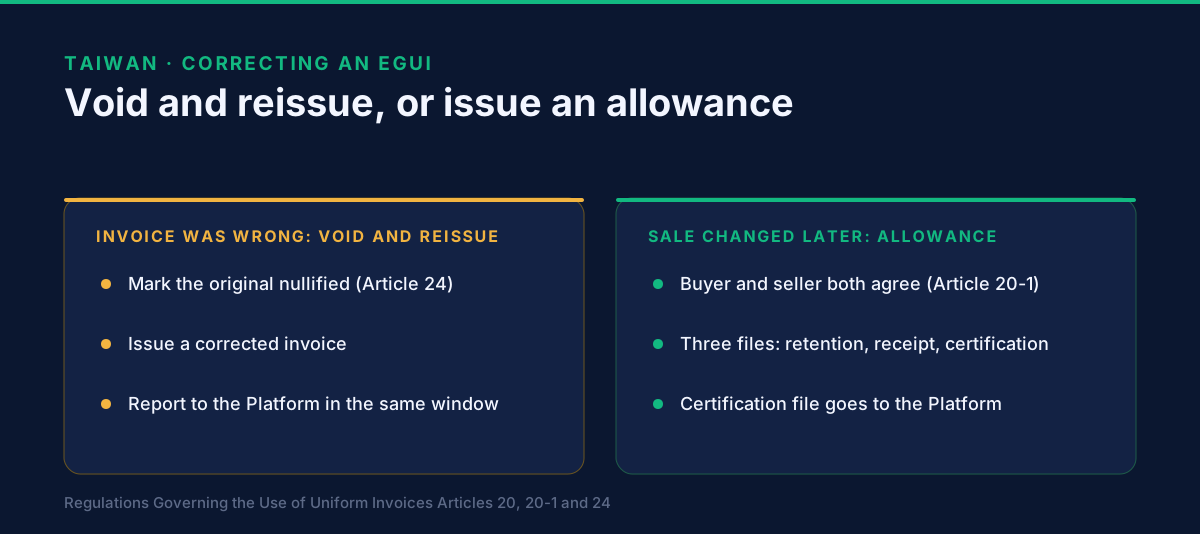
To correct an issued Taiwan eGUI you do one of two things. If the invoice was wrong, you void it and issue a corrected one. If the invoice was right and the sale later shrank, because goods came back or a price was cut, you issue an electronic allowance certificate that both buyer and seller have agreed. Either way the change has to reach the Ministry of Finance E-Invoice Platform inside the same upload window as the invoice itself.
This page walks through the choice, the agreement, the files and the reporting. GoRoute does not issue or upload eGUIs, voids or allowances. We carry the Peppol leg only, and this page is for the accounts-receivable team that has to handle the domestic side.
Should I void the invoice or issue an allowance?
It depends on whether the invoice was an error. The Regulations Governing the Use of Uniform Invoices separate the two.
An error on the invoice. Article 24 says that "business entities recording errors in uniform invoices shall reissue new uniform invoices", and that the incorrect invoice is marked "nullified". For an electronic invoice the printed certification copy has to be recovered, and a remark is made on the invoice breakdown statement for the period.
A sale that changed afterwards. Article 20 covers "sales return, swap, or allowance after the issuance of uniform invoices". The invoice was correct when issued, and the return or price reduction is a separate event with its own certificate. For a swap, the seller reissues a new uniform invoice for the actual amount swapped.
A practical test: could the invoice have been right on the day? If so, it is a return or allowance. If it could not have been, it is a void and reissue.
Why does it matter whether the sales amount was already declared?
For paper invoices, the Regulations treat the two cases differently. Where the sales amount of the issued invoice has not yet been declared, a business seller retrieves the buyer's copies, marks them nullified and attaches them to its retention copy. Where the amount has been declared, the purchaser's certificate of sales return, purchase return or allowances is required.
For electronic invoices the steps are digital, but the same logic holds in the background: the correction has to be evidenced, and the amount in a filed return is not changed by quietly editing the invoice. Ask your tax adviser how the timing affects your own return.
Who has to agree to an electronic allowance?
Both sides. Article 20-1 begins: when a business entity has issued an electronic uniform invoice "and subsequently both the seller and the purchaser agree to a sales return or allowance, or a purchase return or allowance, the entity shall issue, transmit, or receive the Certificate of Sales Return, Purchase Return, or Allowances via the Internet or other electronic means."
The Ministry's Directions for the Implementation of Electronic Uniform Invoices Operations add two requirements about the agreement:
- If the parties agree through a website, a phone call or another electronic means, the system must have encryption or other security measures so that the data is confidential, intact, attributable and not repudiable.
- The record of the purchaser's consent, or other evidence, is kept for at least five years.
A buyer's email saying "yes, credit it" is therefore not enough on its own. Keep it, and keep the log that ties it to the certificate.
What does an electronic allowance certificate consist of?
Three files, each with its own job. Article 20-1 names them:
- Retention media file: kept by the seller as its accounting voucher and for declaring the deduction of output tax.
- Receipt media file: given to the purchaser as a receipt and, where the purchaser is a business, used as its accounting voucher and for declaring the deduction of input tax.
- Certification media file: transmitted by the seller to the E-Invoice Platform for certification.
The seller can download and print the certificate from the retention file, and the purchaser can print it from the certification file held on the Platform.
When must the correction reach the Ministry?
Within the time limit set in the Act, the same one that applies to the invoice. The Directions say the entity must transmit the certificate information to the E-Invoice Platform "within the time limit set forth in the Act", and that issuing, correcting and nullifying are all covered.
GoRoute's Taiwan page gives those windows as 2 days for a consumer invoice and 7 days for a business invoice, and says returns, allowances and cancellations follow the same path as the invoice. We do not give a separate figure for allowances because the Directions do not state one in the text we read. Confirm against the Ministry's platform.
A value-added centre that carries your files is held to a stricter standard. The Directions say it must ensure data is exchanged with the Platform in real time when a business entity issues, corrects or nullifies an invoice or an allowance certificate.
How does the buyer find out?
By notification or by query. The Directions split it by buyer type:
- Business buyer: the Platform notifies the purchaser. If the purchaser has not set up automatic acceptance, the issuer must notify the purchaser directly. For any correction, nullification, return or allowance the issuer has to complete that notification within the legal time limit.
- Consumer buyer: the issuer must make sure the information is available to the purchaser on the Platform, and that the purchaser can query nullified invoices and allowance details there.
An issuer that follows those steps is treated as having delivered the document, and the purchaser is treated as having received it.
What stays outside this page?
The XML that carries these messages is the Ministry's Message Implementation Guide. We have not reproduced message codes here, because the guide is published on the Ministry's platform and changes by version, and we could not read the current release on the day this page was written. The MIG page explains what the guide is and how to find the version in force. The consumer lottery is not covered.
For the foreign side of an invoice, see exporting from Taiwan when a foreign buyer asks for Peppol and invoicing a Taiwanese business from abroad.
What to do next
Write down your correction rule in one page: who may void, who may agree an allowance, where the buyer's agreement is stored, and who checks that the correction reached the Platform inside the window. Then test the flow with your own Turnkey self-test before a real correction depends on it.
If some of your invoices cross a border, the Taiwan page shows where Peppol fits, and the documentation covers sending a corrected or credit document over Peppol. The tutorials have a walkthrough, and you can book a demo. For the next read, what a Peppol access point is explains why a Turnkey client is not one.
GoRoute is a certified Peppol Access Point (POP000991).
Primary sources: Regulations Governing the Use of Uniform Invoices, Articles 20, 20-1 and 24, Laws & Regulations Database of the Republic of China (Taiwan); Directions for the Implementation of Electronic Uniform Invoices Operations, Ministry of Finance, amended 22 April 2026; Ministry of Finance E-Invoice Platform.
Frequently asked questions
- What is the difference between voiding an eGUI and issuing an allowance?
- A void cancels an invoice that was wrong, and a corrected invoice replaces it. An allowance, or a sales return, reduces an invoice that was right when issued, because the buyer later returned goods or the seller agreed a price reduction. Regulations Article 24 covers the error case and Article 20 covers returns and allowances.
- Who has to agree to an electronic allowance?
- Both parties. Article 20-1 of the Regulations applies where the seller and the purchaser both agree to a sales return or allowance after an electronic uniform invoice has been issued. The seller then issues, transmits or receives the electronic certificate. The Directions also require the agreement itself to be kept as evidence for five years.
- How many files does an electronic allowance certificate have?
- Three. Article 20-1 names a retention media file for the seller, a receipt media file for the purchaser, and a certification media file that the seller transmits to the Ministry of Finance E-Invoice Platform.
- Does a void or allowance have to be reported to the Ministry?
- Yes. The Directions require the certificate information, and any correction or nullification, to reach the E-Invoice Platform within the time limit set in the Act. GoRoute's Taiwan page gives the windows as 2 days for a consumer invoice and 7 days for a business invoice.
- Does the buyer have to be told?
- Yes. For a business buyer, the issuer must make sure the purchaser is notified unless the purchaser has set up automatic acceptance on the Platform. For a consumer, the issuer must ensure the buyer can query the change on the Platform.
- Can GoRoute issue or upload a Taiwan void or allowance?
- No. GoRoute carries the Peppol leg only. It does not issue or upload eGUIs, voids or allowances, and it is not a value-added centre. Those stay with your own Turnkey client or a certified value-added centre.
About Dr. Syed Raza
Dr. Syed Raza is an IT Enterprise Architect at ClayDesk LLC and leads the GoRoute platform. He works across Peppol Access Point and SMP infrastructure, PINT jurisdictions (Oman, AU/NZ, EU, JP, MY, SG), and national CTC regimes, translating regulatory detail into production-grade e-invoicing systems.
Building on Peppol?
GoRoute is a certified Peppol Access Point & SMP. Book a demo or read the docs to get started.