
MyGuichet.lu or Peppol: Invoicing a Luxembourg Public Body
Two ways to send an e-invoice to a Luxembourg public body: the MyGuichet.lu web form or Peppol. When the form is enough, what it needs, and when to move.

Use the MyGuichet.lu web form if you send a few invoices a month to Luxembourg public bodies and can log in to it; use Peppol if you send many, or want your accounting system to send for you. Those are the only two channels the Luxembourg government allows. It says plainly that e-mail is not one of them. What differs between the two is the work you do on each invoice.
This page is for the occasional or foreign supplier who has an order from a Luxembourg ministry, commune or public body and needs to know how to invoice it without building anything. It sets out how each route works, what the form needs from you, and when the form stops being worth it. It does not cover which file format to use, which is on our formats page.
What are the two routes?
A network connection, and a government web form. Under Luxembourg's law, in force for all suppliers since 18 March 2023, an invoice or credit note to a public body must be a compliant electronic invoice, sent by one of two channels:
- Peppol, the international delivery network. Your billing software connects through a Peppol access point, and the invoice is sent automatically. Our Luxembourg page sets out the steps.
- MyGuichet.lu, the government's online portal, with two forms. In the first you type the invoice in field by field. In the second you upload an XML invoice you already have.
The government's page says an economic operator that already has access to Peppol does not, in principle, need the web forms. They exist for those who have no access, or not yet.
What does the MyGuichet.lu route need?
A way to log in, or a one-time code. The form with authentication needs a business eSpace on MyGuichet.lu. To create one you need one of:
- a LuxTrust product;
- a Luxembourg identity card with an activated electronic certificate; or
- an eIDAS identification means from another EU or EEA state. The government says about fifteen foreign eIDs are accepted.
If you have none, there is a form without authentication. Before you start, you must ask the public body that will receive the invoice for a one-time code, and you must attach an order form or other document showing the contractual relationship. The government calls this the exception, and says to prefer the form with authentication whenever you can. Without it you cannot:
- pre-fill the form with data from your eSpace;
- duplicate a past invoice that was sent to the same body (the FAQ says duplication is now possible for authenticated users, by clicking the "Duplicate" icon on a procedure still in preparation);
- receive the acknowledgements and the copy of the invoice in your eSpace.
The body must also be on the official list of public bodies, because the manual form reads from it. Our Luxembourg Peppol ID guide explains the list and what a missing body means.
How do the two forms differ?
One is for typing, the other for uploading. Use manual input when you have no structured file. You enter the issuer and recipient, the invoice's key data and payment terms, and the lines, then send. There is a separate manual form for credit notes. Use transmission when you already have an XML file that meets the standard. You choose "invoice" or "credit note" in the document-type field and upload it.
The upload route is only as easy as your file. An XML invoice has to come from somewhere, usually accounting software. That is our own observation, not the government's: if your system can already produce a valid file, you have done most of the work a Peppol connection needs. The formats the upload accepts are listed in Which e-invoice formats Luxembourg public bodies accept.
What does it cost?
MyGuichet.lu has no additional cost; Peppol has an access point cost. The government's FAQ says that if a company uses MyGuichet.lu "there are no additional costs", and that the procedure does not offer all the advantages of electronic invoicing. It says Peppol is linked to the variable costs of renting, setting up or maintaining an access point, but that, with every cost of traditional invoicing counted (paper, printing, postage, manual sending), electronic invoicing generally lowers the total.
The same FAQ describes a state aid. Under the "SME Packages Digital" programme, a company that meets its conditions can receive a grant of 5,000 euros towards an e-invoicing solution. The conditions it gives include an authorisation to set up granted by the SME directorate and meeting the SME headcount, turnover and balance sheet tests. Check the programme with the contact in the FAQ before you rely on it.
When is the form enough, and when is it not?
The form is enough when volume and variety are low. In the government's words, Peppol is always the preferred solution for a business of any size that sends a large number of invoices, because it automates the process. In the short term, the alternative on MyGuichet.lu is more suitable for businesses and other organisations that issue few invoices a month. The government gives no number. Our reading of where the line falls:
| Your situation | Likely better route |
|---|---|
| A handful of invoices a month, one or two public customers, a login that works | The form |
| An occasional foreign supplier, no eID, a body that will give you a one-time code | The form without authentication |
| Dozens of invoices a month, or many public customers | Peppol |
| Invoices already produced by an ERP or shop platform | Peppol |
| Staff time spent re-typing is already noticeable | Peppol |
The table is our judgment, not an official threshold. Move when re-typing costs more than a connection would.
The government's figures show the direction. The explanatory memorandum to bill 8815 says about 15 per cent of e-invoices are now issued through MyGuichet.lu, against about 21 per cent in 2025 and 23 per cent in 2024, and that the volume sent over the common network keeps growing. It also says the form allows only manual, non-automated issuing. If the bill passes, businesses that use the State's alternative solutions beyond a ceiling would pay a fee per invoice. The detail is in our bill 8815 guide.
Can a foreign supplier use the form?
Yes, with a few exceptions. The government says foreign economic operators have exactly the same channels, open and non-discriminatory. The authenticated forms accept about fifteen foreign eIDs. The FAQ lists countries that cannot yet use the manual form for technical reasons: Greece in all cases, the Netherlands and Sweden when the issuer has no VAT number, and Denmark for a private individual with no CVR number. The upload form is not on that list. A German, Belgian or French supplier can use either.
What if I make a mistake?
You issue a new invoice, or a credit note. The government's FAQ says an electronic invoice cannot be rectified once sent, as with an e-mail or a letter. For a credit note use the manual credit-note form, or the upload form with "credit note" chosen as the document type. On Peppol, send a credit note the same way.
What did we not confirm?
Two points, as of 30 October 2026.
- We did not log in to the forms. Everything above comes from the government's pages. The input page was last updated on 11 September 2023 and the transmission page on 8 June 2026, and the FAQ may be ahead of both.
- The ceiling and fees in bill 8815. Not set; a regulation will set them.
What to do next
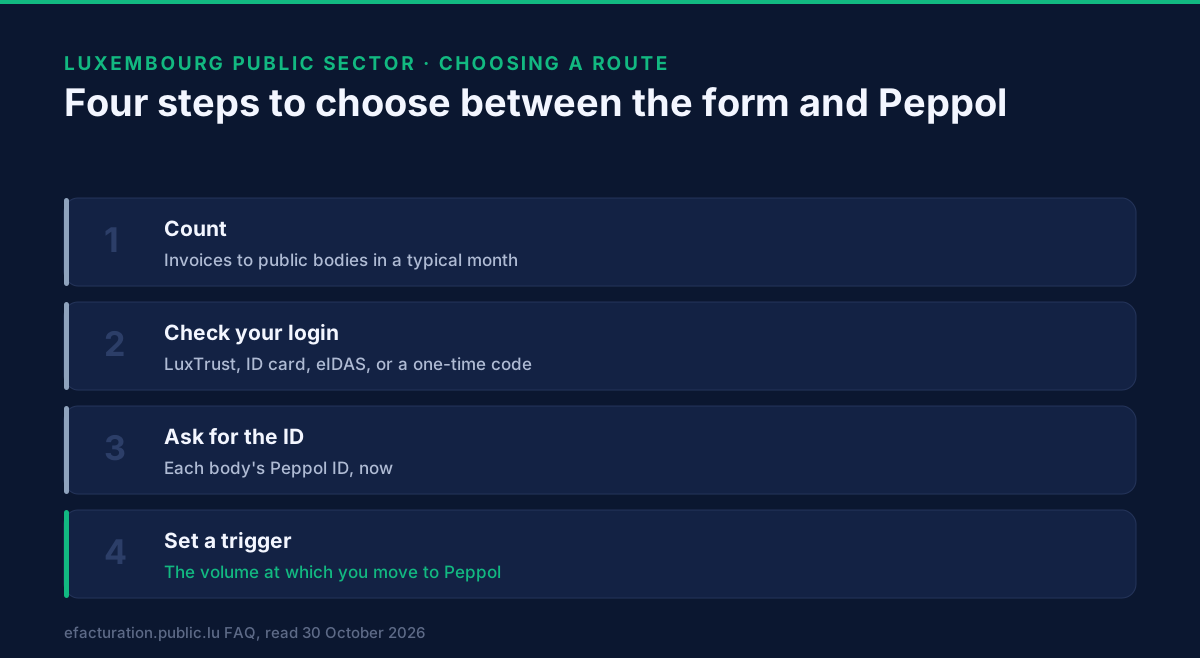
- Count your invoices to Luxembourg public bodies in a typical month. If it is a handful, start with the form.
- Check your login route. LuxTrust, an ID card, or an eIDAS identification. If none, ask the body for a one-time code.
- Ask each body for its Peppol ID now, even if you start with the form. It saves a second round later.
- Set a trigger. Decide the monthly volume at which re-typing costs more than a connection.
Book a demo if you are near that line. GoRoute is a certified Peppol access point (POP000991), and our e-invoice sending page shows how invoices go out from your system. The tutorials and developer documentation cover the connection.
Related Luxembourg guides
- Luxembourg e-invoicing: the public-sector mandate — who must send, and since when.
- Which e-invoice formats Luxembourg public bodies accept — what to put in the file you upload.
- Luxembourg Peppol ID: scheme 9938, VAT number or matricule — find a body's ID.
- Luxembourg B2B e-invoicing from 2028: what bill 8815 would require — why the form may stop being enough for businesses.
Sources, read 30 October 2026: Guichet.lu, Transmission of a compliant electronic invoice (updated 8 June 2026) and Manual input (updated 11 September 2023); the government's Dossiers and FAQs and public sector pages; the explanatory memorandum to bill 8815. This page is not legal advice.
Frequently asked questions
- Can I e-mail an e-invoice to a Luxembourg public body?
- No. The government's pages say the only permitted channels are Peppol and the MyGuichet.lu forms, and give e-mail as an example of a channel that is not allowed.
- Is the MyGuichet.lu form enough for an occasional supplier?
- Often, yes. The government's FAQ says that in the short term the MyGuichet.lu forms suit businesses that issue few invoices a month, and that Peppol is preferred when a business sends many. The government gives no number, so the line is yours to draw.
- Does it cost anything to use MyGuichet.lu?
- The FAQ says there are no additional costs if you use MyGuichet.lu. It adds that the route does not offer all the advantages of electronic invoicing. Peppol has variable costs for renting, setting up or maintaining an access point.
- What do I need to use the form with authentication?
- A business eSpace on MyGuichet.lu, which needs a LuxTrust product, a Luxembourg identity card with an activated electronic certificate, or an eIDAS identification from another EU or EEA state.
- What if I have none of those?
- There is a form without authentication. You must first ask the public body for a one-time code and attach an order form or another document that shows the contract. It lacks pre-fill, duplication of past invoices and the acknowledgements in your eSpace.
- Can a foreign supplier use MyGuichet.lu?
- Yes. The government says foreign suppliers have the same channels, and the authenticated forms accept about fifteen foreign eIDs. The manual-entry form cannot yet be used from Greece, nor from the Netherlands or Sweden without a VAT number.
About Dr. Syed Raza
Dr. Syed Raza is an IT Enterprise Architect at ClayDesk LLC and leads the GoRoute platform. He works across Peppol Access Point and SMP infrastructure, PINT jurisdictions (Oman, AU/NZ, EU, JP, MY, SG), and national CTC regimes, translating regulatory detail into production-grade e-invoicing systems.
Building on Peppol?
GoRoute is a certified Peppol Access Point & SMP. Book a demo or read the docs to get started.