
Luxembourg Peppol ID: Scheme 9938, VAT Number or Matricule
A Luxembourg Peppol ID is scheme 9938 plus a VAT number or an 11-digit matricule. How to read one, find a public body's on the official list, and check it.

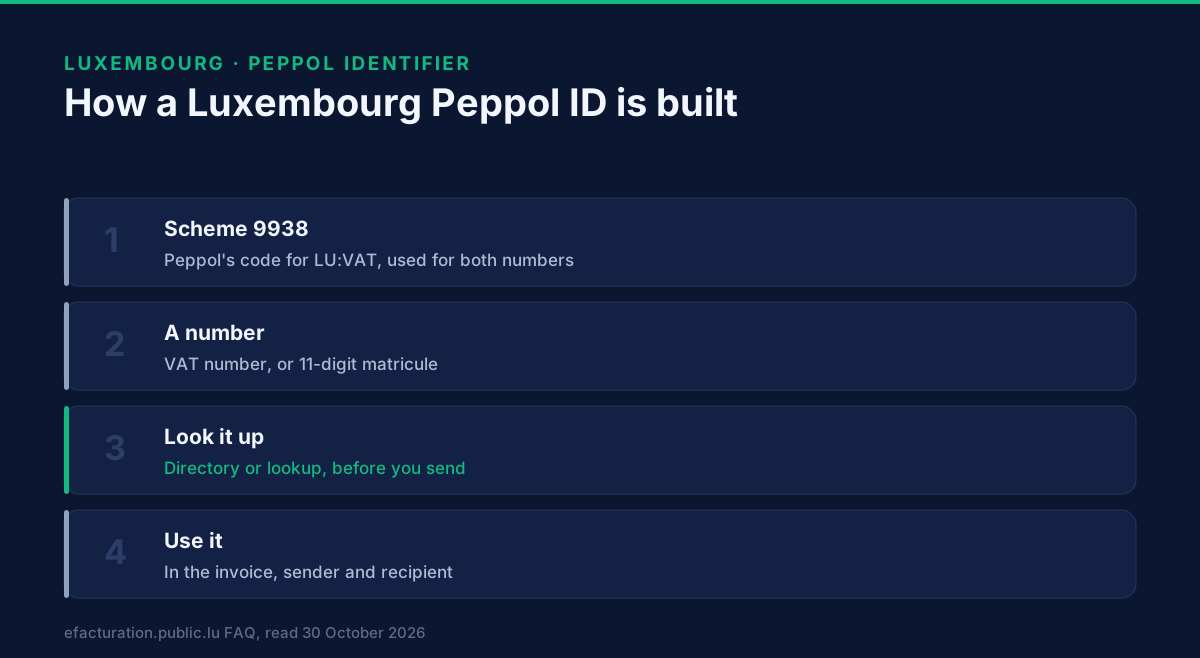
A Luxembourg Peppol ID is the scheme code 9938 followed by either the organisation's VAT number or its
11-digit matricule. The first looks like 9938:lu10061242 and the second like 9938:12345678910. The
Luxembourg government's e-invoicing FAQ gives exactly those two examples and says the code list to use
is always 9938, which Peppol calls LU:VAT, for both.
This page is for the accounts clerk or IT lead who needs to put an ID into an invoice, find a public body's ID, or register their own company. It covers how to read the two forms, where the official list is, how to check an ID before sending, and what we could not confirm. It does not cover how a Service Metadata Publisher (SMP, the directory that says where an ID's invoices should be delivered) works inside; see our SMP-as-a-service page for that.
What is a Peppol ID, and where does it go in the invoice?
It is the address of a business on the Peppol network, written into the invoice twice. The Luxembourg
government compares it to a street address or an e-mail address. Every invoice sent over Peppol carries the
ID of the sender and the ID of the recipient. Without the recipient's ID the network cannot know where
to deliver. In Peppol BIS Billing 3.0 they sit in the two EndpointID fields, and the FAQ says so.
The ID has two parts: a scheme, which says what kind of number follows, and the number itself.
The scheme here is 9938.
What are the two forms of a Luxembourg ID?
A VAT number, or the matricule. Under scheme 9938 the government's FAQ allows an organisation to use:
- The VAT number, written
lufollowed by eight digits:9938:lu10061242in the FAQ's example. - The identity number from the register of legal entities, which has 11 digits and is called the
matricule:
9938:12345678910in the FAQ's example.
The official list of public bodies shows both in use. The file downloaded on 30 October 2026 holds 796
entries: 416 with 11 digits and 380 with LU and eight digits. Some bodies appear twice. The Ministère
d'État, for example, has two entries, each with its own VAT-style number.
Which number should a Luxembourg business register under?
Either is allowed; the guidance does not choose. We found no official rule that ranks the two. Our advice, and it is advice rather than rule, is to pick the number your customers already hold in their own records, and to tell them which you chose.
Keep to the two forms in the guidance, and use scheme 9938, as the guidance does.
What about scheme 0240?
Peppol has a second Luxembourg scheme, but the guidance does not use it. Version 9.7 of the Peppol code
list has 0240, named LU:MAT, "Register of legal persons", issued by the Government IT Centre (CTIE).
It is an 11-character number of Arabic numerals only, whose first four digits are a year and whose
last digit is a check digit. That is the matricule.
The government's FAQ nonetheless says to use 9938 for both numbers. We tested this on 30 October 2026
against the Peppol Directory, using two entries from the official list with
matricule-style IDs: 18415000010 and 00005000041. Both were registered under 9938 and neither
returned a result under 0240. Two samples do not prove that no body uses 0240, but they match the guidance.
If you are registering a Luxembourg business, follow the guidance.
Where is the official list of public bodies?
On the government's public sector page at efacturation.public.lu. It is a searchable table, sortable by body name or Peppol identifier, and can be downloaded in full as an Excel file or as open data in JSON. The numbers in the file carry no scheme prefix: the scheme is 9938, per the FAQ. In the JSON, each entry has a name and an id.
The Ministry for Digitalisation keeps the list. A body gets onto it by filling in a registration form, and the Ministry uses the same information to let that body receive invoices through the MyGuichet.lu forms. The government's page states that a body which has not registered cannot receive through those forms. So a missing body is not a sign that a body is off Peppol. It may simply not have registered.
Ministries and administrations must use the State's access point and its digital mailroom. Other contracting authorities may use their own, or the State's while they have none. For you as a sender this changes nothing: the ID is the ID.
How do I check an ID before I send?
Look it up, and only send when the lookup finds it. Two free ways:
- The Peppol Directory at directory.peppol.eu. Search for the full ID, for example
9938:lu31168204. On 30 October 2026 that returns the Ministry for Digitalisation, with its accepted document types. - A lookup in your access point. GoRoute's free Peppol lookup takes an identifier and shows which document types it accepts and which SMP holds the record. No sign-in is needed.
For a safe trial, the government's FAQ names two test participants in the Peppol test environment: the
Ministry for Digitalisation, 9938:LU31168204, and the Government IT Centre, 9938:LU10889245-TEST or
9938:lu10889245. Other public bodies cannot be reached in test.
What do I do if the ID is not on the list?
Ask the body. The government's FAQ tells public bodies to remind their suppliers of their obligation to invoice electronically and to communicate their Peppol identifier. A supplier who has an order or contract from a body can ask the same person for the ID and the access point. A body that is not on the list cannot receive through the MyGuichet.lu forms either, so ask it to register with the Ministry. See MyGuichet.lu or Peppol for how the two routes differ.
What did we not confirm?
Three points, as of 30 October 2026.
- Letter case. The FAQ writes
lu, the list writesLU, and the Directory returns lower case. We did not test whether a mismatch matters on delivery. - Whether every list entry is in the Directory. We sampled four. All four were found.
- How many Luxembourg businesses, as opposed to public bodies, register under each number. The official list covers public bodies only.
What to do next
- Decide which of your own numbers you register. VAT number or matricule, scheme 9938.
- Look up each public customer on the list, then check it in the Directory or the free lookup.
- Store the ID in your customer record, not in each invoice, so one correction fixes every future one.
- Register your own ID so customers can find you. GoRoute runs an SMP; the Register on Peppol page starts that.
Before you build it, you can book a demo and we will walk through your set-up. GoRoute is a certified Peppol access point (POP000991). The tutorials and the developer documentation show participant lookup in practice.
Related Luxembourg guides
- Luxembourg e-invoicing: the public-sector mandate — who must send, and since when.
- Which e-invoice formats Luxembourg public bodies accept — what goes in the file the ID sits in.
- Luxembourg B2B e-invoicing from 2028: what bill 8815 would require — why businesses will want an ID too.
- MyGuichet.lu or Peppol — the other route to a public body.
Sources, read 30 October 2026: the government's FAQ and public sector page with the official list in JSON (796 entries, file header dated 30 October 2026); the Peppol participant identifier code list version 9.7; searches of the Peppol Directory on 30 October 2026. This page is not legal advice.
Frequently asked questions
- What is a Luxembourg Peppol ID?
- Scheme 9938 followed by one of two numbers: the VAT number, for example 9938:lu10061242, or the 11-digit matricule, the identity number in the register of legal entities, for example 9938:12345678910. The government's FAQ says the code list is always 9938 (LU:VAT) for both.
- Where do I find a Luxembourg public body's Peppol ID?
- On the official list of public sector bodies and contracting entities published at efacturation.public.lu. You can search it on the page, or download it as Excel or JSON. You can also search the Peppol Directory.
- Should I register under my VAT number or my matricule?
- Luxembourg's guidance allows either and does not rank them. We would use the one your customers can already find in their own records, and tell them which. Whichever you choose, use scheme 9938, as the guidance does.
- What about scheme 0240?
- Peppol's code list, version 9.7, has 0240 (LU:MAT) for the matricule. Luxembourg's guidance says to use 9938 for both numbers. On 30 October 2026 two matricule-style IDs we checked in the Peppol Directory were registered under 9938 and returned nothing under 0240.
- Is my public body missing from the list?
- A body that has not told the Ministry for Digitalisation it is on Peppol is not on the list, and cannot receive invoices through the MyGuichet.lu forms. Ask the body for its Peppol ID and the access point it uses.
- Does the case of the letters matter?
- We could not confirm. The government writes the VAT form as lower-case lu in its FAQ and as capitals in its list, and the Peppol Directory shows lower case. Copy the number as the list gives it and check it with a lookup before you send.
About Dr. Syed Raza
Dr. Syed Raza is an IT Enterprise Architect at ClayDesk LLC and leads the GoRoute platform. He works across Peppol Access Point and SMP infrastructure, PINT jurisdictions (Oman, AU/NZ, EU, JP, MY, SG), and national CTC regimes, translating regulatory detail into production-grade e-invoicing systems.
Building on Peppol?
GoRoute is a certified Peppol Access Point & SMP. Book a demo or read the docs to get started.