
Does Your Australian or New Zealand Online Shop Need to Send E-Invoices?
Neither Australia nor New Zealand makes e-invoicing compulsory for a business. What that means for an online shop, its checkout and its business buyers.

Neither Australia nor New Zealand requires your online shop to send e-invoices. There is no general business mandate in either country, no central platform to file through, and no date on which your web shop becomes non-compliant. What exists instead is an obligation on the other side of the transaction — Commonwealth government agencies in Australia have had to be able to receive Peppol e-invoices since July 2022, and New Zealand's central agencies pay Peppol e-invoices within 10 business days under the government procurement rules. For a shop owner that turns a compliance question into a commercial one: you send e-invoices because your business buyers and your government buyers want them, not because a law says so.
This page is for the owner or manager of an online shop registered in Australia or New Zealand that sells at least partly to other businesses. It stays on the shop's own flow — what the checkout asks, what leaves after payment, and what happens when delivery fails.
Is e-invoicing mandatory for an Australian or New Zealand online shop?
No — and it is worth being precise about what is required, because the honest answer is more useful than a scare.
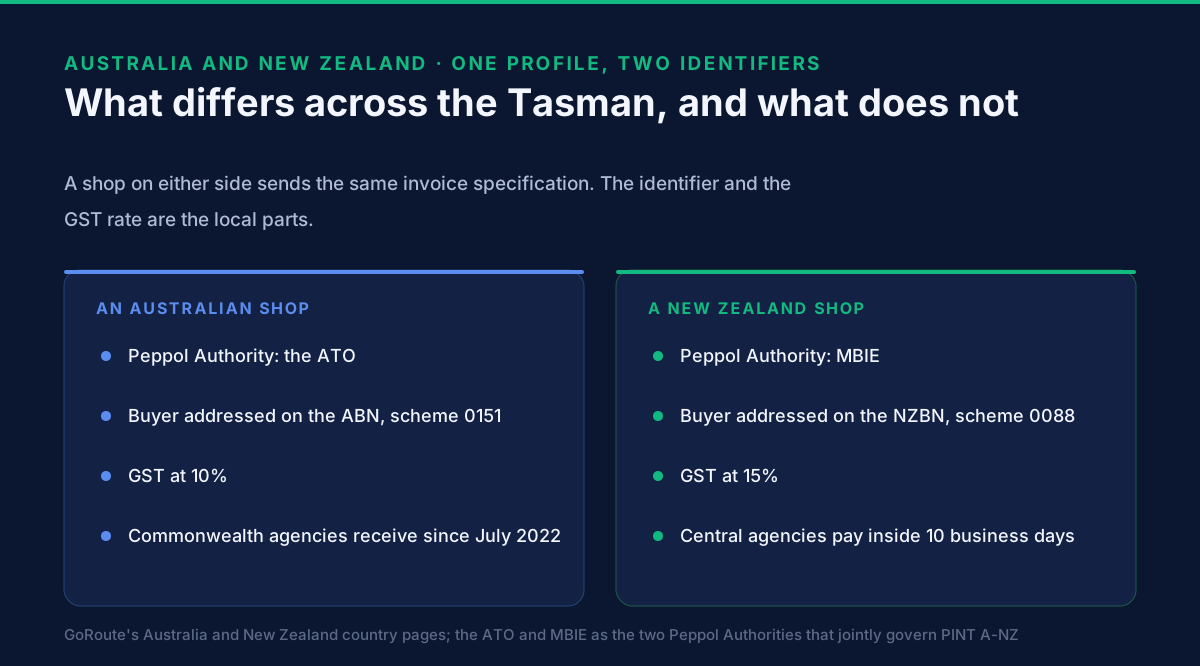
In Australia, the Australian Taxation Office is the Peppol Authority: it governs the country's use of Peppol and accredits the service providers allowed to carry live traffic. It has not imposed a business-to-business mandate. What it has done is put the obligation on government buyers — all Commonwealth agencies have been able to receive Peppol e-invoices since July 2022 — and set a target of 30% of agency invoices arriving by eInvoicing by 1 July 2026. Under the Australian Government's supplier payment policy, eligible e-invoices to Commonwealth agencies are paid faster than paper or PDF, commonly within five business days; thresholds and eligibility have changed over time, so confirm the current policy for your own contract.
In New Zealand, the Ministry of Business, Innovation and Employment is the Peppol Authority and works the same way: adoption through procurement rather than legislation. Central government agencies receive Peppol e-invoices and, under the procurement rules, pay them within 10 business days. Again, no general rule reaches a private-sector shop.
So: nothing forces you, and two large classes of buyer pay you faster if you can. The regimes in full — the ATO's register, the adoption targets, the New Zealand agency thresholds — are on the Australia country page and the New Zealand country page.
Why would an online shop do this at all, then?
Because the reasons that survive the absence of a mandate are the commercial ones, and for a shop there are three.
Your business buyers ask for it. A structured e-invoice arrives inside the buyer's accounting software, matched against their purchase order, with no PDF for somebody to re-type. The request arrives as "can you send us an e-invoice", and the shops that can say yes without a project are the ones that already installed the field.
Government buyers pay faster. Faster payment is the most quoted commercial reason Australian suppliers adopt Peppol, and it is why the New Zealand procurement rules take the form they do. If any part of your revenue touches a Commonwealth agency or a New Zealand central agency, this is cash flow rather than compliance.
It costs nothing to be ready. The checkout field is optional and invisible to consumers, and registering your own identifier is included. With no deadline to race there is also no reason to wait for one: the work is ten minutes now or a scramble inside a tender later.
What has to change at my checkout?
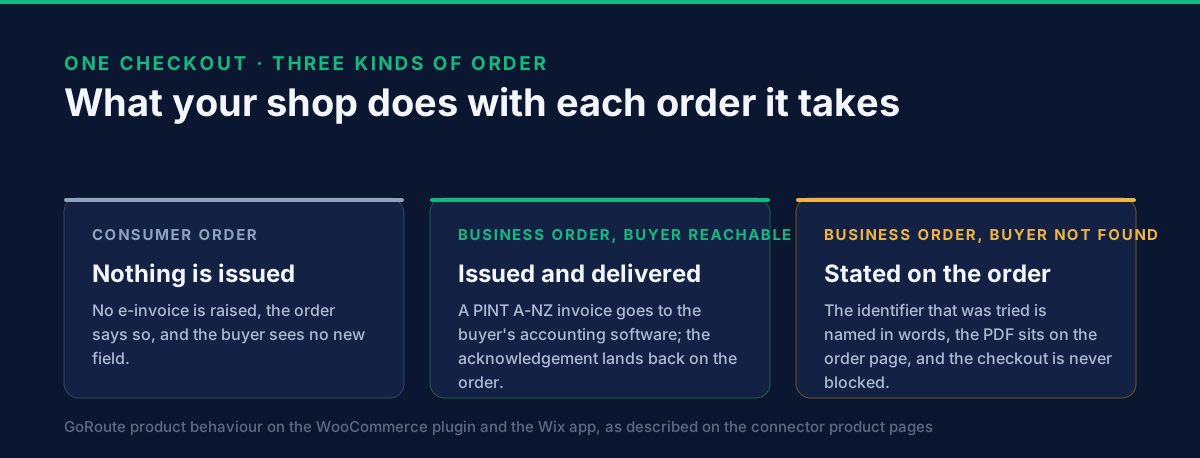
One optional field, shown only to business buyers.
A structured invoice has to be addressed to something a machine can resolve. A company name cannot do that and neither can a delivery address. The identifier is:
- Australia — the ABN. Your buyer's 11-digit Australian Business Number, registered with
the Australian Business Register, carried on the Peppol network under identifier scheme
0151. - New Zealand — the NZBN. Your buyer's 13-digit New Zealand Business Number from the
Companies Office, carried under identifier scheme
0088.
The field is checked before the order completes, not at invoicing time — an identifier that turns out to be unusable after the customer has left is a problem you meet in a queue of failed documents. On WooCommerce in Australia and WooCommerce in New Zealand the buyer types the number and the plugin checks it against the Peppol network as they type, saying whether an e-invoice can actually reach them. The Wix app puts the same field on the checkout from one button in Settings.
Two things follow that are easy to miss. Consumers see nothing — no extra field and no change to your conversion rate on the orders that are usually the larger half of the book. And your own identifier is registered for you: set-up publishes the store's ABN or NZBN on GoRoute's SMP and the Peppol directory, which is what lets delivery acknowledgements and incoming documents find you. Everything else — theme, payment provider, order emails — stays as it is.
Selling across the Tasman needs nothing extra. Your own identifier follows where your business is registered; the buyer's follows theirs. An Australian shop addresses a New Zealand buyer on their NZBN under scheme 0088 from the same store and the same plugin — no second account and no New Zealand entity. GST is the part that does differ: 10% in Australia, 15% in New Zealand, with zero-rated exports and exempt supplies handled per country. Trans-Tasman e-invoicing with one provider covers the arrangement from the accounting side.
What invoice is my shop actually sending?
PINT A-NZ, and the same one in both countries.
PINT A-NZ is the Peppol International invoice specification for Australia and New Zealand. It is jointly governed by the ATO and MBIE, and it is based on Peppol BIS Billing 3.0 — the same European core, narrowed with local business rules for GST treatment, ABN and NZBN identifiers, and the validation each country expects. Two dates matter and both have passed:
- 15 November 2024 — PINT A-NZ became the required invoice profile.
- 15 May 2025 — the legacy ANZ Peppol profiles were retired, leaving PINT A-NZ as the only supported billing profile.
One trap is worth naming because it costs real time. PINT A-NZ is not interchangeable with the European Peppol BIS Billing profile. They share a core and differ in their rules, so an invoice built to the European profile will not automatically pass Australian or New Zealand validation. If a developer has previously built against a European Peppol integration, that is the assumption to check first; PINT A-NZ explained sets out the relationship and PINT A-NZ is now the only accepted profile covers the May 2025 retirement.
For a shop this is deliberately not your decision. Your store raises the sale; the access point produces the document in the profile the destination requires, validates it and delivers it — which is also why your store stays current when the rules move, with no plugin update on your side. What a Peppol Access Point is explains the delivery half in one page.
What happens when the business buyer is not on the network?
You are told so on the order, in words, with the identifier that was tried — and because there is no mandate, nothing about the sale is at risk.
This is where the Australian and New Zealand answer is genuinely easier than the European one, and reading one across to the other is the mistake worth avoiding. Belgium does not accept a PDF by email as a business-to-business invoice at all, which is why the Belgian version of this page tells a shop owner close to the opposite. Here there is no central platform to file through, no prescribed channel and no penalty waiting: an undelivered e-invoice is an inconvenience, and the PDF on the order page answers it completely.
What the apps do is refuse to fail quietly. A failed lookup is stated on the order with the identifier attempted, the PDF sits on the order page, undelivered documents are retried after a hiccup at the buyer's end, and the checkout is never blocked. The useful next step is to ask the buyer which identifier their accounting software receives under — a mistyped ABN and a genuinely unregistered business look identical from your side.
How do refunds, cancellations and duplicates work?
A refund is a credit note that references the original invoice and travels the way the invoice did.
Online retail has habits manual invoicing never had to survive, and each has one correct answer that is not obvious if you have only ever issued PDFs.
- A refund raises a credit note, not a deletion and not a replacement invoice. You refund in your shop as you always have, and the document follows.
- A cancelled order before delivery is the same shape of problem with the same answer.
- A duplicate is not a second invoice. A double-clicked checkout or a gateway retry must return the original document rather than minting a new one. One sale, one invoice, ever.
- A refused document has to be visible — explained on the order in words, never silently dropped.
Underneath all four is one rule: the structured document is the invoice, so the corrections your shop already performs have to produce corrections on the network too. What you keep for your records is that document, not a screenshot of it.
What this looks like on WooCommerce and on Wix
Both apps are live, both list Australia and New Zealand as seller countries, and both are free to start.
- WooCommerce. The GoRoute plugin is on the WordPress plugin directory and works with WordPress 6.0+ and WooCommerce 8.0+, including High-Performance Order Storage and the block checkout. Issuing hooks the payment-complete event, so Stripe, PayPal, bank transfer and cash on delivery all behave identically: paid business order in, e-invoice out. Set-up is four steps and about ten minutes, with no developer and no API key to paste. The country detail is on WooCommerce e-invoicing in Australia and WooCommerce e-invoicing in New Zealand; the view across every country it supports is on the WooCommerce Peppol plugin page.
- Wix. The GoRoute app is on the Wix App Market and requires Wix Stores. Australia and New Zealand are both seller countries and both issue PINT A-NZ. It adds the checkout field, issues on payment, and writes the invoice number, the delivery channel and the delivery state onto the Wix order itself. The detail is on Wix e-invoicing, and the listing is at the Wix App Market.
Both are free for the first fifty e-invoices a month, every feature included, with paid plans above that. Wix plans are bought and billed inside Wix, so the charge lands on the bill the merchant already has; WooCommerce plans are bought from GoRoute inside WordPress. The current ladder lives on each product page rather than here, because a price written into a blog post goes stale without anybody noticing. A custom-built store needs neither app: the same issuing engine is one REST call at checkout, and the developer pages and the developer documentation carry the identifiers, document types and test participants.
The access point behind all of these is GoRoute itself — certified Peppol Access Point POP000991, listed on the ATO's Peppol service provider register under ClayDesk LLC — so issuing, delivery and delivery status are one service, with one place to look when a document does not land. GoRoute is pursuing New Zealand mutual accreditation; the same access point serves both countries today.
What this page does not cover
No mandate date, and no penalties. There is no business-to-business mandate in either country, so there is no date to give you and no penalty schedule for a private-sector shop. Where a date is announced, the country pages are where it will appear first.
Shopify. The GoRoute Shopify app is not listed yet, so there is nothing to install and nothing claimed here. If your shop is on Shopify, book a session and we will tell you where it stands.
Your tax treatment. Whether a sale is a business-to-business supply, and at what rate, is a tax question. The 10% and 15% mechanics are on the Australia page and the New Zealand page.
Related Australian, New Zealand and storefront guides
- Peppol e-invoicing in Australia: the full guide — the country question in full: the ATO as Peppol Authority, ABN registration, GST and what a supplier does now.
- New Zealand e-invoicing: the full guide — MBIE's programme, the agency rules and the supplier thresholds.
- PINT A-NZ explained — the shared specification and how it relates to Peppol BIS Billing 3.0.
- Trans-Tasman e-invoicing with one provider — ABN and NZBN identifiers on one integration.
- Does your Belgian online shop have to send e-invoices? — the same question where the answer is a mandate and a PDF by email is not allowed.
- Does your German online shop have to send e-invoices? — a phased obligation on turnover, and a receiving rule that is already live.
What to do next
Decide today whether any of your revenue touches a government buyer, on either side of the Tasman. If it does, being able to send is already worth money to you in payment terms, and that is the whole business case. If it does not, the case is your business buyers, and the honest answer is that the field costs you nothing while it waits for the first one to ask.
Then install, because there is no deadline to wait for. On WooCommerce that is the plugin directory; on Wix it is the App Market listing. Recorded walkthroughs of the connectors are on tutorials, the identifiers, document types and statuses are in the developer documentation, and the two regimes in full are on our Australia page and our New Zealand page. To walk your own checkout and refund flow against PINT A-NZ with our team, book a session.
Sources: the Australian Taxation Office, Australia's Peppol Authority, for the ATO's role, the Commonwealth receiving obligation from July 2022 and the 1 July 2026 adoption target; the ATO Peppol service provider register, where GoRoute is listed under ClayDesk LLC; MBIE and New Zealand Government Procurement — eInvoicing for New Zealand's Peppol Authority and the 10-business-day payment rule; the OpenPeppol BIS Billing 3.0 specification for the base profile that PINT A-NZ narrows, with PINT A-NZ required from 15 November 2024 and the legacy ANZ profiles retired on 15 May 2025. Product behaviour — the checkout field, the network reachability check, the credit-note path and the PDF fallback — is GoRoute's own, described on the WooCommerce Australia page, the WooCommerce New Zealand page and the Wix page. GoRoute operates certified Peppol Access Point POP000991.
Frequently asked questions
- Does an online shop in Australia have to send e-invoices?
- No. Neither Australia nor New Zealand has a general e-invoicing mandate for businesses, so no law currently requires your shop to issue a structured e-invoice to a private-sector business buyer. The obligation that does exist sits on the buyer's side of the public sector: Commonwealth government agencies in Australia have had to be able to receive Peppol e-invoices since July 2022. If you sell to a government agency, being able to send is a commercial requirement rather than a legal one for you.
- What about New Zealand — is it mandatory there?
- No general business mandate there either. New Zealand's Ministry of Business, Innovation and Employment is the Peppol Authority and drives adoption through government procurement rather than a blanket rule: central government agencies receive Peppol e-invoices and pay them within 10 business days under the procurement rules. For a shop, that is an incentive, not an obligation.
- So why would a shop bother?
- Three reasons a shop owner can act on. Your business buyers get the invoice inside their accounting software instead of a PDF someone has to key in, which is the thing they actually ask for. Government buyers on both sides of the Tasman pay e-invoices faster than paper or PDF. And the checkout field and the network registration cost nothing to have in place before a buyer asks, whereas retro-fitting them during a tender does not go well.
- What does my checkout have to collect?
- One optional field, shown only to business buyers: their ABN in Australia or their NZBN in New Zealand. A structured invoice has to be addressed to a machine-resolvable identifier, and that is the identifier. An ABN is carried under Peppol scheme 0151 and an NZBN under scheme 0088. Consumers see nothing new, which matters because for most shops consumer orders are the larger half.
- Is the invoice my shop sends the same in both countries?
- Yes. Australia and New Zealand share one invoice specification, PINT A-NZ, jointly governed by the ATO and MBIE and based on Peppol BIS Billing 3.0. It has been the required profile since 15 November 2024, and the older ANZ Peppol profiles were retired on 15 May 2025. PINT A-NZ is not interchangeable with the European Peppol BIS Billing profile, so an invoice built for Europe will not pass Australian or New Zealand validation.
- What happens if my business buyer is not on the Peppol network?
- You are told so on the order, in words, with the identifier that was tried. Because there is no mandate and no central platform in either country, there is no compliance failure here — the sale is unaffected and the PDF is on the order page for you to send. It is worth asking the buyer which identifier their accounting software receives under, because a wrong ABN or NZBN looks identical to a buyer who is genuinely not registered.
- How does a refund work?
- A refund raises a credit note that references the original invoice and travels the way the invoice did. You refund in your shop exactly as you always have and the document follows. What you must not do is delete the original invoice or quietly issue a replacement, because the structured document is the record.
- Which apps cover Australia and New Zealand?
- The GoRoute WooCommerce plugin from the WordPress plugin directory, and the GoRoute Wix app from the Wix App Market. Both list Australia and New Zealand as seller countries and both issue PINT A-NZ. Both start free at fifty e-invoices a month with every feature, with paid plans above that — Wix plans are bought inside Wix, WooCommerce plans from GoRoute inside WordPress.
- Do I need to be on the Peppol network to receive invoices as well?
- You do not have to be, but set-up puts you there anyway. Registering your own ABN or NZBN on the network is what lets delivery acknowledgements and incoming documents find you, and it is included with every plan. A shop that can receive is also a shop a government buyer can pay through the same route.
About Dr. Syed Raza
Dr. Syed Raza is an IT Enterprise Architect at ClayDesk LLC and leads the GoRoute platform. He works across Peppol Access Point and SMP infrastructure, PINT jurisdictions (Oman, AU/NZ, EU, JP, MY, SG), and national CTC regimes, translating regulatory detail into production-grade e-invoicing systems.
Building on Peppol?
GoRoute is a certified Peppol Access Point & SMP. Book a demo or read the docs to get started.