
Simplified Tax Invoices in Oman: Every Till Is on the Same 2027 Clock
Oman's amended Article 146 puts simplified tax invoices on the Article 143 timeframes. Retail, fuel and exchange counters share the 2027 dates. What POS needs.

The short answer
The amended Article 146, paragraph two says the simplified tax invoice must be issued within the timeframes specified in Article 143.
That single sentence puts every till in the country on the same clock as the finance department: 1 April 2027 for taxpayers above OMR 5,000,000 of annual supplies, 1 October 2027 for everyone else. There is no slower track for retail.
Article 143 reinforces it from the other direction, covering supplies "to a non-taxable person" explicitly. B2C is not an afterthought in this decision — it is named in both places.
Why this is the amendment most likely to be underestimated
A B2B rollout is a project about documents. A B2C rollout is a project about volume, uptime and physical estate.
A distributor issuing 8,000 invoices a year is changing a format in one system. A retail chain with 40 counters is changing behaviour at 40 devices, some of which are old, some of which are leased, and at least one of which nobody is quite sure who maintains.
Three things make the retail version harder:
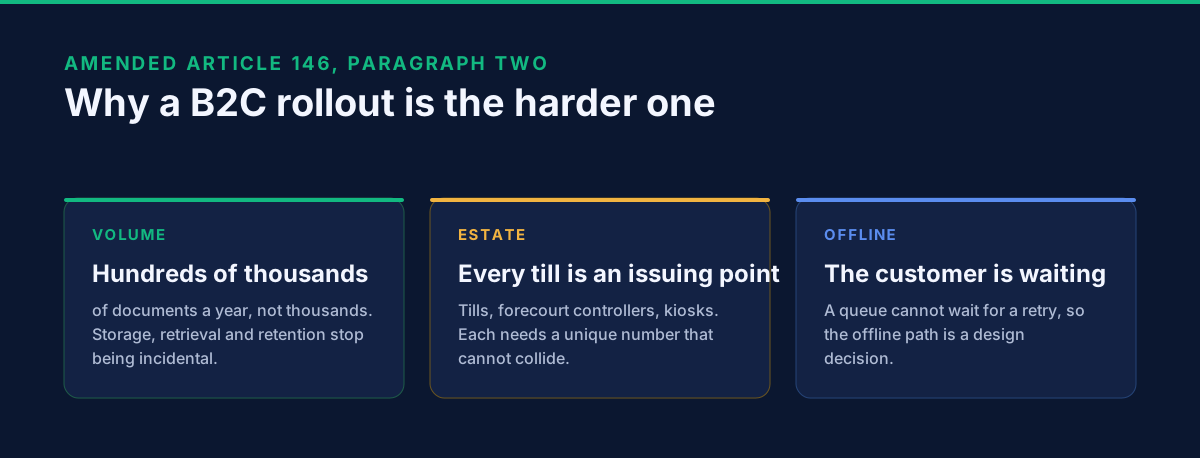
Volume changes the architecture. Hundreds of thousands of documents a year is a different system from thousands. Storage, retrieval, retention and reconciliation all stop being incidental.
The device estate is the project. Tills, fuel forecourt controllers, exchange-counter terminals, kiosk software. Every one of them is an issuing point, and every issuing point needs a unique invoice number that cannot collide with another counter's.
The customer is standing there. A B2B invoice can fail and be retried in the background. A queue cannot wait for a retry, which makes the offline path a design decision you have to make deliberately rather than discover.
What a simplified invoice is, and the QR code
A simplified tax invoice is the reduced-content invoice used for supplies to non-taxable persons — in practice, the receipt handed over at a counter. It carries less party detail than a full tax invoice, but it is still a tax invoice: it needs the approved electronic format, integrity, retention, and a unique number.
Oman's specification requires a QR code on simplified invoices. Two things about it are worth stating plainly, because they are commonly got wrong by teams arriving from other Gulf regimes:
- It is B2C only. Full tax invoices do not carry one.
- The Oman QR contains no hash and no digital signature. Carrying over a neighbouring country's QR construction produces a document Oman's validation rejects.
We wrote up what that looks like in a working till in the Tax Data Document deep dive and the PINT OM CustomizationID reference.
The offline question
Decision 189/2026 does not impose real-time clearance at the point of sale. But Article 143 bis 1 requires procedures for breakdowns and malfunctions, and recovery of data lost for any reason, so that the system does not cease operation.
Applied to a till, that turns "what happens when the link drops" from an implementation detail into a compliance question. Practically you need to decide, before you buy anything:
- does the counter keep trading offline, and if so what does the customer receive
- where does the document live until it can be transmitted
- what guarantees that a locally-held document is not lost when the device is replaced
The third is the one that bites quietly. A till holding documents in local storage is a retention failure waiting to be discovered at audit, given Oman's 10-year record requirement under RD 121/2020.
What to do now
- Inventory every issuing point. Not systems — devices. Include the forecourt, the kiosk and the back-office terminal.
- Fix numbering across the estate. One unique number per invoice, globally, with no possibility of two counters colliding.
- Decide the offline behaviour and write it down before selecting a vendor.
- Size the volume honestly — documents per year, retention for ten, and what retrieval of a single receipt from year six actually involves.
- Pilot on one counter, end to end, including a refund and a device swap.
Where this sits in the mandate
Which wave you are in sets your date. Advance payments and deemed supplies add triggers your systems may not have today — and note that a retail deposit is in scope on both counts. Article 143 bis 1 governs the systems themselves. The full decision covers what changed.
If you run counters and want the volume and offline questions worked through rather than assumed, the Oman compliance page covers the rules, the Peppol API covers the integration, and you can book a session with our Oman team. Elsewhere in the region, Saudi Arabia, Qatar and the UAE are moving on their own timelines.
Sources
- Decision of the Chairman of the Tax Authority No. 189/2026, amended Article 146 paragraph two and Article 143
- Oman Tax Authority and the Fawtara portal
Frequently asked questions
- Does Oman's e-invoicing mandate apply to B2C?
- Yes. The amended Article 146 paragraph two requires simplified tax invoices to be issued within the timeframes specified in Article 143, so retail and point-of-sale share the same dates as B2B - 1 April 2027 above OMR 5,000,000 of annual supplies, 1 October 2027 at or below.
- What is a simplified tax invoice?
- The reduced-content invoice used for supplies to non-taxable persons, typically the receipt a consumer is handed at a counter. It carries less party detail than a full tax invoice but is still a tax invoice.
- Does a simplified invoice need a QR code?
- Oman's specification requires a QR code on simplified invoices. It is a B2C feature - full tax invoices do not carry one - and unlike some neighbouring regimes the Oman QR contains no hash and no signature.
- Do tills need to be online at the moment of sale?
- The decision does not impose a real-time clearance requirement at the till. What it does impose, through Article 143 bis 1, is that the system keeps operating and that data lost for any reason can be recovered - which makes offline behaviour a design question you must answer.
- How many documents will this generate?
- For a retailer, one per transaction. A mid-sized chain can move from thousands of B2B invoices a year to hundreds of thousands of documents, which is an architecture question rather than a compliance question.
- Are fuel stations and exchange houses in scope?
- Yes. Any taxable person making supplies to non-taxable persons issues simplified tax invoices, and they fall on the Article 143 timeframes like every other supply.
About Dr. Syed Raza
Dr. Syed Raza is an IT Enterprise Architect at ClayDesk LLC and leads the GoRoute platform. He works across Peppol Access Point and SMP infrastructure, PINT jurisdictions (Oman, AU/NZ, EU, JP, MY, SG), and national CTC regimes, translating regulatory detail into production-grade e-invoicing systems.
Building on Peppol?
GoRoute is a certified Peppol Access Point & SMP. Book a demo or read the docs to get started.