
KSeF for Foreign Companies: Who Must Issue and Who Receives
Does KSeF apply to a foreign company? Who must issue, who must receive, how a foreign buyer gets the invoice, and where Peppol fits, from Ministry sources.
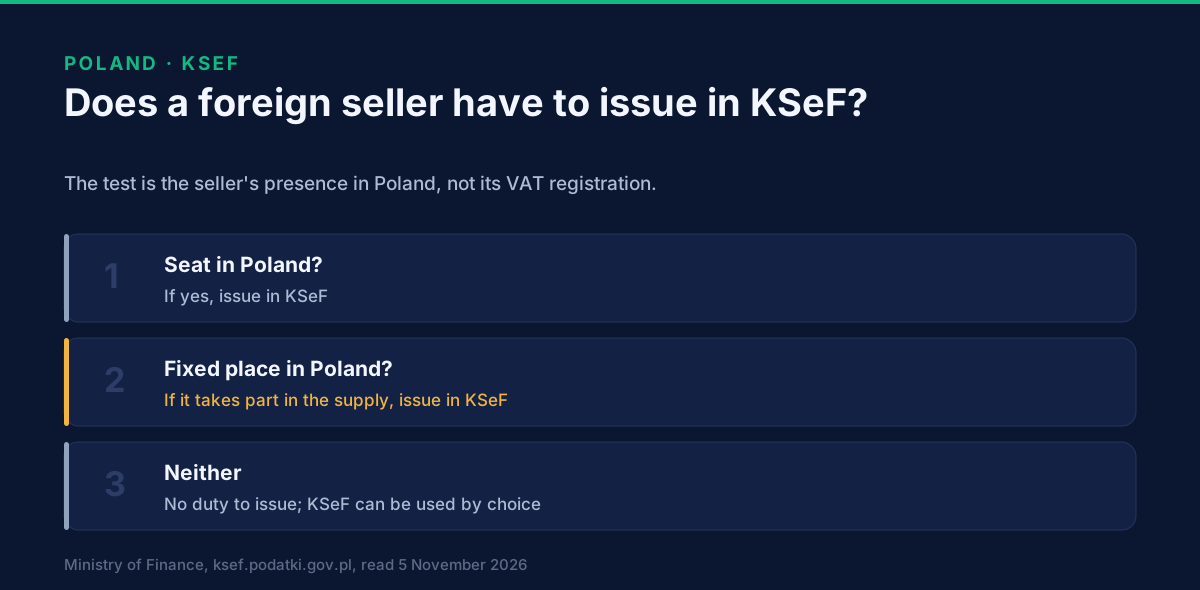
KSeF, Poland's national e-invoicing system, applies to a foreign company only when that company has a seat or a fixed place of business in Poland that takes part in the sale being invoiced. A foreign seller registered for Polish VAT with no such place is not required to issue in KSeF, though it may choose to. A buyer with no seat or fixed place of business in Poland is not required to receive through KSeF. When a Polish seller invoices a foreign buyer, the seller still issues the invoice in KSeF, and then hands the buyer a copy in an agreed form.
This page is for the finance lead of a company outside Poland that sells to Poland, buys from Poland, or is registered for Polish VAT. It sets out who must issue, who must receive, how a foreign buyer gets the invoice, and what we can and cannot say about Peppol. Polish VAT registration itself is not covered. GoRoute is a certified Peppol Access Point and SMP (POP000991). Its KSeF pack applies to organisations whose country is set to Poland, so it is not a way for an organisation outside Poland to issue in KSeF.
Who must issue invoices in KSeF?
Taxpayers with a seat or a fixed place of business in Poland. The Ministry of Finance's questions-and-answers page gives the test for foreign businesses registered as VAT payers in Poland. A foreign business is not obliged to issue in KSeF when:
- it has no seat or fixed place of business in Poland; or
- it has no seat in Poland but has a fixed place of business there, and that place does not take part in the supply of goods or services being invoiced.
A foreign business outside the duty can still use KSeF voluntarily and issue through it. If it does not, it issues the invoice outside the system, on paper or electronically. The Ministry's example is a Slovak buyer, VAT-registered in Poland with a NIP but with no Polish seat or fixed place of business: it has no duty to issue self-billed invoices in KSeF, though nothing stops it doing so.
The wider rule follows from the same point. The Ministry says KSeF invoicing concerns taxpayers who have a seat or fixed place of business in Poland and actively take part in the transaction. It says KSeF changes the form of issuing invoices, not the tax rules, such as where a service is taxed.
What is a fixed establishment, and who decides?
It is decided case by case, and the Ministry has not yet published its explanations. The Ministry's answer is that whether a foreign VAT-registered business has a fixed place of business in Poland "requires an individual assessment of the specific facts". It adds that it plans to publish explanations on the definition. In the pages we read there was no checklist.
If you have a warehouse, an office, staff or a branch in Poland, ask a Polish tax adviser whether it is a fixed place of business that takes part in your sales. The answer decides whether you must issue in KSeF from 1 January 2027, the date penalties start. KSeF in 2027 sets out the fines.
What if a Polish seller invoices a foreign buyer?
The Polish seller still issues the invoice in KSeF. The Ministry's questions-and-answers page says invoices for intra-Community supplies, exports, and services to foreign taxpayers must be issued in KSeF when the seller has a seat or fixed place of business in Poland. Sales to private persons outside business, and non-EU OSS and IOSS sales, are outside mandatory KSeF.
Because the buyer cannot be reached through KSeF, the seller then gives the invoice to the buyer in an agreed way. The VAT Act's article 106gb(4) covers this, and the Ministry's examples are a PDF file or a print-out carrying a QR code. For the foreign buyer, it says, this document is the invoice.
Three practical points from the Ministry:
- The agreement can be informal. The VAT Act does not set the way of handing the invoice over or the form of the agreement.
- The copy can be in English, or bilingual. In commercial software it is the issuer's choice. If it is in another language, it must match the invoice in KSeF once translated.
- A doctor in Poland invoicing a Swedish VAT payer issues the invoice in KSeF under Polish rules and hands it over in the agreed way, with a QR code.
Does a foreign buyer have to receive invoices in KSeF?
Not if it has no seat or fixed place of business in Poland that takes part in the purchase. The duty to receive invoices through KSeF has applied since 1 February 2026, but it does not apply to the buyers listed in article 106gb(4) of the VAT Act, which the Ministry says includes foreign businesses and consumers.
A buyer with no Polish seat or fixed place of business falls in that group even if it has a Polish NIP. A VAT-registered buyer that has a fixed place in Poland which does not take part in the purchase is in it too. What decides it is the buyer's presence in Poland and its role in the purchase, not the NIP.
Two more points from the Ministry:
- Purchases from foreign suppliers are not reported to KSeF. KSeF is for issuing, not for reporting what a Polish company bought abroad.
- A foreign payer need not give the KSeF number. From 1 January 2027 payments for structured invoices must carry the KSeF number or a collective identifier. A foreign business paying a Polish taxpayer is outside that rule.
What about self-billing by a foreign buyer?
The answer depends on whether the buyer has a Polish NIP. The Ministry's two examples show the line.
- A Slovak buyer with a Polish NIP but no Polish seat or fixed place is not obliged to issue self-billed invoices in KSeF. It may issue them outside the system, and may use KSeF by choice.
- A Swiss buyer not identified for the transaction by a Polish NIP is excluded by the regulation of 7 December 2025 on cases where structured invoices are not required (Journal of Laws, item 1740). The invoice is issued outside KSeF, and for technical reasons it cannot be issued in it.
The Ministry's permissions module also has a video on granting permissions to an EU entity entitled to self-bill that is identified by an EU VAT number. We did not read the rules behind it, so this page does not rely on it.
Where does Peppol fit?
We cannot say that Peppol delivers a KSeF invoice to a foreign buyer, because we found no Ministry statement that it does. What we can say is narrower.
- The legal invoice is the one KSeF has accepted. Peppol is not the channel for that document. Poland KSeF 2026 explains the model.
- The Ministry's FAQ says business-to-government invoices are covered by mandatory KSeF.
- It also said work was under way to connect KSeF with PEF, Poland's Peppol-based e-invoicing platform, so that PEF invoices reach KSeF's production system from 1 February 2026. The permissions module has a video on granting a Peppol service provider permission to issue PEF invoices.
If your buyer in Poland expects to receive invoices over Peppol, ask the buyer which route it will accept for the invoice that KSeF holds. The Peppol access point explainer covers the network in general.
What should a foreign company do before 1 January?
- Work out whether you have a seat or fixed place of business in Poland that takes part in your sales. Ask a Polish adviser if it is not clear.
- If you are inside the duty, treat the date as your own: certificates and tokens and offline modes apply to you.
- If you sell to Polish buyers from outside Poland, keep issuing invoices as you do now and expect Polish buyers to ask for the KSeF-related details on them.
- If you buy from a Polish seller, agree how the seller will hand you the invoice, and in which language.
- Write down the decision and the facts it rests on, because the fixed-place test is fact-based.
What to do next
To see what GoRoute does for organisations in Poland, read the Poland e-invoicing page and the KSeF setup reference. To talk about e-invoicing across several countries, book a demo or watch the tutorials.
Related reading
- KSeF in 2027: what changes on 1 January, the dates and penalties.
- KSeF certificates and tokens, how a party signs in.
- KSeF offline modes, how the invoice reaches buyers outside KSeF.
- Poland KSeF 2026: migration path for Peppol-first architectures, the two waves and the Peppol bridge.
- Germany's B2B e-invoicing mandate, the neighbouring model.
Sources, all read on 5 November 2026: Ministry of Finance, KSeF website, Pytania i odpowiedzi KSeF 2.0 (changed 8 October 2026), questions 11, 13 and 14 and the section on PEF; Zasady obowiązywania KSeF i przepisy prawne (27 April 2026), questions 2 to 4; Wystawianie i otrzymywanie faktur, questions 3, 20, 23 and 25; Najczęstsze pytania for the visualisation language; Moduł Certyfikatów i Uprawnień; GoRoute, Poland — KSeF setup and receipts. This is not tax or legal advice.
Frequently asked questions
- Does KSeF apply to a foreign company registered for Polish VAT?
- Only if it has a seat or a fixed place of business in Poland that takes part in the supply being invoiced. The Ministry of Finance says a foreign business with no seat or fixed place of business in Poland is outside the duty to issue in KSeF, and so is one whose Polish fixed place does not take part in that supply. It may still choose to use KSeF.
- How does a foreign buyer get a KSeF invoice?
- The Polish seller issues the invoice in KSeF and then hands it to the foreign buyer in an agreed way, for example as a PDF or print-out carrying a QR code with the KSeF number. The Ministry says that for the foreign buyer this document is the invoice.
- Does a foreign buyer have to pay with the KSeF number?
- No. From 1 January 2027 payments for structured invoices must carry the KSeF number or a collective identifier, but the Ministry says a foreign business paying a Polish taxpayer does not have to give it.
- Do we have to report invoices from foreign suppliers to KSeF?
- No. The Ministry says KSeF is not used to report purchases from foreign suppliers. It is for issuing invoices under Polish rules, including invoices to foreign customers.
- Is Peppol a way to deliver a KSeF invoice to a foreign buyer?
- We did not find a Ministry statement that it is. The legal invoice is the one KSeF has accepted, and Peppol is not the channel for that document. The Ministry has said it was working on connecting KSeF with PEF, Poland's Peppol-based platform, so that PEF invoices reach KSeF.
About Dr. Syed Raza
Dr. Syed Raza is an IT Enterprise Architect at ClayDesk LLC and leads the GoRoute platform. He works across Peppol Access Point and SMP infrastructure, PINT jurisdictions (Oman, AU/NZ, EU, JP, MY, SG), and national CTC regimes, translating regulatory detail into production-grade e-invoicing systems.
Building on Peppol?
GoRoute is a certified Peppol Access Point & SMP. Book a demo or read the docs to get started.