
KSeF in 2027: What Changes on 1 January
KSeF in 2027: penalties start, the PLN 10,000 monthly relief ends and payments must carry the KSeF number. What stays the same, with Ministry sources.

On 1 January 2027 the grace period for KSeF, Poland's national e-invoicing system, ends. Penalties for breaking the rules start to apply. The relief for sellers who invoice PLN 10,000 a month or less (the limit 10 tys. zł) ends, so every business that must issue invoices has to issue them in KSeF. Payments for invoices must carry the KSeF number. Receipts with a buyer's NIP stop counting as simplified invoices. Sign-in with a KSeF token does not end.
This page is for the finance lead or owner of a business that invoices Polish customers, eight weeks before the date. It sets out what changes, what does not, and what is still unclear. Every rule below comes from the Ministry of Finance's KSeF website, ksef.podatki.gov.pl. GoRoute is a certified Peppol Access Point and SMP (POP000991). Its KSeF pack sends invoices to KSeF production and keeps the KSeF number and the UPO receipt (Urzędowe Poświadczenie Odbioru, KSeF's signed proof that it accepted the invoice).
What changes on 1 January 2027?
Four things change. The Ministry's rollout page lists 1 January 2027 as the date KSeF becomes mandatory for everyone, because the small-seller relief ends.
| Change | Until 31 December 2026 | From 1 January 2027 |
|---|---|---|
| Penalties | None are imposed for errors in KSeF use | Penalties can be imposed for breaches |
| Small sellers | May issue outside KSeF while monthly invoiced sales stay at PLN 10,000 with tax or less | Must issue in KSeF |
| Cash-register invoices | Cash registers can issue invoices, including receipts with the buyer's NIP up to PLN 450, outside KSeF | Receipts with a NIP can still be issued but are not simplified invoices |
| Payments | No KSeF number needed | The KSeF number (or a collective identifier) goes on payments |
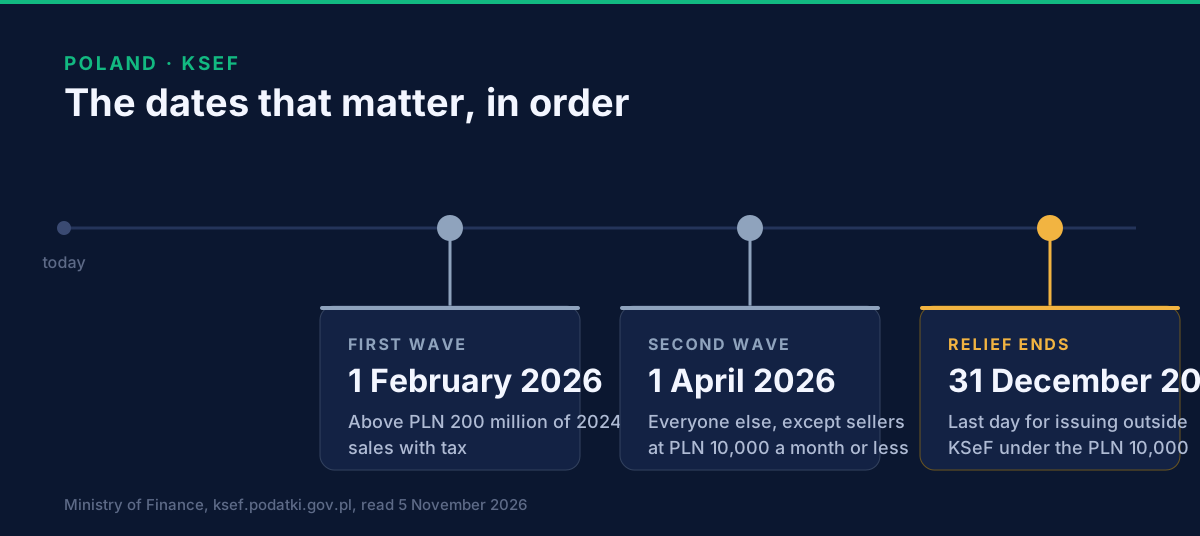
Receiving invoices is not on the list. Every taxpayer with a NIP has had to receive invoices through KSeF since 1 February 2026. The two issuing waves, 1 February 2026 for businesses above PLN 200 million of 2024 sales and 1 April 2026 for the rest, are covered in Poland KSeF 2026.
Who is affected by the end of the PLN 10,000 relief?
Sellers whose invoices that must go through KSeF add up to PLN 10,000 with tax or less in a month. Until the end of 2026 they may issue paper or electronic invoices outside KSeF. The Ministry gives the florist as its example: three invoices a month of PLN 1,500 to 2,500 each. Her obligation starts on 1 January 2027.
Three details from the Ministry's questions-and-answers page decide whether you are really inside the relief:
- Only invoices that must be in KSeF count. Consumer invoices, sales recorded only on a cash register and receipts of up to PLN 450 that count as simplified invoices are left out of the PLN 10,000.
- The invoice date decides the month, not the sale date. An invoice for an April sale issued on 7 May counts towards May.
- Crossing the limit is permanent for the year. A seller who goes over in a month issues in KSeF from the invoice that crossed the limit, and the Ministry says a quiet later month makes no difference.
The relief ends with 2026 either way. A business that has been using it should not wait for the first invoice of January to find out how its software connects to KSeF.
What do the fines look like?
The fine is a maximum set in the VAT Act, and it applies to breaches from 1 January 2027. The Ministry's FAQ says the head of the tax office can impose a fine of up to 100% of the tax shown on the invoice. Where the invoice shows no tax, the cap is 18.7% of the total amount due. The Ministry cites article 106ni of the VAT Act.
It lists three breaches that attract the fine:
- The taxpayer did not issue a structured invoice in KSeF when obliged to.
- During a KSeF failure or unavailability, the taxpayer issued an invoice that does not follow the published template.
- The taxpayer did not send to KSeF, in time, an invoice issued in offline24 mode or during a failure or unavailability. KSeF offline modes sets out each deadline.
Penalties do not reach back. The Ministry says nothing will be imposed for breaches between 1 February and 31 December 2026, and calls 2026 a period in which the tax administration will focus on educating taxpayers rather than punishing them.
What the buyer risks. The Ministry's FAQ is clear that a buyer does not lose the right to deduct VAT just because the seller issued outside KSeF, if the usual conditions in article 86 of the VAT Act are met. It also says buyers should keep proof the transaction happened and treat a missing KSeF invoice as a warning sign. That is guidance on deduction, not a promise about every audit.
What must a payment carry from 1 January 2027?
The KSeF number, or a collective identifier KSeF issues, goes in the payment details. The Ministry's FAQ says the new article 108g of the VAT Act applies to payments made from 1 January 2027. The amended article 108a(3)(3) applies from the same date to invoices paid by split payment.
The Ministry gives the reason as fighting late payment and getting payments matched to the right invoice. Two limits from its answers:
- A foreign payer is outside the rule. A foreign business paying a Polish taxpayer for a structured invoice does not have to give the KSeF number or the collective identifier.
- An advance paid before an advance invoice exists needs no KSeF number. A pro forma invoice is not an invoice under the VAT Act.
We did not find, in the pages we read, the exact field format a bank transfer should use. Ask your accounting software and bank how they will carry the number.
What does not change?
Several things people expect to change do not.
- Tokens stay. The Ministry's FAQ asks whether tokens expire at the end of 2026 and answers "No": after hearing businesses and software providers, it decided to keep tokens as a sign-in method in KSeF 2.0 without an end date, and the regulation will be amended. At its 9 June 2026 consultation it also proposed token lifetimes of 1 to 365 days. See KSeF certificates and tokens.
- Consumers stay outside. Invoices to private persons are not covered by mandatory KSeF. A seller can issue them in KSeF voluntarily.
- The invoice format stays FA(3).
- Deduction rules and deadlines for VAT are unchanged. The Ministry says KSeF changes how invoices are issued, not the tax rules.
- Foreign buyers still get their invoice another way. For a buyer without a Polish seat or NIP, the seller issues in KSeF and hands over the invoice in an agreed form. KSeF for foreign companies covers who is in and who is out.
What is not settled?
Three points, so you do not plan around something we cannot support.
- The dates can still be changed by law. The Ministry's pages we read, with the FAQ last changed on 8 October 2026, say penalties start on 1 January 2027. We found no later notice on the Ministry's site that changes that. Check
ksef.podatki.gov.plagain in December. - The bank-transfer format is not in the passages we read, as above.
- What counts as a fixed establishment for a foreign VAT-registered seller is decided case by case, and the Ministry has said it plans to publish explanations.
What should a finance team do in the next eight weeks?
- Work out which side of the PLN 10,000 line you are on. If you have been issuing outside KSeF under the relief, you start issuing inside it on 1 January.
- Test a real invoice in KSeF production before the date. The Ministry says only keys, certificates and tokens made in production work in production, so a test set-up proves less than it seems.
- Write down your plan for a KSeF failure, including who issues in offline24 mode and who watches the Ministry's announcements. See the offline modes.
- Check how your authentication works. If you use a token, the Ministry says it stays. If you issue offline invoices, you will need a second kind of certificate. See certificates and tokens.
- Ask your bank and accounting system how the KSeF number will reach each payment.
- If you sell through a web shop, read KSeF for online stores, the tutorial for merchants who invoice paid orders.
What to do next
To see how GoRoute's KSeF pack sends invoices to KSeF and keeps the KSeF number and receipt, read the Poland e-invoicing page and the KSeF setup reference. To talk through your own set-up, book a demo. The tutorials show the product in use.
Related reading
- Poland KSeF 2026: migration path for Peppol-first architectures, the 2026 waves and the FA(3) format.
- KSeF certificates and tokens: what stays after 2026.
- KSeF offline modes: offline24, outages and emergency mode.
- KSeF for foreign companies: who must issue and who receives.
Sources, all read on 5 November 2026: Ministry of Finance, KSeF website, Etapy wdrożenia KSeF (changed 29 May 2026); Poniżej 10 000 zł; Zasady obowiązywania KSeF i przepisy prawne (27 April 2026); Najczęstsze pytania (changed 29 April 2026), for the fine under article 106ni; Wystawianie i otrzymywanie faktur, for the foreign payer and the cap of 100% of tax; Pytania i odpowiedzi KSeF 2.0 (changed 8 October 2026), for tokens and the KSeF number on payments; Pierwsze konsultacje po częściowym wdrożeniu KSeF (11 June 2026). This is not tax or legal advice; confirm your own position with the Ministry or a Polish tax adviser.
Frequently asked questions
- What changes in KSeF on 1 January 2027?
- Three things change for businesses that issue invoices. Penalties for breaking the KSeF rules start to apply. The relief for sellers whose invoiced sales are PLN 10,000 a month or less ends, so they must issue in KSeF too. And payments for invoices must carry the KSeF number. Receipts with a buyer's NIP stop counting as simplified invoices.
- Does the PLN 10,000 limit still apply in 2027?
- No. The Ministry of Finance says the limit applies until 31 December 2026. In a month where invoices that must be in KSeF total more than PLN 10,000 with tax, the seller issues in KSeF from the invoice that crosses the limit. From 1 January 2027 the limit no longer exists.
- How big can a KSeF fine be?
- The Ministry's FAQ says the head of the tax office can impose a fine of up to 100% of the tax shown on the invoice, or up to 18.7% of the total amount due where the invoice shows no tax. It applies only to breaches from 1 January 2027, and it is a maximum, not a fixed amount.
- Do KSeF tokens stop working on 1 January 2027?
- No. The Ministry of Finance decided to keep tokens as a way to sign in to KSeF 2.0 without an end date, and says the regulation will be amended to say so. The Ministry's FAQ page was last changed on 8 October 2026.
- Does a foreign company have to put the KSeF number on a payment?
- Not when it is the payer. The Ministry says a foreign business paying a Polish taxpayer for a structured invoice does not have to give the KSeF number or the collective identifier. The rule applies to payments made from 1 January 2027.
About Dr. Syed Raza
Dr. Syed Raza is an IT Enterprise Architect at ClayDesk LLC and leads the GoRoute platform. He works across Peppol Access Point and SMP infrastructure, PINT jurisdictions (Oman, AU/NZ, EU, JP, MY, SG), and national CTC regimes, translating regulatory detail into production-grade e-invoicing systems.
Building on Peppol?
GoRoute is a certified Peppol Access Point & SMP. Book a demo or read the docs to get started.