
Can You Claim GST Credits on an E-Invoice?
Can you claim a GST credit on a Peppol e-invoice? What the ATO needs on a tax invoice, where each item sits in a PINT A-NZ file, and what to keep.

Can you claim a GST credit on an e-invoice?
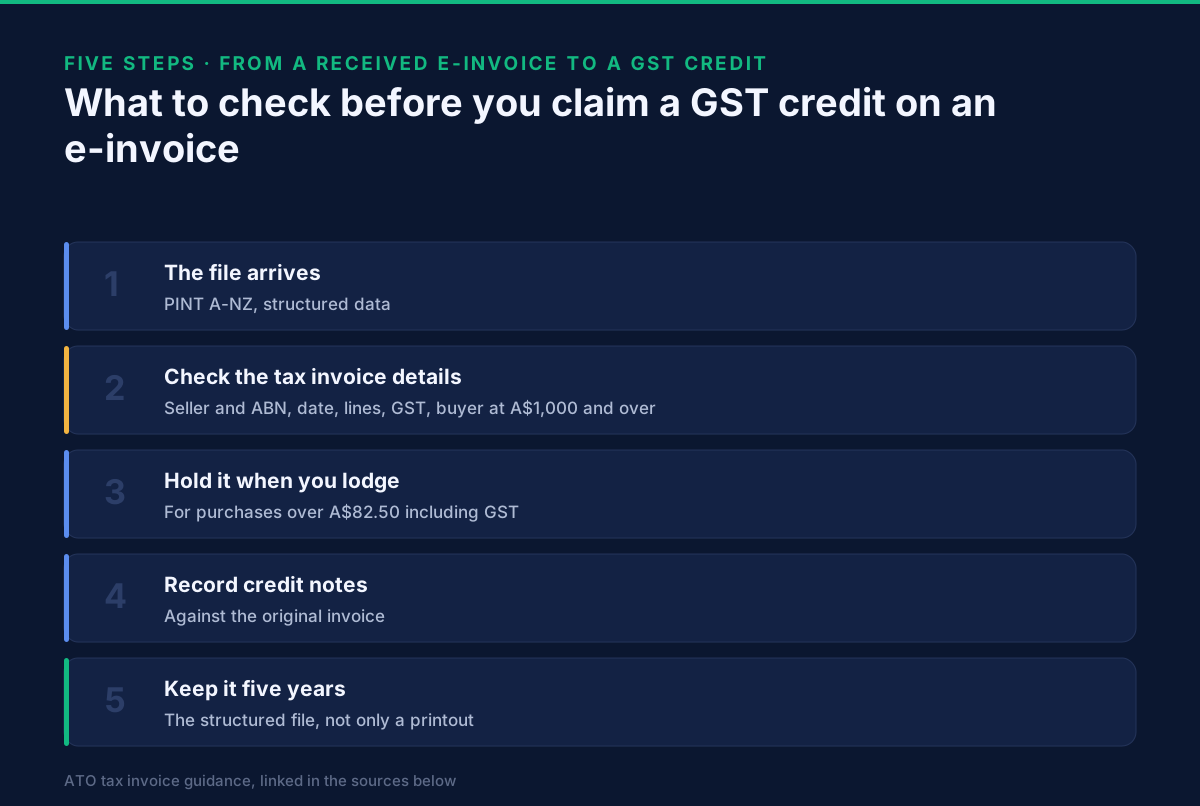
Yes, if the e-invoice contains what the ATO requires of a tax invoice and you hold it when you lodge the activity statement that claims the credit. The ATO's test is about the information in the document, not its format. A Peppol e-invoice in the PINT A-NZ format is a structured file, and it supports a GST credit when the fields below are present and correct. This page maps those requirements to where they appear in the file. It is general information for a bookkeeper or accountant, not tax advice, and the ATO's pages linked at the end govern.
Australia's e-invoicing page and the full guide cover how GST is handled by the supplier who sends the invoice. This page is the other side: the person who receives it.
When do you need a tax invoice at all?
The ATO's rule is that you need a tax invoice to claim a GST credit for a purchase of more than A$82.50 including GST, and you must have it when you lodge the activity statement for the period in which you claim. For smaller amounts, other evidence, such as a receipt or a bank record, can be enough. The thresholds and the wording are on the ATO's tax invoice page; check them there before relying on this page, because the ATO updates its guidance.
What must a tax invoice show, and where is it in a PINT A-NZ file?
The content test, as the ATO states it, is below, with the matching place in a structured invoice. Field names vary between accounting systems, so the right-hand column describes the kind of field rather than a fixed label.
| What the ATO needs | Where to look in a PINT A-NZ invoice |
|---|---|
| The document is identified as a tax invoice | The invoice type and the way your system presents it. Check that your software labels it as a tax invoice when displayed |
| The seller's identity and ABN | The seller party block, with the ABN as the seller's tax registration |
| The date of issue | The issue date |
| A description of what was sold, with quantity and price | The invoice lines |
| The GST payable, or a statement that the total includes GST | The tax breakdown and tax total |
| The extent to which each sale is taxable | The tax category on each line, such as standard-rated or GST-free |
| For A$1,000 or more including GST: the buyer's identity or ABN | The buyer party block, with your ABN |
The point that surprises people is the last row. A paper invoice often leaves the buyer vague. A PINT A-NZ invoice is addressed by ABN in order to be delivered at all, so the buyer's ABN is normally present in the file because it is the address.
Where a field is missing, nothing in the format will invent it for you. If your system displays an e-invoice without the seller's ABN, or the tax breakdown is blank, treat it as an incomplete tax invoice and ask the supplier before you claim.
Does the format change who can claim?
No. Whether you can claim a GST credit depends on the same things as for any invoice: you are registered for GST, the purchase is for a creditable purpose, and you hold a valid tax invoice. Format is not on that list. What a structured file changes is the evidence: the data you act on is the data the supplier sent, rather than a reading of a PDF.
This page does not cover reverse-charge or recipient-created invoices, and it does not cover how to complete a business activity statement. Both are outside it.
How should adjustment notes be handled?
When a supplier needs to change an invoice, for example for a returned item, a price correction or a cancelled order, the ATO's term is an adjustment note. On Peppol, an adjustment arrives as a credit note on the same PINT A-NZ profile. Handle it like this:
- Match it to the original invoice. A credit note normally refers to the invoice it adjusts. Record it against that invoice.
- Check the amounts. The GST on the credit note should reduce the GST on the original by the matching amount.
- Change the credit you claim. Your GST credit for the period is based on the adjusted amount, in the activity statement for the period in which you receive or account for the adjustment.
- Do not net it informally. If a supplier emails "ignore invoice 1042", ask for the credit note. Without it, you have an invoice on file that you are no longer entitled to rely on.
This is one place where receiving through Peppol is stricter than email. A correction has to arrive in the same structured form as the invoice. If your supplier sends adjustments by email, the claim is still valid, but the records are split across two routes.
What records should you keep?
The ATO's general rule is to keep records of GST transactions for five years and to keep them in a form that can be read and accessed. For received e-invoices:
- Keep the structured file as received, not only a printed copy.
- Keep the validation result, if your platform records one, so you can show what the file was checked against. GoRoute's receiving platform records what each document was validated against.
- Keep credit notes together with their invoice, so the adjustment is visible.
- Keep the date of receipt. It determines the period in which you account for the document.
A system that stores only a PDF render of the invoice discards the information that makes the file useful. Ask any provider how long it holds the original and how you export it.
What if the supplier is not on Peppol?
Then the invoice arrives the way it does now, as a PDF, and the same tax invoice test applies to it. Receiving on Peppol is an extra route. It does not change what counts as a valid invoice from a supplier who is not on the network. To find out whether a supplier is registered, use the lookup in how to check whether a business can receive e-invoices.
What to do next
Ask your bookkeeper for one received e-invoice and tick off the table above against it. If every row is there, your process works. If a row is missing, find out whether the supplier's system or yours is dropping it. To see a received invoice with its tax breakdown and validation record, book a demo. The tutorials and the documentation show what a delivered document contains.
How an Australian business starts receiving e-invoices covers the setup that comes first.
Related guides
- How an Australian business starts receiving e-invoices
- Can this business receive e-invoices? Checking an ABN on Peppol
- Does e-invoicing stop invoice fraud? What Peppol changes
- Peppol e-invoicing in Australia: the full guide
- E-invoice receiving software
Sources: the ATO's tax invoices page and its pages on GST credits, adjustment notes and record keeping, and the GST ruling on tax invoices it cites (GSTR 2013/1); the ATO eInvoicing page; the PINT A-NZ specification published through OpenPeppol. Thresholds and wording should be confirmed on the ATO's pages. This page is general information and is not tax advice. GoRoute operates certified Peppol Access Point and SMP POP000991.
Frequently asked questions
- Is a Peppol e-invoice a valid tax invoice in Australia?
- It can be. The ATO's test is whether the document carries the information a tax invoice must have, not what format it is in. A PINT A-NZ invoice that shows the supplier, its ABN, the date, a description, the GST and, at A$1,000 and over, the buyer's identity or ABN meets the content test. Confirm the details with the ATO or your adviser for your own case.
- When do I need a tax invoice to claim a GST credit?
- For a purchase of more than A$82.50 including GST, you need to hold a tax invoice when you lodge the activity statement for the period in which you claim the credit. Below that amount, other records can be enough.
- What if the buyer's details are missing from the e-invoice?
- At A$1,000 or more including GST, the tax invoice must identify the buyer or show the buyer's ABN. A PINT A-NZ invoice addressed to your ABN carries it. If it is missing or wrong, ask the supplier to correct it with a credit note and a new invoice.
- How is an adjustment note received on Peppol?
- As a credit note on the same PINT A-NZ profile. It reduces or cancels an earlier invoice, and you record it against that invoice so the GST credit you claim matches the corrected amount.
- How long do I keep a received e-invoice?
- The ATO's general record-keeping period is five years. Keep the structured file and the copy your system displays, not only a printout, so you can show what you received.
About Dr. Syed Raza
Dr. Syed Raza is an IT Enterprise Architect at ClayDesk LLC and leads the GoRoute platform. He works across Peppol Access Point and SMP infrastructure, PINT jurisdictions (Oman, AU/NZ, EU, JP, MY, SG), and national CTC regimes, translating regulatory detail into production-grade e-invoicing systems.
Building on Peppol?
GoRoute is a certified Peppol Access Point & SMP. Book a demo or read the docs to get started.