
What Is an InvoiceNow-Ready ERP?
InvoiceNow-ready means two things in Singapore: an accreditation the vendor holds, and whether your own system can send. Six checks to tell them apart.

An InvoiceNow-ready ERP is one that can produce a Singapore-profile Peppol invoice, exchange it through an accredited access point, and hold the identifiers and GST fields Singapore requires. The phrase carries two different meanings, and confusing them is expensive: the software may be accredited, and your own installation may still be unable to send a single invoice. This page separates the two and gives you six checks to run against your own system.
If InvoiceNow itself is new to you, start with the Singapore InvoiceNow guide — the network, IMDA's role and the IRAS rollout in one place. This page is the ERP question only.
What does "InvoiceNow-ready" actually mean?
Three things travel under that phrase, and they belong to three different people.
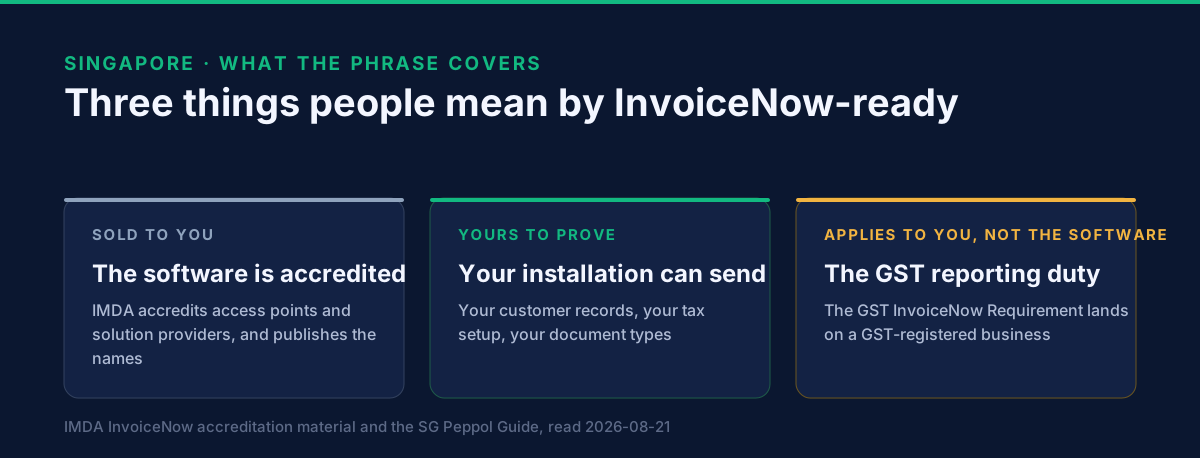
The software. IMDA — Singapore's Peppol Authority — accredits access points and solution providers and publishes the accredited names on its own site. That makes a vendor claim checkable: you can look it up rather than take it. This is the sense in which a product is "InvoiceNow-ready". There are two published lists rather than one, and they answer different questions — how to check a provider against them sets out which is which.
Your installation. Whether your copy of that software, with your customer records and your tax configuration, can produce a valid Singapore invoice today. No badge covers this. It is the part that decides whether your first send works, and it is entirely yours.
The reporting duty. The GST InvoiceNow Requirement applies to a GST-registered business, not to a piece of software, and it adds a transmission of invoice data to IRAS on top of ordinary delivery to your customer. How that leg works is a page of its own: how invoice data reaches IRAS.
How do I check whether my own ERP is ready?
Six checks. Each one is answerable from inside your finance system this week, without a vendor call.
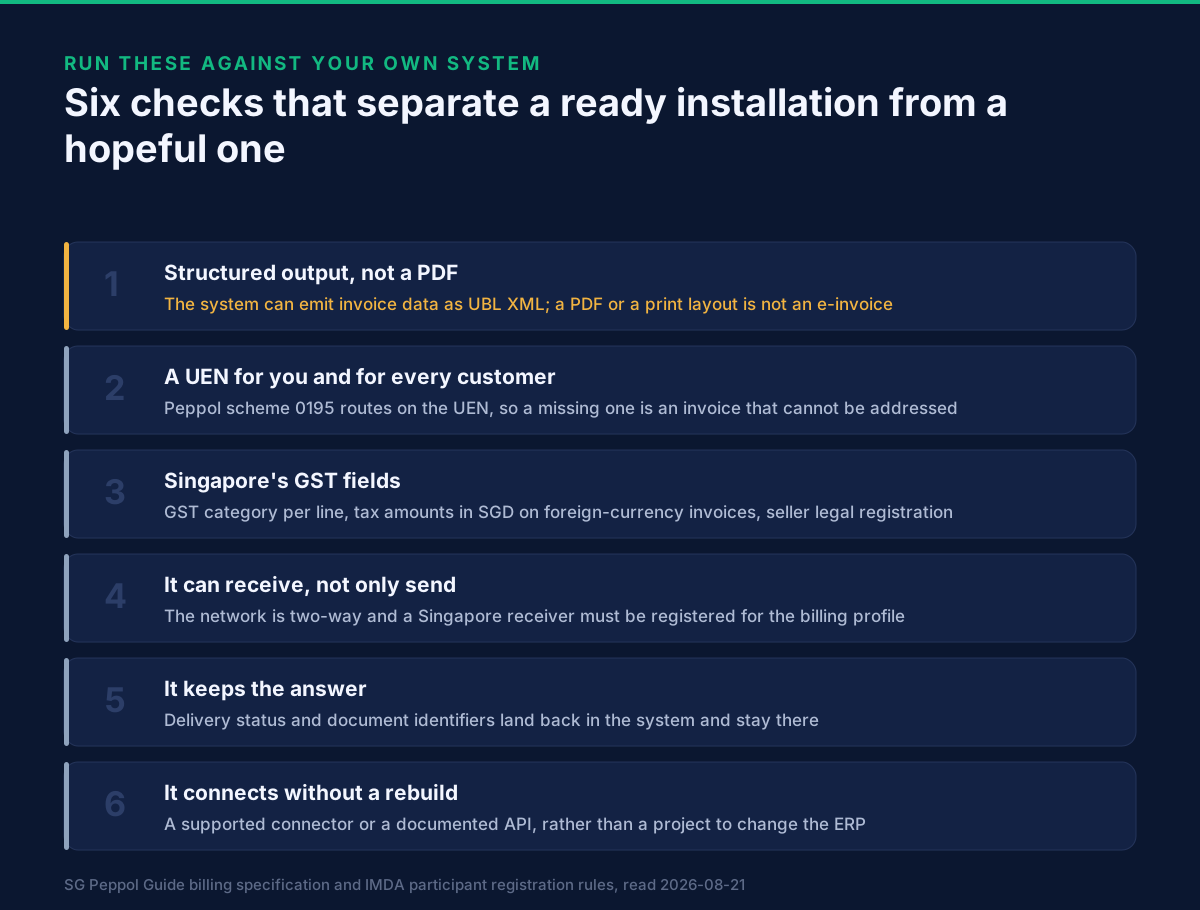
1. Can it produce structured invoice data rather than a PDF?
An e-invoice is data a machine reads — a UBL 2.1 XML document, in Singapore's case. A PDF, even a beautifully laid-out one, is a picture of an invoice. If your system's only electronic output is a PDF or a print stream, that is the first piece of work, and it usually means a connector or an integration rather than a change to the ERP itself.
2. Does it hold a UEN for you and for every customer?
Singapore participants are addressed on the Peppol network under scheme 0195, using
the Unique Entity Number, in the form 0195: followed by an IMDA-assigned prefix and the
UEN. A customer with no UEN in your records is an invoice that cannot be addressed.
Run the count now: active customers with no usable UEN. That number is the size of the data work, and nobody can do it for you.
3. Does it carry Singapore's GST fields?
The Singapore billing profile applies its own validation on top of the European base rules. The pieces that catch finance systems out:
- A GST category on every line — standard-rated, zero-rated, exempt, out of scope, not GST-registered, and taxable supplies where GST need not be charged. The standard rate has been 9% since 1 January 2024.
- Tax amounts in Singapore dollars when the invoice is in another currency. Singapore's rules require the GST amount in SGD even when the document currency is not; a system that holds only the foreign-currency total cannot satisfy that.
- The seller's legal registration identifier on a GST invoice, alongside the GST identifier — two different fields that systems frequently hold in one.
- Rounding. Singapore's rules allow a small, defined slack between a line's calculated tax and the tax stated. Systems that round differently from the rule fail on documents that look correct to a human.
4. Can it receive, not only send?
The network is two-way, and receiving is the half that gets forgotten in a project scoped around sending. A Singapore receiver has to be registered for the billing profile in the central registry so that other people's access points can find them. Ask what happens to an incoming supplier invoice: does it land in your system, or in an inbox?
5. Does it keep the answer?
Sending is not the end of a transaction. The delivery status, the document identifiers and the response from the network are what let you answer "was this invoice delivered?" a year later, in front of an auditor. A system that fires and forgets has moved the problem rather than solved it.
6. Can it be connected without a rebuild?
Either a supported connector exists for your system, or it exposes its invoice data to an API. Both are ordinary work. What is not ordinary is re-platforming your ERP to satisfy an e-invoicing rule, and it is almost never necessary.
Which invoice format does an InvoiceNow-ready ERP have to produce?
Singapore has two billing profiles in use, both UBL 2.1:
| Profile | CustomizationID | What it is |
|---|---|---|
| SG Peppol BIS Billing 3.0 | urn:cen.eu:en16931:2017#conformant#urn:fdc:peppol.eu:2017:poacc:billing:international:sg:3.0 |
Singapore's long-standing billing profile, validated in three layers: the Singapore subset of EN 16931, the Singapore subset of Peppol BIS 3, and Singapore's own rules |
| PINT@SG | urn:peppol:pint:billing-1@sg-1 |
Singapore's specialisation of the Peppol International model, the direction the network as a whole is moving in |
Both are versioned, and the version matters. When we last read the SG Peppol Guide, the current SG BIS Billing release was 3.0.16, published on 11 December 2025 and mandatory from 11 March 2026. Check the guide for the release in force when you build — a specification that names a mandatory-from date will name another one.
If the difference between the two families is unfamiliar, Peppol vs PINT explains it without the acronym soup.
What does the GST reporting leg add to the list?
For a GST-registered business, invoice data is also transmitted to IRAS. The transmission itself is the access point's job, not your ERP's — but the data has to exist in your ERP first, correctly categorised, or there is nothing to report. In practice the reporting leg does not add new work to this checklist so much as raise the cost of failing check 3.
The mechanics, corner by corner, are in how invoice data reaches IRAS through InvoiceNow.
Which systems connect to InvoiceNow?
InvoiceNow is Peppol, so the connection is the ordinary Peppol connection with Singapore's profile, identifiers and reporting on top. These are the systems GoRoute connects to the network:
| System | Connector |
|---|---|
| SAP S/4HANA and ECC | SAP integration |
| Oracle Cloud ERP | Oracle integration |
| Microsoft Dynamics 365 | Dynamics 365 integration |
| Odoo | Odoo integration |
| Sage 50, Sage 200 and Sage Cloud | Sage integration |
| Zoho Books | Zoho Books integration |
| Certinia on Salesforce | Certinia integration |
| Zuora, for subscription billing | Zuora integration |
| Stripe | Stripe integration |
Anything not on that list connects through the REST API, which is the same path the connectors use; the full picture is on the integrators page. If you are weighing one integration against several country programmes at once, the multi-country API is the argument for doing it once.
What "ready" does not mean
- It does not mean your first invoice will pass. Validation is what tells you that, and it can be run against a real document before anything is sent. The failures that recur across every market are catalogued in validation errors you can prevent.
- It does not mean you are registered. In Singapore, participant registration runs through IMDA's central registry, and a Singapore company with a UEN completes it by authenticating itself — the provider starts the registration, the business finishes it. There is a time limit on that step, and a registration nobody completes is dropped.
- It does not stay true on its own. Profiles get new mandatory versions, and the set of document types Singapore service providers must support has already changed once — the advanced ordering documents and Singapore's order-balance document became mandatory for service providers on 1 April 2026, replacing the older order-only profile.
What to do this week
- Count your identifier gap — active customers with no usable UEN. One number, and it sizes the whole data project.
- Export one real invoice from your system as structured data and look at it. If you cannot, that is check 1 answered.
- Check three GST behaviours: category per line, tax amounts in SGD on a foreign-currency invoice, and where your seller legal registration identifier is held.
- Ask any provider two questions in writing — their accreditation status with IMDA, and which Singapore profile version they validate against today.
Where GoRoute stands
GoRoute operates a Peppol-certified Access Point and SMP (Service Provider ID POP000991, ClayDesk LLC) and connects the systems listed above to the network. Singapore adds requirements on top of ordinary Peppol — accreditation by IMDA, registration in the central registry, and the IRAS reporting leg — and those are exactly the questions to put to any provider, in writing, before you sign anything.
To try the mechanics rather than read about them, the developer sandbox validates real documents without sending them. To scope it against your own system, book a working session. For the market view, see Singapore e-invoicing.
Sources
- IMDA — nationwide e-invoicing framework — InvoiceNow, and IMDA's role as Singapore's Peppol Authority
- IMDA — InvoiceNow solution provider accreditation — what accreditation covers and who holds it
- SG Peppol Guide — billing specification — the Singapore billing profile, its versions and its schematron rules
- PINT@SG specification — Singapore's PINT profile
- IRAS — GST InvoiceNow Requirement — the reporting duty and who it applies to
- Singapore Validex — IMDA's online validation service for Singapore document types
Frequently asked questions
- What is an InvoiceNow-ready ERP?
- It is an ERP or accounting system that can produce a Singapore-profile Peppol invoice, send and receive it through an accredited access point, and hold the identifiers and GST fields Singapore requires. The phrase is used in two senses: the software has been accredited by IMDA, and your particular installation can actually send. The first is a vendor claim you can check with IMDA; the second depends on your own data and configuration.
- Does my ERP have to be on IMDA's accredited list?
- No. What has to be accredited is the access point or solution provider that connects you to the InvoiceNow network. Your ERP has to be able to produce the invoice data and exchange it through that provider. Many businesses run an ERP that appears on no list at all and connect through a provider that is accredited.
- What is the difference between InvoiceNow-ready and GST InvoiceNow-ready?
- InvoiceNow-ready is about exchanging invoices over the network. The GST InvoiceNow Requirement adds a reporting leg: invoice data is also transmitted to IRAS. The reporting duty falls on a GST-registered business rather than on the software, and the transmission is carried out by the access point, so the question for your ERP is whether it holds the data the reporting leg needs.
- Is a Peppol-ready ERP the same as an InvoiceNow-ready ERP in Singapore?
- Nearly, but not quite. InvoiceNow is Peppol, so a Peppol-ready system starts from the right place. Singapore then adds its own layer: the UEN-based participant identifier under scheme 0195, the Singapore billing profile with its GST rules, registration in IMDA's central service metadata publisher, and the IRAS reporting leg. A system that produces a generic European invoice is not yet producing a Singapore one.
- Which invoice format does my system have to produce?
- One of the two Singapore billing profiles: SG Peppol BIS Billing 3.0, or PINT@SG. Both are UBL 2.1 documents with Singapore-specific validation on top, and both are versioned, so the version in force matters as much as the profile. The SG Peppol Guide publishes the current release and its schematron rules.
- How do I know if my customer records are ready?
- Count the active customers with no usable UEN. Peppol scheme 0195 routes on the UEN, so a customer without one cannot be addressed on the network. That single count is the size of the data work, and it is far better known in week one than in week nine.
- What if my accounting system has no InvoiceNow connector?
- Then it connects through an API, or its invoice data is exported and sent through a service that does. Neither route requires replacing the system. The question to settle first is whether the data exists inside it — identifiers, GST categories, the tax amounts — because no connector can invent a field the source system never held.
- Does being InvoiceNow-ready stay true?
- Not automatically. Singapore's billing specification is versioned and its releases carry dates from which they are mandatory, and the document types service providers must support have changed too. Readiness is a state your provider maintains with you, not a certificate that keeps its value on a shelf.
About Dr. Syed Raza
Dr. Syed Raza is an IT Enterprise Architect at ClayDesk LLC and leads the GoRoute platform. He works across Peppol Access Point and SMP infrastructure, PINT jurisdictions (Oman, AU/NZ, EU, JP, MY, SG), and national CTC regimes, translating regulatory detail into production-grade e-invoicing systems.
Building on Peppol?
GoRoute is a certified Peppol Access Point & SMP. Book a demo or read the docs to get started.