
How to Change Your Oman E-Invoicing Service Provider Without a Delivery Gap
Switching Oman e-invoicing providers: the outgoing provider removes you from the SMP in one working day, the incoming one has three. How to control the gap.

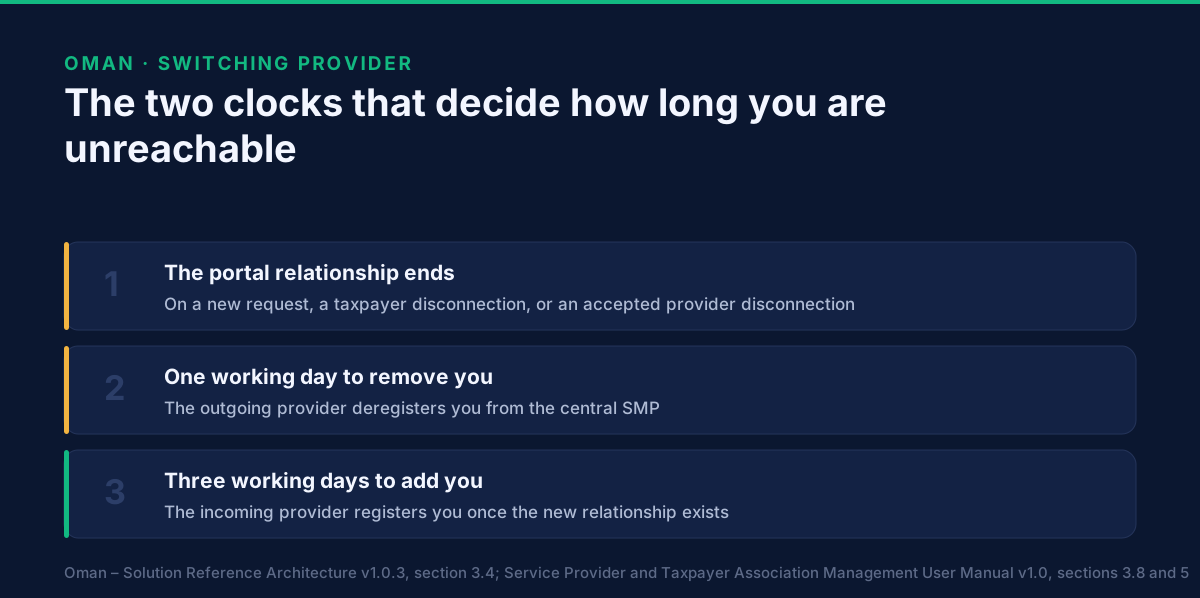
Changing your accredited service provider in Oman ends one relationship and starts another, and there is a window between them in which nothing on the network resolves to your business. The Tax Authority's solution architecture sets both sides of it: when a taxpayer switches from one accredited service provider to another, the existing provider must deregister them from Oman's central SMP within one working day, and the new provider must add them within three working days. The portal has no transfer function. There is an exit and an entry, and the order you do them in is the only part you control.
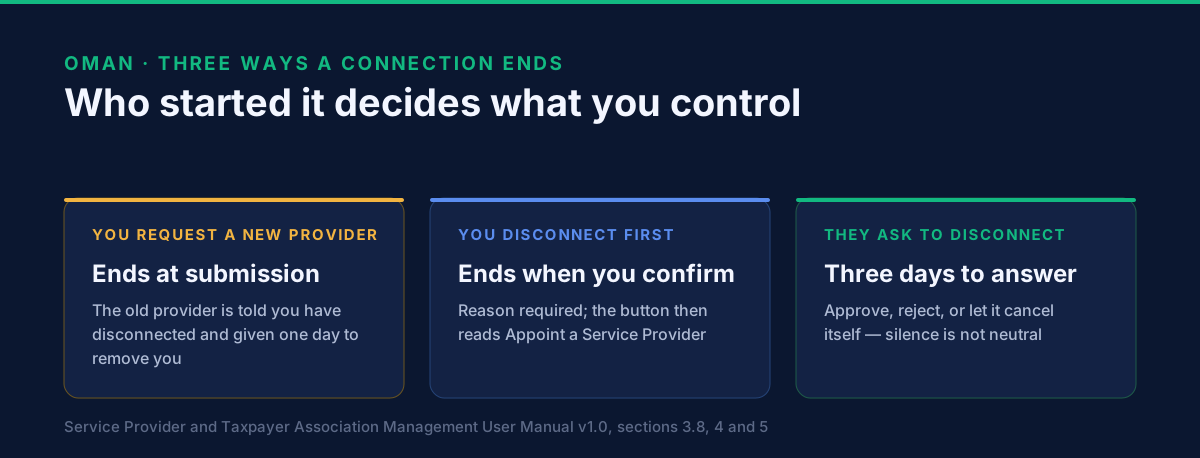
The part that catches finance teams out is earlier than they expect. Sending a connection request to a new provider while you are still connected to your current one ends the current relationship at submission, not when the new provider accepts. The acceptance is a separate event that may not come.
This page is for a finance or tax manager whose business is already connected and is moving. If you are connecting for the first time, the portal sequence is on how to connect your Omani business to an accredited service provider.
What actually happens when you switch?
Four things, in this order, and only the first is yours.
One: the portal relationship ends — because you sent a connection request to a different provider, because you disconnected on the Manage Service Provider page, or because you accepted a disconnection request your provider raised.
Two: the outgoing provider is told to clear the record. The manual uses the same wording on all three routes: the provider is guided that they have one business day to remove the taxpayer from the SMP. The architecture states it as one working day from the relationship ceasing to exist or being terminated.
Three: the new provider accepts, which establishes the new relationship. The manual says both sides are notified, and the provider's notification guides them to add the taxpayer in three business days on SMP.
Four: the new provider registers you. Your participant identifier and service group go back on Oman's central SMP, the receiving capabilities are attached, and the lookup record is created again. What that registration consists of, and how to read it, is on how to check your Omani business is really registered on Oman's SMP.
Only steps three and four put you back on the network, and neither of them is on your side of the table.
When exactly does the old connection end?
At the moment you submit the new request — which is the single most useful fact on this page.
The manual's note under a successful submission is explicit. If an active service provider connection exists for the taxpayer, then in parallel with the new request being sent: the current provider receives SMS, email and portal notification informing them that the taxpayer has disconnected from them, including the reason, and guiding them that they have one day to remove the taxpayer from the SMP; and the request is added to the new Service Provider's dashboard.
Read those two bullets next to each other. The disconnection is an accomplished fact; the connection is a request in somebody else's queue, which they may accept, reject or leave until it expires — all three are documented outcomes with their own notifications.
One thing does work in your favour: if you send a request to another provider while one is already outstanding, the manual says the earlier request is withdrawn automatically and both you and the dropped provider are told. Competing requests are not a state the portal allows.
What can you still send and receive during the gap?
Receiving is the half that fails, and it fails quietly.
Being reachable in Oman means three records exist: your participant identifier and service group on Oman's central SMP, the receiving capabilities attached to that service group, and the lookup record that points your identifier at the SMP. Deregistration removes them. A sending access point resolves your identifier before it sends you anything, so when the lookup returns nothing there is nothing to address the document to — your counterparties see a participant who is not there.
On sending, the honest answer is narrower than you would like. Neither the architecture nor the manual states what happens to a document your outgoing provider is still holding when the relationship ends, and we are not going to infer it. What both sources do establish is that the provider's authority to act for you is the portal relationship itself: the manual describes the SMP checking with the portal that a valid connection exists between that provider and that taxpayer before it will add, amend or remove anything. Ask your outgoing provider, in writing, what they will do with in-flight documents and with your archive — that belongs in the exit terms covered in what to settle with an Oman service provider before you connect.
Your obligations do not pause either: nothing in either document suspends an invoicing requirement because a handover is in progress.
What does the effective date do, and what does it not do?
It sets the start of the new relationship. It is not a bridge across the gap.
After you upload your documents, the portal asks for your preferred effective date of onboarding with the service provider, and the manual says it should be a current or future date. If you do not give one, "your connection will take effect as soon as your service provider accepts the connection request" — that is, on a date chosen by whoever opens the dashboard, not by you.
So a future effective date is the one scheduling instrument the portal gives you, and it turns "some time next week" into a date both providers have seen. What it does not do is defer the outgoing provider's one-working-day removal duty: the architecture ties that duty to the relationship ceasing to exist, and the manual fires the notification at submission.
The working conclusion for a switch: agree the date with the incoming provider before you touch the portal, so acceptance is a scheduled action rather than an inbox lottery.
Which route should you use?
Whichever keeps the acceptance close to the disconnection — in practice, a prepared request to the new provider rather than a disconnection followed by shopping around.
| Route | What ends it | What you control | What it costs you |
|---|---|---|---|
| Connect to a new provider while connected | Your submission | The timing, and the effective date you attach | Nothing if the new provider is ready to accept; a full outage if they are not |
| Disconnect first on Manage Service Provider | Your confirmation, with a reason | The timing | The gap starts before any new request exists |
| Your provider raises a disconnection request | Your approval, or three days of silence | Only whether you approve, reject or wait | The manual states the request is cancelled if nobody acts within three days |
On the third route, letting the request lapse is not a reprieve: the manual says the provider is still emailed and told they have one business day to remove you from the SMP. Treat a disconnection request as a project trigger on the day it arrives.
Where a disconnection completes, the Manage Service Provider button on your dashboard changes to Appoint a Service Provider, which the manual says exists so the taxpayer can connect to another provider and ensure business continuity.
What do you check, and when?
Three checks, none of which takes longer than a minute.
Before you submit anything. Look your own business up on the network and write down what comes
back — the participant identifier and the number of document types. Two entries is right for an
ordinary Omani business; four means the self-billed pair was registered. That list is what the new
provider has to reproduce. Our free Peppol lookup runs the same two-leg query
a supplier's access point would, using scheme 0248 and your VAT identification number.
On the working day after the relationship ends. Repeat the lookup. A record that has gone confirms the outgoing provider met their obligation.
Three working days after the new provider accepts. Repeat it, and compare with the list you wrote down at the start: same identifier, same count of document types. A short list usually means the optional self-billed capabilities were dropped in the handover — the quietest failure of a switch, because ordinary invoices keep arriving while self-billed documents do not. What each possible answer means, and what to ask for on day four, is on how to check your Omani business is really registered on Oman's SMP.
What this page does not cover
Penalties. Neither the architecture nor the manual states a penalty for a lapsed connection or a late registration, so no figure appears here. Ask the Tax Authority or your tax adviser.
VAT-return treatment. Nothing in either source describes how changing provider interacts with a VAT return. We are not going to infer it.
Choosing the replacement. The six questions to put to each candidate are on how to choose an e-invoicing service provider in Oman.
Re-integrating your software. That is a separate project: how to connect your software to Fawtara.
Related Oman guides
- How to connect your Omani business to an accredited service provider — the portal sequence, status by status, that a switch repeats from the beginning.
- What to settle with an Oman service provider before you connect — where the exit terms this page relies on are actually negotiated.
- How to check your Omani business is really registered on Oman's SMP — the lookup that answers whether the handover finished.
- How to choose an e-invoicing service provider in Oman — the decision behind the switch.
- Peppol in Oman: Fawtara readiness — the programme both providers operate inside.
What to do next
Get the acceptance scheduled before you submit the request. The submission ends your current connection on its own; the acceptance is what starts the next one, and the sources give the new provider three working days for the registration that follows it.
Record your current SMP entry today, whether or not you are switching. It is the only before-and-after evidence you will have, and it takes a minute.
The commercial ground for Oman, including where GoRoute sits on the accredited list, is on our Oman Fawtara e-invoicing page. Connector walkthroughs for the systems that feed a new provider are on tutorials, and the participant, service-group and transmission detail behind this page is in the developer documentation. To plan a handover against these rules with our team — including the dates, the capability list and the checks above — book a session.
Sources: the Oman – Solution Reference Architecture v1.0.3 of 27 July 2026 (Final; OpenPeppol AISBL with the Oman Tax Authority), section 3.4 for the one-working-day deregistration and three-working-day registration obligations and for the switching case that names both, and section 3.2 for the relationship and participant-registration steps; and the Oman Tax Authority's Service Provider and Taxpayer Association Management User Manual v1.0, section 3.3 for one provider per taxpayer, section 3.7 for the effective date, section 3.8 for the submission outcome and the note on an existing connection, section 3.9 for withdrawal, section 4 for a provider-raised disconnection and its three-day response window, section 5 for taxpayer-initiated disconnection, section 7 for acceptance and the three-business-day SMP instruction, and section 11 for the SMP verifying the portal connection before acting. Oman's e-invoicing material is published by the Tax Authority.
Frequently asked questions
- How do I change my e-invoicing service provider in Oman?
- Through the Fawtara portal, by connecting to the new provider from the accredited list in the same way you connected to the first one. The Tax Authority's manual states that a taxpayer may choose only one service provider from the list, and that the Manage Service Provider page lets you connect to a new provider or disconnect the current one. There is no transfer function: the old relationship ends and a new one is created.
- How long am I unreachable when I switch Oman providers?
- Up to the difference between two deadlines. The solution architecture states that when a taxpayer decides to switch from one accredited service provider to another, the existing provider must deregister them from the central SMP within one working day and the new provider must add them within three working days. Those are the outer limits of each obligation, not a schedule; a well-organised handover can be shorter, and nothing in either source guarantees continuity across it.
- Does the old connection end when the new provider accepts, or before?
- Before. The manual's note on a successful connection request states that if an active service provider connection already exists, then in parallel the current provider is notified that the taxpayer has disconnected from them, including the reason, and is told they have one day to remove the taxpayer from the SMP — while the request is only added to the new provider's dashboard. So the old relationship ends at submission, and the new one still has to be accepted.
- What does the effective date on a Fawtara connection request do?
- It sets when your onboarding with the new provider takes effect. The manual asks for a preferred effective date after your documents are uploaded, says it should be a current or future date, and states that if an effective date is not provided the connection takes effect as soon as the service provider accepts the request. It governs the start of the new relationship. Neither source says it delays the outgoing provider's one-working-day removal obligation.
- Can I be connected to two Oman service providers at once?
- No. The manual states that taxpayers can choose only one service provider from the accredited list, and that sending a connection request while an active connection exists notifies the current provider that the taxpayer has disconnected from them. Your participant record on Oman's central SMP points at one provider's service metadata, which is the technical reason the portal is built this way.
- What happens if the new provider rejects my request after I have disconnected?
- You are unconnected, and the portal offers Appoint a Service Provider so you can start again with another one. The manual describes rejection and expiry as ordinary outcomes, each with its own email and on-screen notification to both sides. Neither the manual nor the architecture sets a limit on how long a taxpayer may remain without a provider, so treat that as a question for the Tax Authority rather than a rule we can state.
- Can I withdraw a connection request I have already sent to a new provider?
- Yes, until it is accepted. The manual states that after a successful connection request the taxpayer can withdraw it, and that sending a request to a different provider withdraws the previous one automatically, with notifications to the taxpayer and to the provider that was dropped. After acceptance, withdrawal is no longer the mechanism — a disconnection request is.
- What should I check on the day the handover completes?
- The network, not the portal. Look your own participant identifier up on the Peppol network and count the document types that come back: two for an ordinary Omani business, four if self-billed invoices were agreed. The portal tells you who you are connected to; only a lookup tells you whether a supplier's access point can address a document to you.
About Dr. Syed Raza
Dr. Syed Raza is an IT Enterprise Architect at ClayDesk LLC and leads the GoRoute platform. He works across Peppol Access Point and SMP infrastructure, PINT jurisdictions (Oman, AU/NZ, EU, JP, MY, SG), and national CTC regimes, translating regulatory detail into production-grade e-invoicing systems.
Building on Peppol?
GoRoute is a certified Peppol Access Point & SMP. Book a demo or read the docs to get started.