
Which Peppol Identifier Is Yours, and How Do You Get One?
A Peppol ID is a business number you already hold plus a code for the register it came from. Which number is yours, country by country, and how to register it.

Last updated .
Your Peppol ID is a business number you already hold, written after a code that says which register it came from. Nobody issues you a new one, there is no application form and there is no central membership office. What you actually need is a registration: that pair published somewhere a stranger's software can find it. This article covers which number is yours, which code goes in front of it, and how the registration is made.
If the wider mechanics are new, how do you join the Peppol network sets out the three moving parts. This one is narrower on purpose: it answers "which number, and what do I do with it".
Do you apply for a Peppol ID anywhere?
No. There is nothing to apply for.
OpenPeppol maintains the list of scheme codes and the rules for using them — its Policy for use of Identifiers, version 4.4.0 of 6 February 2025, requires every participant identifier to be built from that list and defines the meta-scheme all Peppol components use, iso6523-actorid-upis. What OpenPeppol does not do is hand out numbers. The numbers come from national business registers that already exist, and that your company is already in.
This is the single most common misunderstanding we are asked about, and it changes what you should be doing. There is no queue to join and no waiting time to plan around. The work is choosing correctly and getting the registration published.
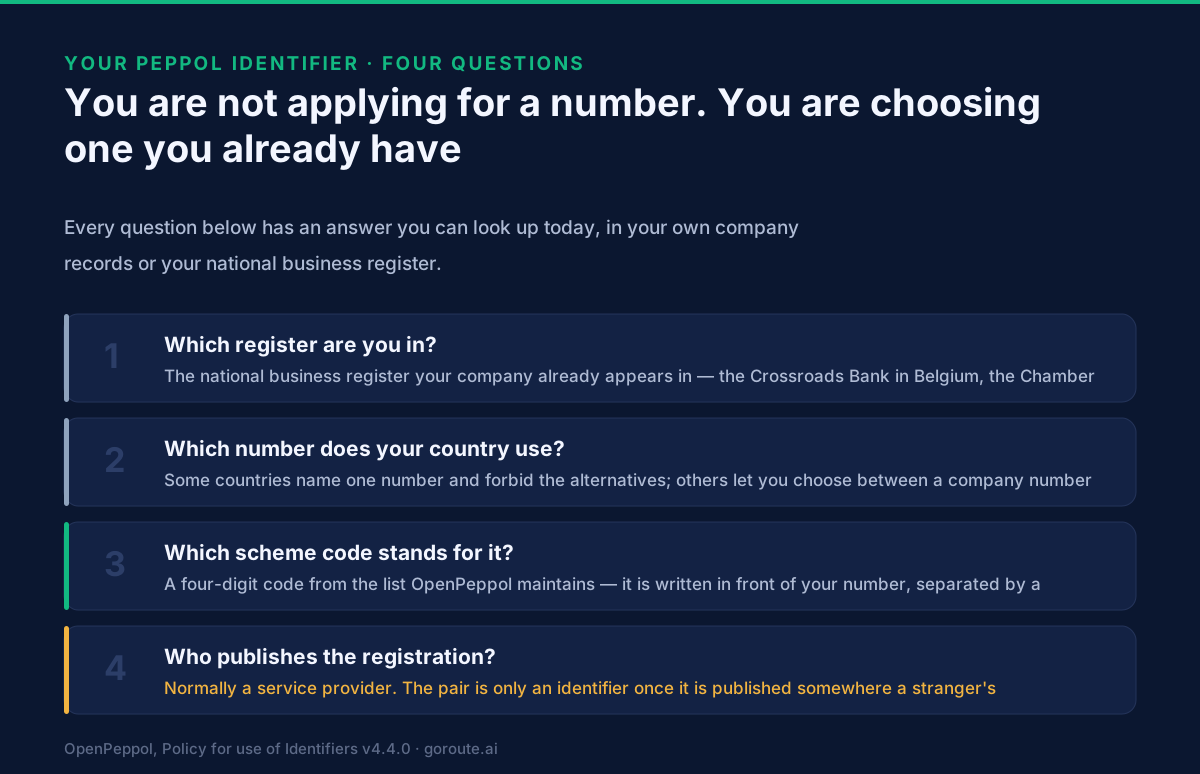
Which number is yours?
The one your country names for Peppol — usually a company registration number, sometimes a VAT number, and the difference is not cosmetic.
| Where you are | The number | Scheme code |
|---|---|---|
| Australia | Australian Business Number (ABN) | 0151 |
| Belgium | Enterprise number from the Crossroads Bank (KBO/BCE) | 0208 |
| France | SIRENE number | 0002 |
| Netherlands | Chamber of Commerce number, VAT identifier, or OIN | 0106, 9944 or 0190 |
| Singapore | Unique Entity Number (UEN), with an IMDA-assigned prefix | 0195 |
| Anywhere | Global Location Number (GLN) — international, not national | 0088 |
That is a sample, not the list. The full set is the code list OpenPeppol publishes and revises, and a provider registering you works from the current version of it rather than from a table in an article. Two countries in the sample show why the national rule matters more than the code:
- Belgium names one form and rejects the other. A Belgian participant is registered under the enterprise number, not the VAT number, and registering one under the VAT scheme breaches the service provider's obligations. Peppol's own validation rejects a malformed enterprise number before the invoice reaches anybody. The detail, including the check digit that catches typos, is in the Belgian enterprise number on Peppol.
- The Netherlands offers a choice, with one exception. The Netherlands Peppol Authority names three usable identifiers — the Chamber of Commerce number under
0106, a VAT identifier under9944, and an OIN under0190— and the OIN is required for central government, provinces and municipalities. Everyone else may choose. See e-invoicing in the Netherlands.
Singapore is the case where the number is a data problem before it is a registration problem. Singapore participants are addressed under scheme 0195 using the Unique Entity Number, in the form 0195: followed by an IMDA-assigned prefix and the UEN. Peppol routes on that number, so a customer with no usable UEN in your system is an invoice that cannot be addressed at all. If InvoiceNow is your reason for reading this, count your active customers with no UEN before anything else — that count is the size of the work, and what makes an ERP InvoiceNow-ready covers the rest of it.
What if more than one of your numbers qualifies?
Pick the one your customers will address you by, and then use only that one.
Where a country genuinely allows a choice, the risk is not choosing wrongly. It is choosing twice. A company registered under two identifiers is two participants as far as the network is concerned, and a sender who looks up the other one either fails to find you or delivers to a record nobody is watching. The rule that keeps this simple: one identifier per legal entity, recorded in the same place your finance team records the bank details, and given to counterparties in that form.
Two further rules from the identifier policy catch people out. Identifier values are case-insensitive, so 0088:abc and 0088:ABc are the same participant — but 0088:abc and 0010:abc are different ones, because the scheme is part of the identity. And scheme codes marked deprecated in the code list must not be used for new registrations, because the agency that issued them is no longer operating.
How do you get your identifier registered?
Someone publishes it for you, together with what you are willing to receive.
A registration is not just your number. The entry carries your participant identifier, each document type you accept, the process each type belongs to, and the address and certificate of the access point that will actually take delivery. That last part is why registration cannot be fully separated from the question of who receives for you: the registry has to name somewhere for documents to go.
In practice there are three ways it happens:
- Your service provider registers you. The normal case. You supply the number; they publish the record and name a receiving access point — theirs, or one you nominate.
- You buy registration on its own and keep your existing provider for transmission. This is the case people are usually looking for when they search for how to register, and it is what our Peppol registration service does: you give us the number, we publish the record, and documents go to whichever access point you name rather than through us by default. It is 29 US dollars a month per organisation, covering up to 50 registered participants.
- A tax authority creates it centrally. In some countries the authority operates the registry itself and creates your participant identifier once you nominate a provider on its portal. Nobody sells you registration in that model because the authority performs it. How do you join the Peppol network sets out which situation is which, and who registers you on Peppol takes these three models one at a time — who holds the entry, who can change it, and what you are actually buying in each.
How do you check it worked?
Run the same lookup a sender runs, and read what comes back.
A registered identifier returns a service group: the document types you accept, and the endpoint that will receive them. An unregistered one returns a 404 — not an error, but the network reporting accurately that nobody by that identifier is reachable. You can run it free and without an account on our Peppol lookup.
Do this before you register as well as after. Companies are sometimes on the network already, put there by a provider engaged years ago or by a group parent, and registering a second time is how the two-participant problem above begins.
The four things that stop a registration
Each of these is ordinary, and each is cheaper to catch now than after a supplier's first invoice fails.
- The wrong scheme for the country. Valid Peppol, invalid locally. Belgium is the clearest example, and it is a contractual breach rather than a warning.
- A number that does not pass its own check digit. Business numbers usually carry one. Validation applies it before anything else, so a transposed digit fails at the registry rather than at the receiver.
- No number to route on at all. The Singapore UEN case: the identifier scheme is fine, the customer record is empty.
- A record nobody owns. The registration succeeds, documents arrive, and they arrive into a system nobody is watching. A structured invoice landing unread is a payment deadline nobody sees.
What to do next
If you know your number, the remaining work is one registration and one lookup to prove it. Register your business on Peppol is the direct route, and it names your existing access point if you already have one. If you do not yet know which number your country uses, start from the table above and confirm it against your national rule before anyone publishes anything on your behalf.
Sources: OpenPeppol, Policy for use of Identifiers v4.4.0 (6 February 2025) and the participant identifier scheme code list · OpenPeppol eDelivery specifications · Netherlands Peppol Authority identifier rules, as set out in e-invoicing in the Netherlands · Singapore UEN and scheme 0195 as set out in what is an InvoiceNow-ready ERP · Belgian enterprise number and scheme obligations as set out in the Belgian enterprise number on Peppol.
Frequently asked questions
- What is a Peppol ID?
- A Peppol ID is a participant identifier — a scheme code and a business number written together as scheme:value. The scheme code says which national register the number came from, so an Australian Business Number appears as 0151 followed by a colon and the ABN. It is not a number anyone issues you; it is a number you already hold, paired with a code.
- How do I get a Peppol ID?
- You already have the number. What you get is a registration — an entry in a Service Metadata Publisher that lists your identifier, the documents you accept and the address of the access point that will receive them. A service provider creates that entry for you, normally in minutes once you have supplied the number.
- Do I have to apply to OpenPeppol for an identifier?
- No. OpenPeppol maintains the list of scheme codes and the rules for using them, but it does not issue identifiers and there is no membership office to apply to. Your identifier comes from your national business register, and your registration comes from a service provider.
- Which scheme code do I use?
- It depends on the country. An Australian Business Number is scheme 0151, a Belgian enterprise number 0208, a French SIRENE number 0002, a Singapore Unique Entity Number 0195, and a Dutch company may use a Chamber of Commerce number under 0106, a VAT identifier under 9944 or an OIN under 0190. Some countries mandate one form and treat the alternatives as a breach, so check the national rule before registering.
- Can I use my VAT number as my Peppol ID?
- Sometimes, and it is country-specific. The Netherlands permits a VAT identifier under scheme 9944 for organisations outside central government. Belgium does not permit the equivalent choice — a Belgian participant registered under the VAT scheme rather than the enterprise number breaches the provider's obligations. Treat the VAT number as a fallback you must justify, not a default.
- How do I know my Peppol ID is registered?
- Look it up the way a sender would. A registered identifier returns a service group listing the document types you accept and your receiving endpoint. An unregistered one returns a 404, which is the network correctly reporting that nobody by that identifier is reachable.
- What does it cost to register a Peppol ID?
- GoRoute's registration service is 29 US dollars a month per organisation, covering up to 50 registered participants, with documents delivered to whichever access point you name. Some providers include registration in a wider subscription; the cost is rarely the deciding factor, and who receives on your behalf is.
About Dr. Syed Raza
Dr. Syed Raza is an IT Enterprise Architect at ClayDesk LLC and leads the GoRoute platform. He works across Peppol Access Point and SMP infrastructure, PINT jurisdictions (Oman, AU/NZ, EU, JP, MY, SG), and national CTC regimes, translating regulatory detail into production-grade e-invoicing systems.
Building on Peppol?
GoRoute is a certified Peppol Access Point & SMP. Book a demo or read the docs to get started.